
How the US-Iran War Pause Deal Avoids Treaty Status
- Authority
- United States and Iran
- Rule type
- non-binding political commitment
- Jurisdiction scope
- International (US-Iran; UN Security Council)
- Effective date
- Jun 17, 2026
- Source text
- Read primary rule text ↗
Verify full memorandum text, implementing waivers, and any UN Security Council resolution before relying on sanctions relief or reconstruction-fund commitments.
As of August 4, 2026, the 60-day negotiation window opened by the June 17 Islamabad Memorandum is roughly twelve days from expiry. The legal implications of the US-Iran war pause talks are therefore no longer an abstract treaty-negotiations question. Counsel advising a bank, shipper, energy buyer, insurer, reconstruction contractor, or sanctions-screening team need to know what kind of legal object they are being asked to rely on before mid-August.
This is not legal advice, and the caution matters more than usual: the full MoU text still requires clause-level verification. Public analysis has quoted and summarized key provisions, including the opening “have jointly agreed” formulation and provisions concerning UN Charter commitments, sanctions relief, Strait of Hormuz passage, nuclear limits, and reconstruction finance. But no prudent opinion should treat those summaries as a substitute for the authenticated instrument, any annexes, any waiver documents, and any subsequent UN Security Council action.

The compressed answer is this: the Islamabad Memorandum is not an Article II treaty. It is best treated, on the present public record, as a non-binding political commitment or informal international arrangement whose strongest path to legal force is deferred to a contemplated binding UN Security Council resolution. That does not make it operationally harmless. In sanctions and trade practice, a document can be short of treaty status and still change what counterparties, regulators, banks, ports, and compliance officers are willing to do.
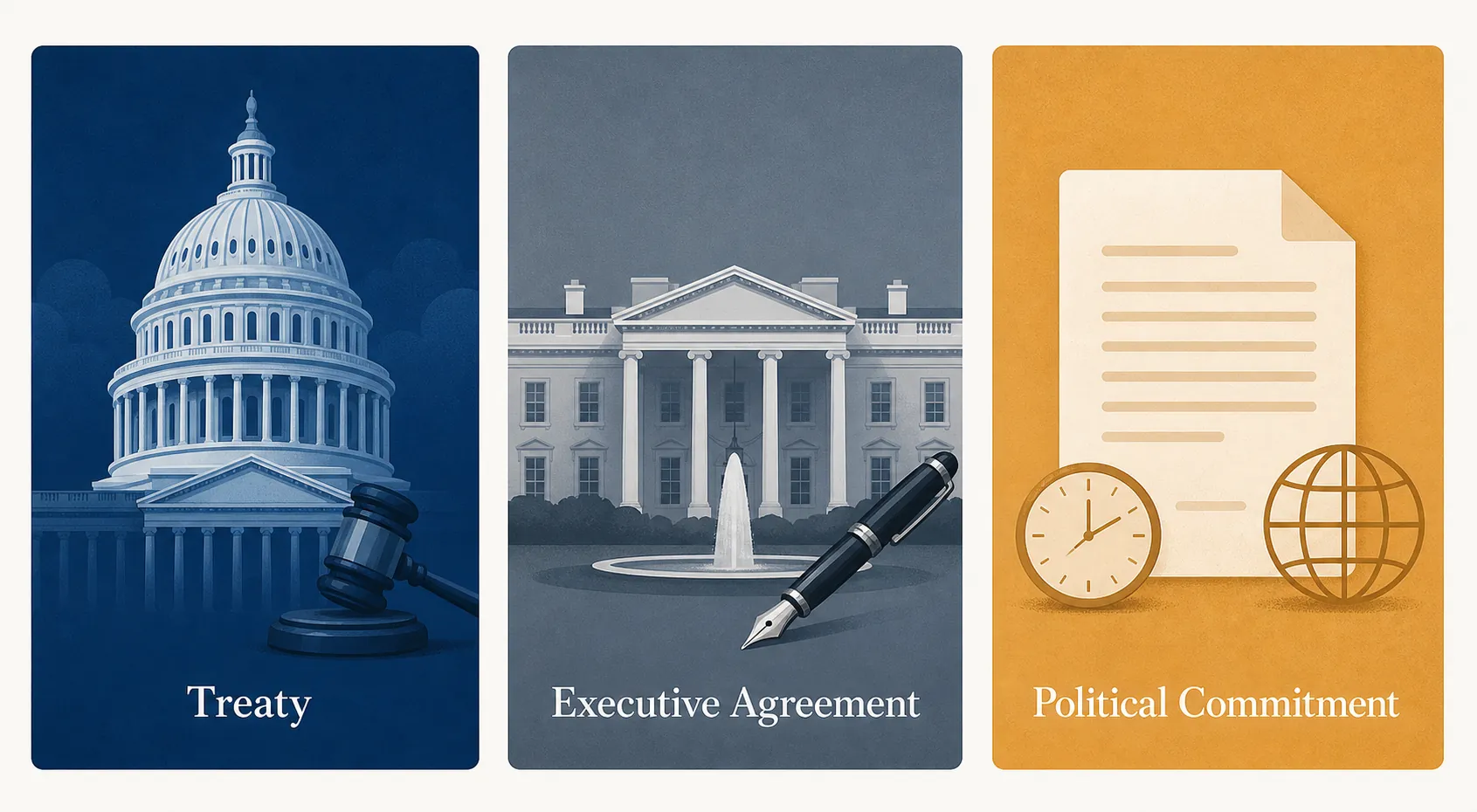
The three boxes counsel should not merge
The first mistake is to ask whether the MoU is “legally binding” as though that phrase has only one address. It has at least three.
| Legal category | What would matter | Where the Islamabad Memorandum appears to sit |
|---|---|---|
| Article II treaty | Formal treaty status under the US Constitution, with Senate advice and consent | The public record strongly points away from this category |
| Executive agreement or domestic executive act | Whether the executive branch can implement waivers, licenses, military posture changes, or diplomatic commitments under existing statutory or constitutional authority | Some implementation steps may fall here, but that does not convert the MoU itself into a treaty |
| Political commitment with deferred binding mechanism | Whether the parties have made a serious but non-treaty commitment, with binding force expected later through a UN Security Council resolution or domestic implementing acts | This is the strongest current characterization, subject to full-text verification |
Chatham House’s analysis is useful because it focuses on the drafting hinge rather than the signing ceremony. The MoU’s opening language, described as “have jointly agreed,” points toward an informal legal arrangement or political commitment, while the same analysis stresses that the instrument avoids formal treaty form and appears to rely on later UN Security Council action for binding effect.[1]
That distinction is not pedantry. An Article II treaty question asks whether the United States has entered a constitutional treaty requiring Senate involvement. An international-law question asks whether the parties intended to create legal obligations, and if so where those obligations arise. An operational-enforceability question asks something narrower and often more urgent: whether a compliance team may safely release funds, move cargo, issue insurance, amend a sanctions clause, or accept a counterparty certificate before the planned binding mechanism exists.
Why avoiding Article II treaty status is not incidental
The treaty label was not merely omitted; it appears to have been avoided because treaty form would have moved the deal into a domestic approval channel the administration had little reason to invite. A pause instrument that depends on rapid sanctions relief, nuclear restraint, maritime passage, and reconstruction finance would be slowed, narrowed, or politically exposed if treated as a formal treaty from the start.
The JCPOA precedent matters for exactly that reason. Marc Weller’s ASIL analysis of the Iranian nuclear sanctions snapback controversy describes the JCPOA as a “Plan of Action,” not a treaty, and explains how the arrangement sat alongside Security Council endorsement rather than entering US law as a conventional treaty.[2] The point is not that the Islamabad Memorandum is the JCPOA repeated under a new name. The point is structural: when domestic treaty approval is politically unavailable or deliberately avoided, negotiators may create a detailed diplomatic instrument, give it practical effect through waivers and reciprocal conduct, and look to the Security Council or domestic administrative action to supply the harder legal edges.
That workaround creates a familiar drafting posture. The instrument must be serious enough to justify reliance by adversaries and markets, but not so formally legal that it triggers the domestic approval path the parties are trying to avoid. Phrases such as “have jointly agreed” sit in that uncomfortable middle. They are not ceremonial fluff. Nor, without more, do they settle the question of binding treaty obligation.
For counsel, the consequence is that “not a treaty” is only the beginning of the analysis. A sanctions waiver can be real even if the political bargain behind it is not a treaty. A bank’s risk committee can freeze a transaction because the other side alleges breach of a memorandum. A shipper can face insurance exclusions or port-state scrutiny because a maritime clause is contested. A reconstruction payment can be delayed because verification has not occurred. None of those decisions requires Article II treaty status.
Where legal force is being postponed
The Islamabad structure appears to reserve its strongest binding effect for a later Security Council step. Chatham House describes the MoU as nodding to international law while questioning whether its UN Charter pledges are more than “words only” until the contemplated Security Council route is actually used.[1] That is the door-click moment in the instrument: the parties can announce a pause now, generate reliance now, and defer binding international-law force to a future Council resolution.
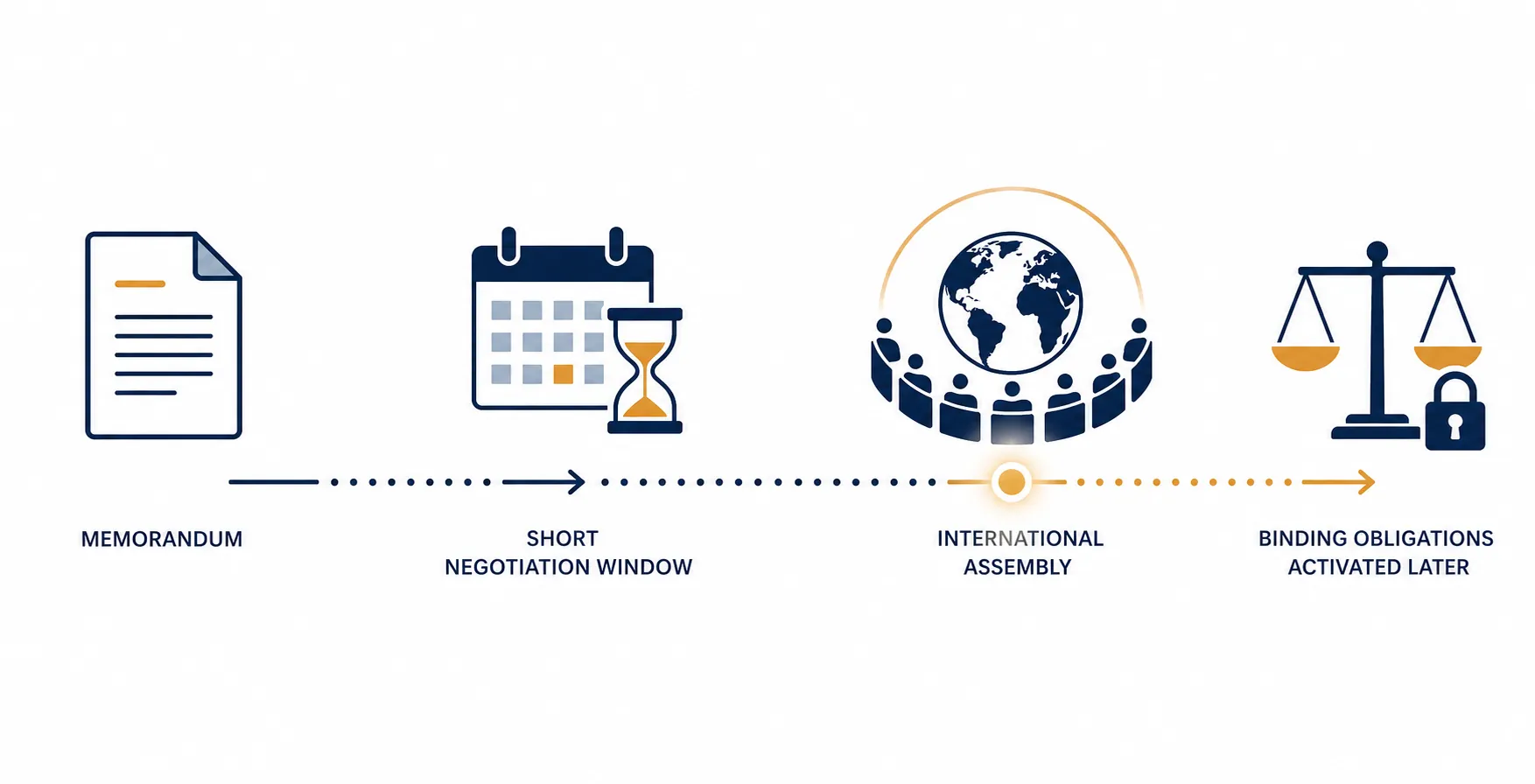
This matters because a Security Council resolution can do legal work that a non-treaty memorandum cannot do by itself. It can create obligations under the UN Charter framework, alter the legal environment for sanctions, and give domestic actors a clearer basis for treating certain conduct as permitted, prohibited, or conditioned. Until that happens, the MoU’s provisions may guide conduct and expectations, but their enforceability remains uneven.
The JCPOA’s afterlife shows why this sequencing is unstable. Weller’s ASIL account of the snapback controversy describes a legal fight over who could invoke a Security Council sanctions mechanism once participation in the underlying nuclear arrangement became contested.[2] The Islamabad Memorandum inherits the lesson without copying the facts: if a political instrument depends on a later or surrounding Security Council mechanism, then eligibility, timing, breach, and participation questions can become the real enforcement battlefield.
That is also why the mid-August window is not just a diplomatic date. If the parties reach the end of the 60-day period without a verified extension, a Security Council text, or agreed implementing instruments, the legal status of performance already taken in reliance on the MoU becomes harder to defend. The answer will not be the same for every actor. A government waiver, a private contract condition, a shipping assurance, and a nuclear-verification milestone each draw authority from a different place.
Ambiguity is the operating risk, not a footnote
The MoU’s most important legal risk is not that it is vague in the abstract. It is that the vague provisions appear to sit exactly where performance must occur: maritime passage, nuclear restraint, sanctions sequencing, revenue flow, verification, and reconstruction finance.
| MoU issue | Why the ambiguity matters operationally |
|---|---|
| Strait of Hormuz passage | A shipping or insurance decision may turn on whether the MoU creates a passage assurance, a services arrangement, or an implied payment regime |
| Enrichment limits | A sanctions-relief step may depend on whether nuclear restraint has been verified, not merely promised |
| Sanctions sequencing | A bank needs to know whether relief is immediate, conditional, revocable, or only politically expected |
| $300 billion reconstruction fund | A contractor or financier needs to know who controls disbursement, what verification gates apply, and whether payments remain blocked if reciprocal performance is disputed |
The Strait of Hormuz provisions are a good example of why the formal-status question cannot be separated from commercial risk. Chatham House reads the maritime-services language as potentially creating an implied regime that looks less like a pure navigation guarantee and more like a disguised toll arrangement.[1] If that reading is right, the legal question for a shipper is not simply whether the MoU is binding. It is whether the route now carries a payment, services, security, or certification condition that a sanctions clause or marine policy has not priced.
Readers working the maritime side should pair the MoU text with the separate corridor analysis in Why Iran's Hormuz Corridor Rejection Has Legal Grounding. The reason is practical: passage language that looks diplomatic in the MoU can become a freight, insurance, port-clearance, or sanctions-screening problem before anyone has litigated its legal character.
Sanctions sequencing is even less forgiving. Perry World House’s June 18 analysis identifies immediate waivers, a proposed $300 billion reconstruction fund, and the verification-before-revenue-flow problem as central features of the MoU.[3] That sequence is where reliance becomes dangerous. If revenue is supposed to flow only after verification, then a counterparty’s representation that the “deal allows payment” is not enough. The relevant question is which waiver exists, which agency issued it, what conduct it covers, whether verification has occurred, and whether the waiver survives an allegation of breach.
The same point applies to the reconstruction fund. A headline figure can create commercial pressure long before the legal channels are safe. A contractor may be asked to bid. A bank may be asked to prepare accounts. A logistics provider may be asked to move equipment. But if the fund depends on verified reciprocal performance, a Security Council step, or sanctions waivers that have not yet been issued or may be suspended, the MoU is not enough documentation for release of value.
The July 2026 breach accusations, including Iran’s formal complaint to the Security Council, show why this is already actionable rather than theoretical. The accusations do not prove which side is right. They do show that the parties are capable of reading the same instrument in mutually incompatible ways within weeks of signature. In a treaty, that dispute would still be serious. In a non-binding or partly deferred instrument, it is worse for compliance because there may be no settled forum, trigger, or remedy that tells private actors when reliance must stop.
The surrounding pressure does not convert the MoU into a treaty
The domestic war-powers fight explains why the administration would prefer a narrow, flexible instrument. It does not decide the MoU’s status. Lawfare’s analysis of congressional resolutions on the Iran war describes a contested legal environment in which Congress sought to constrain hostilities and the executive branch had incentives to treat the pause as resolving or narrowing the conflict posture.[4] Reuters reported on June 25 that Congress had backed Iran war-powers resolutions and described the resulting dispute over what follows when the executive claims hostilities have been terminated.[5]
That fight is relevant for domestic authority, especially for readers tracking the War Powers Resolution and Youngstown-style limits. It is not a shortcut to the MoU’s international-law character. For that domestic backdrop, see What the Iran War Powers Resolution Actually Means for Legal Risk and The Iran Strike Pause Exposes the War Powers Resolution's Blind Spot. The MoU analysis remains separate: domestic authority to pause, waive, or negotiate is not the same thing as treaty formation.
Nor do the UN Charter controversies surrounding earlier strikes make the MoU binding by themselves. Just Security published an April 13 letter in which more than 100 international-law experts warned that US strikes on Iran violated the UN Charter and may constitute war crimes.[6] That criticism helps explain why the MoU’s Charter language has diplomatic and reputational weight. It does not supply the missing mechanics of enforceability.
The sanctions backdrop is similarly contested. The Security Council record on March 12 reflected disagreement over Iran-related sanctions and snapback questions, while the JCPOA snapback controversy described by ASIL shows how participation and trigger rights can remain disputed long after a political arrangement has been announced.[7][2] That background should make counsel more cautious about relying on informal assurances, not more eager to treat the MoU as self-executing.
What can be said before the 60-day window closes
A cautious opinion can say several things now, provided it keeps the categories separate.
- Do not describe the Islamabad Memorandum as an Article II treaty on the present public record.
- Do not assume that lack of treaty status means lack of compliance exposure.
- Treat executive waivers, licenses, military deconfliction steps, and sanctions guidance as separate legal instruments that must be verified on their own terms.
- Treat any promised Security Council resolution as a deferred source of binding force, not as already-operative law unless and until adopted.
- Do not release funds, amend sanctions clauses, route vessels, or rely on reconstruction-fund commitments without checking the full MoU text, implementing documents, verification status, and breach allegations.
For sanctions-specific follow-up, the overlapping-regime problem is closer to the analysis in Iran Travel Warning's Three Overlapping Legal Regimes than to a conventional treaty-ratification explainer. The MoU may shape behavior, but the operative permission for a transaction usually comes from a waiver, license, regulation, contract condition, or Security Council measure.
The best current characterization is therefore narrow but consequential: the Islamabad Memorandum is a non-binding political commitment with real legal-risk consequences and a contemplated path to binding force through the UN Security Council. Before the 60-day window closes, counsel should verify every relied-on clause against the full instrument and any subsequent UN or domestic implementing act. Treaty status is not the only trigger for compliance exposure.
References
- The US–Iran memorandum of understanding nods to international law. Can that be taken seriously? — Chatham House, June 19, 2026
- The Controversy about the Iranian Nuclear Sanctions Snapback — ASIL Insights
- An Analysis of the U.S.-Iran Memorandum of Understanding — Perry World House, June 18, 2026
- What Congressional Resolutions Mean for the War in Iran — Lawfare
- Explainer: Congress backed an Iran war powers resolution. Now what? — Reuters, June 25, 2026
- Over 100 International Law Experts Warn: U.S. Strikes on Iran Violate UN Charter and May Be War Crimes — Just Security, April 13, 2026
- SC/16316 — UN Meetings Coverage, March 12, 2026
Operationalizing workflow
No workflow has been explicitly linked to this obligation yet. See Workflows generally.
Illustrative cases
No illustrative case is currently tracked for this obligation. See Risk Digest for documented incidents generally.
← Back to RegulationReport a correction or tip
Spotted an outdated figure, a misstated fact, or a ruling this regulation entry should reflect? Public comments are disabled for this content given the professional cost of a misreported case outcome, penalty amount, or rule text — use the structured correction channel instead.
Report a correction or tip for this record →