
AI Compliance in 2026: Mapping the EU AI Act High-Risk Deadline, U.S. State Law Patchwork, and Federal Preemption Battle
- Effective date
- Aug 2, 2026
Executive Summary: Why Mid-2026 Is a Compliance Inflection Point
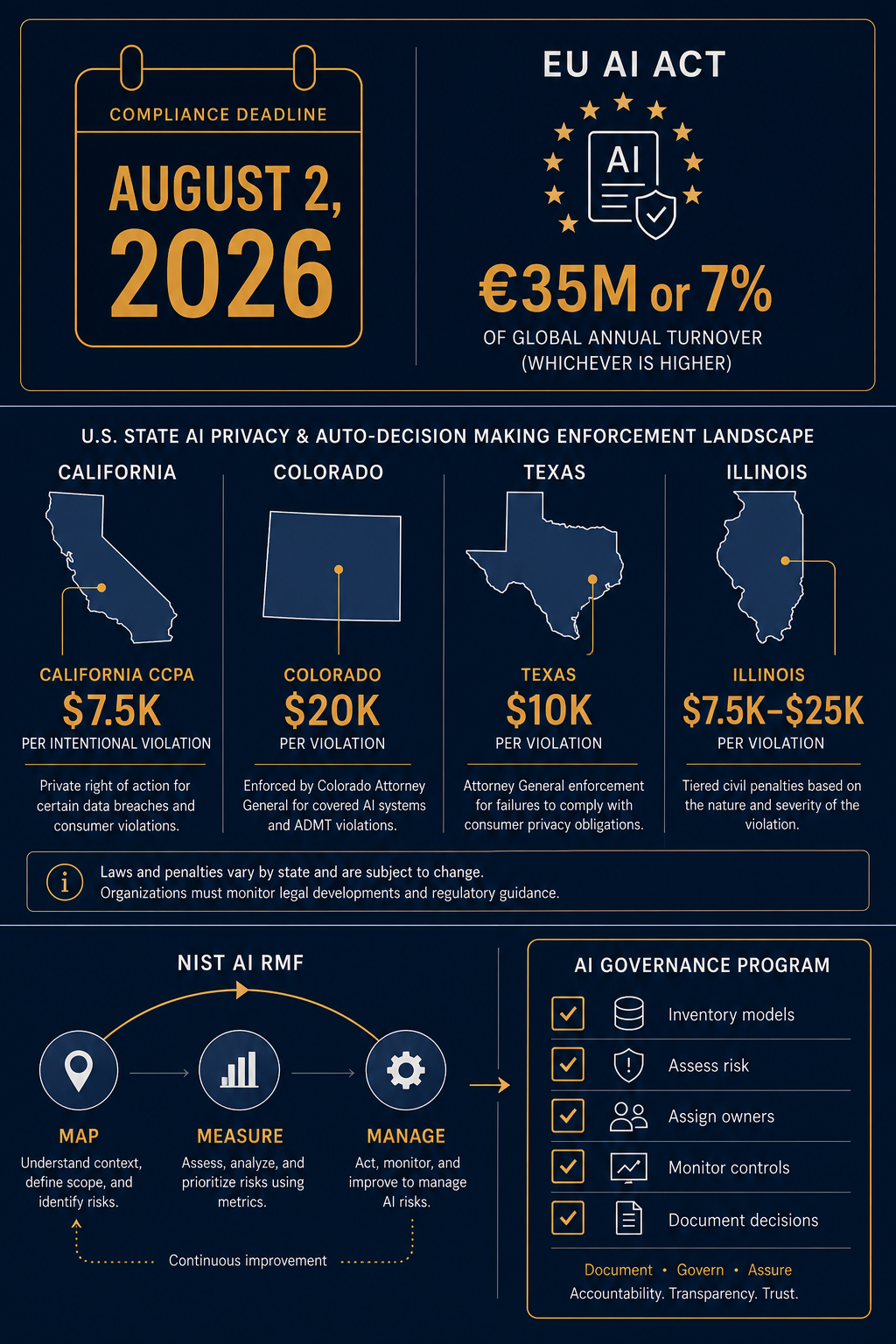
For compliance officers, in-house counsel, and law firm risk managers, the second half of 2026 represents an unprecedented convergence of binding regulatory deadlines across multiple jurisdictions. On August 2, 2026, the European Union's AI Act will enforce its high-risk AI system obligations — a set of requirements that carry fines of up to €35 million or 7% of global annual turnover for prohibited practices. Simultaneously, a wave of U.S. state-level AI laws — including the Colorado AI Act, California's CCPA ADMT regulations, Illinois HB 3773, and Texas TRAIGA — are taking effect, creating a patchwork of overlapping and sometimes conflicting compliance demands.
The situation is further complicated by the Trump administration's December 2025 executive order seeking federal preemption of state AI laws. However, that order does not automatically void existing state statutes — they remain fully enforceable until courts rule otherwise. The result is a compliance environment where legal professionals cannot rely on any single framework. Instead, they must monitor multiple overlapping regimes, build programs around the strictest applicable requirements, and prepare for a period of regulatory uncertainty that may last years.
This article provides a cross-jurisdictional reference for that environment. It maps the specific obligations, effective dates, penalty structures, and compliance costs associated with each major regime, and offers a practical roadmap for building a defensible AI governance program in mid-2026.
EU AI Act High-Risk Deadline: What August 2, 2026 Requires
The EU AI Act's phased implementation reaches its most consequential milestone on August 2, 2026, when the obligations for high-risk AI systems under Articles 9 through 17 become enforceable. These provisions apply to any AI system classified as high-risk under the Act's framework — a category that includes systems used in employment, credit scoring, access to essential services, law enforcement, migration, and administration of justice, among others.
The specific requirements that deployers and providers must satisfy include:
- Risk management system (Article 9): A continuous, iterative process to identify, evaluate, and mitigate risks throughout the AI system's lifecycle.
- Data governance (Article 10): Training, validation, and testing datasets must be relevant, representative, and free from errors and biases to the extent possible.
- Transparency and provision of information (Article 13): Deployers must ensure that high-risk systems are designed with sufficient transparency to allow users to interpret the system's output and use it appropriately.
- Human oversight (Article 14): Measures must be in place to enable human review of the system's output, override decisions, or stop the system when necessary.
- Accuracy, robustness, and cybersecurity (Articles 15–17): Systems must achieve appropriate levels of accuracy, resilience to errors, and protection against adversarial manipulation.
The penalty structure for non-compliance is severe. For prohibited AI practices — the most serious category — fines can reach €35 million or 7% of the infringing organization's total worldwide annual turnover from the preceding financial year, whichever is higher. For breaches of high-risk system obligations, fines are up to €15 million or 3% of global annual turnover.
For legal professionals deploying AI systems in the EU — whether through law firm operations, client-facing tools, or internal compliance monitoring — the August 2026 deadline is binding unless the Digital Omnibus amendments are formally adopted. Organizations that have not yet begun their conformity assessment and risk management documentation face a compressed timeline.
For a deeper dive into the specific obligations for legal services, see our EU AI Act High-Risk AI Obligations for Legal Services: A Deployer's Guide. For a reference on key terms like 'high-risk' and 'general-purpose AI,' consult our EU AI Act Risk Categories Glossary.
U.S. State Law Patchwork: Key Provisions and Penalties Effective in 2026
While the EU AI Act provides a single, unified regulatory framework, the United States presents a fragmented landscape. In 2025 alone, state legislators introduced over 1,100 AI-related bills, with roughly 100 enacted into law. The result is a patchwork of state-level obligations that vary significantly in scope, applicability, and penalty severity.
The table below summarizes the major state AI laws taking effect in 2026 that are most relevant to legal professionals and the organizations they advise.
| Jurisdiction | Law / Regulation | Effective Date | Key Provisions | Penalty Range |
|---|---|---|---|---|
| Colorado | Colorado AI Act (SB 24-205) | June 30, 2026 | Mandates impact assessments and risk management programs for high-risk AI systems used in consequential decisions; creates a duty of care to prevent algorithmic discrimination. | Up to $20,000 per violation |
| California | CCPA ADMT Regulations | January 1, 2026 (full enforcement January 1, 2027) | Defines automated decision-making technology (ADMT) broadly; requires pre-use notices, opt-out rights, and risk assessments. | $2,500 per unintentional violation; $7,500 per intentional violation |
| California | SB 53 (Frontier AI Transparency) | January 1, 2026 | Requires developers with $500M+ annual revenue to create safety frameworks and report critical incidents. | Up to $1,000,000 per violation |
| California | SB 243 (Chatbot Safeguards) | January 1, 2026 | Creates a private right of action for harms caused by companion chatbots; minimum damages of $1,000 per violation. | Minimum $1,000 per violation (private right of action) |
| Texas | TRAIGA (Texas Responsible AI Governance Act) | January 1, 2026 | Bans harmful AI uses (e.g., systems designed to incite self-harm or produce unlawful deepfakes); requires disclosures when government and healthcare providers use consumer-interacting AI. | Up to $10,000 per violation |
| Illinois | HB 3773 (Employment AI Discrimination) | January 1, 2026 | Prohibits AI discrimination in employment; applies to any employer with 1+ employees in Illinois for 20+ weeks. | Private right of action; individuals may file charges with the Human Rights Commission or pursue civil complaints for damages |
For compliance teams, the most significant implication is that these laws apply to different types of entities and activities. The Colorado AI Act targets businesses deploying high-risk AI for consequential decisions. California's CCPA ADMT regulations apply to any business subject to the CCPA that uses automated decision-making. Illinois HB 3773 covers virtually any employer with a presence in the state. Texas TRAIGA focuses on government and healthcare AI use. A single organization may be subject to multiple regimes simultaneously.
The Trump Executive Order and Federal Preemption Uncertainty
In December 2025, the Trump administration issued an executive order seeking to establish federal preemption over state AI laws. The order's stated goal is to create a unified national framework for AI regulation, arguing that a patchwork of state-level requirements undermines innovation and creates compliance burdens for businesses operating across state lines.
However, the practical effect of the executive order is far more limited than its rhetoric suggests. Executive orders cannot automatically void state laws. As multiple legal analyses have confirmed, state AI laws remain fully enforceable until they are amended, repealed, or struck down through the legal process — a process that could take years and would require either congressional action or successful court challenges.
The executive order relies primarily on litigation and funding mechanisms rather than preemptive legislation. It directs federal agencies to review state AI laws for potential conflicts with federal policy and to consider legal action where appropriate. But until courts rule on specific challenges, the Colorado AI Act, California's ADMT regulations, Texas TRAIGA, and Illinois HB 3773 remain in full effect.
For legal professionals advising clients on AI compliance, the key message is that the federal preemption battle is just beginning. The outcome will depend on litigation, congressional action, and potentially the next presidential administration. In the meantime, the states remain the primary drivers of AI governance in the United States.
The Compliance Cost Reality: 17% Overhead and $16K Annual Burdens
The regulatory burden of multi-jurisdictional AI compliance is not abstract. Documented estimates indicate that compliance costs add approximately 17% overhead to AI system expenses. For small businesses, the compliance burden is particularly acute: California's privacy and cybersecurity requirements alone could impose nearly $16,000 in annual compliance costs.
These figures reflect the costs of conducting impact assessments, implementing risk management programs, maintaining documentation, training personnel, and responding to enforcement actions. For organizations deploying AI systems across multiple jurisdictions, the costs multiply as they must satisfy different — and sometimes conflicting — requirements for each regime.
The scale of legislative activity underscores the challenge. In 2025 alone, state legislators introduced over 1,100 AI-related bills, with roughly 100 enacted. This pace shows no signs of slowing in 2026. For compliance teams, the implication is clear: AI compliance is not a one-time project but an ongoing operational cost that must be budgeted and staffed accordingly.
Practical Compliance Roadmap for Legal Teams
The following roadmap provides a structured approach for compliance officers, in-house counsel, and law firm risk managers who need to build a defensible AI governance program in the current multi-jurisdictional environment. This roadmap is informational and does not constitute legal advice.
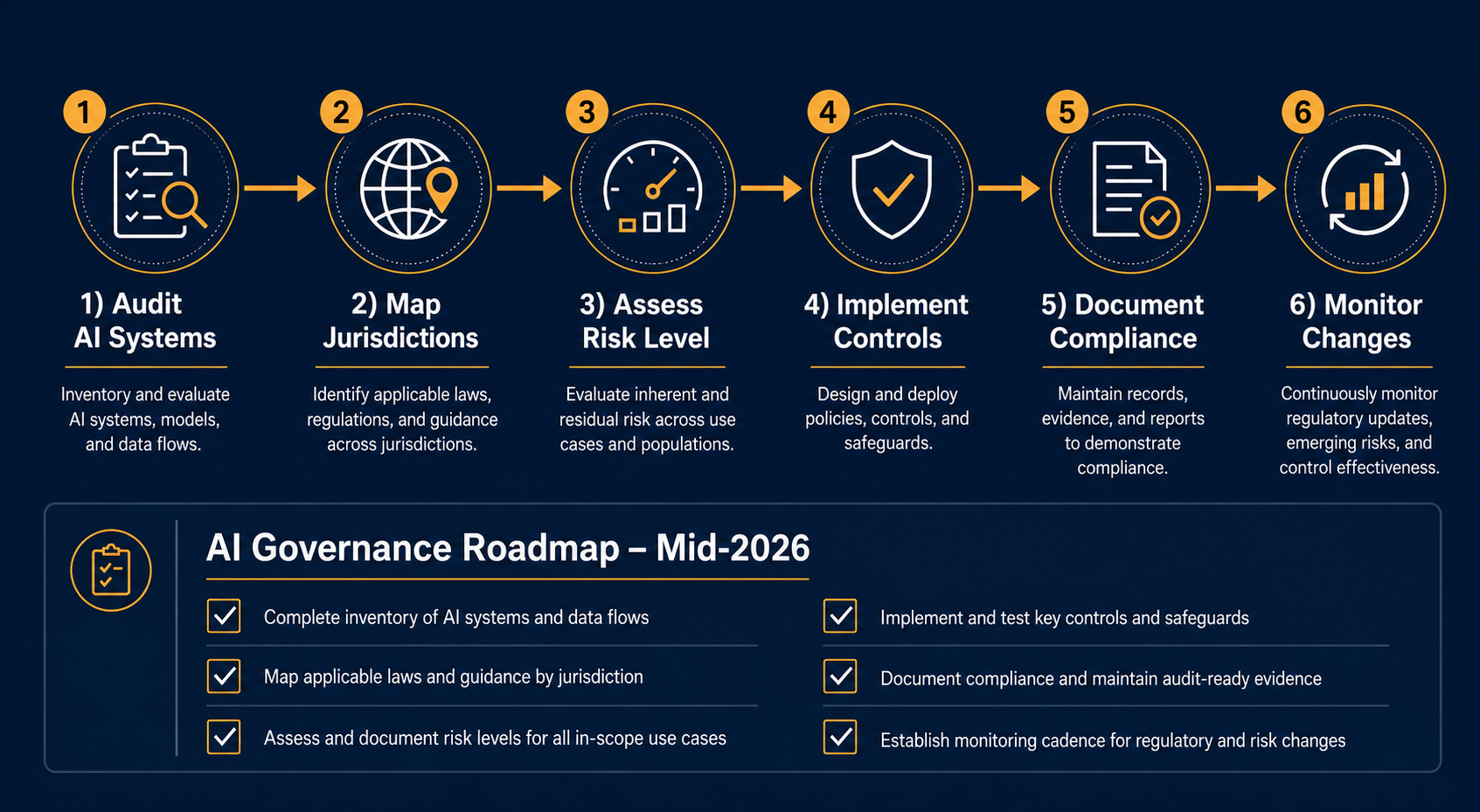
- Audit all AI systems in use. Inventory every AI tool and system deployed across the organization — including those used by individual attorneys or departments without central IT approval. Classify each system by function, data processed, and decision type.
- Map applicable jurisdictions. Determine which regulatory regimes apply based on where the organization operates, where its users are located, and where its AI systems are deployed. Consider both the EU AI Act (if any users or operations are in the EU) and each relevant U.S. state law.
- Assess risk level for each system. Apply the risk classification frameworks from each applicable jurisdiction. A system that is high-risk under the EU AI Act may also trigger obligations under the Colorado AI Act or California's ADMT regulations. Use the strictest classification as your baseline.
- Implement controls and impact assessments. Develop risk management programs, conduct algorithmic impact assessments, and implement human oversight mechanisms. Where requirements conflict across jurisdictions, adopt the most protective standard.
- Document compliance for each regime. Maintain separate compliance documentation for each applicable jurisdiction. This documentation should demonstrate the steps taken to satisfy each regime's specific requirements, including risk assessments, data governance measures, and transparency notices.
- Monitor legislative and regulatory changes continuously. The AI regulatory landscape is evolving rapidly. Assign responsibility for tracking new laws, amendments, court challenges, and enforcement actions. Update compliance programs as the landscape shifts.
For organizations that need to navigate the conformity assessment and certification process under the EU AI Act, our AI Compliance Certification Decision Framework provides a structured approach to determining which certification path applies to your systems.
Operationalizing workflow
No workflow has been explicitly linked to this obligation yet. See Workflows generally.
Illustrative cases
No illustrative case is currently tracked for this obligation. See Risk Digest for documented incidents generally.
← Back to RegulationReport a correction or tip
Spotted an outdated figure, a misstated fact, or a ruling this regulation entry should reflect? Public comments are disabled for this content given the professional cost of a misreported case outcome, penalty amount, or rule text — use the structured correction channel instead.
Report a correction or tip for this record →