
Navigating the AI Compliance Certification Maze: A Decision Framework for Compliance Officers and In-House Counsel
- Effective date
- Aug 2, 2026
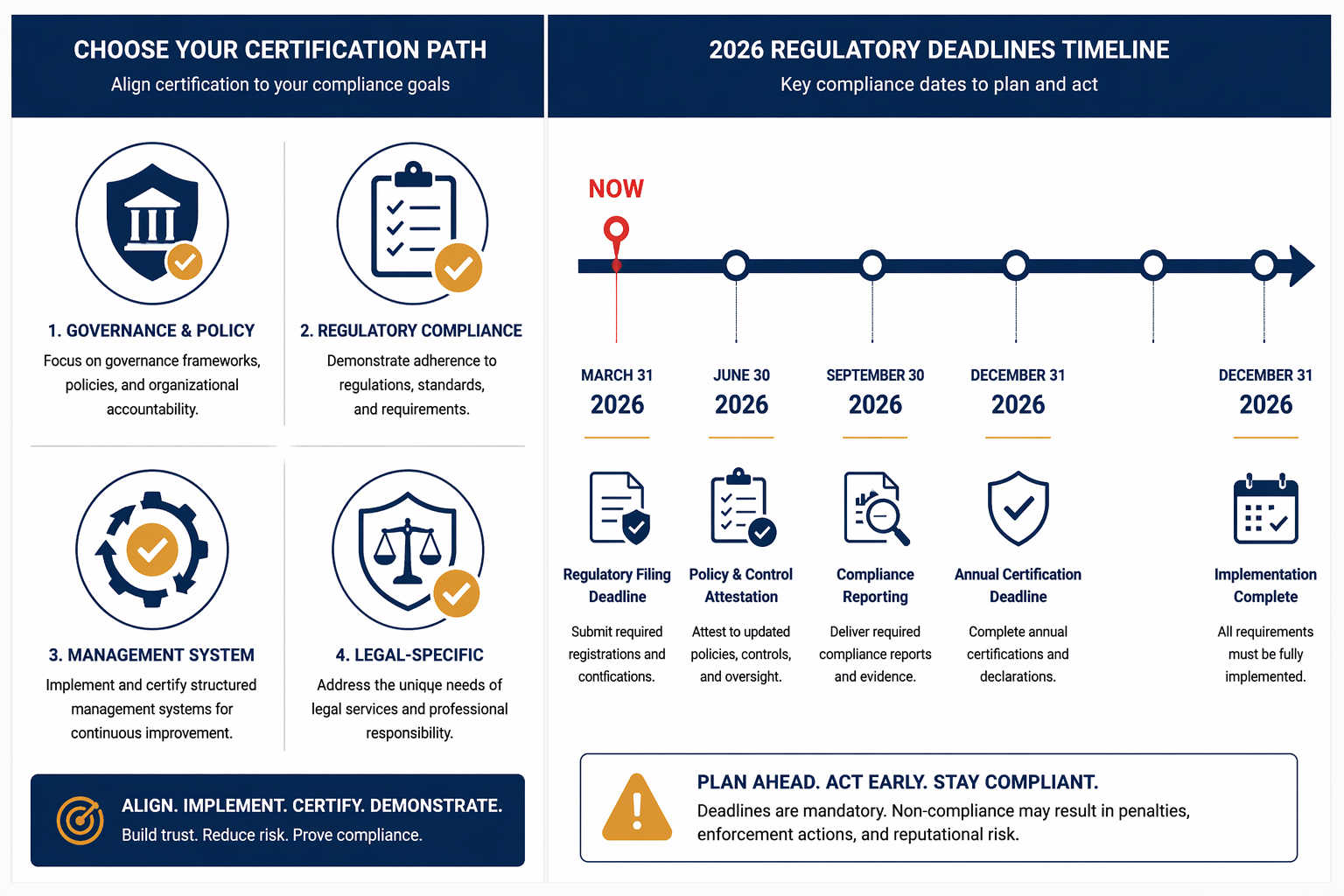
The Regulatory Pressure Point: Why Now?
The compliance calendar for AI in legal practice has compressed into a single critical window. As of June 17, 2026, organizations deploying or developing high-risk AI systems have 47 days until the EU AI Act's high-risk compliance deadline of August 2, 2026. Non-compliance carries penalties of up to €35 million or 7% of global annual turnover — whichever is higher — for prohibited-practices violations. That is not a theoretical ceiling; it is the enforcement floor for the most serious infractions.
The pressure is not limited to Europe. Colorado's SB 189 shifts to a disclosure-based framework effective January 1, 2027, requiring developers to document intended uses, known limitations, and training data categories, while deployers must notify consumers when AI materially influences consequential decisions. Texas's TRAIGA is already in an enforcement posture. The result is a multi-jurisdictional compliance environment where a single organizational AI system may need to satisfy EU conformity assessment, US state disclosure obligations, and professional responsibility duties simultaneously.
For a deeper treatment of the EU AI Act's phased timeline and the Digital Omnibus contingency, see the site's EU AI Act August 2026 Deadline guide. This article assumes that background and focuses specifically on the certification decision — a distinct problem that the deadline pressure has made urgent.
The Fundamental Distinction Most Guides Miss: Personal vs. Organizational vs. System Certifications
The most common mistake compliance professionals make when searching for "AI compliance certification" is treating all credentials as interchangeable. They are not. The market offers three fundamentally different categories of certification, each serving a distinct purpose, audience, and regulatory function. Confusing them wastes time, money, and — most critically — creates a false sense of compliance readiness.
| Certification Type | What It Validates | Who Issues It | Regulatory Weight | Example |
|---|---|---|---|---|
| Individual Professional | Personal knowledge of AI governance, law, or compliance frameworks | Professional bodies (IAPP, EXIN, ISACA, GAICC) | None — does not satisfy organizational obligations | IAPP AIGP, EXIN AICP, GAICC-CAILCP |
| Organizational Management System | Formal AI management system (AIMS) with documented policies, risk processes, and controls | Accredited certification bodies (e.g., BSI, SGS, DNV) | Maps directly to EU AI Act conformity assessment requirements | ISO/IEC 42001:2023 |
| System-Level Conformity Assessment | Compliance of a specific high-risk AI system with regulatory requirements | Notified bodies (EU) or self-assessment (limited cases) | Mandatory — not optional — for high-risk systems under EU AI Act | CE marking via EU AI Act conformity assessment |
An individual certification — whether the IAPP's AIGP, EXIN's AICP, or the newer GAICC-CAILCP — demonstrates that a specific person has studied relevant frameworks and passed an exam. It is a professional development credential. It does not certify that the organization has implemented a governance system, that its high-risk AI systems have undergone conformity assessment, or that any particular AI tool in use is compliant. As the Modulos AI Compliance Guide states explicitly: no individual certification satisfies an organization's obligations under the EU AI Act. Compliance requires conformity assessment, technical documentation, CE marking, and continuous monitoring — not a certificate of attendance.
Individual Certifications: What They Cover and Who They Serve
For compliance officers, in-house counsel, and risk professionals who need to demonstrate personal competence in AI governance, four major individual certifications are currently available. Each targets a different professional profile and regulatory focus.
| Certification | Issuer | Target Audience | Focus Area | Exam Cost (Approx.) | Exam Format |
|---|---|---|---|---|---|
| AIGP (AI Governance Professional) | IAPP | Privacy officers, compliance leads, legal professionals | AI governance frameworks, ethical deployment, global regulatory landscape | $550 (IAPP member) / $750 (non-member) | Self-paced, 8 modules, covers EU AI Act and major frameworks |
| AICP (AI Compliance Professional) | EXIN | Professionals across multiple roles (not lawyer-specific) | Broad regulatory compliance, risk classification, documentation | ~$390 | Single exam, no prerequisites |
| AI Auditing Certificate | ISACA | Auditors with CISA, CIA, or CPA credentials | Technical auditing of AI systems, controls evaluation | $459 (ISACA member) / $549 (non-member) | Requires existing audit certification |
| CAILCP (Certified AI Law & Compliance Professional) | GAICC | Legal and compliance professionals specifically | Multi-jurisdictional regulations, practical AI application in legal practice | $2,794 (member) / $2,995 (non-member) | 60 scenario-based MCQs, 90 min, 70% pass, 16 CPD hours |
The IAPP AIGP is the most established credential for professionals whose primary concern is governance policy and ethical deployment. It covers foundational knowledge of AI systems, how current and emerging laws apply (including the EU AI Act and other major frameworks), the AI life cycle, and responsible AI governance. For a compliance officer building a personal knowledge base, this is the strongest option.
The EXIN AICP is broader and more affordable, designed for professionals across multiple roles — not just lawyers or data scientists. It covers regulatory compliance fundamentals without requiring deep technical expertise. The ISACA AI Auditing Certificate is the most technically rigorous, but it requires an existing audit credential (CISA, CIA, or CPA) and is best suited for professionals whose role includes auditing AI systems rather than deploying or governing them.
What none of these credentials do: certify that your organization's AI systems are compliant. They certify that you have studied the material. That distinction matters enormously when a regulator asks for your conformity assessment documentation rather than your exam score.
Organizational Certifications: ISO 42001 and the NIST AI RMF
For organizations — law firms, corporate legal departments, compliance consultancies — the relevant certification is ISO/IEC 42001:2023, the only certifiable management system standard for AI governance. Unlike individual credentials, ISO 42001 certifies that an organization has implemented a formal Artificial Intelligence Management System (AIMS) covering accountability, risk management, ethics, transparency, data protection, and regulatory compliance across the AI lifecycle.
The certification process follows a structured path: gap analysis, implementation, internal audit, then Stage 1 and Stage 2 external audits by an accredited certification body. For a mid-size organization, this typically takes six to nine months. That timeline is critical: if your organization has not started the process by June 2026, ISO 42001 certification cannot be achieved before the August 2, 2026 deadline.
The NIST AI Risk Management Framework (AI RMF) serves a complementary role. It is the de facto standard for AI risk management in the United States, and alignment with the NIST AI RMF is increasingly expected by US regulators and state laws. However, the NIST AI RMF does not offer certification. Organizations can align their practices with it and document that alignment, but there is no external audit and no certificate. For organizations subject to both EU and US obligations, the recommended approach is ISO 42001 certification (which maps to EU AI Act conformity assessment requirements) combined with NIST AI RMF alignment documentation for US-facing compliance.
For a detailed walkthrough of building the underlying governance infrastructure that ISO 42001 requires, see the site's guide to building AI compliance governance infrastructure. That guide covers the policies, risk registers, and documentation structures that form the foundation of any certifiable AIMS.
Mandatory AI Product Compliance: The EU AI Act Conformity Assessment
For organizations that develop or deploy high-risk AI systems — and many legal AI tools fall into this category — the EU AI Act imposes a mandatory conformity assessment that no certification can replace. This is not an optional credential. It is a legal obligation.
The conformity assessment requires:
- Technical documentation demonstrating the system's design, development methodology, and intended purpose
- A risk management system covering the entire AI lifecycle
- Data governance and training data quality measures
- Transparency and explainability documentation
- Human oversight mechanisms
- Accuracy, robustness, and cybersecurity specifications
- CE marking and EU declaration of conformity
- Continuous monitoring and post-market surveillance processes
The critical point: no individual certification — AIGP, AICP, CAILCP, or any other — satisfies any part of this obligation. An organization whose compliance officer holds an AIGP credential but whose high-risk AI system has not undergone conformity assessment is not compliant. The two are unrelated.
For a comprehensive treatment of what high-risk classification means for legal AI systems and what deployers must do, see the site's EU AI Act High-Risk Obligations for Legal Services: A Deployer's Guide.
Mapping Certification Type to Role: Who Needs What?
The certification decision depends on role, organizational context, and regulatory exposure. The following matrix maps common professional roles to the appropriate certification type(s), with the understanding that many professionals will need combinations.
| Role | Primary Certification Need | Secondary Certification Need | Critical Note |
|---|---|---|---|
| Compliance Officer | Individual: AIGP or AICP for personal knowledge base | Organizational: ISO 42001 if leading implementation | Individual credential does not satisfy organizational obligations |
| Law Firm Managing Partner | Organizational: ISO 42001 for firm-wide governance | Individual: AIGP for personal oversight competence | Firm's AI systems may need conformity assessment if high-risk |
| In-House Counsel (Legal Dept) | Individual: AIGP or CAILCP for legal-specific governance | Organizational: ISO 42001 if department operates AI systems | Must verify vendor conformity assessments for procured tools |
| AI Vendor / Developer | System: EU AI Act conformity assessment (mandatory) | Organizational: ISO 42001 for management system | Individual credentials are irrelevant to regulatory compliance |
| Risk Officer | Individual: ISACA AI Audit for technical auditing | Organizational: ISO 42001 for risk management framework | Focus on audit and control verification, not governance policy |
| Solo Practitioner | Individual: AIGP or AICP for competence demonstration | N/A | Must verify that any AI tools used have undergone conformity assessment by their providers |
The table reveals a pattern: individual credentials serve personal competence and professional development; organizational certifications serve institutional governance; system-level conformity assessments serve regulatory compliance. A compliance officer at a law firm that deploys high-risk AI systems needs all three — personal knowledge (AIGP), organizational governance (ISO 42001), and verification that the firm's AI systems have undergone conformity assessment. No single credential covers all three.
Realistic Timeline: What Can Be Achieved Before August 2, 2026?
With 47 days until the high-risk deadline, the window for action is narrow but not closed — provided expectations are realistic about what each certification path requires.
| Certification Path | Typical Timeline | Achievable Before Aug 2, 2026? | Notes |
|---|---|---|---|
| IAPP AIGP (individual) | 4–8 weeks of study, exam scheduling | Yes | Self-paced, 8 modules. Register now, study intensively, schedule exam for late July. |
| EXIN AICP (individual) | 3–6 weeks of study, exam scheduling | Yes | Lower cost, faster path. No prerequisites. Good for rapid competence demonstration. |
| ISACA AI Audit (individual) | 4–8 weeks, requires existing audit credential | Yes, if you hold CISA/CIA/CPA | Requires prerequisite certification. Not suitable as a first AI credential. |
| GAICC-CAILCP (individual) | Self-paced, 16 CPD hours of study | Yes | Higher cost. Newer credential with unproven recognition. Achievable but consider value. |
| ISO 42001 certification (organizational) | 6–9 months for mid-size organization | No, if starting from scratch | Cannot achieve full certification by August 2. Prioritize gap analysis and partial implementation. |
| EU AI Act conformity assessment (system) | Varies by system complexity, 3–12 months | Unlikely if not already in progress | Must have started technical documentation. Prioritize gap analysis and document what is achievable. |
For organizations that have not yet started ISO 42001 implementation or conformity assessment preparation, the realistic goal between now and August 2 is not full compliance — it is a documented gap analysis, identification of high-risk systems, assignment of a compliance owner, and initiation of the technical documentation process. The Digital Omnibus proposal, if enacted, would extend the high-risk deadline to December 2027, providing additional runway. But as noted, the conservative assumption is that the August deadline holds.
For a detailed breakdown of the Digital Omnibus timeline and what the delay would mean for law firms and in-house counsel, see the site's EU AI Act Compliance Deadlines analysis.
The Risk of Certification Theater: When a Certificate Becomes False Comfort
The most dangerous outcome of the certification scramble is not inaction — it is the illusion of action. "Certification theater" occurs when an organization invests in credentials that create a sense of compliance without moving the organization closer to actual regulatory obligations.
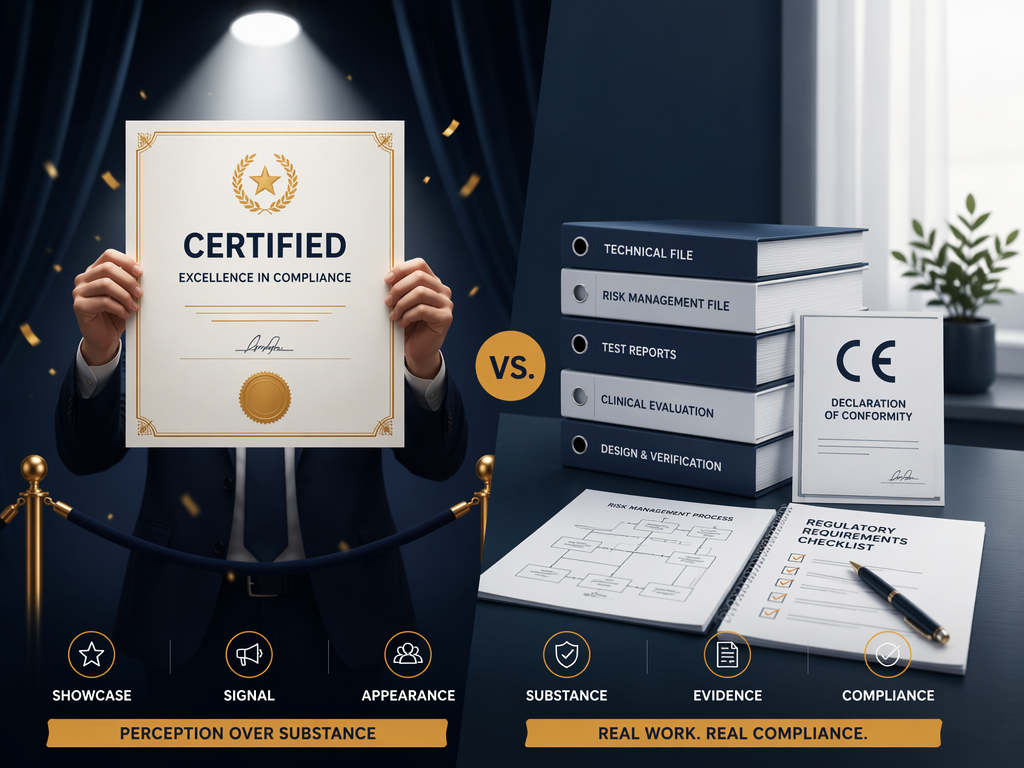
Common forms of certification theater include:
- A compliance team where every member holds an AIGP or AICP credential, but the organization's high-risk AI systems have not undergone conformity assessment
- A law firm that displays ISO 42001 certification on its website but has not mapped the certification to its specific AI tool deployments or verified vendor conformity assessments
- An organization that treats a single individual's certification as evidence of organizational compliance in regulatory filings or client communications
- Procurement of training courses and exam fees without allocating budget for the technical documentation, risk management, and monitoring infrastructure that actual compliance requires
The enforcement environment has shifted. As detailed in the site's analysis of the enforcement shift from guidance to penalties, regulators across jurisdictions are moving from advisory postures to active enforcement. The EU AI Act's penalty structure — up to €35 million or 7% of global annual turnover — is designed to make non-compliance more expensive than compliance. A wall of individual certificates will not impress a notified body conducting a conformity assessment audit.
For guidance on evaluating compliance tools and avoiding theater in procurement decisions, see the site's AI Compliance Tool Buyer's Guide for Legal Departments.
Practical Next Steps: A Decision Framework Organized by Weeks-to-Deadline
The following framework organizes actions by time horizon, recognizing that different organizations are at different stages of readiness. The goal is to match certification decisions to the organization's actual compliance posture rather than pursuing credentials in isolation.
Immediate Actions (Weeks 1–2: June 17 – June 30, 2026)
- Conduct a gap analysis against EU AI Act high-risk obligations. Identify which AI systems in your organization or under your supervision are classified as high-risk under Annex III.
- Assign a compliance owner with authority to allocate resources. This person should hold or be studying for an individual certification (AIGP or AICP) to build personal competence, but the role's primary function is organizational, not personal.
- Register for an individual certification exam if personal competence demonstration is a priority. AIGP (IAPP) and AICP (EXIN) are achievable in this window. Budget $550–$750 for AIGP or ~$390 for AICP.
- Document the current state of technical documentation, risk management processes, and monitoring procedures for each AI system in use.
Short-Term Actions (Weeks 3–5: July 1 – July 21, 2026)
- Complete individual certification exam if registered. Schedule for late July to allow study time.
- Initiate ISO 42001 gap analysis if organizational certification is the goal. Even if full certification cannot be achieved by August 2, the gap analysis creates a roadmap and demonstrates good-faith effort.
- Begin compiling technical documentation for high-risk AI systems. The EU AI Act requires specific documentation on design, development methodology, data governance, risk management, and human oversight.
- Verify that all AI tool vendors have completed or are in the process of completing conformity assessment for their systems. Request documentation.
Medium-Term Actions (Weeks 6–7: July 22 – August 2, 2026)
- Finalize and document the compliance posture as of the deadline. If full compliance is not achieved, document what has been completed and what remains, with a timeline for completion.
- Prepare for the Digital Omnibus contingency. If the deadline is extended to December 2027, use the additional runway to complete ISO 42001 implementation and conformity assessment.
- Establish continuous monitoring processes. Compliance is not a one-time event — the EU AI Act requires ongoing post-market surveillance.
Ongoing (Post-August 2, 2026)
- Monitor state law developments in the US. Colorado SB 189 takes effect January 1, 2027, and other states are likely to follow.
- Schedule ISO 42001 external audit if gap analysis and implementation are complete.
- Renew individual certifications as required (GAICC-CAILCP requires renewal every 3 years with 60 CPD hours; AIGP and AICP have their own continuing education requirements).
- Review and update technical documentation, risk assessments, and monitoring procedures on a regular cadence.
| Scenario | Recommended Certification Path | Primary Action This Week |
|---|---|---|
| Solo practitioner using AI for legal research and drafting | Individual: AIGP or AICP | Register for exam; verify vendor conformity assessments for tools used |
| Compliance officer at mid-size law firm | Individual: AIGP; Organizational: initiate ISO 42001 gap analysis | Register for AIGP; assign compliance owner; begin gap analysis |
| In-house counsel at corporate legal department | Individual: AIGP or CAILCP | Register for exam; audit current AI tool deployments for high-risk classification |
| Managing partner at Am Law 200 firm | Organizational: ISO 42001 certification | Engage certification body for Stage 1 audit; allocate budget for AIMS implementation |
| AI vendor developing legal tech products | System: EU AI Act conformity assessment | Engage notified body or begin self-assessment documentation; verify high-risk classification |
The certification maze resolves to a single question: what are you trying to prove? If the answer is personal competence, pursue an individual credential. If the answer is organizational governance, pursue ISO 42001. If the answer is regulatory compliance for a specific AI system, pursue conformity assessment. The professionals who navigate this landscape successfully will be those who match the certification type to the obligation — not those who collect the most badges.
Operationalizing workflow
No workflow has been explicitly linked to this obligation yet. See Workflows generally.
Illustrative cases
No illustrative case is currently tracked for this obligation. See Risk Digest for documented incidents generally.
← Back to RegulationReport a correction or tip
Spotted an outdated figure, a misstated fact, or a ruling this regulation entry should reflect? Public comments are disabled for this content given the professional cost of a misreported case outcome, penalty amount, or rule text — use the structured correction channel instead.
Report a correction or tip for this record →