
From Ethics Opinions to Enforcement: The Professional Responsibility of AI Compliance for Attorneys in 2026
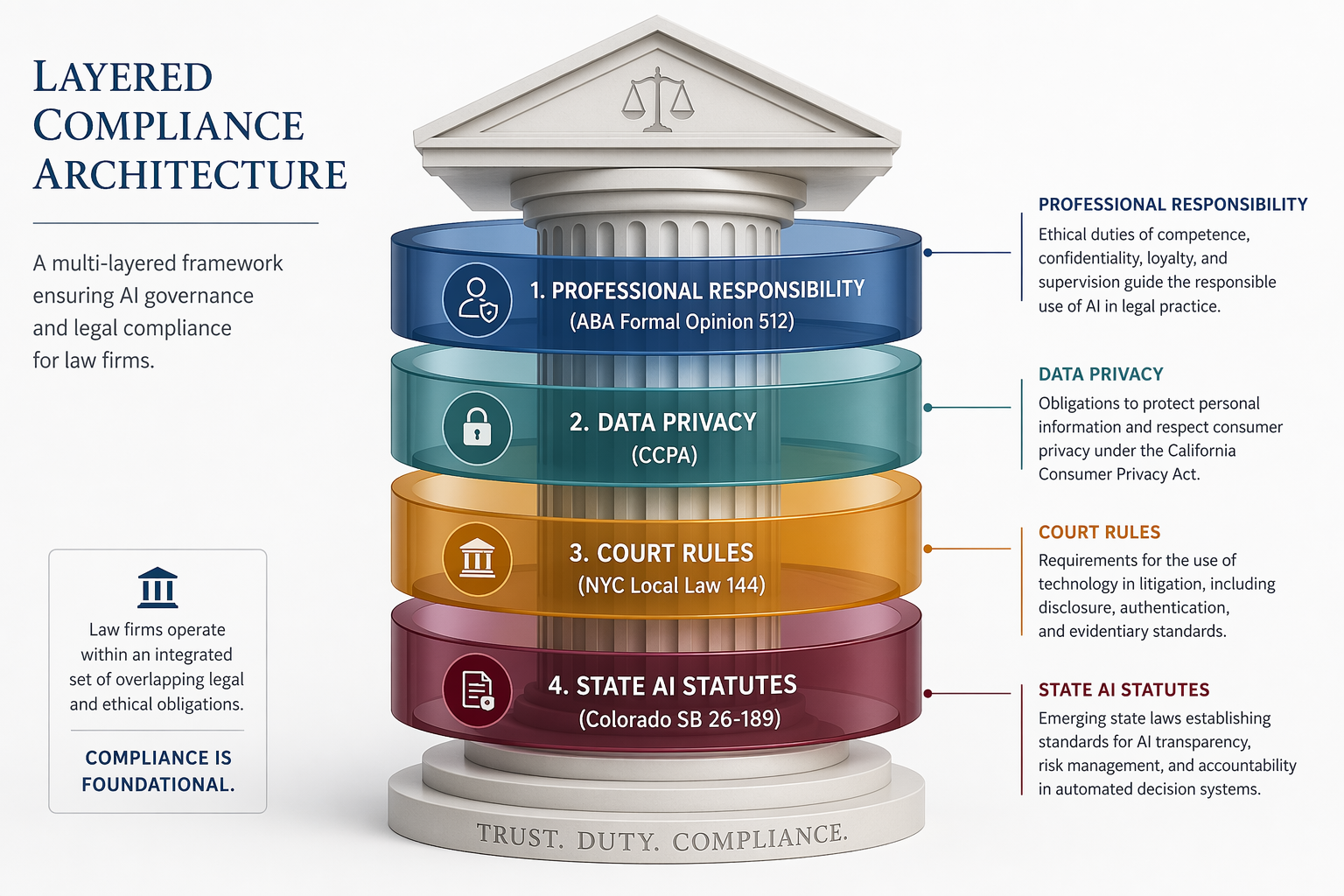
When the American Bar Association issued Formal Opinion 512 in July 2024, it gave the legal profession something it desperately needed: a national baseline for how generative AI intersects with professional responsibility. The opinion addressed competence, confidentiality, communication, candor toward tribunals, supervision, and fees — the six pillars that every attorney must consider before integrating AI tools into practice.
But 2026 is not 2024. The baseline has held, but the state-level divergence has been dramatic. Nearly 80% of U.S. lawyers now use AI in their practice, according to Clio's 2025 Legal Trends Report — an increase of roughly 60 percentage points in two years. Yet 44% of law firms still lack formal AI governance policies. That gap between adoption and governance is where the professional responsibility exposure lives.
This article does not re-litigate ABA Formal Opinion 512. Instead, it maps the post-512 landscape: where state bars have agreed, where they have diverged, and what enforcement actions have already demonstrated about the cost of getting it wrong. The target reader is the practicing attorney or ethics advisor who needs to know not just the general principles, but the specific edge cases in their jurisdiction.
The ABA Baseline: Formal Opinion 512's Five Pillars
ABA Formal Opinion 512 established that attorneys using generative AI must: (1) maintain competence sufficient to understand the technology's capabilities and limitations (Model Rule 1.1); (2) protect client confidentiality, including understanding whether AI vendors have access to input data (Model Rule 1.6); (3) communicate with clients about material AI use where it affects the representation (Model Rule 1.4); (4) maintain candor toward tribunals, including verifying AI-generated citations (Model Rule 3.3); (5) supervise both human and AI assistants appropriately (Model Rules 5.1 and 5.3); and (6) ensure fees remain reasonable when AI reduces the time required for a task (Model Rule 1.5).
The opinion was deliberately principles-based. It did not prescribe specific technical safeguards, mandate particular disclosure language, or create a per se rule about fee reductions. That flexibility was a feature — but it also created the conditions for the state-level divergence that followed.
State-by-State Divergence: A Comparison of 8+ Jurisdictions
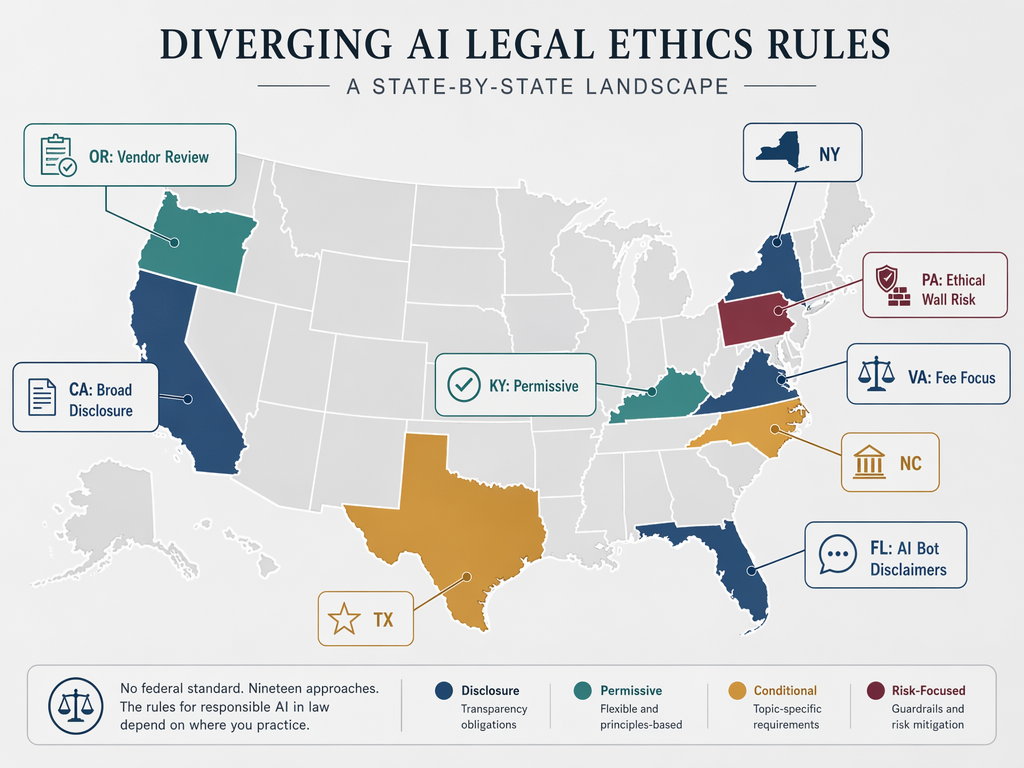
The table below summarizes the key positions taken by nine state and local bar authorities as of mid-2026. Each entry is drawn from the primary opinion or guidance document cited.
| Jurisdiction | Opinion / Date | Key Position on Fees | Key Position on Client Disclosure | Unique Requirement |
|---|---|---|---|---|
| California | Practical Guidance for Generative AI (Nov. 2023) | No specific fee guidance beyond ABA baseline | Broader view: disclosure may be required when AI use materially affects representation | Emphasizes competence and confidentiality; proposed rule amendments may make guidance mandatory |
| Florida | Opinion 24-1 (Jan. 2024) | No specific fee guidance | No explicit disclosure requirement for routine AI use | Requires AI chatbot disclaimer for client intake on law firm websites |
| New York City | Formal Opinion 2024-5 (2024) | No specific fee guidance | Addresses candor and confidentiality; disclosure context-dependent | Covers competence, confidentiality, conflicts, and candor comprehensively |
| Virginia | Legal Ethics Opinion 1901 (2024) | Focuses on output value, not time saved — no automatic fee reduction | No specific disclosure requirement beyond ABA baseline | Directly contradicts ABA's fee position; most significant divergence |
| Texas | Opinion 705 (Feb. 2025) | Billing must be reasonable; AI efficiency does not automatically reduce fees | No specific disclosure requirement | Emphasizes verification of AI outputs and confidentiality protections |
| Pennsylvania | Joint Formal Opinion 2024-200 (2024) | No specific fee guidance | No specific disclosure requirement | Flags conflict-of-interest risk: LLMs may use client data across matters without ethical wall safeguards |
| North Carolina | 2024 Formal Ethics Opinion 1 (2024) | No specific fee guidance | No specific disclosure requirement | Analogizes AI to nonlawyer staff; permits use with competent and secure deployment |
| Kentucky | Ethics Opinion KBA E-457 (Mar. 2024) | No specific fee guidance | No disclosure needed for routine AI-assisted research unless outsourced or separately charged | Requires written agreement for AI subscription costs passed to client |
| Oregon | Formal Opinion 2025-205 (Feb. 2025) | No specific fee guidance | May require informed consent before using open AI models with client data | Requires review of AI vendor contracts for confidentiality protections |
The table reveals several patterns. First, most states have not issued specific fee guidance beyond the ABA baseline — Virginia is the clear outlier. Second, client disclosure requirements vary significantly, with Kentucky taking the most permissive stance and California the broadest. Third, several states have introduced unique requirements — Florida's chatbot disclaimer, Oregon's vendor contract review mandate, and Pennsylvania's ethical wall concern — that have no parallel in the ABA opinion.
For a deeper look at Texas-specific requirements, see our Texas State Bar AI Ethics Opinion 2024 entry. For California's proposed rule amendments that may shift guidance into binding requirements, see California's AI Ethics Rulemaking.
The Hallucination Sanction Crisis: Enforcement in Practice
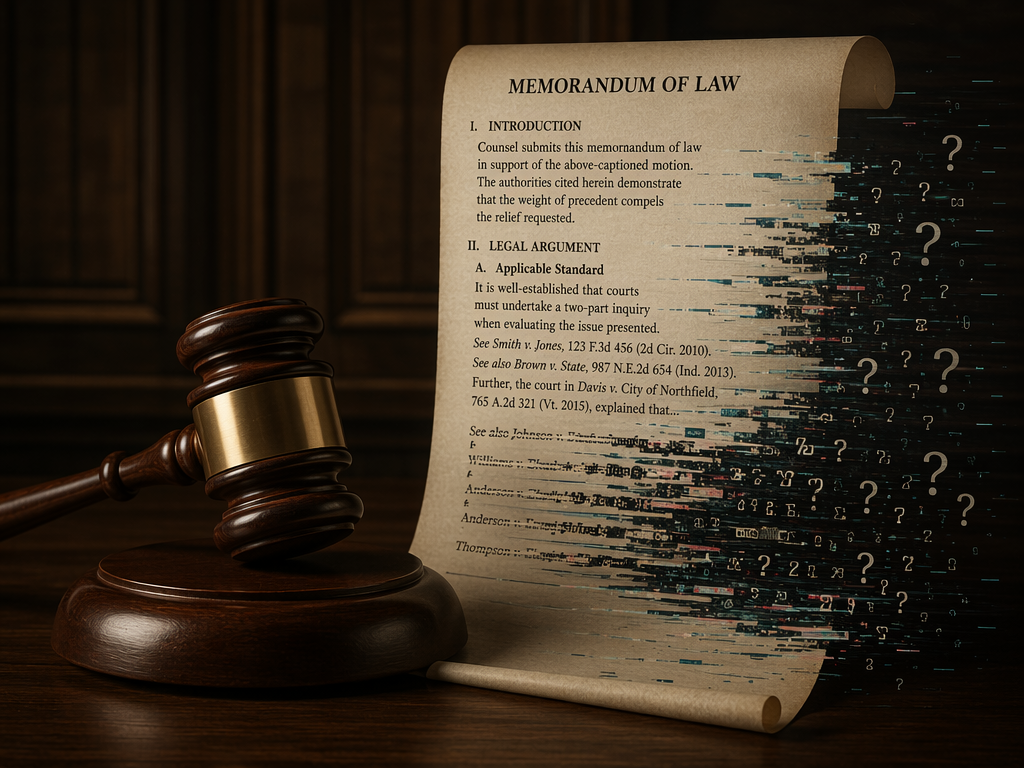
The most concrete enforcement signal in the AI ethics landscape is the wave of sanctions imposed on attorneys who submitted AI-generated citations that turned out to be fabricated. Researchers have identified over 1,400 AI hallucination sanction cases globally, with more than 955 in the United States. These are not hypothetical risks — they are documented disciplinary actions with real financial and reputational consequences.
Two cases illustrate the pattern. In the Morgan & Morgan matter, attorneys were sanctioned for filing a motion that contained nonexistent case citations generated by an AI tool. In a separate California case, an attorney was fined $10,000 for citing fake cases fabricated by ChatGPT. Both cases directly implicate Model Rule 3.3 (candor toward the tribunal) and Model Rule 1.1 (competence).
For a detailed account of a significant sanction case, see our Levidow LeGendre AI Citation Hallucination incident record.
One of the most underappreciated risks in legal AI adoption is the potential waiver of attorney-client privilege. When privileged content is routed through an AI vendor's infrastructure — including cloud-based inference endpoints, training data pipelines, or human review systems — the voluntary disclosure analysis applies regardless of the attorney's intent.
As the Kiteworks analysis notes, every AI tool touching privileged content requires a privilege analysis with legal ethics counsel before deployment, not just a standard IT security assessment. This is a critical distinction: a vendor's SOC 2 Type II report does not, by itself, establish that privilege has been preserved.
The recommended technical mitigations include implementing matter-level access controls using Attribute-Based Access Control (ABAC) policy to restrict AI agents to authorized client files, maintaining tamper-evident audit trails, and applying FIPS 140-3 Level 1 validated encryption for client data in transit and at rest. These are not optional technical details — they are the infrastructure of privilege preservation.
Client Notice and Informed Consent: When Disclosure Is Required
The question of when attorneys must disclose AI use to clients has produced some of the sharpest divergence among state bars. Kentucky's Ethics Opinion KBA E-457 (March 2024) takes the most permissive position: attorneys do not need to disclose routine AI-assisted research to clients unless the AI work is outsourced to a third party or the client is being separately charged for the AI tool's cost. The opinion does, however, require a written agreement if AI subscription costs are passed to the client.
California takes a broader view. The State Bar's Practical Guidance for Generative AI (November 2023) suggests that disclosure may be required when AI use materially affects the representation — a standard that could encompass a wide range of AI applications. Oregon's Formal Opinion 2025-205 goes further, requiring careful review of AI vendor contracts for confidentiality protections and potentially requiring informed consent before using open AI models with client data.
| Scenario | Disclosure Likely Required | Disclosure Likely Not Required | Key Authority |
|---|---|---|---|
| Routine AI-assisted legal research (no third-party access) | No (KY); Possibly (CA) | Yes (KY); No (CA) | KBA E-457; CA Practical Guidance |
| AI use that materially affects representation strategy | Yes (CA, OR) | No | CA Practical Guidance; OR 2025-205 |
| Client data input into open AI model (e.g., public ChatGPT) | Yes (OR, likely CA) | No | OR 2025-205 |
| AI subscription costs passed to client | Yes (KY requires written agreement) | No | KBA E-457 |
| AI chatbot for client intake on law firm website | Yes (FL requires disclaimer) | No | FL Opinion 24-1 |
Fee Structures and AI Efficiency: The Virginia vs. ABA Dispute
The most significant state-level divergence from the ABA baseline concerns fees. ABA Formal Opinion 512 raised the question: if AI reduces the time required to complete a task, can an attorney still charge the same flat fee? The opinion suggested that the reasonableness analysis under Model Rule 1.5 must account for efficiency gains — implying that some fee reduction may be warranted.
Virginia's Legal Ethics Opinion 1901 takes a notably different position. The Virginia Supreme Court's opinion focuses on the output's value to the client, not the time saved by the attorney. Under this framework, an attorney who uses AI to produce a high-quality brief in two hours instead of ten is not automatically required to reduce the fee — the value to the client is the same or greater. This is a direct contradiction of the ABA's implied position.
The practical implications are significant. A firm practicing in both Virginia and a jurisdiction that follows the ABA's approach would need different billing policies for each jurisdiction. Engagement letters should explicitly address how AI efficiency affects fee calculations, and the language should be tailored to the governing ethics opinions of the jurisdictions where the firm practices.
Practical Compliance Checklist for Multi-Jurisdiction Practice
The following checklist is designed for law firms and legal departments that operate across multiple U.S. jurisdictions. It is not a substitute for jurisdiction-specific ethics advice, but it provides a structured framework for building an AI governance program that addresses the divergence documented above.
- Verify AI outputs against primary sources. Every AI-generated citation, case summary, or statutory reference must be independently verified against the original source. This is not optional — it is a direct requirement of Model Rule 3.3 and the competence obligation under Model Rule 1.1.
- Conduct vendor due diligence with privilege analysis. Before deploying any AI tool that touches client data, obtain a written privilege analysis from legal ethics counsel. Review vendor contracts for confidentiality protections, data retention policies, and access controls. Implement ABAC and FIPS 140-3 encryption as recommended by Kiteworks.
- Update engagement letters to address AI use and fee structures. Include language that: (a) discloses material AI use where required by applicable bar opinions; (b) specifies how AI efficiency affects fee calculations; and (c) addresses any subscription costs passed to the client (required in writing by Kentucky).
- Implement court disclosure compliance. Several federal courts, including the SDNY, have standing orders requiring disclosure of AI-generated content in filings. Check the local rules of every court where you practice and maintain a compliance log.
- Adopt a risk-based 'traffic light' policy. The North Carolina Bar Association recommends a three-tier framework: Red Light (prohibited) for inputting confidential client data into public AI tools or using AI for fact-finding without verification; Yellow Light (oversight required) for legal research, document review, and first drafts requiring specific verification protocols; Green Light (standard use) for administrative tasks, marketing content, and internal scheduling.
- Maintain a jurisdiction-specific ethics opinion tracker. The divergence documented in this article will continue to evolve. Assign responsibility for monitoring new bar opinions in every jurisdiction where the firm practices and update policies within 30 days of any material change.

For a deeper explanation of how Model Rules 5.1 and 5.3 apply to AI supervision, see our ABA Model Rules and Attorney AI Use entry.
Operationalizing workflow
No workflow has been explicitly linked to this obligation yet. See Workflows generally.
Illustrative cases
No illustrative case is currently tracked for this obligation. See Risk Digest for documented incidents generally.
← Back to RegulationReport a correction or tip
Spotted an outdated figure, a misstated fact, or a ruling this regulation entry should reflect? Public comments are disabled for this content given the professional cost of a misreported case outcome, penalty amount, or rule text — use the structured correction channel instead.
Report a correction or tip for this record →