
The eminent domain question around AI data centers is narrower, and more legally interesting, than the phrase “land seizure” suggests. As of mid-2026, the documented disputes are not about governments taking farms or homes so a technology company can pour a data center slab. They are about utilities using, or threatening to use, delegated condemnation authority to acquire easements for transmission lines that serve large new power loads, including AI data centers. That distinction matters because the condemnor on the pleadings is usually a regulated utility, not the data center company that made the load request. WilmerHale’s July 2026 litigation survey identifies that utility pathway, including Certificates of Public Convenience and Necessity, as a central feature of data center infrastructure litigation.[1]
That does not make the property-rights problem disappear. It changes the legal question. The issue is not whether AI data centers consume power, or whether the grid needs new investment. The issue is whether a particular state’s eminent domain law permits private land to be burdened when the immediate driver of the project is a private technology load, and when the route chosen places the remedial burden on owners who did not invite the project.
The Federal Floor Is Permissive, but It Is Only the Floor
Federal eminent domain doctrine starts from a broad premise. In Kohl v. United States, the Supreme Court recognized federal eminent domain power as an incident of sovereignty. In Kelo v. New London, the Court held that economic development could satisfy the Fifth Amendment’s “public use” requirement, even where condemned property was ultimately transferred for private redevelopment. The important point for AI data center infrastructure is not that Kelo automatically validates every transmission easement. It is that federal doctrine sets a permissive constitutional minimum, leaving states free to impose stricter public-use rules under their own constitutions and statutes.[2][3]
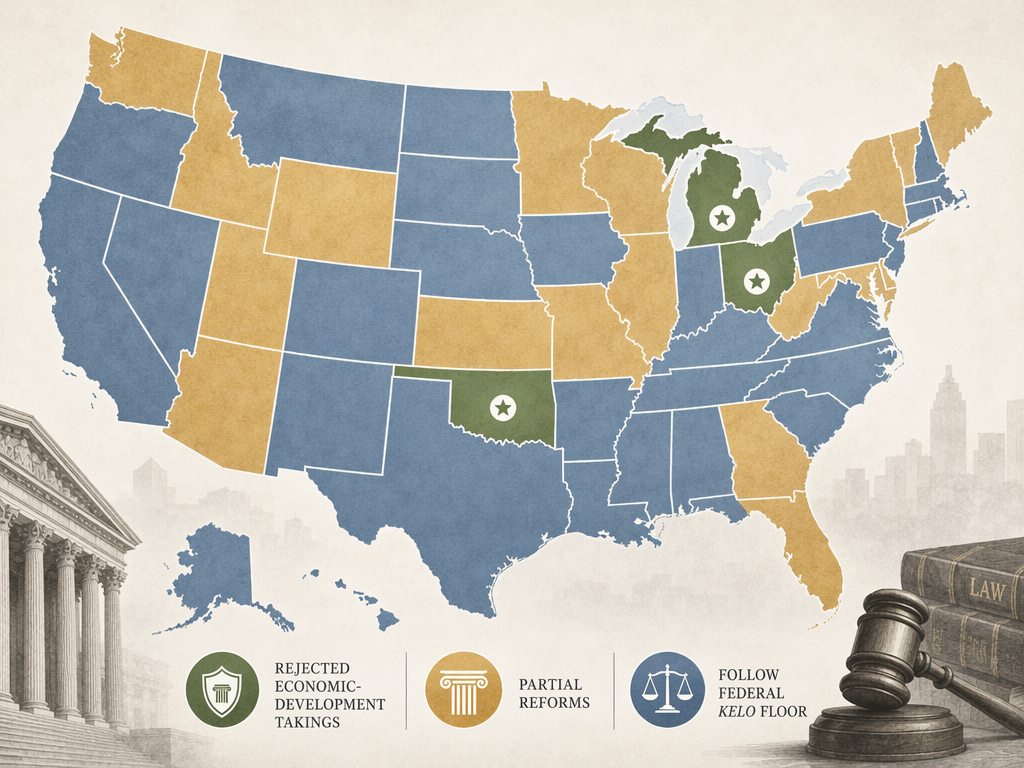
That state-law layer is not decorative. After Kelo, 45 states enacted some form of eminent domain reform, and Michigan, Ohio, and Oklahoma are identified in the available materials as states that rejected economic-development takings under their own state constitutions.[2][3] The result is a fragmented map: a project that fits comfortably inside the federal floor may still face a serious state constitutional or statutory objection if the taking looks like economic development dressed in utility clothing.
The geography of the asset also matters. A highway, dam, courthouse, or substation usually carries an obvious locational logic: it must be somewhere, and often it must be near a particular crossing, water source, road network, or population center. Data centers are not location-free, but they are more location-flexible than many traditional public works. Commentary on AI infrastructure and eminent domain has emphasized that flexibility, including the argument that the federal government’s own interest in siting data centers on Superfund sites implicitly acknowledges that many facilities can be steered among alternative sites.[2][3]
That does not defeat every transmission taking. It does require sharper proof. If the project is framed as grid reliability, the record needs to show more than the existence of a large private customer. If it is framed as public convenience, the question becomes whose convenience, at what scale, and why this route should be imposed on these owners.
CPCNs Are the Practical Hinge
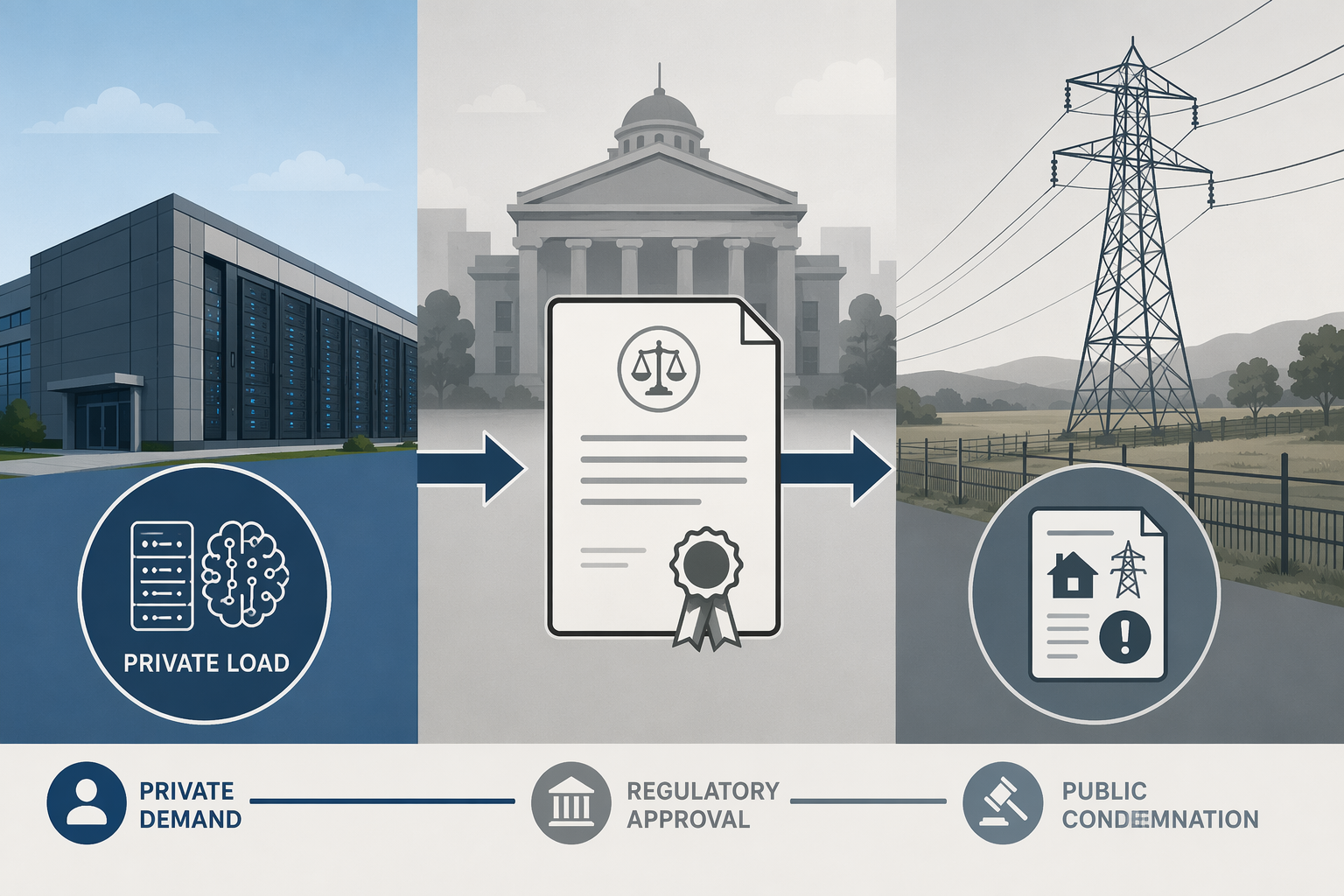
The Certificate of Public Convenience and Necessity is where the AI data center power dispute stops being an abstract constitutional debate and becomes a land-record problem. A utility seeks approval from a public utility commission or similar state body. If the certificate issues, state law may give the utility condemnation authority for the approved route. The formal taking is for a utility project, even where the load forecast, timing, or routing pressure traces back to data center demand.[1]
| Legal layer | Question that matters for AI data center transmission |
|---|---|
| Federal constitutional floor | Does the taking satisfy the Fifth Amendment’s broad public-use standard? |
| State constitution | Has the state rejected or narrowed economic-development takings after Kelo? |
| State utility statute | Does a CPCN or similar approval delegate condemnation authority for this line? |
| Project record | Does the evidence separate general grid reliability from a discrete private load? |
| Parcel-level proceeding | Are route necessity, easement scope, and compensation adequately supported? |
This structure explains why many lawsuits do not name the data center developer as the condemning party. It also explains why a landowner can lose the rhetorical debate before the legal one begins. Once a private load is absorbed into a commission-approved reliability project, the homeowner or farmer is no longer arguing with a technology company over siting choices. The owner is arguing with a public utility over a route that may already have regulatory approval.
Utilities and commissions do have a serious side of the argument. Large loads can require new generation, substations, reconductoring, and transmission expansion. Reliability obligations are not optional, and public utility law has long treated network infrastructure differently from ordinary private development. The legal weakness appears when filings blur the difference between ordinary public load growth and infrastructure whose timing or scale is driven by a small number of private technology customers.
State Reform Determines How Much Kelo Matters
A property owner challenging an AI-driven transmission easement usually cannot stop at “a private company benefits.” Kelo makes that argument too thin under the federal Constitution. The stronger challenge asks whether state law treats this kind of private-benefit taking differently. Some post-Kelo reforms bar condemnations for economic development. Others regulate procedure, compensation, blight findings, or transfer mechanics without categorically eliminating private-benefit projects.[2][3]
The hard cases sit between classic poles. A line serving an entire region looks like ordinary utility infrastructure. A spur built to serve one named facility looks closer to private industrial service. Many AI data center cases are likely to be argued in the middle: the utility will point to network upgrades, reliability needs, and future load growth; opponents will point to the project’s commercial trigger and ask whether the public is being used as the legal wrapper for a private siting decision.
The Mississippi precedent discussed in the available legal commentary shows why that distinction can matter. The Mississippi Supreme Court rejected a power company’s condemnation where transmission lines served out-of-state customers and produced no in-state benefit, a fact pattern that has obvious relevance where power infrastructure crosses local burdens with benefits that may accrue elsewhere.[3] It is not a universal rule for data center lines, but it is a warning against treating “utility” as a self-proving public use.
The broader regulatory environment is also moving. ArentFox Schiff’s 2026 survey describes a shifting state landscape involving data center-specific legislation, tax incentives with conditions, and moratoriums.[4] MultiState’s 2026 tracker places that state resistance against a federal AI infrastructure push, including Executive Order 14318, issued on July 23, 2025, to accelerate federal permitting of data center infrastructure.[5][6] Those materials matter because eminent domain disputes rarely stay inside condemnation pleadings. They travel with tax incentives, utility tariffs, zoning approvals, environmental review, and legislative backlash.
Six State Disputes Show Where the Pressure Points Are
The active disputes documented in Georgia, Wisconsin, Washington, Pennsylvania, Maryland, and Tennessee do not present one clean national test case. They show different procedural postures and different weaknesses in the public-use story. Some are about demolition and load-growth forecasts. Some are about conservation easements. Some are about compensation. Some are not direct condemnation cases at all, but survey-rights or inverse-condemnation disputes that sit next to the same infrastructure buildout.
Georgia: Load Growth, Demolition, and the Public Utility Label
Georgia’s Project Wansley dispute is the most concrete example of the scale problem. Georgia Public Broadcasting reported that Georgia Power’s plan for new power lines affected 330 properties and that 20 to 30 homes were slated for demolition.[7] The same reporting stated that about 80% of Georgia Power’s new load growth was from data centers.[7] Those two facts belong in the same sentence because they show why landowners resist a generic “grid need” explanation.
A utility can argue that once data center demand enters the grid forecast, meeting that demand becomes part of its public service obligation. That is not frivolous. But when hundreds of parcels are drawn into a corridor and homes are identified for removal, the public-use analysis should not hide the identity of the load that made the project urgent. The legal question is not whether Georgia needs electricity infrastructure; it is whether the state’s utility and condemnation framework permits this project, on this route, with this private-load profile.
Georgia Power has said eminent domain represents less than 1% of all land transactions, according to national coverage of these disputes.[8] That figure may be useful in describing the utility’s overall acquisition practice, but it is self-reported in the cited coverage and does not answer the parcel-level question for the owner whose home or land falls inside the corridor.
Wisconsin: A Conservation Easement Tests the Meaning of Public Use
Wisconsin presents a cleaner public-use challenge because the burdened property is not simply a generic rural parcel. The Wisconsin Institute for Law & Liberty describes litigation on behalf of artist Tom Uttech involving a transmission line through his 52-acre conservation easement, reportedly tied to the Stargate data center campus.[9] The reported campus figure is $15 billion, and the challenge argues that the taking lacks a valid public use where the project serves private data center development.[8][9]
A conservation easement sharpens the remedial mismatch. Money can compensate for acreage in the formal sense, but it may not restore the conservation value the owner bargained to protect. That does not mean the easement is immune from condemnation. It does mean the public-use and necessity record should do more work before a private technology load can justify cutting across land already encumbered for conservation purposes.
Washington: Compensation Doctrine Meets the Easement Offer
The Quincy, Washington dispute shows the gap between “just compensation” as a constitutional phrase and the lived economics of a transmission easement. The Spokesman-Review reported that Grant County PUD’s 31-mile line affected 112 parcels and 34 homes.[10] In one cited example, a landowner was offered $2,415 for a one-third-acre easement, described as roughly 25% of fair market value.[10]
That one offer should not be treated as representative of every parcel in the project. It is still legally revealing. Easement compensation often turns on the land actually occupied or encumbered, while owners experience the project as a broader loss: changed views, changed farming operations, financing complications, resale effects, and the presence of high-voltage infrastructure across land they still own but can no longer use in the same way.
The same reporting described the utility as standing to earn millions monthly from the data center-related power demand.[10] That fact does not by itself invalidate condemnation. Regulated utilities earn revenue from public service. But when the compensation to an owner is measured in thousands and the project economics are measured in millions, courts and commissions should be careful about treating statutory compensation as if it resolves the public-use question.
Pennsylvania: Necessity Is Not Absolute Necessity
Pennsylvania’s Sugarloaf and MidAtlantic Resiliency Link disputes put emphasis on necessity standards rather than only on public use. HMS Legal reports that the Pennsylvania Commonwealth Court held a utility’s eminent domain exercise was not limited to “absolute necessity.”[11] The broader contested project materials include 240-foot towers, an estimated $1.7 billion cost, and roughly 200 miles of contested line.[8][11]
That distinction is consequential. If a statute requires only a showing of public convenience, service improvement, or reasonable necessity, landowners may not win by proving that the utility could have chosen another route. They may need to show that the certificate, route, or taking fails the particular statutory standard, exceeds delegated authority, or rests on a defective record. In data center cases, that pushes the fight back into the administrative record: what load was studied, what alternatives were rejected, and how much of the asserted need belongs to ordinary customers rather than large private facilities.
Maryland: Survey Rights Arrive Before Condemnation
Maryland’s Piedmont Reliability Project illustrates an earlier procedural stage. National coverage describes a federal court fight over survey rights connected to the PSEG project.[8] Survey access can look minor compared with condemnation, but it is often the first physical intrusion that tells an owner the corridor is no longer theoretical.
The legal posture matters. A survey-rights case may not decide final public use, final compensation, or final route approval. It can still shape leverage. If a utility gains access to inspect, stake, test, and document property, the project gains factual momentum before a condemnation petition is filed. For landowners, resisting or conditioning survey access may be one of the few chances to contest the route before the administrative and engineering record hardens.
Tennessee: Inverse Condemnation in a Data Center Siting Fight
Tennessee is procedurally different again. National coverage identifies a Metro Nashville inverse-condemnation posture connected to efforts to stop a DC Blox data center near the zoo.[8] Inverse condemnation is not the same as a utility filing a direct condemnation action for a transmission easement. It is generally a claim that government action has effectively taken or damaged property rights without using formal eminent domain procedures.
That distinction keeps the Tennessee dispute from doing too much work in a transmission-line analysis. It belongs in the tracker because it reflects the same infrastructure conflict: public bodies, private data center development, and property owners arguing over who bears the land-use consequence. It should not be cited as proof that direct land seizures for data center buildings are now routine.
Public Opposition Is Context, Not the Legal Test
Public opinion has moved against nearby data center development. Gallup reported in May 2026 that 71% of Americans opposed AI data centers in their area.[12] Pew reported that 67% of new data centers locate in rural areas, a siting pattern that helps explain why transmission and landowner disputes are showing up in farm, conservation, and small-community settings rather than only in industrial parks.[13]
Those numbers are politically important, but they do not decide eminent domain cases. Unpopularity is not a constitutional defect. Rural siting is not illegal. The legal work is done by state public-use doctrine, utility statutes, CPCN records, route necessity standards, compensation evidence, and any post-Kelo limits that the state has actually adopted.
The same caution applies to broad claims that communities have blocked or delayed enormous dollar volumes of AI data center projects. Available secondary materials refer to a $153 billion figure for Q1 2026, but the primary source has not been independently verified by the cited sources. For condemnation analysis, the better evidence is not the national blockage number. It is the filed route, the certificate, the parcels, the homes, the easement language, and the state-law theory.
Where the Strongest Legal Battles Are Likely to Form
The strongest challenges are unlikely to be framed as a categorical rule that AI data centers may never benefit from utility infrastructure. That would overstate the law and ignore how regulated grids actually work. The more durable challenges will be jurisdiction-specific and record-specific.
- In states that rejected or narrowed economic-development takings after Kelo, challengers will press whether the project is a public utility improvement or an economic-development taking in functional terms.
- Where CPCN approval supplies condemnation authority, challengers will examine whether the commission record separated general reliability needs from a discrete private customer’s load.
- For route disputes, challengers will focus on why the selected corridor is necessary when data centers and related facilities may have alternative siting options.
- For conservation easements, farms, and homes, challengers will argue that nominal acreage compensation understates the legal and practical burden imposed by the easement.
- For interstate or export-oriented power projects, challengers may look for arguments that local burdens lack a corresponding in-state or local public benefit.
For counsel tracking adjacent land-use risk, eminent domain is only one part of the docket. Zoning challenges raise different questions about local approvals, special exceptions, moratoriums, environmental impacts, and procedural standing. Those issues are covered separately in Three categories define legal challenges to AI data center zoning.
As of Q3 2026, the eminent domain issue is therefore not a single national answer. The Fifth Amendment permits more than many landowners would expect, but state law may permit less than utilities and data center customers assume. The cases to watch are the ones that force commissions and courts to say precisely when a private AI load becomes a public utility necessity, and when that label is not enough to put another person’s land in the corridor.
References
- Data Centers in Court, WilmerHale, July 13, 2026.
- AI Development, Pipelines, and Emin Domain, Texas Undergraduate Law Journal.
- Can the government seize your land to power AI?, The Conversation.
- State Regulation of Data Centers in 2026, ArentFox Schiff.
- State Data Center Laws vs. Federal AI Push: 2026 Tracker, MultiState.
- Accelerating Federal Permitting of Data Center Infrastructure, The White House, July 23, 2025.
- Georgia Power has a massive plan for new power lines, Georgia Public Broadcasting, June 23, 2026.
- Landowners and local communities fight back, PBS NewsHour/AP.
- Wisconsin Artist Battles Utility in Landmark Property Rights Case, Wisconsin Institute for Law & Liberty.
- WA homeowners, farmers say their land is being stolen for data centers, The Spokesman-Review, May 13, 2026.
- PA Utility Eminent Domain Exercise Not Limited to 'Absolute Necessity', HMS Legal.
- Americans Oppose AI Data Centers in Their Area, Gallup, May 2026.
- What we know about energy use at U.S. data centers, Pew Research, Oct. 2025.
Comments
Join the discussion with an anonymous comment.