
The EU AI Act and Your Law Firm: A Practical Compliance Guide for Legal Practitioners
- Effective date
- Dec 2, 2027
Introduction: The EU AI Act Is Already Affecting Your Firm
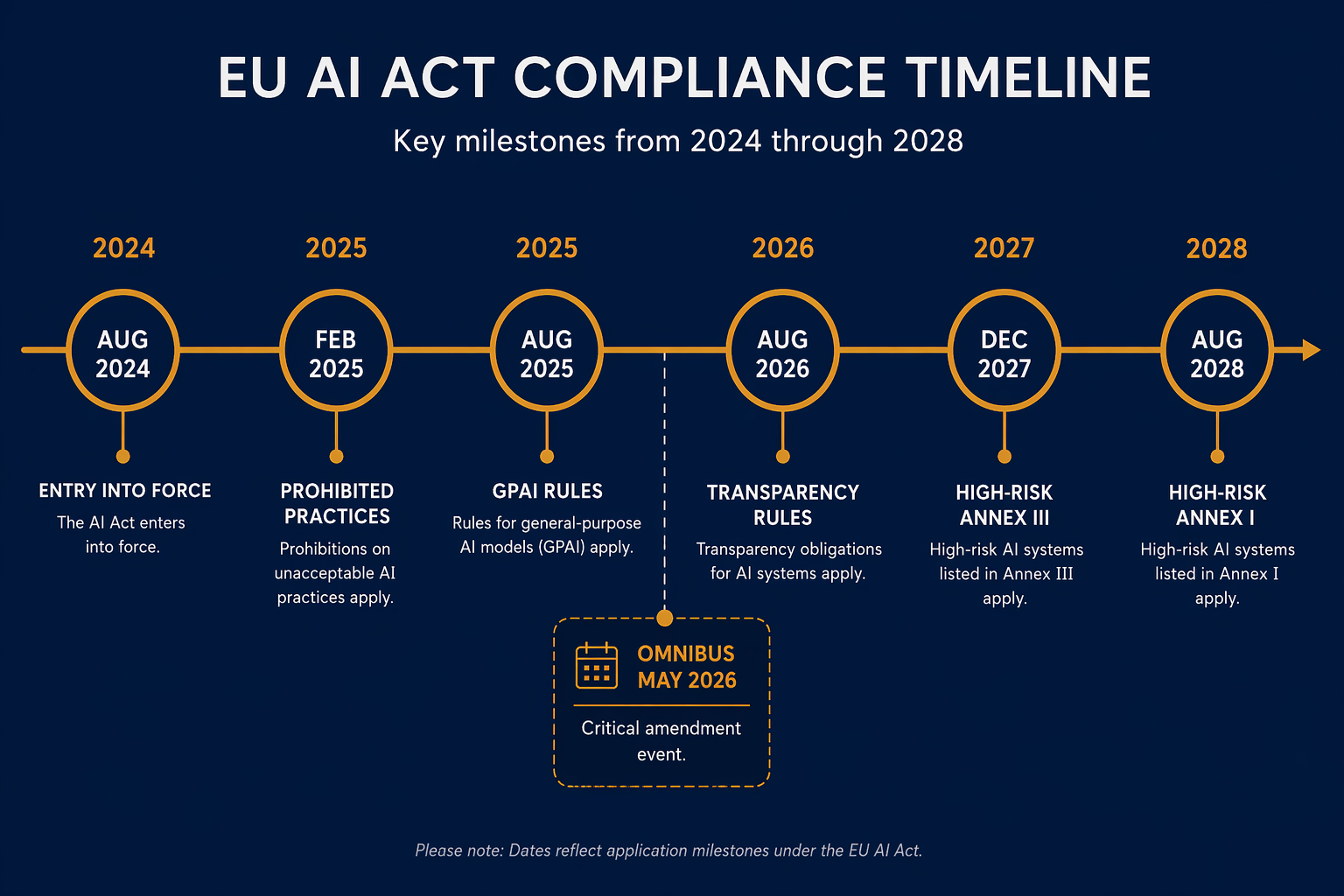
If your law firm uses AI tools for document review, contract analysis, legal research, or drafting, the EU AI Act has already imposed obligations on your practice — regardless of whether your firm is based in Brussels or Boston. The common misconception is that compliance deadlines are distant. They are not. The AI literacy mandate under Article 4 has been legally binding since February 2025. The general-purpose AI (GPAI) model rules and penalty framework have been in effect since August 2025. And on August 2, 2026, the Article 50 transparency obligations will take effect, covering everything from client-facing chatbots to AI-generated draft contracts.
The Digital Omnibus political agreement reached on May 7, 2026, extended the deadline for high-risk Annex III systems to December 2, 2027, but that extension is a preparation window, not a reprieve. The core thesis of this guide is straightforward: law firms deploying AI in legal practice face concrete compliance obligations around transparency, human oversight, and record-keeping that demand immediate attention. Understanding how the Act classifies your firm — as a deployer or a provider — and how it classifies your AI tools — as high-risk or not — is the foundation of any compliance strategy.
Are You a Deployer or a Provider? How the AI Act Classifies Law Firms
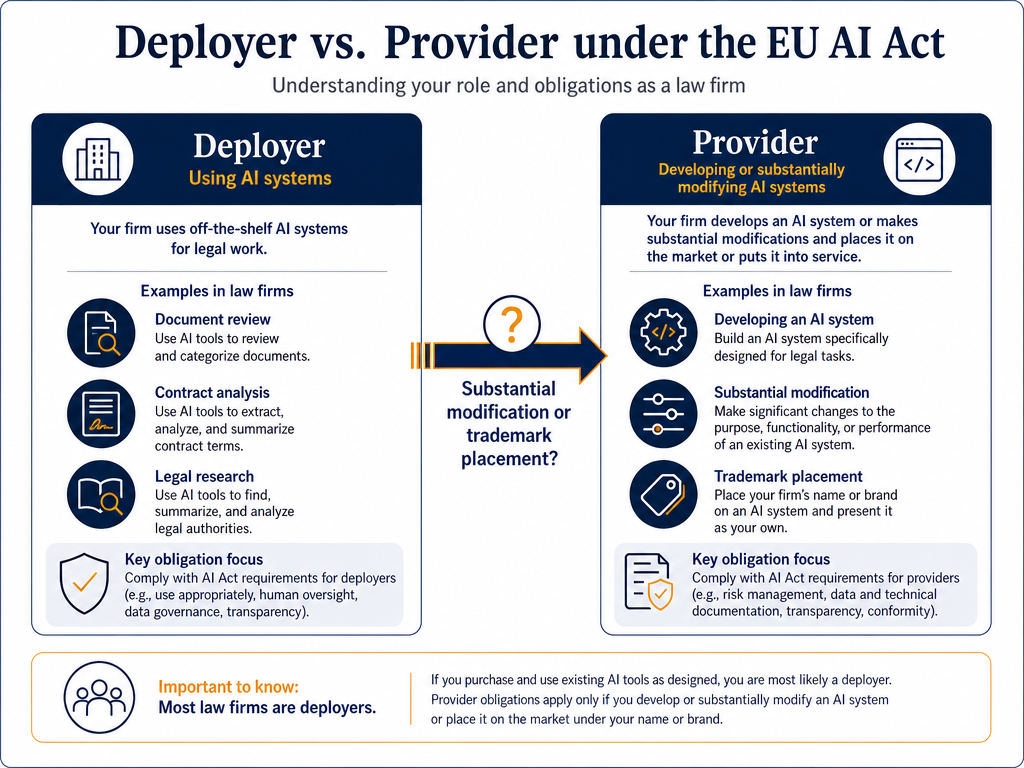
The EU AI Act distributes obligations unevenly between two roles: providers (developers who place AI systems on the market) and deployers (users who employ AI systems in their operations). Most law firms fall into the deployer category when they use off-the-shelf legal AI tools for tasks like contract review, legal research, or document drafting. Deployer obligations include using the system according to the provider's instructions, ensuring human oversight, and monitoring for risks.
However, the line blurs quickly. A law firm that substantially modifies a general-purpose AI model — for example, by fine-tuning it on proprietary case law or client data — may assume obligations equivalent to those of a provider. The same applies if the firm places its own trademark on a modified system or puts it on the market for other legal professionals to use. The high-level summary of the AI Act makes clear that the provider role carries the heaviest regulatory burden: risk management systems, technical documentation, data governance, and quality management systems.
| Role | Typical Scenario for Law Firms | Key Obligations |
|---|---|---|
| Deployer | Using an off-the-shelf AI contract review tool as intended by the vendor | Use according to instructions; ensure human oversight; monitor for risks; comply with transparency rules (Article 50); maintain AI literacy (Article 4) |
| Provider | Fine-tuning a model on proprietary data and offering it to other firms; placing a modified system on the market under the firm's brand | All deployer obligations plus: risk management system; technical documentation; data governance; record-keeping; conformity assessment; registration in EU database |
| Deployer crossing into provider | Substantially modifying a GPAI model's intended use or integrating it into a custom workflow that changes its risk profile | Must assess whether the modification triggers provider obligations; document the assessment under Article 6(3) |
When Legal AI Becomes High-Risk: Annex III and the Administration of Justice
Annex III of the EU AI Act lists eight specific areas where AI systems are presumed high-risk. Point 8 covers the administration of justice and democratic processes. According to the high-level summary, this includes AI systems used to research and interpret facts, apply the law to concrete facts, or assist in alternative dispute resolution. For law firms, this classification is directly relevant: many legal AI tools — particularly those marketed for legal research, case outcome prediction, or document analysis — fall within this scope.
The practical consequence is significant. High-risk classification triggers the most stringent obligations under the Act. Providers must establish risk management systems, ensure high-quality datasets, design for record-keeping and logging, provide detailed instructions for use, and implement human oversight. Deployers must use the system according to those instructions, ensure human oversight is in place, and monitor for risks throughout the system's lifecycle.
- AI systems that research and interpret facts and apply the law to concrete facts are explicitly listed as high-risk under Annex III, point 8(a).
- AI systems used in alternative dispute resolution are also listed as high-risk under point 8(b).
- The Article 6(3) carve-out may apply if the system performs a narrow procedural task or improves a completed human activity, but this must be assessed and documented on a case-by-case basis.
- Systems that perform profiling of natural persons are always high-risk, regardless of the carve-out.
Obligations Already in Force: AI Literacy and GPAI Model Rules
Two sets of obligations are already legally binding and require immediate action from law firms.
First, Article 4 mandates that firms ensure their staff have sufficient AI literacy. This obligation has been in force since February 2, 2025. AI literacy is not defined in the Act itself — it is an evolving standard that the European Commission and national competent authorities will shape over time. For law firms, this means training programs must cover not only how to use specific AI tools but also the limitations, risks, and professional responsibility implications of AI-generated outputs. The implementation timeline confirms that this requirement is not prospective — it is active.
Second, the GPAI model rules and the penalty framework under Articles 99 and 100 have been in effect since August 2, 2025. Providers of general-purpose AI models must now provide technical documentation, instructions for use, comply with the Copyright Directive, and publish a summary of training data. For law firms that deploy GPAI-based tools (such as large language models used for drafting or research), this means the providers of those tools should already be able to supply documentation about their systems' capabilities and limitations.
The urgency of these obligations is underscored by adoption data. According to Thomson Reuters data cited by Artekia, only 22% of legal organizations have a defined AI strategy. Yet according to Litify data cited in the same source, 78% of legal professionals already use generative AI personally. The gap between individual usage and organizational readiness is a compliance vulnerability.
The August 2026 Transparency Deadline: Article 50 and Your Client Communications
On August 2, 2026, the Article 50 transparency obligations take effect. These obligations apply to all AI systems — not just high-risk ones — and cover four specific situations relevant to law firm operations.
- When an AI system interacts directly with people — such as chatbots or virtual assistants on a firm's website — users must be informed that they are interacting with AI.
- When an AI system generates synthetic content — including draft contracts, memos, or legal research summaries — providers must mark the outputs in a machine-readable format.
- When an AI system is used for emotion recognition or biometric categorization — less common in law firms but relevant for certain security or client intake applications — deployers must inform exposed individuals.
- When an AI system creates deepfakes or generates text published on matters of public interest — such as AI-generated blog posts, client alerts, or marketing content — deployers must disclose the AI-generated nature of the content.
The practical guide to Article 50 notes that transparency obligations are the second most common compliance trigger after AI literacy, affecting approximately 33% of all compliance checker respondents. For law firms, the most immediate impact will likely be on client-facing chatbots and AI-generated draft documents. The Digital Omnibus includes a grandfathering rule: generative AI systems already on the market before August 2, 2026, have until December 2, 2026, to meet the machine-readable marking requirement under Article 50(2).
The December 2027 High-Risk Deadline: A Window to Prepare, Not to Delay
The Digital Omnibus political agreement of May 7, 2026, extended the compliance deadline for stand-alone high-risk AI systems under Annex III from August 2, 2026, to December 2, 2027 — a 16-month delay. For high-risk systems integrated into products regulated under Annex I (such as lifts or toys), the deadline was extended to August 2, 2028. The Omnibus also introduced a new prohibition on AI systems generating non-consensual intimate content and child sexual abuse material, effective December 2, 2026.
As Latham & Watkins and Covington have both noted, this extension is not a reason to defer compliance. The Omnibus preserves the AI Act's risk-based architecture and general obligations. The delay provides breathing room for firms to conduct thorough risk assessments, request documentation from AI providers, implement human oversight procedures, and establish record-keeping systems. Firms that treat the extension as a license to wait will find themselves scrambling in late 2027.
| Deadline | Obligation | What Law Firms Must Do |
|---|---|---|
| February 2, 2025 (in force) | AI literacy (Article 4); prohibited practices (Article 5) | Train staff on AI capabilities and limitations; ensure no prohibited AI practices are used |
| August 2, 2025 (in force) | GPAI model rules; penalties (Articles 99, 100) | Verify that AI tool providers comply with GPAI documentation requirements |
| August 2, 2026 | Transparency obligations (Article 50) | Label AI-generated content; disclose AI interactions to clients; implement machine-readable marking |
| December 2, 2027 | High-risk Annex III obligations (including administration of justice) | Complete risk classification; implement human oversight; establish record-keeping; request provider documentation |
| August 2, 2028 | High-risk Annex I obligations (product-regulated systems) | Compliance for AI systems integrated into regulated products |
Practical Compliance Checklist for Law Firms
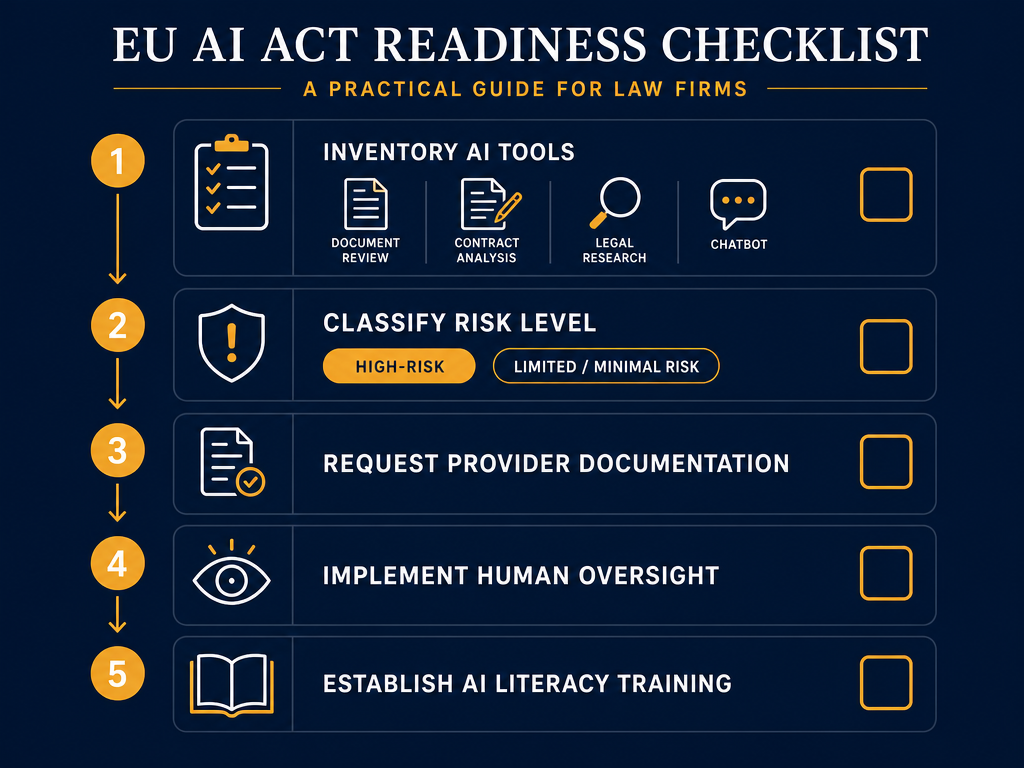
The following checklist provides a concrete starting point for law firms to assess their current compliance posture and build a roadmap toward the December 2027 high-risk deadline. Each step is actionable and can be initiated immediately.
- Inventory all AI tools used in the firm. Include tools used by individual attorneys, paralegals, and support staff — not just firm-approved systems. Document the vendor, the specific AI model or system, the intended use case, and whether the tool is cloud-hosted or on-premises.
- Classify each tool's risk level under Annex III. For each tool, determine whether it falls under point 8 (administration of justice) or another Annex III category. Assess whether the Article 6(3) carve-out applies. Document the assessment for each tool.
- Request documentation from AI providers. For each high-risk or potentially high-risk tool, request the provider's instructions for use, risk assessment, and technical documentation. Under the AI Act, providers are obligated to supply this information to deployers.
- Implement human oversight procedures. For high-risk systems, define who in the firm is responsible for monitoring AI outputs, what escalation procedures exist for errors or hallucinations, and how the firm ensures that a qualified attorney reviews AI-generated work product before it is used in client matters.
- Establish an AI literacy training program. Develop or procure training that covers the capabilities and limitations of the AI tools used in the firm, the professional responsibility implications (competence, supervision, confidentiality), and the specific obligations under the AI Act. Ensure all staff who operate AI systems complete the training.
Conclusion: Compliance Is a Professional Responsibility, Not Just a Regulatory One
The EU AI Act's obligations are not merely regulatory hurdles to be cleared by a compliance team. They intersect directly with the professional responsibility duties that attorneys already owe under frameworks like the ABA Model Rules and state bar guidance. Competence (Model Rule 1.1), supervision of non-lawyer assistants (Model Rule 5.3), and confidentiality (Model Rule 1.6) all have implications when AI tools are deployed in legal practice. A failure to understand how an AI system reaches its outputs, or a failure to verify those outputs before using them in client work, is not just an AI Act violation — it is a professional responsibility exposure.
The cost of non-compliance under the AI Act is substantial. Article 99 sets fines for non-compliance with deployer obligations or transparency rules at up to €15,000,000 or 3% of total worldwide annual turnover, whichever is higher. For violations of prohibited practices, fines reach €35,000,000 or 7% of global turnover. But the reputational damage and malpractice exposure from an AI-related failure — a hallucinated citation submitted to a court, a confidential document leaked through an AI tool, a biased algorithm used in a client screening — can far exceed any regulatory fine.
The December 2027 deadline for high-risk systems is a window to prepare, not a reason to delay. Firms that begin now — inventorying tools, classifying risk, training staff, and implementing oversight — will be positioned to comply not only with the AI Act but also with the professional responsibility standards that govern their practice. For a fuller treatment of the professional responsibility obligations around AI use, see our article on From Ethics Opinions to Enforcement: The Professional Responsibility of AI Compliance for Attorneys in 2026.
Operationalizing workflow
No workflow has been explicitly linked to this obligation yet. See Workflows generally.
Illustrative cases
No illustrative case is currently tracked for this obligation. See Risk Digest for documented incidents generally.
← Back to RegulationReport a correction or tip
Spotted an outdated figure, a misstated fact, or a ruling this regulation entry should reflect? Public comments are disabled for this content given the professional cost of a misreported case outcome, penalty amount, or rule text — use the structured correction channel instead.
Report a correction or tip for this record →