
New York does not have one data center moratorium with one operative threshold and one deadline. As of July 20, 2026, it has one binding executive-order pause, one pending legislative framework, and one separate Public Service Commission track that can affect project economics even where a project is outside the permitting pause.
That distinction is not semantic. Executive Order No. 62 is in effect now and halts new discretionary permits issued by the Department of Environmental Conservation for data center projects expected to consume 50 megawatts or more, subject to stated exemptions and the completion of a Generic Environmental Impact Statement process.[1][2] S10642/A11560, the Responsible Data Center Development Act, has passed the Legislature but is not current law unless and until it is enacted; if it becomes law, it would lower the operative moratorium threshold to 20 megawatts and impose a broader set of energy, labor, community-benefit, and public-review obligations.[3] PSC Case 26-E-0045 sits beside both of them, focused on large-load interconnection and cost allocation rather than DEC permitting, and may create a different kind of exposure before either moratorium question is resolved.[4][5]
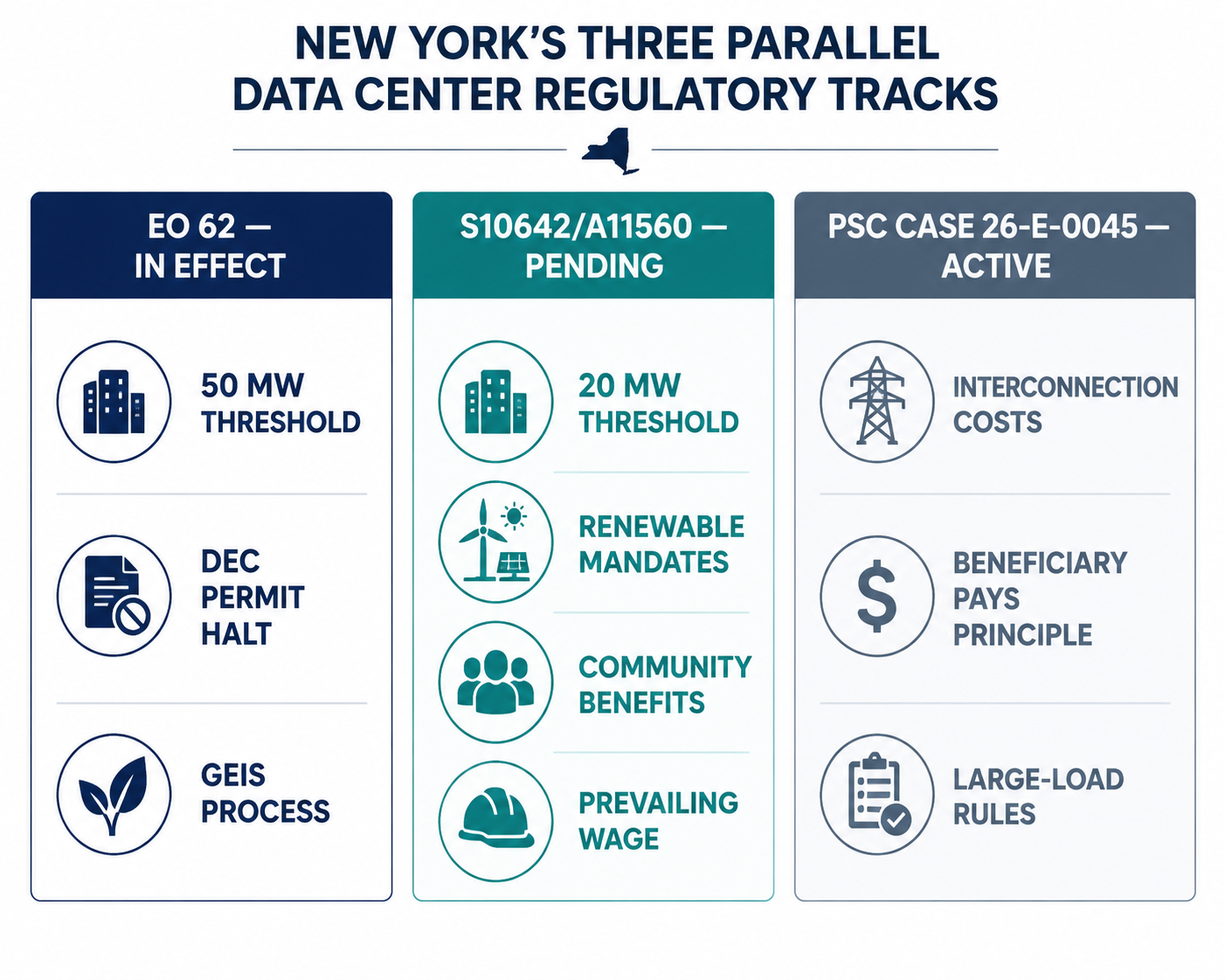
| Track | Status as of July 20, 2026 | Projects most directly affected | Primary legal risk |
|---|---|---|---|
| Executive Order No. 62 | In effect | Data centers consuming 50 MW or more that need new DEC discretionary permits | Permit halt pending GEIS and related agency review |
| S10642/A11560 | Passed by Legislature; not yet effective | Would reach data centers at 20 MW or more if enacted | Change-in-law risk, expanded mandates, and lower threshold |
| PSC Case 26-E-0045 | Active regulatory proceeding | Large-load customers seeking utility interconnection or upgrades | Interconnection cost allocation and potential beneficiary-pays exposure |
For counsel, the first question is therefore not whether “the moratorium” applies. It is which instrument is being discussed, whether that instrument is legally operative, and whether the project’s immediate next approval is a DEC discretionary permit, a utility interconnection milestone, a local land-use approval, or an internal procurement commitment that may become stranded if the rules move.
EO 62 Is The Binding Constraint
Executive Order No. 62 took effect on July 14, 2026, and is the instrument that should anchor any current compliance analysis.[2] It directs DEC to halt issuance of new discretionary permits for data center projects that are expected to consume 50 megawatts or more until DEC completes a Generic Environmental Impact Statement addressing the environmental and electric-system impacts of covered development.[1]
The practical word is “discretionary.” A covered project does not become unlawful simply because it exists on a site plan or in an interconnection queue. The immediate choke point is the DEC approval path. The order identifies discretionary permits that can include freshwater wetlands permits, water quality certifications, and State Pollutant Discharge Elimination System permits.[1] If a 50 MW-plus project needs one of those permits and does not fit an exemption, the project team should assume that the DEC permit cannot simply proceed on its old calendar.
That matters most for sites where power procurement, long-lead equipment, land options, local approvals, and environmental permits were being sequenced in parallel. A project may have spent months reducing local zoning risk and still find that a wetlands permit or discharge permit is now the controlling path. Conversely, a project below 50 MW, or a project without a new DEC discretionary permit in the critical path, is not analyzed the same way under EO 62. Treating those projects as if they face the same current legal bar would overstate the order.
The executive order also contains exemptions for research, education, and medical facilities.[1] Those exemptions should not be read casually. A facility with some research use is not automatically outside the order if the data center project itself is not within the exempted category. The safer analysis is facility-specific, tied to the actual applicant, use, load profile, and permit being sought.
The GEIS timing is another place where shorthand can mislead. The process is projected to take up to 12 months, but “up to 12 months” is not a guaranteed outside date for every affected project to receive every needed approval.[1][2] A completed GEIS can create a framework for agency review; it does not by itself solve utility upgrades, local approvals, site-specific mitigation, water-supply constraints, or litigation risk.
What DEC Is Being Asked To Study
EO 62 is not only a pause. It is also a directive to build a record. DEC must complete the GEIS, and the order separately directs review of whether new regulations are needed under 6 NYCRR Parts 601 and 602 for data center water consumption, with a 12-month timeline.[1][6] That water-withdrawal instruction deserves more attention than it has received in some deal discussions because it points to a regulatory issue that may survive the initial moratorium period.
For a data center lawyer, water is not an environmental talking point floating somewhere outside the transaction documents. It can determine whether a site depends on municipal supply, groundwater withdrawal, surface-water withdrawal, cooling technology changes, additional infrastructure, or mitigation measures that were not priced into the first model. If DEC ultimately proposes rules under Parts 601 and 602, the impact may not be limited to the same project set caught by the initial 50 MW permit halt.
ESD, Community Investment, And The Grid Acceleration Fund
The executive order also directs Empire State Development to establish a Community Investment Framework within 60 days.[1] That is not the same as a fully adopted community-benefit rule, but it is a signal that the state wants host-community commitments brought into the formal development conversation rather than left as late-stage political accommodations.
EO 62 further directs ESD to consider creating a Grid Acceleration Fund using a beneficiary-pays cost-allocation principle.[1][4] The verb matters. “Consider” does not create a tariff, surcharge, or payment obligation on its own. It does, however, create a stakeholder window in which developers, utilities, municipal hosts, and large customers will try to shape who pays for upgrades that serve high-load projects.
The pressure behind that discussion is not abstract. Nearly 12 gigawatts of data center load requests were in the NYISO interconnection queue as of May 2026, with more than 8 gigawatts added in 2025 alone.[6] At the same time, New York’s average residential electricity price has climbed approximately 68 percent since 2019.[7] Those two numbers explain why the state is unlikely to treat grid-upgrade cost allocation as a private matter between a developer and a utility.
The Pending Bill Would Change The Analysis, But It Is Not Current Law
S10642/A11560 should be tracked closely, but it should not be cited in a closing checklist as if it is already binding. As described in multiple law-firm analyses, the bill has passed the Legislature and awaits gubernatorial action; its obligations are therefore change-in-law risk, not present compliance obligations as of July 20, 2026.[3][4][5]
If enacted, the bill would lower the moratorium threshold from 50 MW to 20 MW.[3] That single move would pull a different class of projects into the state-level pause. A 24 MW project that can currently say EO 62 does not apply by load threshold would have a different answer under the bill. A phased project would need careful treatment as well, because threshold analysis often turns on expected consumption and project structure, not merely the first energized increment.
The bill would also add substantive mandates that go beyond pausing permits. Reported provisions include renewable procurement schedules of 33 percent by 2030, 66 percent by 2035, and 90 percent by 2040; separate utility rate classes for data centers; host-community benefit programs; prevailing wage requirements; domestic sourcing requirements; public hearings; and an environmental impact report within 18 months.[3][4][5]
| Issue | EO 62 now | Pending bill if enacted |
|---|---|---|
| Threshold | 50 MW or more | 20 MW or more |
| Legal status | Binding executive order | Contingent on enactment |
| Immediate mechanism | Halt on new DEC discretionary permits | Broader statutory moratorium and mandates |
| Energy obligation | Study and planning directives tied to GEIS and grid framework | Renewable phase-in targets reported at 33% by 2030, 66% by 2035, 90% by 2040 |
| Community and labor obligations | Community Investment Framework to be established by ESD | Host-community benefits, prevailing wage, domestic sourcing, and public hearings |
The renewable schedule would be particularly important for procurement and credit support. A developer can sometimes manage a permitting delay through option extensions and revised construction milestones. A statutory renewable procurement schedule changes the operating model. It raises questions about eligible resources, contract tenor, deliverability, replacement energy, penalties, and whether a project can pass costs through to customers whose own AI infrastructure commitments were priced on different assumptions.
Separate utility rate classes would be just as consequential. A special data center class could isolate costs that might otherwise be socialized across broader customer groups, depending on how PSC rules are written. Developers may describe that as discrimination against a new industry; residential and small-business customers may describe it as overdue cost discipline. The legal issue is not which slogan wins. It is whether tariff design, cost causation, and public-interest findings support the classification.
Host-community benefits, public hearings, prevailing wage, and domestic sourcing requirements would also move more issues into the approval timeline. These obligations affect more than public relations. They influence construction cost, EPC contracting, supply-chain representations, local negotiations, and the record that opponents or supporters can use in later administrative or judicial challenges.
Because the New York Senate bill page was unavailable, those bill details should be treated with appropriate source hierarchy. The descriptions are reconstructed from three independent law-firm analyses that are mutually consistent, but they are still secondary descriptions of pending legislation rather than the operative text of an enacted statute.[3][4][5]
The PSC Track Can Bite Even Where The Moratorium Does Not
PSC Case 26-E-0045 is easy to misfile as background because it does not announce a simple pause. That would be a mistake. The proceeding concerns large-load interconnection and cost allocation, and it is moving on a regulatory timeline separate from DEC permitting and legislative enactment.[4][5]
A project below 50 MW may avoid EO 62. A project below 20 MW may avoid the pending bill’s reported threshold if the bill is enacted in that form. Neither fact answers whether the project’s interconnection requires utility upgrades, whether those upgrades trigger contribution obligations, or whether a future PSC rule allocates costs under a beneficiary-pays principle. That is where stranded-asset risk starts to look less like a permitting issue and more like a sequencing issue.
The most exposed projects are not necessarily the largest in the press release. They may be projects that have paid for site control, ordered equipment, or negotiated customer commitments while assuming that network-upgrade costs would be handled under existing utility practices. If the PSC adopts a cost-allocation approach that shifts more upgrade expense to high-load beneficiaries, the project may remain legally developable but commercially impaired.
The proceeding is still in early stages, including comment and working-group formation; final rules have not been issued.[5] That status cuts both ways. It means counsel should not model a final tariff that does not exist. It also means the record is being built now, while developers, utilities, consumer advocates, municipalities, and state agencies still have room to contest how benefits and costs are defined.
Project Size Is Only The Starting Point
The cleanest threshold chart still leaves hard questions. A 55 MW project requiring a wetlands permit sits plainly in EO 62 territory unless an exemption applies. A 30 MW project may be outside EO 62 today but inside the pending bill if enacted. A 10 MW project may avoid both moratorium thresholds but still face local zoning review, utility interconnection costs, water-supply limits, or incentive risk.
- For 50 MW-plus projects, start with EO 62, the DEC permit inventory, exemption analysis, GEIS timing, and any water-withdrawal exposure.
- For 20 MW to 49 MW projects, treat the pending bill as a material change-in-law risk rather than a current prohibition.
- For large-load projects of any size, separate the PSC interconnection and cost-allocation analysis from the moratorium analysis.
- For projects needing municipal approvals, keep local zoning and site-plan authority on a separate checklist because EO 62 does not preempt local land-use control.
- For projects relying on tax or energy-price assumptions, test whether incentive repeal, new rate classes, or upgrade deposits would change the investment decision.
This is also where earlier diligence can be both valuable and insufficient. A project team that already mapped wetlands, water quality, local zoning, utility service, and construction labor exposure is in a better position than one that treated New York as a power-price exercise. But diligence done under one legal regime has to be refreshed when the state is actively reconsidering thresholds, rate design, community benefits, and water rules.
New York Is Not Acting In A Vacuum
New York’s framework is being watched because it is the first enacted statewide pause of its kind, but that label is less important than the mechanics.[8] At least 11 states introduced statewide moratorium bills in 2026, while Maine’s governor vetoed a similar bill in April 2026.[8] More than 40 states considered 267 data-center-related bills in 2025, and nearly 50 localities across the United States adopted construction pauses in 2026.[8][9]
The classification counts vary because trackers define the universe differently: introduced moratorium bills, broader restriction activity, local pauses, incentive changes, and active regulatory proceedings are not the same thing. That distinction matters when national data is used to brief a board or negotiate a change-in-law clause. A moratorium bill in another state does not carry the same risk as an effective executive order in New York or an active PSC cost-allocation proceeding.
There is also a federal bill in the background. The Artificial Intelligence Data Center Moratorium Act, S.4214, would impose a national pause on AI data center construction until Congress passes comprehensive AI legislation, but it faces significant industry opposition.[6] For New York projects, that federal proposal is not the governing constraint today. It is another signal that data center growth is being evaluated through energy, infrastructure, and public-cost lenses rather than only through economic-development claims.
Tax incentives belong in the same risk conversation. Governor Hochul is pursuing repeal of New York’s sales tax exemption for large data centers, and Arizona and Illinois paused their data center tax incentives in mid-2026.[7][10] Incentive risk does not decide whether DEC may issue a permit, but it can decide whether a project still clears its investment committee after new interconnection, labor, renewable-procurement, or community-benefit obligations are added.
For readers who need the broader policy and industry overview before the legal sorting exercise, What New York's Data Center Moratorium Means for AI Development provides a companion primer. The legal analysis, however, should stay disciplined: permitting status, project threshold, utility pathway, local approvals, and financial assumptions have to be tested separately.
The Practical Legal Read For Q3 2026
As of Q3 2026, a New York AI data center moratorium legal analysis should begin with three separate questions. First, does EO 62 currently halt a needed DEC discretionary permit because the project is expected to consume 50 MW or more? Second, would S10642/A11560 materially change the project’s obligations if enacted, especially for projects at or above 20 MW? Third, could PSC Case 26-E-0045 change the cost of interconnection or utility upgrades regardless of the moratorium timeline?
Those questions do not produce the same answer for every site. They also do not move on the same clock. EO 62 is a present permitting constraint. The bill is contingent statutory risk. The PSC proceeding is an active cost-allocation track. A project can be safe on one and exposed on another.
That is the legal posture that matters for developers, utilities, host communities, and ratepayers. New York has not merely paused a category of projects; it has opened several forums where the cost, timing, and public conditions of high-load development are being reassigned.
References
- Executive Order No. 62, Governor of New York
- First Statewide Moratorium on New Hyperscale Data Centers, Governor of New York, July 14, 2026
- New York Legislature Passes Data Center Moratorium Bill, Awaits Governor’s Approval, Greenberg Traurig LLP, June 2026
- New York Establishes First-in-the-Nation Statewide Moratorium on Data Center Permits, Barclay Damon
- New York State Legislature Passes Bill to Examine Data Center Impacts, Including One-Year Moratorium, Phillips Lytle LLP
- New York’s AI Data Center Moratorium: A Potential Turning Point for U.S. Data Center Development, Foley & Lardner, July 2026
- New York AI Data Center Ban, CNBC, July 14, 2026
- State Data Center Policy 101, MultiState
- Data Center Moratoriums, Interconnected Capital
- New York Becomes First State to Impose Data Center Moratorium, Reuters, July 14, 2026
Comments
Join the discussion with an anonymous comment.