
Is 7-OH Kratom Legal After the DEA Schedule I Order?
The DEA's temporary Schedule I order on 7-OH is threshold-based, not a kratom ban, and it had not yet taken effect as of August 4, 2026. This status record separates what becomes federally controlled at publication, what stays legal, and what stricter state bans still require.
- Jurisdiction
- US Federal
- Court
- DEA
- AI tool named
- None
- Ruling date
- Jul 6, 2026
- Source document
- View primary court order ↗
- Last verified
- Aug 4, 2026
Lex Machina Review is an independent risk-tracking and reference resource. Nothing on this site is legal advice, and using it does not create an attorney-client relationship. Every record is reviewed against primary sources but may not reflect the most current status of a matter — always verify directly against the cited court order, rule text, or a licensed attorney before relying on it.
Companion explanation — secondary to the source document above
Last verified: August 4, 2026, 16:00 UTC. Legal-background reviewer: Elena Markovic, J.D., regulatory counsel. This record is for legal and compliance background only and is not legal advice. Recheck the Federal Register before acting on any federal status conclusion.
The phrase “7-OH kratom legality after DEA Schedule I ban” contains the first compliance error: as of this verification, the DEA temporary scheduling order had not yet taken effect. The operative notices published on July 6, 2026, state that the temporary order “will be published in the Federal Register on or after August 5, 2026” and will become effective on the date the order is published, not on the date of the July notice of intent.[1]
| Question | Status as verified August 4, 2026 |
|---|---|
| Is 7-OH federally Schedule I now? | Not yet under the temporary order described in FR Doc. 2026-13580, because the final temporary scheduling order had not yet been published. |
| What happens when the order is published? | 7-hydroxymitragynine above the specified federal thresholds becomes temporarily placed in Schedule I. |
| Is kratom itself federally banned by this DEA action? | No. Botanical kratom with naturally occurring 7-OH below the DEA threshold is outside this federal order. |
| Are there separate federal rules for synthetic derivatives? | Yes. Mitragynine pseudoindoxyl, MGM-15, and MGM-16 are covered at any concentration once the separate temporary order takes effect. |
| Can state law still prohibit sale, shipment, or possession? | Yes. The federal exclusion below threshold does not override stricter state prohibitions or product-registration regimes. |
The primary-source file for this status record is the DEA’s 7-OH notice of intent, the separate notice for three synthetic derivatives, the HHS/OASH request for information on the threshold question, and the DEA’s July 1 press release.[1][2][3][4] Secondary summaries are useful only after the operative text has been read against the product in hand.
The federal line is a threshold rule, not a kratom ban
FR Doc. 2026-13580 does not schedule every product containing any detectable 7-hydroxymitragynine. It defines two product settings and gives different measurement hooks for each. For “botanical material,” the temporary placement covers 7-OH “above 0.050% by dry weight.” For “synthetic or processed products,” it covers 7-OH “above 0.050% w/w, w/v, or v/v, or above 1.00 mg per article.”[1]
That distinction matters because it changes the compliance question. A dried botanical sample is not assessed the same way as a beverage, extract, tablet, gummy, capsule, or other processed article. A paraphrase that collapses the dry-weight rule and the per-article milligram rule into one general “0.05% or 1 mg” standard is too imprecise for an inventory hold or distributor notice.
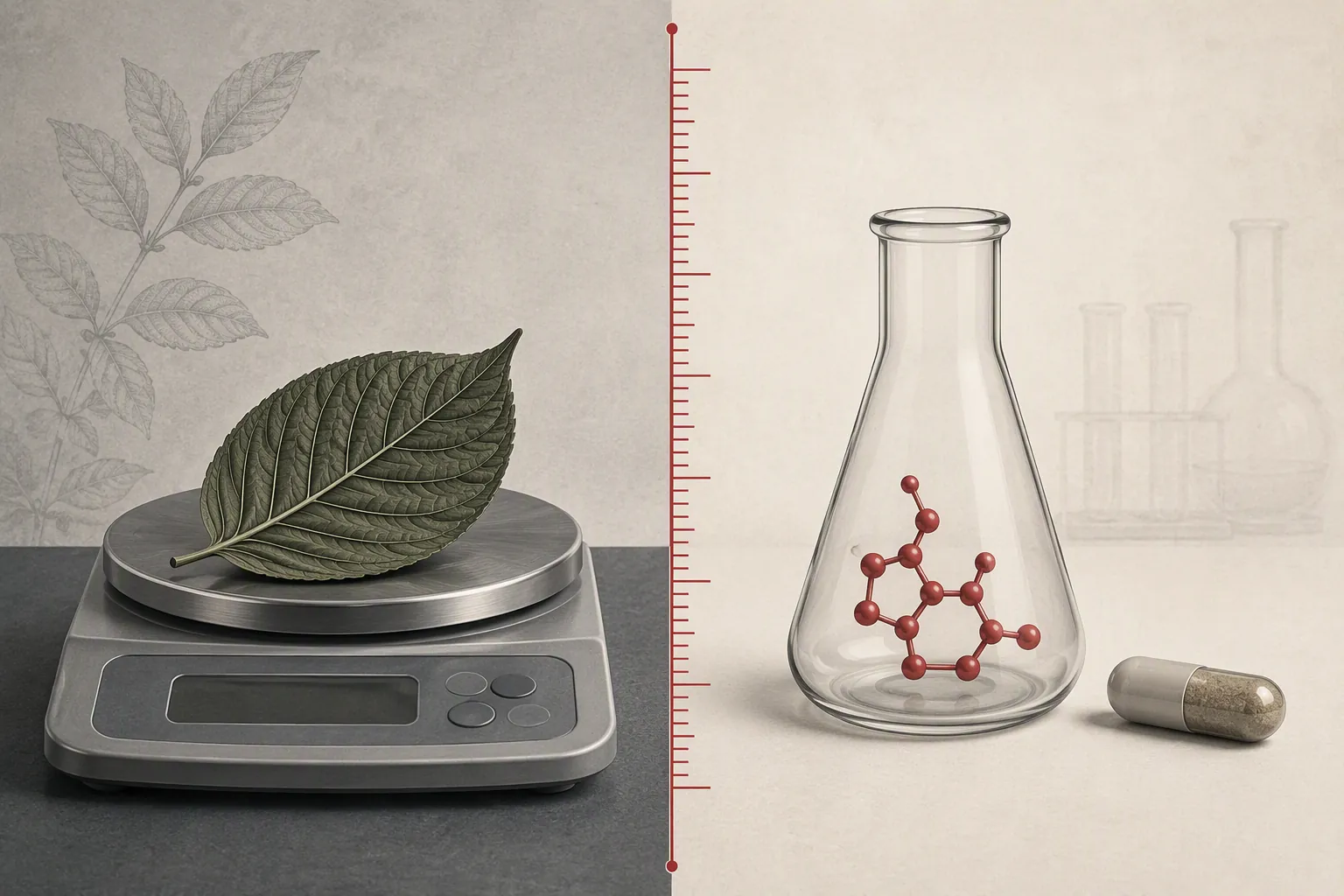
The DEA press release states the exclusion in plainer language: the action “does not apply to natural kratom leaf products that contain naturally occurring 7-OH below the threshold.”[4] That sentence is not a safe-harbor for all kratom-labeled products. It is a federal exclusion for below-threshold botanical material under this DEA action, subject to the effective-date problem and subject to state law.
The duration mechanics also belong in the legal answer. The notice invokes 21 U.S.C. 811(h), under which a temporary scheduling order may remain in effect for two years and may be extended for one additional year while permanent scheduling proceedings are pending. The notice also states that temporary scheduling orders under that provision are not subject to judicial review.[1]
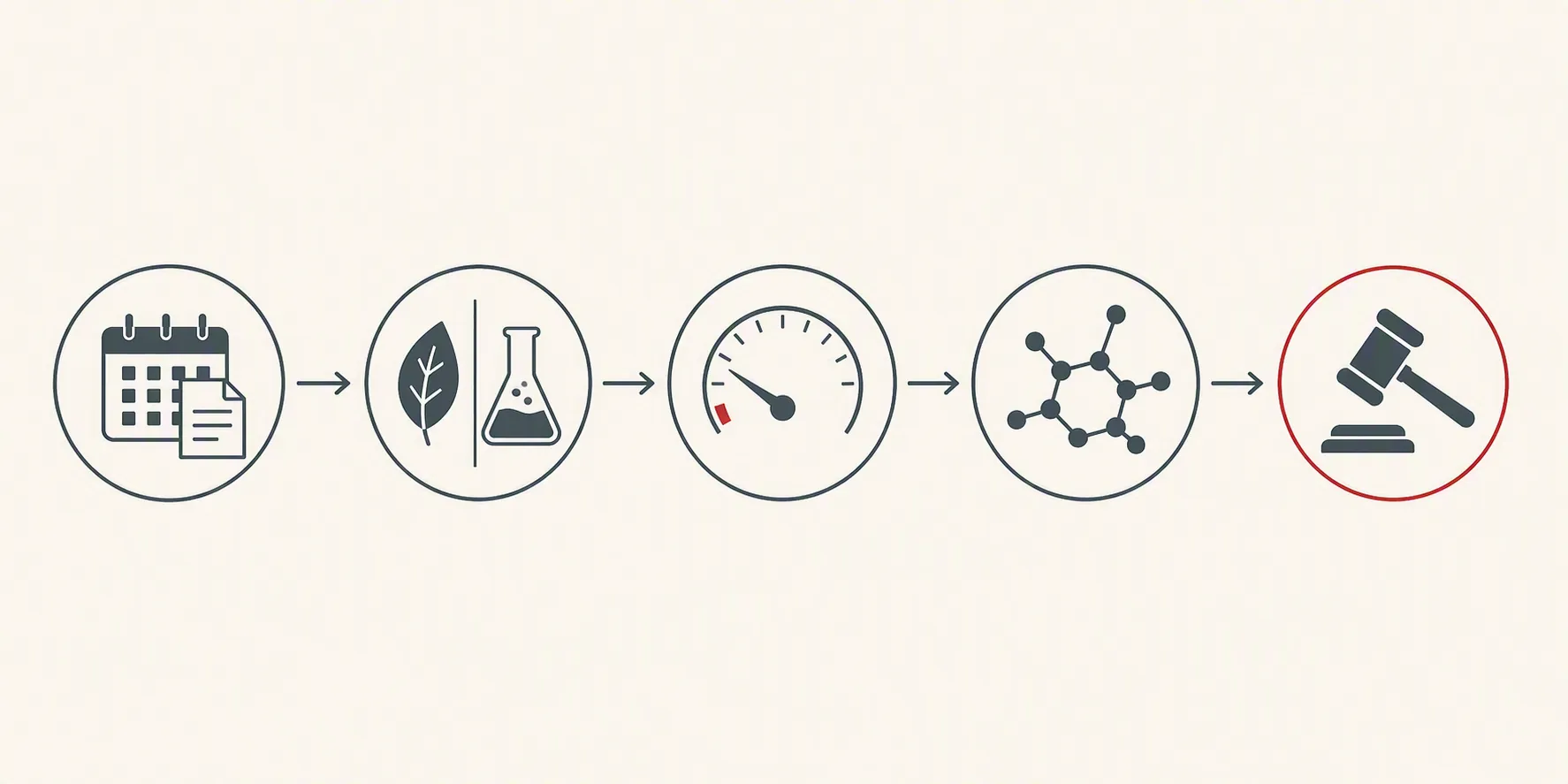
The five checks before anyone calls a product federally legal
| Check | What to verify | Why it changes the answer |
|---|---|---|
| 1. Federal Register publication | Has the final temporary scheduling order been published? | The federal Schedule I trigger is the order’s publication date, not the earlier notice of intent. |
| 2. Product category | Is the item botanical material, a synthetic product, or a processed product? | Botanical material uses the dry-weight threshold; synthetic and processed products use concentration and per-article thresholds. |
| 3. 7-OH measurement | Does measured 7-OH exceed the applicable 0.050% threshold or the 1.00 mg per article threshold? | Only above-threshold 7-OH is covered by the 7-OH temporary order. |
| 4. Synthetic derivatives | Is mitragynine pseudoindoxyl, MGM-15, or MGM-16 present? | Those three substances are controlled at any concentration under the separate DEA action. |
| 5. State law | Does the destination, sale, possession, or manufacturing state impose a stricter rule? | A federal exclusion does not authorize conduct prohibited by state law. |
For counsel or compliance staff, the first box should not be buried in a footnote. If a client asks on August 4 whether federal Schedule I exposure has already attached under this DEA action, the answer is no, based on the notice language available at that time. If the same client asks on or after August 5, the answer has to be rechecked against the final Federal Register publication.
The second and third boxes should be tied to a product-level record, not a brand-level assumption. A seller may carry raw botanical material, enhanced leaf, extracts, beverages, capsules, and gummies under the same trade name. The DEA thresholds do not treat those as one legal object.
- Keep the certificate of analysis or other testing record with the lot, not only with the supplier profile.
- Record whether the sample was treated as botanical material, synthetic product, or processed product.
- Screen for the three separately listed synthetic derivatives, not only for 7-OH concentration.
- Apply the strictest relevant state rule to the transaction path: manufacture, storage, sale, shipment, and possession may not be in the same jurisdiction.
- Refresh the federal citation once the final temporary order appears, because the notice of intent is not the effective order.
The three synthetic derivatives are not threshold-based
The separate DEA notice for mitragynine pseudoindoxyl, MGM-15, and MGM-16 works differently. It proposes temporary Schedule I placement for those three substances themselves, without the 0.050% or 1.00 mg threshold structure used for 7-OH.[2]
The agency’s public-health record is stronger and more specific for treating those substances separately. The notice reports mitragynine pseudoindoxyl in at least 31 overdose cases from February 2025 through February 2026, including 25 fatal overdose cases, and states that MGM-16 demonstrated approximately 240 times the potency of morphine in animal models.[2]
Those figures do not prove the risk profile of ordinary below-threshold botanical kratom. They explain why the DEA did not draft one uniform rule for every kratom-adjacent material. A legal memo that treats mitragynine pseudoindoxyl and below-threshold leaf as the same category is making the same mistake in the other direction.
CSA exposure starts when the federal trigger exists
Once a substance is actually placed in Schedule I, the federal Controlled Substances Act consequences are not cosmetic. The DEA press release identifies manufacture, distribution, sale, and possession as conduct affected by Schedule I control, and outside compliance summaries point to the familiar CSA provisions governing unlawful distribution, communication-facility offenses, and possession under 21 U.S.C. 841, 843, and 844.[4][5]
But timing is part of exposure. Before the temporary order is published, the July notices support preparation, holds, contract notices, and product review. They do not, by themselves, establish that the threshold-based federal Schedule I order is already in force.
That is the same effective-date discipline used in other obligation trackers, whether the deadline is an AI statute or a sanctions screening update. The useful question is not whether an agency has announced a direction; it is when the operative obligation attaches and what text defines the screened item. For similar deadline-focused formats, see the site’s coverage of the EU AI Act high-risk obligations deadline and the Hormuz insurers sanctions screening checklist.
State law can still make the sale unlawful
The federal threshold answer is not a preemption answer. FR Doc. 2026-13580 identifies nine states as prohibiting 7-OH: Alabama, Arkansas, Florida, Indiana, Kentucky, Louisiana, Ohio, Vermont, and Wisconsin. The same notice also identifies 19 states with Kratom Consumer Protection Act-style regulation rather than a full prohibition.[1]
That list should not be read as a clean national kratom-ban list. A state can prohibit concentrated 7-OH or synthetic kratom substances while leaving some natural leaf products lawful. Another state can ban kratom more broadly without appearing in a DEA list framed around 7-OH. Kansas and Tennessee are examples identified in available state-law materials as already having state bans in force, while the DEA notice’s nine-state list is framed around 7-OH prohibitions.[1]
Florida and Ohio require special verification before any transaction advice. The research record flags Florida’s concentrated-7-OH emergency-rule posture and Ohio’s separate emergency and permanent synthetic-kratom actions as fluid or inconsistently summarized in secondary sources. The narrow drafting point is simple: do not turn a federal below-threshold exclusion into permission to ship into a state with a stricter rule.
For a multi-state seller, this is where the operational burden sits. The sales screen has to distinguish at least four categories: states that prohibit 7-OH or synthetic derivatives; states that prohibit kratom more broadly; states that allow regulated kratom products under registration, labeling, testing, or age-gating rules; and states where the legal status requires fresh confirmation. The category label should match the state statute or rule being applied, not a national tracker’s shorthand.
The same jurisdiction-split problem appears in other regulatory records where a federal answer does not end the analysis. The useful comparison is not topical; it is structural. A federal-status memo still has to map state enforcement, local transaction points, and the screened legal object, as in the site’s Paramount-WBD antitrust status record and its discussion of federal-state regulatory posture in AI regulation after Nvidia CEO testimony.
The threshold basis is still under agency review
HHS/OASH opened a request for information limited to the 7-OH threshold question under docket HHS-OASH-2026-0232, with comments due July 31, 2026.[3] That does not suspend the DEA notice or rewrite the current federal line. It does mean the scientific and policy basis for the threshold is still an active agency issue.
For present compliance purposes, the RFI is a monitoring item, not a license to choose a preferred threshold. A product review on August 4 should use the DEA notice text and then be refreshed when the final temporary order is published.
Bottom line for 7-OH kratom legality after the DEA action
As verified on August 4, 2026, the DEA’s temporary Schedule I order for 7-OH had not yet taken effect because the order had not yet been published in the Federal Register. When it is published, the federal rule described in FR Doc. 2026-13580 controls 7-OH only above the specified thresholds: above 0.050% by dry weight in botanical material, or above 0.050% w/w, w/v, or v/v, or above 1.00 mg per article, in synthetic or processed products.[1]
Below-threshold botanical kratom with naturally occurring 7-OH remains federally outside this DEA action as verified on August 4, 2026. That federal answer must be rechecked on Federal Register publication and against state law before anyone treats it as permission to sell, ship, possess, manufacture, or advise.
References
- Schedules of Controlled Substance: Temporary Placement of 7-Hydroxymitragynine Above a Specified Threshold in Schedule I, Federal Register, July 6, 2026
- Schedules of Controlled Substances: Temporary Placement of Mitragynine Pseudoindoxyl, MGM-15, and MGM-16 in Schedule I, Federal Register, July 6, 2026
- Temporary Placement of 7-Hydroxymitragynine Above a Specified Threshold in Schedule I; Request for Information, Federal Register, July 6, 2026
- DEA to Temporarily Schedule 7-OH and Related Substances to Protect Public Safety, DEA, July 1, 2026
- What Schedule I Means for 7-OH, Bicycle Health
Related records
Tool profile
Browse tool evaluations →Governing regulation
Browse the obligations tracker →Preventive workflow
Browse verification workflows →
Report a correction or tip
Spotted an outdated figure, a misstated fact, or a ruling this case record should reflect? Public comments are disabled for this content given the professional cost of a misreported case outcome, penalty amount, or rule text — use the structured correction channel instead.
Report a correction or tip for this record →