
When does an airport ICE arrest require a bond hearing?
After an airport ICE arrest — the situation in the reported Maryland teacher case — release turns on the circuit's reading of §1225 versus §1226 and on how quickly habeas relief is pursued. This map covers the July 2025 no-bond policy shift, the split rulings as of August 2026, and the enforcement gap that can delay release even after a court orders a hearing.
- Jurisdiction
- US Federal
- Court
- Board of Immigration Appeals
- Judge
- Jeremy Daniel
- AI tool named
- No AI tool implicated
- Ruling date
- Jul 30, 2026
- Source document
- View primary court order ↗
- Last verified
- Aug 4, 2026
Lex Machina Review is an independent risk-tracking and reference resource. Nothing on this site is legal advice, and using it does not create an attorney-client relationship. Every record is reviewed against primary sources but may not reflect the most current status of a matter — always verify directly against the cited court order, rule text, or a licensed attorney before relying on it.
Companion explanation — secondary to the source document above
Legal information only, not legal advice. Last verified: Aug. 4, 2026. Legal-background review: Anika Patel, J.D. This record is limited to the bond-hearing fight after an airport ICE arrest—especially the §1225 versus §1226(a) classification problem—and does not replace case-specific immigration or habeas counsel.
The reported arrest of Berhanu Kibret at Dallas Fort Worth International Airport is the kind of event that makes families search for “ice detention legal rights teacher arrested at airport” before they have a docket number, a confirmed facility, or a lawyer. CBS Baltimore, WBAL, and The Baltimore Banner reported that Kibret, a University of Maryland Baltimore instructor and former Maryland Teacher of the Year, was detained by ICE at DFW on July 21, 2026; DHS’s explanation was relayed through those news reports, not through a court order cited in the reports.[1][2][3]
That distinction matters. A reported airport arrest does not, by itself, answer the release question. The immediate bond-hearing question is narrower: held where, classified under which detention statute, and in which circuit?
For the generic airport encounter workflow—documents, phone calls, locator checks, consular or family contact, and the practical first-hour checklist—use the companion airport ICE arrest rights checklist. This record does not re-derive that material. It maps the bond-hearing fork that decides whether the detainee may ask an immigration judge for individualized release conditions, or whether habeas counsel must first fight the government’s no-bond position in federal court.
The first fork is §1225 versus §1226(a)
The government’s no-bond theory after many airport arrests runs through 8 U.S.C. §1225, the inspection statute used for “applicants for admission.” If the person is treated as detained under that label, the government argues that mandatory detention applies and that an immigration judge lacks authority to hold a bond hearing. The detainee-favorable route is §1226(a), which covers discretionary arrest and detention during removal proceedings and allows individualized bond determinations.[4][5]
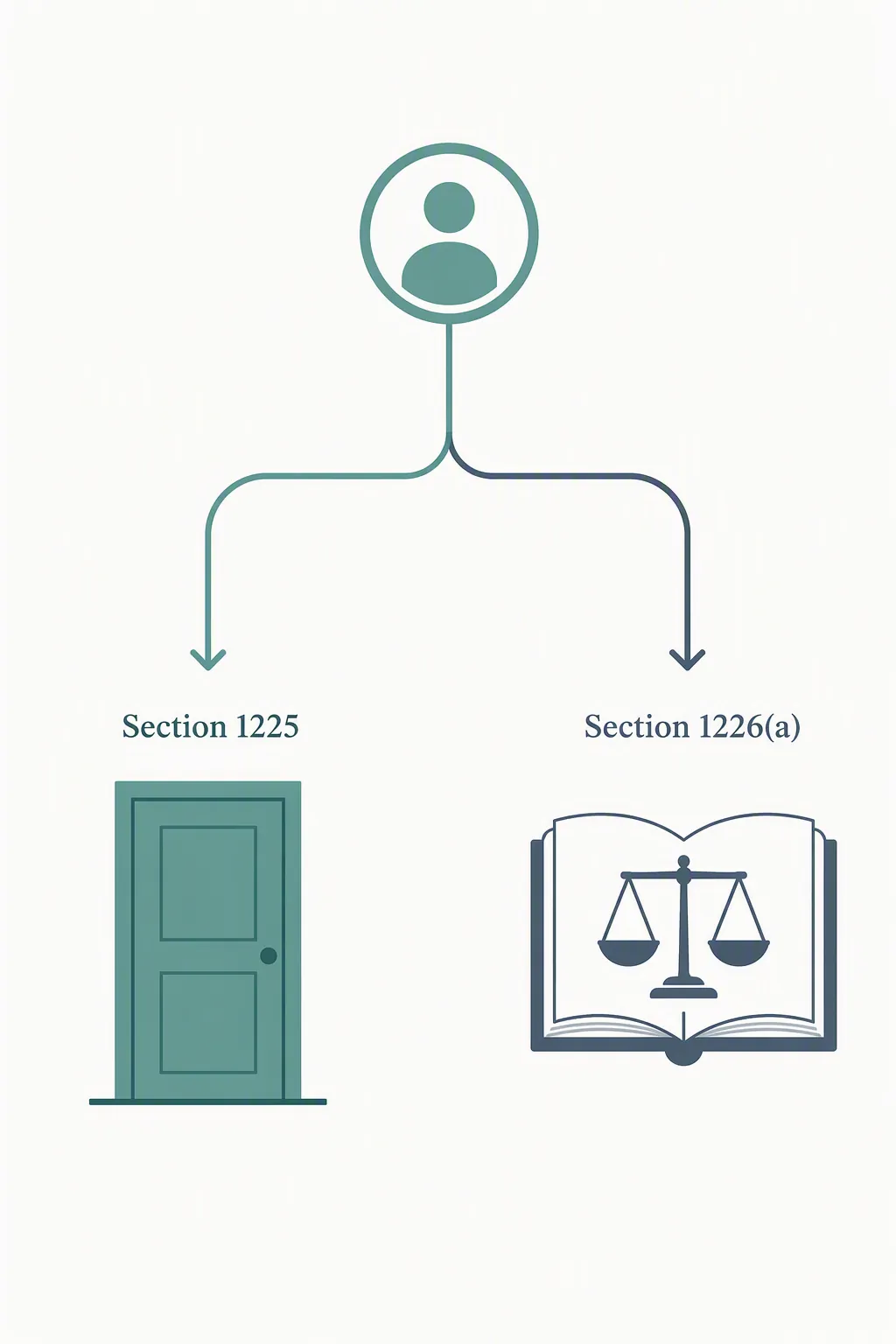
That statutory label is not a technical afterthought. It determines the forum. If §1226(a) applies, the person can seek an immigration-judge bond hearing. If the government successfully places the person under §1225, the immigration court may treat bond as unavailable, and the practical route becomes a habeas petition asking a federal court to order a hearing.
The fight became operational nationwide after ICE issued interim guidance on July 8, 2025, followed by the Board of Immigration Appeals’ Matter of Yajure Hurtado, 29 I&N Dec. 216, and EOIR nationwide guidance dated Jan. 13, 2026, as tracked by the Immigration Policy Tracking Project.[6] The upshot was not merely a change in agency vocabulary. Immigration judges began receiving a government position that many noncitizens previously treated as bond-eligible under §1226(a) should instead be treated as detained without immigration-judge bond authority under §1225.
That is why a family’s first useful question is not simply “Was he arrested at an airport?” It is: where is he detained now, and what statutory custody box has the government put on the file?
The circuit map as of Aug. 4, 2026
As of this record’s verification date, the answer depends heavily on circuit law. The 5th and 8th Circuits have adopted the government’s no-bond reading. The 2d, 6th, 7th, 9th, 10th, and 11th Circuits have ordered hearings for detainees challenging the no-bond classification. The two July 30, 2026 decisions are especially recent, so any live case still needs docket-level checking before a filing relies on this map.[6]
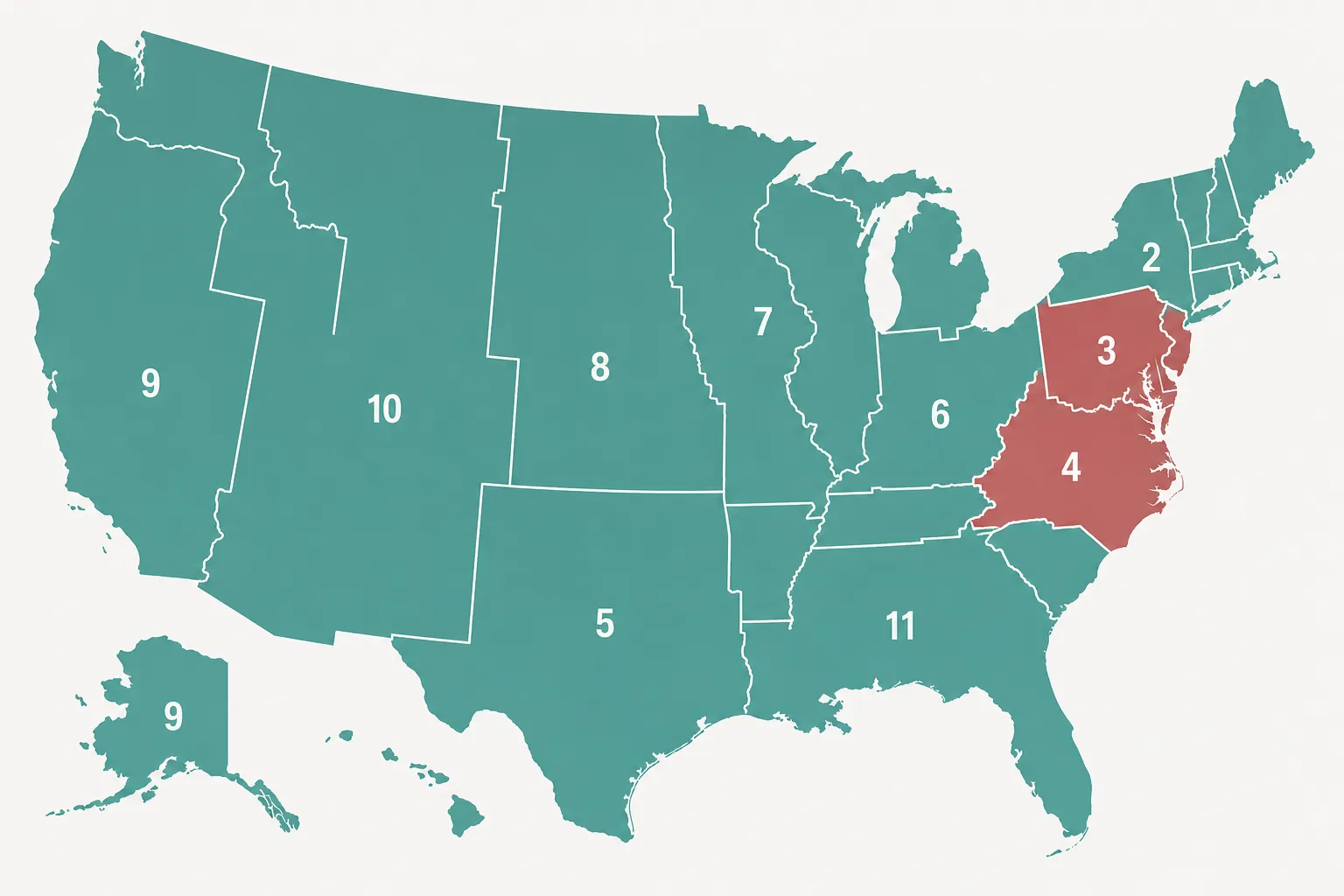
| Circuit | Reported current position on the §1225 / §1226(a) bond-hearing fight | Key decision and date |
|---|---|---|
| 5th Circuit | Adopted the government’s no-bond reading. | Buenrostro-Mendez, Feb. 6, 2026.[6] |
| 8th Circuit | Adopted the government’s no-bond reading. | Avila v. Bondi, Mar. 26, 2026.[6] |
| 2d Circuit | Ordered a hearing. | Cunha v. Freden, Apr. 28, 2026.[6] |
| 6th Circuit | Ordered a hearing. | Lopez-Campos, May 11, 2026.[6] |
| 11th Circuit | Ordered a hearing. | Hernandez Alvarez, May 6, 2026.[6] |
| 10th Circuit | Ordered a hearing. | Quiroz v. Mullin, Jun. 30, 2026.[6] |
| 7th Circuit | Ordered a hearing. | Cirrus Rojas, Jul. 30, 2026.[6] |
| 9th Circuit | Ordered a hearing. | Rodriguez Vazquez, Jul. 30, 2026.[6] |
This map is not the same thing as an individualized release prediction. A court ordering a bond hearing does not order the immigration judge to release the detainee. It creates—or recognizes—the obligation to hold an individualized hearing where flight risk, danger, equities, and conditions can be addressed. The outcome then depends on the bond record.
For a detainee held in Texas after a DFW airport arrest, the 5th Circuit line is an obvious problem. For someone transferred elsewhere, the analysis follows the place of custody and the federal district where habeas relief is sought, not the airport terminal where the encounter began. Transfer can therefore change the litigation posture even when the facts of the airport arrest have not changed.
What the Maryland teacher reports do—and do not—establish
The Kibret reports are useful because they anchor the practical scenario: an educator returning through a major airport is reported detained, and people outside custody are left trying to identify status, location, and process. They are not, on the present public record described in those stories, a court-confirmed bond case.
The Baltimore Banner reported that it could not locate Kibret in ICE’s public detainee database and that, as of Aug. 1, 2026, no attorney or public court docket had been identified.[3] That is a reported uncertainty, not proof that he was not in custody, not proof of transfer, and not proof of release. Public locator gaps happen for reasons that are not visible from outside the file.
The same discipline applies to agency statements. DHS assertions relayed in news coverage may explain the government’s public position, but they are not the same as an immigration judge’s custody order, a federal habeas docket, or a Board decision. If a family is trying to act, the useful documents are the charging document, the custody determination, the hearing notice, any EOIR case-status entry, any federal habeas filing, and the facility record.
Why habeas speed matters even in circuits ordering hearings
In a circuit that has rejected the government’s no-bond reading, the next problem is time. If the immigration court refuses bond jurisdiction or treats the detainee as locked into §1225, habeas counsel may need to move quickly in federal district court. A favorable circuit rule helps, but it does not file the petition, serve the respondent, obtain an order, schedule the hearing, or force the agency to comply on the detainee’s timeline.
That enforcement gap is not theoretical. The site’s running unlawful-detention and habeas docket record tracks the current habeas surge and documented non-compliance examples, including Kumar v. Soto and Juan TR v. Noem. The lesson for this bond-hearing question is narrow: a paper ruling can create the hearing obligation, while docket congestion and agency response can still decide whether the remedy arrives soon enough to matter.
A Nov. 12, 2025 district-court order in Santillana Galeano, reported by the Chicago Tribune, illustrates the distinction between legal entitlement and custody reality. Judge Jeremy Daniel held mandatory detention unlawful in that case and ordered a bond hearing for a day care teacher arrested by ICE.[7] That kind of order is important, but it is still an order for a process—a bond hearing—not an automatic release command.
The practical filing sequence is therefore usually compressed. Confirm custody if possible. Identify the facility and district. Determine the statutory custody label. Check circuit law. Look for any immigration-court bond denial or refusal of jurisdiction. Then decide whether habeas relief is needed now, rather than after another administrative loop. In a fast-moving detention case, waiting for perfect public information can become its own decision.
Do not confuse the airport timelines
Airport detention stories tend to mix three different clocks: port-of-entry inspection detention descriptions, warrantless-arrest custody-determination timing, and ICE detainer timing. They do not answer the same question, and they should not be used interchangeably.
- A port-of-entry hold or secondary-inspection description may explain an initial airport delay, but it does not itself decide immigration-judge bond jurisdiction.
- A warrantless-arrest custody-determination rule concerns how quickly the agency must make an initial custody decision after certain arrests; it is not the same as a bond-hearing entitlement under §1226(a).
- An ICE detainer timeline concerns a request to another law-enforcement agency to hold someone for ICE; that is a different posture from a person already in ICE custody after an airport arrest.
For the bond question, the controlling issue remains the detention authority and the forum. A family can lose time by arguing the wrong clock while the person is being routed into a no-bond statutory category.
Airport arrest does not mean airport law decides the case
A separate airport-detention report involving Johns Hopkins researcher Ameaka ended in release, according to ABC7.[8] That kind of reported outcome is worth noting only for what it does—and does not—show. It shows that airport detention is not a single-path event. It does not establish that another airport detainee will be released, that the same statute applies, or that the same circuit rule governs.
The hard part for relatives is that the record they need may lag behind the custody event. News coverage may identify the airport before anyone can identify the court. The public detainee locator may not resolve the location. An agency statement may describe allegations without revealing the custody classification that will control bond. That is why the next filing question has to be more precise than the headline.
As of Aug. 4, 2026, an airport ICE arrest itself does not decide whether a bond hearing is available. The answer turns on the person’s current place of detention, the government’s §1225 or §1226(a) classification, the governing circuit, the speed of any habeas filing, and whether the resulting order is actually implemented.
References
- University of Maryland instructor, former Teacher of the Year detained by ICE at Dallas airport, CBS Baltimore.
- UMB instructor detained at Dallas airport, WBAL.
- University of Maryland teacher detained by ICE at Dallas airport, The Baltimore Banner.
- 8 U.S.C. §1226 — Apprehension and detention of aliens, U.S. Code.
- Think Immigration: Understanding §1225 and §1226 and Their Impact on Detention and Bond, AILA.
- ICE Issues Memo Eliminating Bond Hearings for Undocumented Immigrants, Immigration Policy Tracking Project.
- Federal judge: Illegal ICE arrest of day care teacher, Chicago Tribune, Nov. 12, 2025.
- Johns Hopkins researcher released after being detained by ICE at airport, ABC7.
Related records
Tool profile
How Meta's AI Spending Reshapes Law Firm ProfitabilityGoverning regulation
Browse the obligations tracker →Preventive workflow
Browse verification workflows →
Report a correction or tip
Spotted an outdated figure, a misstated fact, or a ruling this case record should reflect? Public comments are disabled for this content given the professional cost of a misreported case outcome, penalty amount, or rule text — use the structured correction channel instead.
Report a correction or tip for this record →