
Akagi files new Moritomo disclosure suit over notebooks
Masako Akagi filed a new suit on July 28, 2026 at Osaka District Court seeking disclosure of three notebooks and audio files the Finance Ministry withheld after a 146,000-page document release. This Risk Digest record tracks the full procedural history, the parties' arguments, and the disclosure exemptions at issue.
- Jurisdiction
- Japan
- Court
- Osaka District Court
- AI tool named
- No AI tool named
- Ruling date
- Jul 28, 2026
- Source document
- View primary court order ↗
- Last verified
- Aug 2, 2026
Lex Machina Review is an independent risk-tracking and reference resource. Nothing on this site is legal advice, and using it does not create an attorney-client relationship. Every record is reviewed against primary sources but may not reflect the most current status of a matter — always verify directly against the cited court order, rule text, or a licensed attorney before relying on it.
Companion explanation — secondary to the source document above
Masako Akagi filed a new disclosure suit against the Japanese state in Osaka District Court on July 28, 2026, seeking records the Finance Ministry kept back after its large Moritomo-related production: three handwritten notebooks believed to have belonged to her late husband Toshio Akagi’s direct supervisor, and audio files of exchanges between the Kinki Local Finance Bureau and Moritomo Gakuen. The case is therefore not simply a complaint that the ministry released too little after losing once. It is a second suit over a narrower set of materials that may sit closer to the disputed decision chain than much of the archive already disclosed. [1]
The legal hinge is Article 5 of Japan’s information-disclosure framework. The state’s position, as reported in the new dispute, rests on exemptions for information that can identify individuals and for information whose disclosure could impede official business. The question now pending is whether those exemptions reach notebooks and audio made or kept by civil servants in the course of official work, after the prior litigation had already forced disclosure of major Moritomo records. [1]
Current posture: a new Osaka filing, not an implementation footnote
As of Aug. 2, 2026, the operative case is the July 28 Osaka District Court action by Masako Akagi, age 55, against the state. The state’s precise pleading has not yet been tested in the new docket; what is already clear is the category of withheld material and the exemption theory the ministry has invoked. [1]
| Point | Status as of Aug. 2, 2026 |
|---|---|
| Plaintiff | Masako Akagi |
| Defendant | Japanese state |
| Court | Osaka District Court |
| New filing date | July 28, 2026 |
| Withheld notebooks | Three handwritten notebooks believed to belong to Toshio Akagi’s direct supervisor |
| Withheld audio | Audio files of exchanges between the Kinki Local Finance Bureau and Moritomo Gakuen |
| Live legal issue | Whether Article 5 personal-identification and official-business-impediment exemptions apply |
That posture matters because the earlier litigation did not decide every future dispute over every remaining record. It produced a major appellate reversal and a large disclosure sequence. It did not end the ministry’s ability to assert specific statutory exemptions over discrete records. The new complaint tests that remaining space.
How the first disclosure case became final enough to force production
The procedural chain begins, for present purposes, with the Osaka High Court’s Jan. 30, 2025 judgment in Reiwa 5 (Gyo-ko) No. 118. The panel, presided over by Judge Maki Kenji with Judges Uchida and Shimato, reversed the lower-court outcome and required disclosure of major Finance Ministry records connected to the Moritomo matter. [2]
The government then chose not to appeal. That decision was reported across Feb. 6–7, 2025, and it made the High Court ruling final enough to trigger the later production process. In practical terms, the case moved from appellate merits to administrative execution: the ministry had to review, process and release records under the judgment rather than continue litigating that judgment upward. [3]
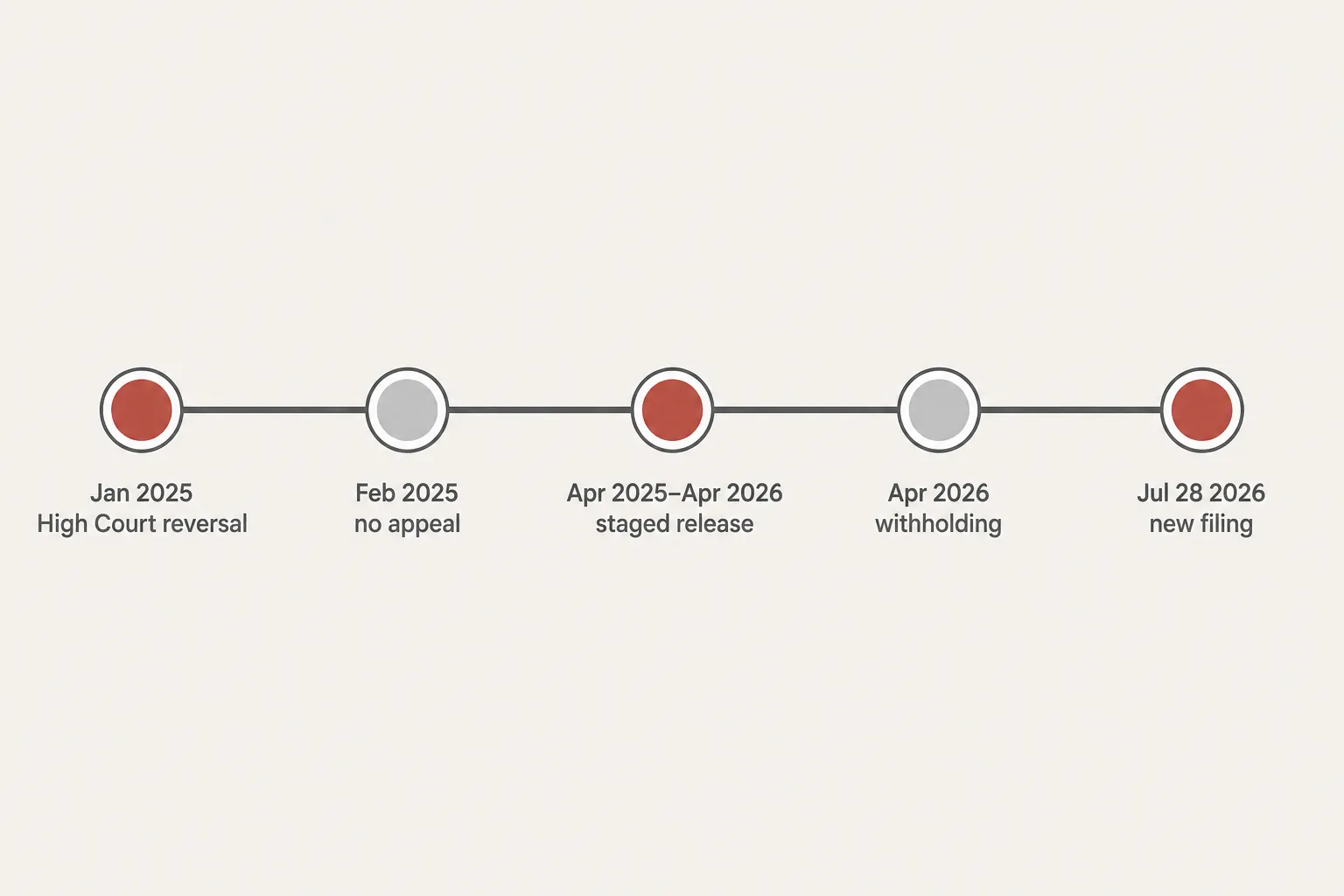
The production that followed was large by any ordinary administrative-law measure. Between April 2025 and April 14, 2026, the ministry disclosed major documents in seven installments, reported at roughly 140,000 to 146,000 pages. [1][4]
The page count is useful, but only up to a point. A high-volume release tells readers that the ministry could no longer maintain its earlier blanket posture over the major records covered by the first suit. It does not answer whether the remaining exclusions were proper. In a document case, the hard question often shifts from the number of pages released to the character of the few records withheld.
The April 2026 narrowing
By April 2026, the disclosure process had narrowed rather than ended the dispute. The ministry released the major body of documents, but withheld three notebooks and audio files. Those are the items now carried into the second Osaka District Court case. [1]
The notebooks are important not because handwritten notes are inherently disclosable, but because of who is believed to have created or kept them: Toshio Akagi’s direct supervisor. The audio files are important for a related reason. They are said to concern exchanges between the Kinki Local Finance Bureau and Moritomo Gakuen, the kind of communications that may illuminate how official positions were transmitted, negotiated or recorded. [1]

None of that proves the records must be disclosed. It does explain why the withholding decision is not a small remainder after a successful production. If the released archive shows the institutional surroundings, the withheld notebooks and audio may concern the more immediate documentary trail around official handling. That is exactly where exemption law becomes consequential.
What the prior suit resolved — and what it left open
The first Akagi disclosure case resolved the state’s broader refusal to disclose major Moritomo-related records. After the Osaka High Court reversal and the government’s decision not to appeal, the ministry could no longer treat that large body of documents as outside disclosure. The seven-installment production through April 14, 2026 was the consequence. [2][3][4]
The new suit asks a different question. It does not re-argue whether the ministry had to release the already produced archive. It asks whether the state can still withhold specific notebooks and audio under Article 5 exemptions, despite the records’ connection to official work. That distinction is the difference between a case about general document production and a case about the boundary of remaining statutory exclusions.
For litigators and disclosure counsel, the sequence is the useful part of the record. A public body may lose on a broad disclosure refusal, release an enormous archive, and still preserve targeted exemption claims over individual documents. Whether those claims survive depends less on the size of the prior release than on the record’s content, origin, use and statutory fit.
The Moritomo context, kept to the documents
The Moritomo Gakuen controversy arose from a government land-sale matter involving the Finance Ministry and its regional bureau. Toshio Akagi was a Kinki Local Finance Bureau official connected to the document-alteration episode that later became central to public scrutiny. Masako Akagi has pursued disclosure litigation to obtain records bearing on what happened inside the ministry and bureau. [1][2]
That human context explains why this litigation has continued after a major disclosure victory. It also should not obscure the narrower task of the present case. The Osaka District Court is not being asked to write a general history of Moritomo Gakuen. It is being asked to decide whether the three notebooks and audio files can lawfully remain withheld.
Why Article 5 is the live gate
The reported exemption grounds are the familiar pressure points in public-records disputes: personal identification and impairment of official business. The first asks whether disclosure would reveal protected personal information. The second asks whether release would create a legally cognizable obstacle to official operations. [1]
The plaintiff’s likely force comes from the duty-created character of the records. If notebooks and audio were made by public employees during official work, the argument for treating them as public administrative records is stronger than it would be for purely private material. The state’s likely answer is that even official records can contain protected personal information or operationally sensitive content. The court will have to work at that level of specificity.
That is why the second case cannot be reduced to the fact that the ministry already released roughly 146,000 pages. The existence of a vast production may affect how the withholding is perceived, but it does not itself decide the Article 5 analysis. The decisive questions are what the notebooks and audio are, how they were created, what they contain, and whether redaction or partial disclosure is legally required or available.
Pending status
The Moritomo Gakuen document-disclosure record is therefore a two-suit procedural file. The first suit produced the Jan. 30, 2025 Osaka High Court reversal, the government’s Feb. 6–7, 2025 decision not to appeal, and the seven-installment document release through April 14, 2026. The second suit began on July 28, 2026, and concerns the remaining notebooks and audio files. [1][2][3][4]
For comparison with another pending-status litigation record, see Shiloh Hendrix split-verdict appeal reaches Minnesota Court of Appeals.
As of Aug. 2, 2026, the second Akagi disclosure suit is newly filed in Osaka District Court. The state’s Article 5 exemption position is the live issue. The next meaningful development will be the court’s handling of whether notebooks and audio created or kept in the course of public duties remain exempt after the prior disclosure win.
References
- Asahi Shimbun report on Masako Akagi’s July 28, 2026 filing over withheld Moritomo notebooks and audio — The Asahi Shimbun
- Osaka High Court judgment, Reiwa 5 (Gyo-ko) No. 118, Jan. 30, 2025 — Osaka High Court
- Reports on government decision not to appeal Osaka High Court Moritomo disclosure ruling, Feb. 6–7, 2025
- Reports on seven-installment Finance Ministry Moritomo document disclosure through Apr. 14, 2026
Related records
Tool profile
How Meta's AI Spending Reshapes Law Firm ProfitabilityGoverning regulation
Browse the obligations tracker →Preventive workflow
Browse verification workflows →
Report a correction or tip
Spotted an outdated figure, a misstated fact, or a ruling this case record should reflect? Public comments are disabled for this content given the professional cost of a misreported case outcome, penalty amount, or rule text — use the structured correction channel instead.
Report a correction or tip for this record →