
Shiloh Hendrix split-verdict appeal reaches Minnesota Court of Appeals
A verified docket-status record of Shiloh Hendrix's appeal from her split verdict for disorderly conduct, covering the sentence, appellate grounds, and pending status at the Minnesota Court of Appeals, with source conflicts flagged and a last-verified date of August 1, 2026.
- Jurisdiction
- Minnesota, US
- Court
- Minnesota Court of Appeals
- Judge
- Christa M. Daily
- AI tool named
- No AI tool implicated
- Ruling date
- Jul 23, 2026
- Source document
- View primary court order ↗
- Last verified
- Aug 1, 2026
Lex Machina Review is an independent risk-tracking and reference resource. Nothing on this site is legal advice, and using it does not create an attorney-client relationship. Every record is reviewed against primary sources but may not reflect the most current status of a matter — always verify directly against the cited court order, rule text, or a licensed attorney before relying on it.
Companion explanation — secondary to the source document above
Last verified: August 1, 2026. The Shiloh Hendrix appeal is pending in the Minnesota Court of Appeals after a notice of appeal was filed with the Clerk of the Appellate Courts on July 30, 2026; KSTP reports that the notice was dated July 27 and that no hearing has been set.[1] KIMT likewise reports the appeal from the Third Judicial District conviction to the Minnesota Court of Appeals.[2] No briefing schedule is confirmed in the materials reviewed. This is a docket-status and legal-risk record, not legal advice, and it is being logged as an exceptional non-AI matter: the available record documents a criminal free-speech appeal, not AI use, AI evidence, or an AI-hallucination incident.
For anyone checking the Shiloh Hendrix appeal, conviction, and racial-slur case, the usable answer is narrower than most headlines: Hendrix was not convicted on every charged theory that reached the jury. The jury returned a split verdict—guilty on the disorderly-conduct count involving videographer Sharmake Omar, not guilty on the count involving the child—and the appeal is only at the opening docket stage.[3]

| Field | Current record |
|---|---|
| Appellate status | Notice of appeal filed July 30, 2026; appeal pending before the Minnesota Court of Appeals; no hearing confirmed as of August 1, 2026.[1][2] |
| Trial court origin | Olmsted County case in Minnesota’s Third Judicial District.[2] |
| Trial dates | Reported four-day trial from July 20 to July 23, 2026.[4] |
| Verdict | Split verdict: guilty on the count involving Sharmake Omar; not guilty on the count involving the child.[3] |
| Sentence | A 90-day jail term stayed, a $1,000 fine, 200 hours of community service, and supervised probation; FOX 9 reports the sentence was imposed by District Court Judge Christa M. Daily.[5] |
| Charged statute | Charges were reported under Minnesota’s disorderly-conduct statute, Minn. Stat. § 609.72, subd. 1(3).[4][6] |
| Unverified docket fields | Exact appellate case number, the rule cited in the notice or motion practice, and any briefing deadlines still require direct Minnesota Courts public-access verification. |
| AI status | No documented AI involvement in the available record; this should not be cited as an AI case. |
For comparison within this site’s risk-digest format, this record is closer to a status-is-narrower-than-headlines docket note than to a doctrinal explainer. It also follows the same non-AI logging discipline used for the Trump IRS self-dealing appeal record and the Linda Blair kennel investigation note: log the matter if it is useful for legal-risk tracking, but do not borrow the site’s AI-hallucination category when the record does not support it.
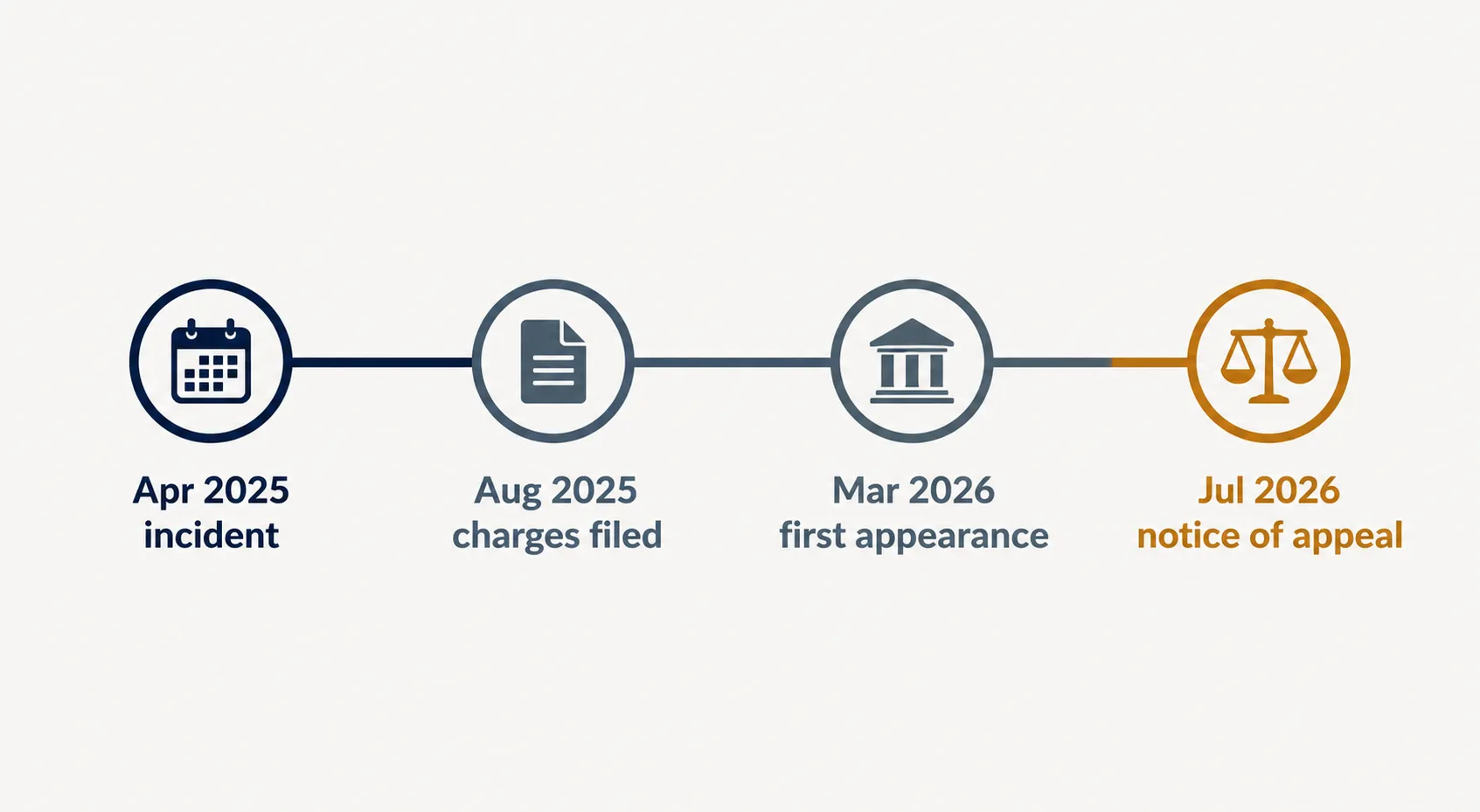
Verified timeline to the appeal filing
| Date | Event | Verification note |
|---|---|---|
| April 28, 2025 | Incident at Roy Sutherland Playground/Soldier’s Field Park in Rochester, Minnesota. | Reported in the consolidated public timeline.[4] |
| August 26, 2025 | Charges filed as three misdemeanor disorderly-conduct counts. | Reported in the public timeline and tied to Minn. Stat. § 609.72, subd. 1(3).[4][6] |
| March 25, 2026 | One count dropped at the first in-person appearance. | Reported in the public timeline.[4] |
| July 20–23, 2026 | Four-day trial in Olmsted County. | Reported trial window.[4] |
| July 23, 2026 | Jury returns split verdict. | Guilty on the Omar count; not guilty on the child count.[3] |
| July 30, 2026 | Notice of appeal filed with the Clerk of the Appellate Courts. | KSTP reports the notice was dated July 27 and filed July 30; KIMT confirms the appeal filing.[1][2] |
| August 1, 2026 | Current verification date for this record. | Appeal pending; no hearing or briefing schedule confirmed in the reviewed materials.[1][2] |
The trial record still matters more than the viral frame. The count that produced the conviction involved Omar, the videographer. The jury acquitted Hendrix on the count involving the child. That distinction is not cosmetic; it affects how the appeal should be described in any memo, tracker, or article that relies on the case.[3]
Sentence and verdict: the usable formulation
A safe formulation is: Shiloh Hendrix was convicted of one misdemeanor disorderly-conduct count involving Sharmake Omar and acquitted on a second count involving the child; she received a stayed 90-day jail term, a $1,000 fine, 200 hours of community service, and supervised probation.[3][5] “Convicted in the racial slur case” is not wrong in ordinary conversation, but it is too blunt for legal use unless the split verdict is supplied immediately.
Secondary coverage also contains avoidable record friction. KSTP’s split-verdict article describes the child as an “8-year-old girl with autism,” while FOX 9’s complaint summary and the public timeline describe an 8-year-old boy.[3][5][4] That discrepancy should not be resolved by editorial confidence. If the child’s gender matters to a later citation, the complaint, jury instructions, verdict forms, or trial transcript should be checked directly.
The same discipline applies to fundraiser figures. The public timeline states that a GiveSendGo fundraiser had exceeded $700,000 by May 6, 2025, while FOX 9 reported the total as nearly $900,000 by late July 2026.[4][5] Those figures may describe different dates rather than a conflict in substance, but they should not be merged into a single unsupported number.
The statute is relevant, but it does not decide the appeal by itself
The reported charge path runs through Minnesota’s disorderly-conduct statute, Minn. Stat. § 609.72. The materials reviewed identify subdivision 1(3) as the charged clause, which covers certain offensive, obscene, abusive, boisterous, or noisy conduct or language when it tends reasonably to arouse alarm, anger, or resentment.[4][6] That statutory label is necessary background; it is not a substitute for the actual jury instructions, evidentiary rulings, and preserved objections.
The Minnesota Revisor page for § 609.72 also carries a note that State v. Hensel, 901 N.W.2d 166 (Minn. 2017), held subdivision 1, clause (2), substantially overbroad.[6] That note is worth flagging because it reminds a reader that disorderly-conduct speech cases can turn on constitutional limits. It should not be silently converted into a holding about the specific clause, instruction, or evidentiary record in Hendrix’s trial.
Reported appellate issues, with confidence labels
Defense counsel Brian P. Karalus gave the press the broadest version of the appeal posture after the verdict: “We have so many appellate issues, I don’t even know where to begin,” KSTP reported.[1] That is a public statement by counsel, not a merits forecast from the Court of Appeals.
| Issue or claim | Current confidence | How it should be cited |
|---|---|---|
| Appeal filed after conviction | Confirmed by current secondary docket reporting. | Notice filed July 30, 2026; appeal pending; no hearing confirmed.[1][2] |
| Split verdict | Confirmed by trial-result reporting. | Guilty on Omar count; not guilty on child count.[3] |
| First Amendment issue | Reported appellate issue, not yet tested through appellate briefing in the reviewed materials. | Describe as a defense-reported ground until the notice, statement of the case, briefs, or orders are checked. |
| Refused First Amendment jury instruction | Reported by KAAL as part of counsel’s post-verdict claims. | Attribute to counsel/KAAL unless verified against the jury-instruction record.[7] |
| Evidence or discovery rule problem | Reported but rule identification is unstable in secondary coverage. | KAAL’s article discusses a claimed rule problem while appearing to conflate or confuse rule references; do not state the exact rule without the trial record.[7] |
| Omar’s dismissed 2022 criminal-sexual-conduct charges were not heard by the jury | Reported-not-confirmed in this record. | The Washington Examiner op-ed makes the assertion; it should not be treated as a court-verified fact from the materials reviewed.[8] |
KAAL’s post-verdict article is useful because it identifies the kinds of issues counsel is discussing publicly: a First Amendment instruction dispute and a claimed evidence or discovery problem. It is also a reminder not to outsource rule work to a fast story. The research record flags confusion among “Rule 109,” “Rule 901,” and Rule 9 discovery duties in the coverage; the exact rule cannot be repaired by inference.[7]
That distinction matters for any lawyer tempted to cite the Hendrix appeal in a First Amendment brief. There may be a preserved constitutional-instruction issue. There may be an evidentiary or discovery issue. There may be a trial-record dispute about what the jury was allowed to hear. But as of this verification date, the reviewed public materials do not provide the appellate briefs, the trial judge’s written or oral rulings, the final jury instructions, or the full notice package.
What should not be imported into the docket record
National commentary on whether the conviction can be squared with the First Amendment may be useful for issue-spotting, but it is not a docket source. The Washington Examiner piece, for example, is an op-ed and is useful here only for the attributed claim it adds about alleged excluded background involving Omar; that claim remains reported-not-confirmed for this record.[8]
The unavailable documents are the hard edge of this snapshot. The criminal complaint PDF, the NAACP press-release PDF, and the notice of appeal itself were not readable during this review. Any field that depends on those documents should be treated as reported or court-adjacent until someone verifies it through Minnesota Courts public access or the trial-court file.
For the same reason, this record should not be used to say that the Court of Appeals has accepted any particular constitutional theory, set a hearing, ordered briefing, or signaled interest in reversal. Filing a notice of appeal starts the appellate process; it does not validate counsel’s issue list.
Minimum verification before citing the Hendrix appeal
A citation-ready note should carry its own docket timestamp. At minimum, check the Minnesota appellate docket for the exact appellate case number, the notice-of-appeal filing date, the party names, any statement-of-the-case filing, the briefing schedule, and any order setting or denying a hearing. Then check the trial record for the complaint, dismissed count, verdict forms, sentence, jury instructions, and the ruling behind each appellate issue.
If the case is being used in a newsroom or law-firm tracker, the note should say: “Last checked [date/time]; appeal pending; no briefing schedule located” or update that language if the docket has moved. The same confirmed-versus-reported discipline used in source-conflict status briefs and verification workflow checklists applies here: do not let a public quote, an op-ed detail, or a flattened headline do the work of a docket check.
As of August 1, 2026, the Hendrix appeal exists, the split verdict and sentence are reportable, and the broad categories of appellate issues are identifiable. The legally usable record is still thinner than the commentary around it. Any citation to the appeal should carry a fresh Minnesota Courts docket check and should state the split verdict precisely.
References
- Lawyer files appeal in Shiloh Hendrix racial slur case — KSTP
- Shiloh Hendrix takes conviction fight to Minnesota appeals court — KIMT
- Jury reaches split verdict in Shiloh Hendrix racial slur case — KSTP
- Rochester racial slur video incident — Wikipedia
- Woman found guilty in Rochester racial slur case — FOX 9
- Sec. 609.72 MN Statutes (Disorderly conduct) — Minnesota Revisor of Statutes
- “So many appellate issues”: Breaking down claims made by Shiloh Hendrix’s defense attorney following verdict — ABC 6 News (KAAL)
- Shiloh Hendrix verdict free speech precedent — Washington Examiner
Related records
Tool profile
How Meta's AI Spending Reshapes Law Firm ProfitabilityGoverning regulation
Browse the obligations tracker →Preventive workflow
Browse verification workflows →
Report a correction or tip
Spotted an outdated figure, a misstated fact, or a ruling this case record should reflect? Public comments are disabled for this content given the professional cost of a misreported case outcome, penalty amount, or rule text — use the structured correction channel instead.
Report a correction or tip for this record →