
AstraZeneca–Bristol Myers Squibb merger's antitrust gauntlet
Map the three concurrent reviews — US FTC, UK CMA, European Commission — that a reported $400B AstraZeneca–Bristol Myers Squibb combination would trigger, with HSR timing, second-request mechanics, and each agency's theory of harm on the Opdivo–Imfinzi checkpoint overlap. With the FTC's $13.4B Otezla divestiture against BMS as precedent, the practical question is what divestitures and conditions clearance would require, not whether it is possible.
- Jurisdiction
- US, UK, EU
- Court
- FTC; UK CMA; European Commission
- AI tool named
- None
- Ruling date
- Aug 2, 2026
- Source document
- View primary court order ↗
- Last verified
- Aug 3, 2026
Lex Machina Review is an independent risk-tracking and reference resource. Nothing on this site is legal advice, and using it does not create an attorney-client relationship. Every record is reviewed against primary sources but may not reflect the most current status of a matter — always verify directly against the cited court order, rule text, or a licensed attorney before relying on it.
Companion explanation — secondary to the source document above
The reported AstraZeneca–Bristol Myers Squibb talks are still talks. Reuters reported on Aug. 2, 2026 that AstraZeneca and BMS had held preliminary discussions about a combination valued at nearly $400 billion, citing a person familiar with the matter; no definitive agreement, transaction structure, consideration mix, premium, signing date, or timetable has been announced, and the talks may collapse before any filing is made. These status points were last verified on Aug. 3, 2026 UTC, and deal figures tied to market value, revenue, or debt should be refreshed at publication because they are moving inputs, not durable legal facts. This is a legal-analysis article, not legal advice. [1]
If the discussions become a binding agreement, the legal implications of an AstraZeneca–Bristol Myers Squibb merger would start with a less glamorous question than the financial headline suggests: which regulators get the clock, what information can stop it, and what divestitures would make the oncology overlap tolerable? The answer is not a single “antitrust scrutiny” label. It is a three-track review, at minimum, with the US Federal Trade Commission, the UK Competition and Markets Authority, and the European Commission each asking whether the combined company would control too much of a live and innovative checkpoint-immunotherapy franchise.
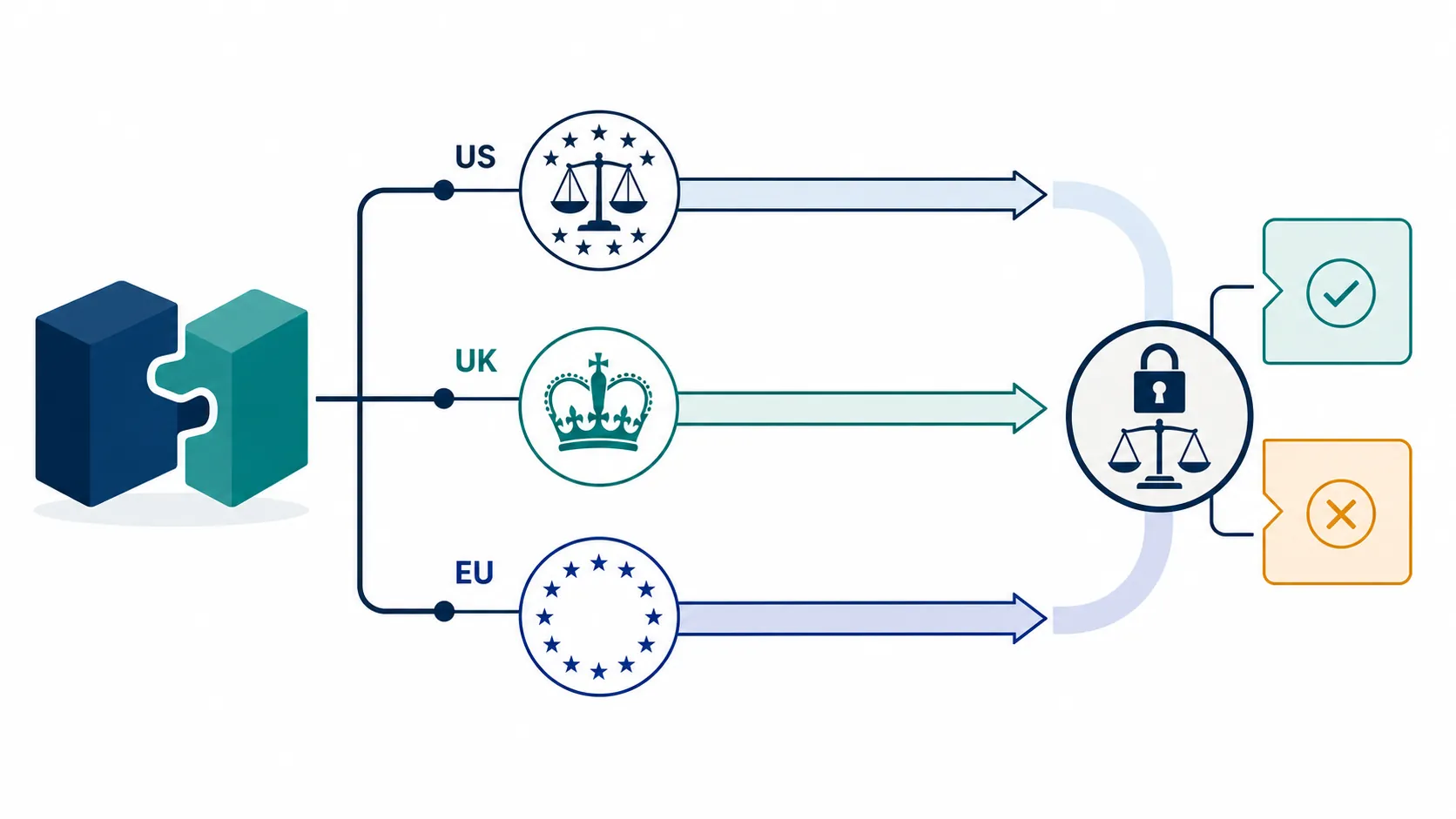
The review map before anyone argues the merits
The US filing clock is the easiest place to begin because it has defined mechanics. Under FTC guidance, the Hart-Scott-Rodino initial waiting period is generally 30 days, or 15 days for cash tender offers; if the agency issues a Second Request, the clock is stopped until the parties substantially comply, and a second waiting period, typically 30 days, follows substantial compliance. [2] For practitioners comparing this to other current merger matters, the filing-and-Second-Request sequence is the same basic calendar problem discussed in How the Grant Thornton–CBIZ merger's antitrust review works, although the pharmaceutical remedy questions here are much heavier.
| Regulator | First procedural question | Likely center of gravity | What a clearance path would probably require |
|---|---|---|---|
| US FTC / HSR | HSR notification, initial waiting period, and a probable Second Request if the agencies see meaningful oncology or pipeline overlaps. | Checkpoint immunotherapy, innovation competition, pipeline substitution, and whether the combined firm could delay or redirect competing assets. | A structural divestiture package with buyer, timing, monitor, trustee, and possible unwind protections rather than a bare promise to preserve R&D. |
| UK CMA | UK jurisdictional review and phase-one assessment, with phase-two risk if the CMA finds a realistic prospect of a substantial lessening of competition. | UK oncology markets, innovation incentives, access, and a UK-specific political sensitivity around AstraZeneca’s London listing. | Either unconditional clearance if overlaps are narrower than they look, or undertakings that satisfy the CMA without depending entirely on US remedies. |
| European Commission | EU merger notification if thresholds are met, with information requests and possible phase-two review if the oncology overlap raises serious doubts. | Innovation competition, pipeline assets, and whether structural remedies are needed to preserve independent future competition. | A divestiture that can operate as a viable competitive business in Europe, not only a contractual carve-out on paper. |
That map leaves the hardest work in the US record because the FTC has already forced BMS to sell a major drug asset in a pharma merger on an innovation-competition theory, and because the current checkpoint overlap gives agencies a named set of products, revenues, and litigation history to test.
The US track: HSR filing is the opening move, not the review
A signed AstraZeneca–BMS agreement would almost certainly be planned around a Second Request. That does not mean the FTC has prejudged the deal; it means the agency would need enough documents, data, ordinary-course forecasts, trial information, customer and physician evidence, and pipeline strategy to decide whether a remedy can preserve competition. In a transaction of this scale, counsel would not treat the 30-day HSR waiting period as a realistic outside date for clearance. It is the window in which the agency decides whether to demand the deeper file. [2]
The 2023 Merger Guidelines make that file harder to cabin. They direct agencies to examine concentration, potential competition, and innovation effects, and they lowered the structural thresholds that can trigger concern. [3] Norton Rose Fulbright’s pharma-merger analysis reads the guidelines as giving the FTC room to challenge transactions where a merged firm exceeds roughly a 30% share even with limited direct overlap, while also stressing a necessary caveat: the guidelines are enforcement policy, not binding law, and the agencies still have to persuade courts if they litigate. [4]
Why the Otezla order is the precedent to read first
The closest practical template is not a generic pharmaceutical merger chart. It is the FTC’s own BMS/Celgene order. In 2019, the FTC required Bristol Myers Squibb to divest Celgene’s Otezla business to Amgen for $13.4 billion as a condition of clearing BMS’s acquisition of Celgene; the agency described the divestiture as the largest ever required in a US merger enforcement matter. [5][6]
The legal theory matters as much as the amount. The FTC said the Celgene transaction would eliminate future competition between a marketed product, Otezla, and a BMS pipeline product. That is the innovation-competition theory in operational form: the harm is not only that two current sellers combine, but that a future independent challenger disappears inside the same company. The Commission vote was 3-2, and Commissioners Rohit Chopra and Rebecca Kelly Slaughter dissented because they viewed the remedy as too weak, not because they thought pharma innovation concerns were imaginary. [5][6]
The order architecture is the part deal teams tend to under-read. The FTC required divestiture within 10 days of consummation and included monitor, trustee, and unwind-and-redivest provisions. [5] Those details are not boilerplate decoration. They answer the obvious enforcement worry: if the buyer cannot operate the asset, if the parties withhold people or know-how, or if the divestiture deteriorates after closing, the agency needs tools other than a disappointed press release.
That is why an AstraZeneca–BMS remedy discussion would not end with “sell something.” The buyer would have to be credible, the divested business would have to be more than an isolated molecule, and the agency would want confidence that the transfer preserves development incentives rather than merely reducing the merged company’s spreadsheet share.
The checkpoint overlap is concrete enough for agencies to test

The likely antitrust center is the PD-1/PD-L1 checkpoint-immunotherapy space: BMS’s Opdivo and AstraZeneca’s Imfinzi. Only a modest amount of science is needed for the legal point. These drugs sit in a therapeutic area where products can compete across tumor types, indications, combinations, trial strategy, and line-of-therapy positioning. That gives enforcers more to examine than a single product code.
The current revenue frame is large enough to make the overlap impossible to dismiss. Reported Q2 2026 revenue for Opdivo was $2.49 billion and for Imfinzi was $1.85 billion, together more than $4.3 billion in a quarter and over $17 billion annualized; the same reported frame places Yervoy and Imjudo in the adjacent CTLA-4 category and says oncology accounted for more than 40% of BMS’s first-half 2026 sales. Those figures should be rechecked at publication, but they explain why this is not an obscure pipeline-footnote problem.
There is also a prior adversarial record between the same companies in the same franchise. BMS sued AstraZeneca in Delaware in March 2022 over cancer-treatment patents involving Imfinzi and Opdivo, and the disputes also reached Imjudo and Yervoy claims; the cases were dismissed with prejudice in July 2023 after AstraZeneca agreed to pay BMS $510 million to settle the PD-L1 and CTLA-4 patent disputes. [7][8]
That patent history does not prove an antitrust market by itself. It does, however, give investigators a concrete document trail showing that the parties understood these franchises as commercially and technologically close enough to fight over. In a Second Request, that history would sit next to ordinary-course market plans, clinical-trial documents, pricing evidence, indication-by-indication forecasts, and internal views of how each company constrained the other.
Dated concentration evidence would have to be handled carefully. An IQVIA 2021 white paper found that Opdivo and Keytruda together commanded about 80% of the global checkpoint inhibitor market. That is useful historical context for how concentrated the PD-1 segment once was, but it predates later Imfinzi growth and should not be treated as a current market-share finding for an AstraZeneca–BMS review in 2026. [9]
Why a pipeline-only fix may not satisfy the agencies
The cleanest-looking remedy is often the weakest one: identify a pipeline program, transfer it to a buyer, and tell the agency future competition has been preserved. Pharma divestitures do not always behave that neatly. Norton Rose Fulbright, citing work by Robin Feldman, notes that in 17 FTC pharma merger cases from 2008 through 2018 involving 56 pipeline divestitures, only about 36% of divested products held an active marketing license. [4]
That number does not mean every pipeline remedy fails. It means a regulator looking at marketed checkpoint assets would have reason to press for more than a future-development promise if the overlap is central. A marketed-asset divestiture is more disruptive and more expensive, but it gives the agency a clearer path to preserving an existing competitive constraint. A pipeline package requires sharper questions: who receives the trial data, who employs the scientists, who controls manufacturing and pharmacovigilance, who funds the next indication, and what happens if the buyer misses a milestone?
The Otezla structure shows the likely direction of negotiation. A credible order would need defined assets, transition services, employee transfer rights, intellectual-property licenses, supply commitments where necessary, and enforcement tools if the divestiture does not take. If the FTC concluded that Opdivo–Imfinzi competition is central and current, it could be difficult to persuade the agency that a small, precommercial carve-out is enough.
The UK track: the Alexion clearance helps, but only so far
The CMA has reviewed a major AstraZeneca acquisition before. It opened an inquiry into AstraZeneca’s $39 billion Alexion acquisition in May 2021 and cleared the transaction at phase one in July 2021. [10] That precedent is relevant because it shows the CMA can clear an AstraZeneca life-sciences deal without a phase-two fight. It does not say the CMA would treat a BMS combination the same way.
The legal question for the CMA would be narrower and more disciplined than UK political commentary about national champions. It would ask whether the transaction creates a realistic prospect of a substantial lessening of competition in any UK market, including through loss of current or future innovation competition. If the same checkpoint overlap drives concerns in the United States, the CMA would not need to invent a separate theory simply because the company is British.
There is still a UK-specific sensitivity. FiercePharma reported during the Alexion process that AstraZeneca’s UK position and listing carried political salience, and the present deal reporting has noted AstraZeneca’s status as one of the London Stock Exchange’s most valuable companies. [11] That is a monitoring flag for timing, communications, and ministerial attention. It is not a substitute for the CMA’s competition analysis.
Practically, UK counsel would want to know whether a US divestiture package can also satisfy the CMA. Sometimes global remedies can travel. Sometimes they cannot, especially if the CMA wants UK-specific assurances about supply, clinical access, or the competitive viability of the buyer in the UK. The mistake would be to assume that an FTC consent order automatically clears the UK lane.
The European Commission would look hard at innovation, not just present sales
The European Commission’s review would likely be framed around the same commercial overlap but through a familiar EU lens: loss of innovation competition, pipeline consolidation, and whether a structural divestiture is needed to keep an independent competitive force alive. Cleary Gottlieb’s Global Competition Review chapter describes intensified EU scrutiny of pharma transactions, including innovation and so-called killer-acquisition theories, and notes the Commission’s structural-remedy preference in merger control. [12]
The remedy statistic often attached to EU merger control should be used with care. The same discussion cites a Commission case handler’s statement that about 6% of reviewed mergers required remedies. [12] That is not a safe probability estimate for this transaction. A reported $400 billion pharma combination with a named checkpoint-immunotherapy overlap would not be an average reviewed merger, and the Commission’s concern would turn on the actual market definition, pipeline documents, and whether the proposed buyer can compete across the relevant therapeutic space.
The EU review also creates coordination pressure. If the FTC wants a marketed-asset sale and the Commission is willing to accept a narrower pipeline divestiture, the parties still need one transaction that can close. If the Commission demands a broader European carve-out than the FTC requires, the US order may become only the starting point. Multi-jurisdiction deals live or die in those gaps. For readers tracking how separate enforcement tracks can persist after headline clearance, the same caution appears in Where the Paramount-WBD merger antitrust review stands now and State Antitrust Suit Tests Cleared Paramount-Warner Merger.
Political and security issues are monitoring flags, not the spine
Reuters reported that a person familiar with the discussions saw regulatory risk under US antitrust authorities in the Trump administration, and quoted antitrust lawyer Andre Barlow as expecting scrutiny and meaningful divestitures, with bipartisan support for examining pharma deals. [1] That is useful color, but it should not replace the filing analysis. FTC leadership, commissioner composition, and enforcement priorities should be verified at the date of any signed agreement.
CFIUS is a secondary lens unless the signed structure, assets, manufacturing footprint, data, or sensitive technology make it more prominent. Counsel should watch it, especially in a life-sciences transaction with cross-border consequences, but the core legal gauntlet remains merger control. For broader political-risk framing, compare the executive-action framework in Predict Executive Action Risk with Gorsuch's Major Questions Doctrine and the CFIUS discussion in KLAC and the Legal Risks of AI Infrastructure Investments.
If talks become binding, the three questions that matter
Clearance is legally possible. The better question is what it would cost. The BMS/Celgene order shows that the FTC can clear a large pharma merger with a major divestiture, but it also shows that “clearance with conditions” can mean a rapid post-consummation sale, a named buyer, a monitor, a trustee, and an unwind mechanism. For AstraZeneca and BMS, the checkpoint overlap would make that remedy conversation central rather than incidental.
- First, watch how the agencies define the oncology markets. A broad checkpoint-immunotherapy market, a narrower PD-1/PD-L1 market, tumor-specific markets, and innovation markets can produce different remedy demands.
- Second, watch whether regulators demand a marketed-asset divestiture rather than pipeline commitments. The more the agencies see Opdivo and Imfinzi as present competitive constraints, the less likely a small pipeline package is to carry the deal.
- Third, watch whether the FTC, CMA, and Commission converge. A single global remedy is easier to close around; inconsistent buyer, asset, or conduct requirements can turn conditional clearance into a sequencing problem.
Until there is a signed agreement, none of those questions has a final record. But they are the questions a board memo should answer before the first filing draft is circulated.
References
- AstraZeneca held talks with Bristol Myers Squibb on $400 billion megadeal, source says, Reuters, Aug. 2, 2026
- Premerger Notification and the Merger Review Process, Federal Trade Commission
- Merger Guidelines (2023), Federal Trade Commission and U.S. Department of Justice, 2023
- FTC's watchdog role in pharma mergers: Road bumps and the way forward, Norton Rose Fulbright
- Bristol-Myers Squibb Company/Celgene Corporation, In the Matter of, Federal Trade Commission, Docket C-4690
- FTC Requires Bristol-Myers Squibb Company and Celgene Corporation to Divest Psoriasis Drug Otezla as a Condition of Acquisition, Federal Trade Commission, November 2019
- Bristol Myers sues AstraZeneca over cancer-treatment patents, Reuters, March 18, 2022
- AstraZeneca Pays $510M to BMS to Settle PD-L1, CTLA-4 Patent Disputes, BioSpace
- In the Eye of the Storm: PD-1 Inhibitors Weathering Turbulence, IQVIA, 2021
- AstraZeneca / Alexion Pharmaceuticals merger inquiry, Competition and Markets Authority, 2021
- AstraZeneca hits U.K. antitrust roadblock with $39B Alexion buy despite U.S. FTC clearance, FiercePharma
- European Union: intensified competition enforcement and innovation scrutiny reshape pharma sector, Cleary Gottlieb / Global Competition Review
Related records
Tool profile
Browse tool evaluations →Governing regulation
Browse the obligations tracker →Preventive workflow
Browse verification workflows →
Report a correction or tip
Spotted an outdated figure, a misstated fact, or a ruling this case record should reflect? Public comments are disabled for this content given the professional cost of a misreported case outcome, penalty amount, or rule text — use the structured correction channel instead.
Report a correction or tip for this record →