
What the Austin Metcalf Case Teaches About AI Misinformation Risk
The Austin Metcalf murder case produced a documented wave of AI-generated misinformation that contaminated the investigation before any trial began. This article examines four specific vectors of AI content fraud and explains what legal professionals must do to verify evidence in an environment where AI fabrications are indistinguishable from authentic materials.
- Jurisdiction
- US-State-Texas
- Court
- Collin County District Court
- AI tool named
- Generative AI
- Ruling date
- Apr 4, 2025
- Source document
- View primary court order ↗
- Last verified
- Jul 25, 2026
Lex Machina Review is an independent risk-tracking and reference resource. Nothing on this site is legal advice, and using it does not create an attorney-client relationship. Every record is reviewed against primary sources but may not reflect the most current status of a matter — always verify directly against the cited court order, rule text, or a licensed attorney before relying on it.
Companion explanation — secondary to the source document above
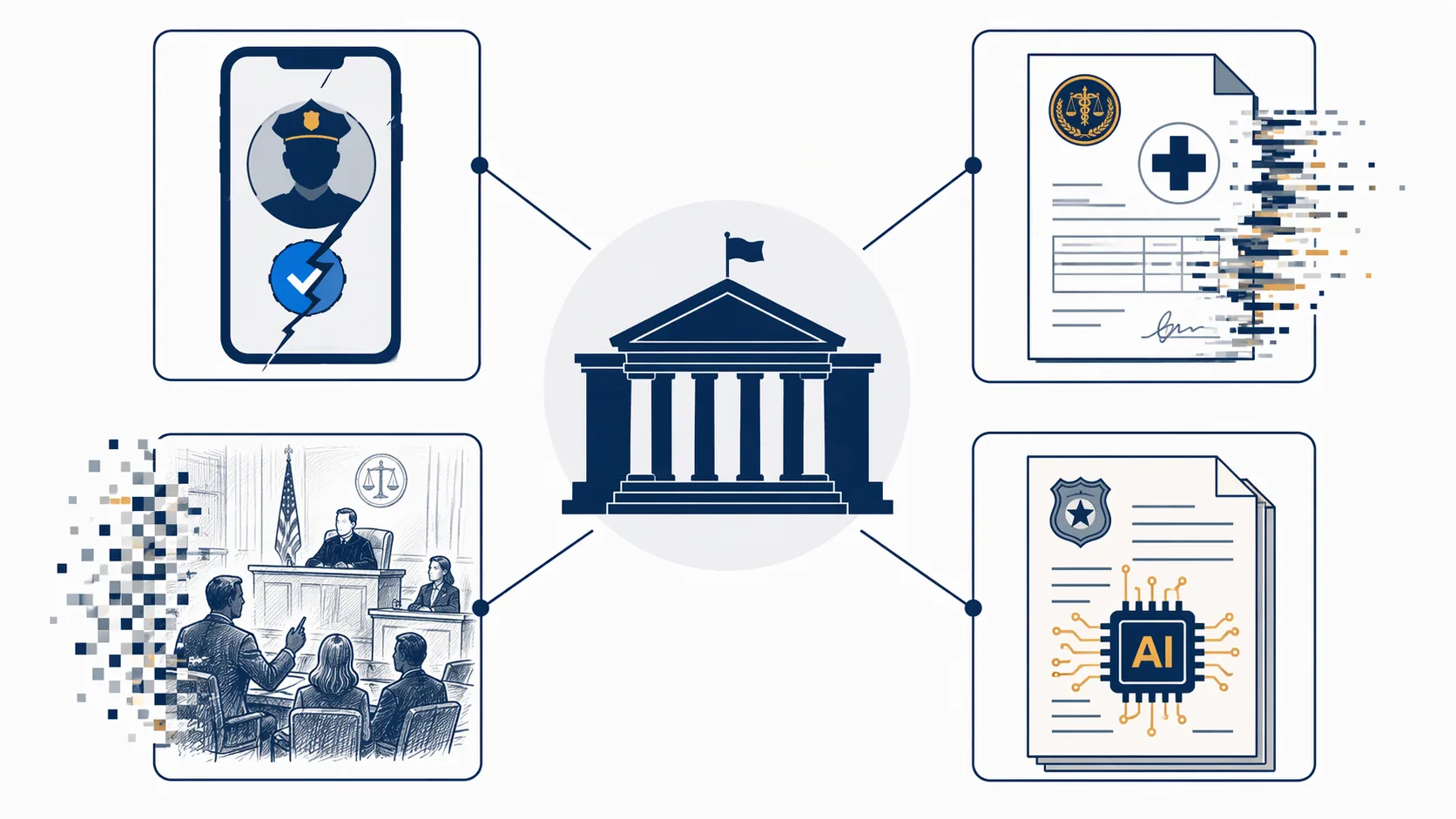
Within hours of the April 2025 stabbing that killed Austin Metcalf, a fake X account posing as Frisco Police Chief David Shilson began publishing fabricated investigation details. The account was not a stray rumor in a quiet corner of the internet. Its posts were amplified by high-profile accounts, including Elon Musk and Libs of TikTok, and reached a reported 50 million views before the record of the case had anything close to procedural stability. The Frisco Police Department and the FBI investigated the impersonation. As of the available public reporting, no identified creator or arrest has been reported. [1]
That is the useful starting point for the legal risk analysis. The Austin Metcalf case is not primarily a story about AI evidence admitted at trial. It is a story about AI-shaped material entering the information environment before investigators, counsel, court staff, and the public could reliably separate authenticated facts from convincing fraud. For anyone approaching the case through youth-violence prevention or foundation-related legal context, that distinction matters: the legal lesson sits less in a final courtroom exhibit than in the earlier contamination of source provenance.
The fake police-chief account borrowed authority at the most vulnerable moment
An impersonated law-enforcement account does something different from an ordinary anonymous post. It borrows the public-facing authority of the agency before the agency has time to correct the false version. The reader sees a name, a badge-adjacent identity, an official tone, and investigation language. By the time the account is debunked, downstream users may already have screenshotted, summarized, argued from, or emotionally committed to the false material.
The Dallas Morning News reported that the fake account appeared within hours of the stabbing and spread fabricated details while posing as Frisco Police Chief David Shilson. Frisco police and the FBI were probing the posts, and the reported amplification pushed the material across tens of millions of views. [1]
For counsel, the problem is not just reputational. A fake account can create leads that investigators must waste time excluding. It can generate witness chatter that later has to be separated from first-hand recollection. It can influence what potential jurors think they already know. It can also create exhibits of uncertain value: screenshots with no reliable capture metadata, reposts detached from the original account, and compilations that collapse verified statements and fabricated ones into the same visual format.
The open uncertainty matters. Public reporting says the FBI and Frisco police investigated the impersonation, but it does not identify who created the account or establish a complete attribution chain. That leaves a familiar litigation-support problem in sharper form: the most viral artifact may be the one with the weakest provenance.
A fabricated autopsy report moved the fraud into medical-legal form
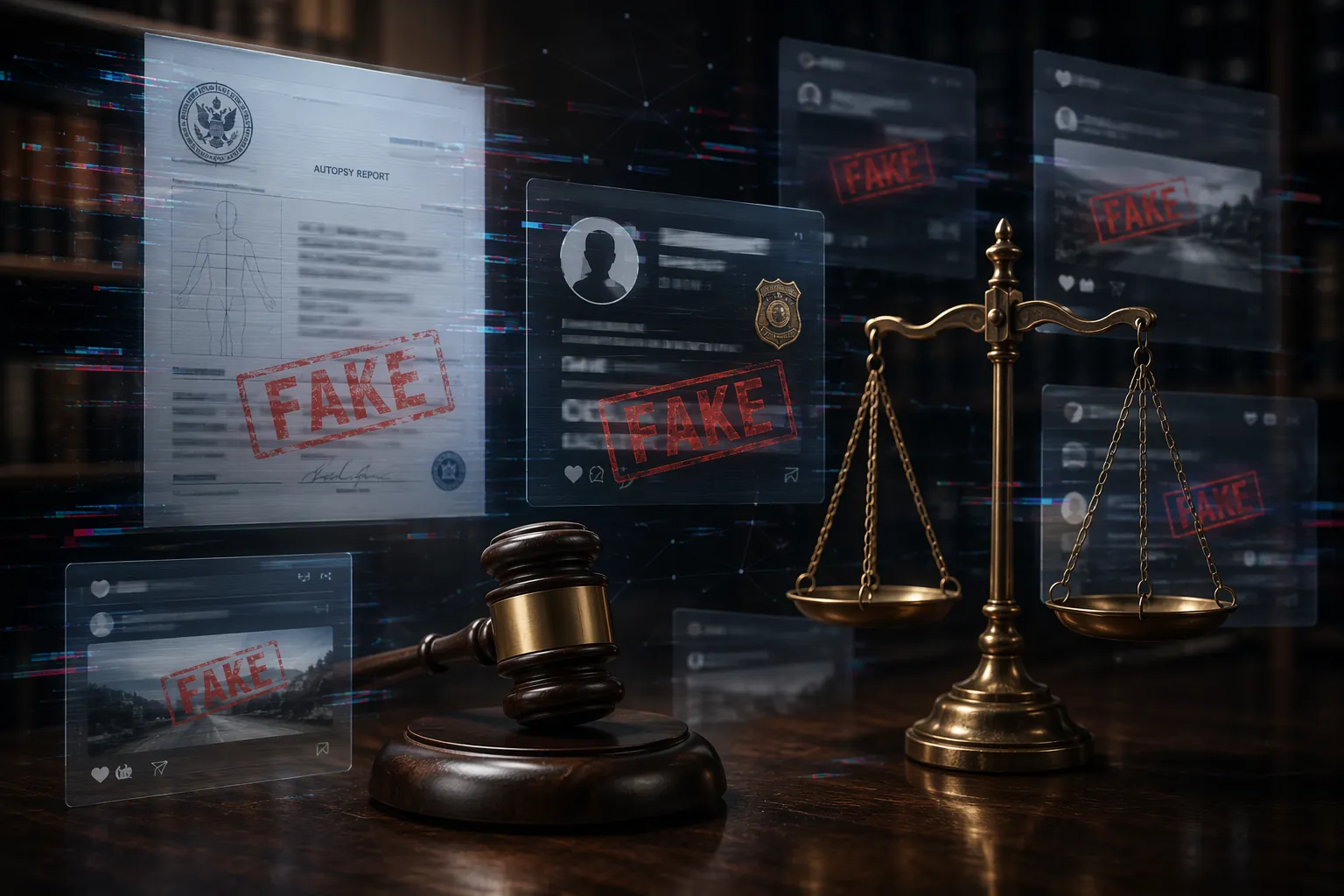
The second vector was more dangerous because it imitated a document type that legal professionals are trained to treat seriously. A fake autopsy report circulated on Facebook falsely claiming drugs were involved in Metcalf’s death. CBS News Texas’s Confirm team and the Frisco Police Department confirmed that the report was fake. [2]
A fabricated autopsy report does not merely add a rumor. It simulates institutional custody. It presents itself as the output of medicine, law, and procedure: a death investigation, a medical examiner’s finding, a document with a purpose beyond ordinary speech. That makes the fraud harder to quarantine after circulation, because the false claim arrives wearing the costume of a record.
The legal consequence is practical. Once a report-like document has circulated, lawyers and investigators cannot safely treat later references to it as independent corroboration. A witness who says they “saw the autopsy report” may have seen a fake. A social-media compilation that quotes the document may be repeating fabricated text. A public claim that appears to have multiple sources may trace back to the same false image.
This is where verification labor becomes expensive. Someone has to identify the first accessible version, compare it against agency releases, request or confirm the existence of official records through proper channels, preserve the false artifact without laundering it into evidence, and document the correction. The work is not glamorous. It is also exactly the work that prevents a fake document from becoming the anchor point for later argument.
| Misinformation vector | What was documented | Legal-risk consequence |
|---|---|---|
| Impersonated law-enforcement account | A fake X account posed as Frisco Police Chief David Shilson and spread fabricated investigation details within hours of the stabbing. | Screenshots and reposts may look official while lacking source provenance. |
| Fabricated autopsy report | A fake report falsely claimed drug involvement and was confirmed fake by CBS News Texas and Frisco police. | Report-like images can borrow medical-legal authority before authentication occurs. |
| AI courtroom images and deepfakes | AI-generated courtroom images and deepfakes circulated during the connected trial coverage. | Public-facing visuals may be mistaken for actual courtroom documentation. |
| AI-generated police reports | A 2025 issue brief warned that AI-generated police reports have fabricated dialogue, misidentified people, and listed officers who were not present. | Official records themselves may require new source-checking and drafting audits. |
Courtroom deepfakes created noise, but the record caveat remains
During the connected Karmelo Anthony trial coverage, AI-generated courtroom images and deepfakes also circulated. CBS News Texas treated the problem as significant enough to publish verification guidance for the public as part of its reporting on the misinformation surge. [2]
Those images belong in the risk file, but they should not be overstated. The available materials do not establish that AI misinformation changed the verdict, and the appeal posture described in the case materials does not make AI misinformation a stated ground. The cleaner trial-stage discussion belongs in the companion Risk Digest entry on Karmelo Anthony trial AI misinformation risk.
The distinction is not a technicality. Courts already have rules for exhibits, authentication, expert testimony, prejudice, and admissibility. Those rules are imperfect but recognizable. Investigation-stage misinformation often lives outside that channel. It can shape what people believe, what lawyers must rebut, and what investigators must clean up without ever becoming a numbered exhibit.
The police-report problem is not hypothetical
The broader risk category is already visible in AI-generated police reports. Fair and Just Prosecution’s 2025 issue brief warned that AI-generated reports have fabricated dialogue, misidentified individuals, and included officers who were not present at scenes. [3]
That issue brief does not prove that an AI-generated police report caused the Metcalf misinformation wave. It shows why the wave is not an isolated internet oddity. The same technology that can imitate an account or fabricate a medical-legal document can also enter the ordinary documentation pipeline through tools marketed to reduce officer paperwork. Adoption and reliability are separate questions. A report can be faster to draft and still require more authentication work later.
For prosecutors, the danger is disclosure and credibility. If a generated report contains invented dialogue or misidentifies a person, the issue may become impeachment material, a discovery dispute, or a reason to revisit charging assumptions. For defense counsel, the danger runs the other way: accepting a polished report as a stable factual account without testing how it was created. For risk staff, the question is not whether the output looks professional. It is whether the office can reconstruct who entered the source information, what tool processed it, what edits were made, and who approved the final language.
What verification discipline has to look like now
The Metcalf matter points to a verification standard that is more mundane than most AI commentary suggests. Counsel do not need to treat every viral item as unknowable. They need to stop allowing appearance to substitute for custody.
- For an alleged official account, verify through the agency’s website, press office, known public-information channels, or direct confirmation before relying on screenshots.
- For a report-like document, separate visual authenticity from record authenticity: seals, formatting, and institutional language do not prove issuance.
- For viral courtroom images, require source metadata, original publication context, and confirmation that the image depicts an actual proceeding rather than a generated scene.
- For AI-assisted police reports, preserve drafting history, tool identity, human edits, and reviewer approval so later readers can reconstruct the path from observation to record.
- For any corrected fake, keep a clean record of the debunking source and date so the office can explain when it learned the item was false and what reliance, if any, occurred before correction.
This is not a call to make every lawyer a forensic technologist. It is a call to assign ownership before the bad artifact becomes everyone’s problem. Someone has to decide whether a screenshot is merely background chatter, potential evidence, impeachment material, a client-risk issue, or a false item that must be walled off from the matter file except as misinformation documentation.
The hard cases will not announce themselves as deepfakes. They will arrive as a forwarded image from a colleague, a client email asking whether a document is real, a juror-background concern, a local post embedded in a demand letter, or a report that reads cleanly enough to pass through a busy office. The earlier the verification habit starts, the less likely the false version becomes the version everyone has to spend money disproving.
The disciplined risk finding
The Austin Metcalf case supports a narrow but serious conclusion. AI misinformation can contaminate the pre-trial environment through institutional impersonation, fabricated official-looking records, generated courtroom visuals, and AI-assisted documentation risks before a court ever decides what counts as evidence. The available record does not prove that the misinformation altered the verdict or supplied an appellate ground. It does show that lawyers can inherit a poisoned information environment long before the formal record is ready to protect itself.
References
- Frisco police, FBI probing fake social posts posing as chief after fatal track stabbing, Dallas Morning News, April 4, 2025.
- Frisco stabbing sparks surge in misinformation online, KWTX/CBS News Texas, April 15, 2025.
- New FJP Issue Brief Warns of Risks with AI-Generated Police Reports, Fair and Just Prosecution, 2025.
Related records
Tool profile
How Meta's AI Spending Reshapes Law Firm ProfitabilityGoverning regulation
Browse the obligations tracker →Preventive workflow
Browse verification workflows →
Report a correction or tip
Spotted an outdated figure, a misstated fact, or a ruling this case record should reflect? Public comments are disabled for this content given the professional cost of a misreported case outcome, penalty amount, or rule text — use the structured correction channel instead.
Report a correction or tip for this record →