
What Claude's July 29 Outage Means for Legal Work Today
The July 29, 2026 Claude outage is the fifth multi-model incident in five months. This Risk Digest record examines the ethics exposure it creates under ABA Formal Opinion 512 and the failure modes legal teams should check before tomorrow's filings.
- Jurisdiction
- United States
- Court
- United States
- AI tool named
- Claude
- Ruling date
- Jul 29, 2026
- Source document
- View primary court order ↗
- Last verified
- Jul 30, 2026
Lex Machina Review is an independent risk-tracking and reference resource. Nothing on this site is legal advice, and using it does not create an attorney-client relationship. Every record is reviewed against primary sources but may not reflect the most current status of a matter — always verify directly against the cited court order, rule text, or a licensed attorney before relying on it.
Companion explanation — secondary to the source document above
Risk Digest record: what is verified today
Last verified: July 30, 2026, UTC. This is a risk record for legal teams, not legal advice and not a finding that any firm violated an ethics rule.
| Item | Verified record |
|---|---|
| Incident wording | Claude’s status history recorded “elevated errors across all models” for the July 29–30, 2026 incident. [1] |
| Affected surfaces | The status record identifies Claude-facing services including claude.ai, API, Claude Code, and Claude Cowork as affected surfaces. [1] |
| Current posture | The incident is recorded as resolved as of July 30, 2026. [1] |
| Root cause | No public root-cause analysis or post-mortem for this specific July 29 incident is available in the cited status record as of July 30, 2026. [1] |
| Legal-workflow impact | No public source cited here measures legal-specific disruption from this incident. Any legal-workflow risk assessment has to be inferred from outage metadata, recurrence, and a team’s own dependency records. |
For a lawyer checking today’s Claude outage and its impact on legal work, the immediate answer is narrow: the public record supports that Claude had a multi-model error incident, that the incident is now marked resolved, and that legal teams using Claude during the affected period should verify their own work logs before relying on anything drafted, researched, summarized, or routed through the tool.
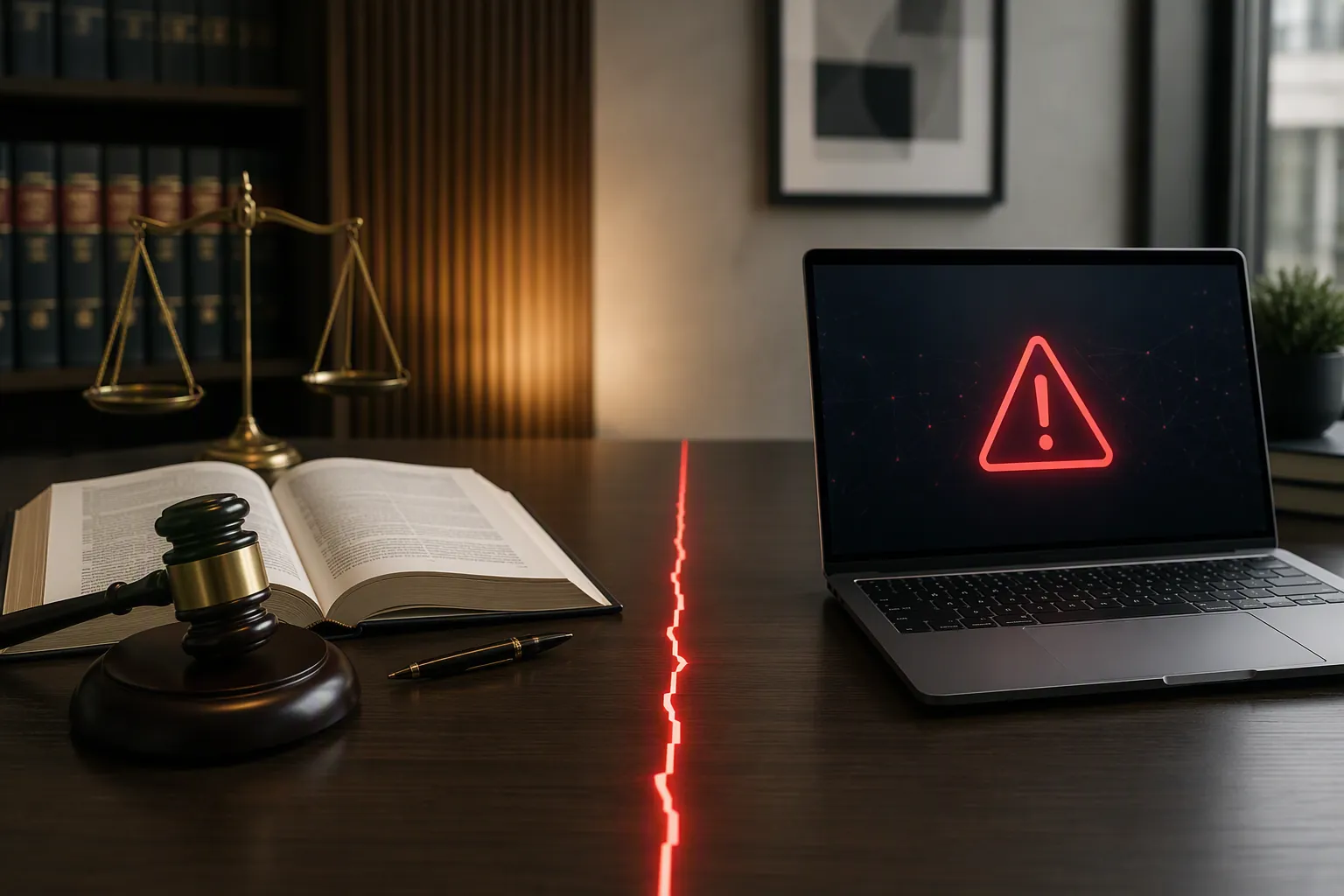
The July 29–30 record is more useful than the hallway version
“Claude was down” is too loose for a filing review. It does not tell a supervising lawyer whether a draft brief was generated before the error window, whether a citation check was postponed because the tool was unavailable, whether a contract-review queue was rerouted through another vendor, or whether client material was placed into an emergency substitute system without the usual approval.
The status-page wording matters because it is not a single-model complaint or a stray user screenshot. The July 29–30 incident was recorded as “elevated errors across all models,” with multiple Claude services identified in the incident history, and with the record later marked resolved. That is enough to require a matter-level check; it is not enough to infer that every Claude-assisted legal task during that window failed. [1]
The distinction is not pedantic. If a filing due tomorrow contains research that was completed before the incident and independently checked after it, the outage may be irrelevant to the filing record. If a team used Claude during the incident window, received partial output, then treated that output as final because a deadline was pressing, the risk is different. If the team abandoned Claude and used another system without documenting confidentiality review or human verification, the outage becomes the first fact in a longer supervision problem.
Five multi-model incidents in five months is no longer a one-off interruption
The July 29–30 incident lands differently because it is part of a short, visible pattern. The Claude status history documents a 2026 sequence that includes March 2, June 2, June 18, July 6, and July 29–30 multi-model incidents. [1]
| Date | Why it matters for legal operations |
|---|---|
| March 2, 2026 | A publicly reported Claude disruption put business-continuity questions on the table early in the year. [1][2] |
| June 2, 2026 | The pattern was no longer confined to a single March disruption. [1] |
| June 18, 2026 | A second June incident made monthly recurrence harder to dismiss as an isolated service event. [1] |
| July 6, 2026 | Contemporary reporting described a multi-model Claude outage before the later July incident. [3] |
| July 29–30, 2026 | The current record: “elevated errors across all models,” affected Claude services, and resolved status. [1] |
Enterprise commentary after the March disruption treated the event as a business-continuity warning, and later analysis of the June outages framed Claude’s availability as part of a larger question about generative AI becoming operational infrastructure. [4][5] Those are useful frames, but they should not obscure the more immediate law-firm point: recurrence changes what a reasonable supervisor can call “unexpected.”
The broader June pattern and ethics mapping were covered in Claude’s June 2026 outages expose law firm ethics risk. This July record is narrower. It asks what a team should be able to reconstruct now, while the affected work is still recent enough that email, chat, document history, and reviewer memory may still be intact.
The ethics issue is the missing handoff
ABA Formal Opinion 512 is the right frame here because it does not treat generative AI as magic or as forbidden machinery. The duties most exposed by an outage are competence, supervision, and confidentiality: knowing enough about the tool and its limits, supervising how work is reviewed and delegated, and protecting client information when AI systems are used. The Illinois Supreme Court Commission on Professionalism’s breakdown of the ABA guidance emphasizes those professional-responsibility obligations in practical terms. [6]
The adoption backdrop also matters. The ABA’s cited 8am Legal Industry Report says 69% of surveyed legal professionals used generative AI and 54% reported no formal AI training. [7] That combination is exactly where outage records become ethics records: lawyers are already using the tools, but many organizations have not trained people to respond when the tools fail at the wrong point in a legal workflow.
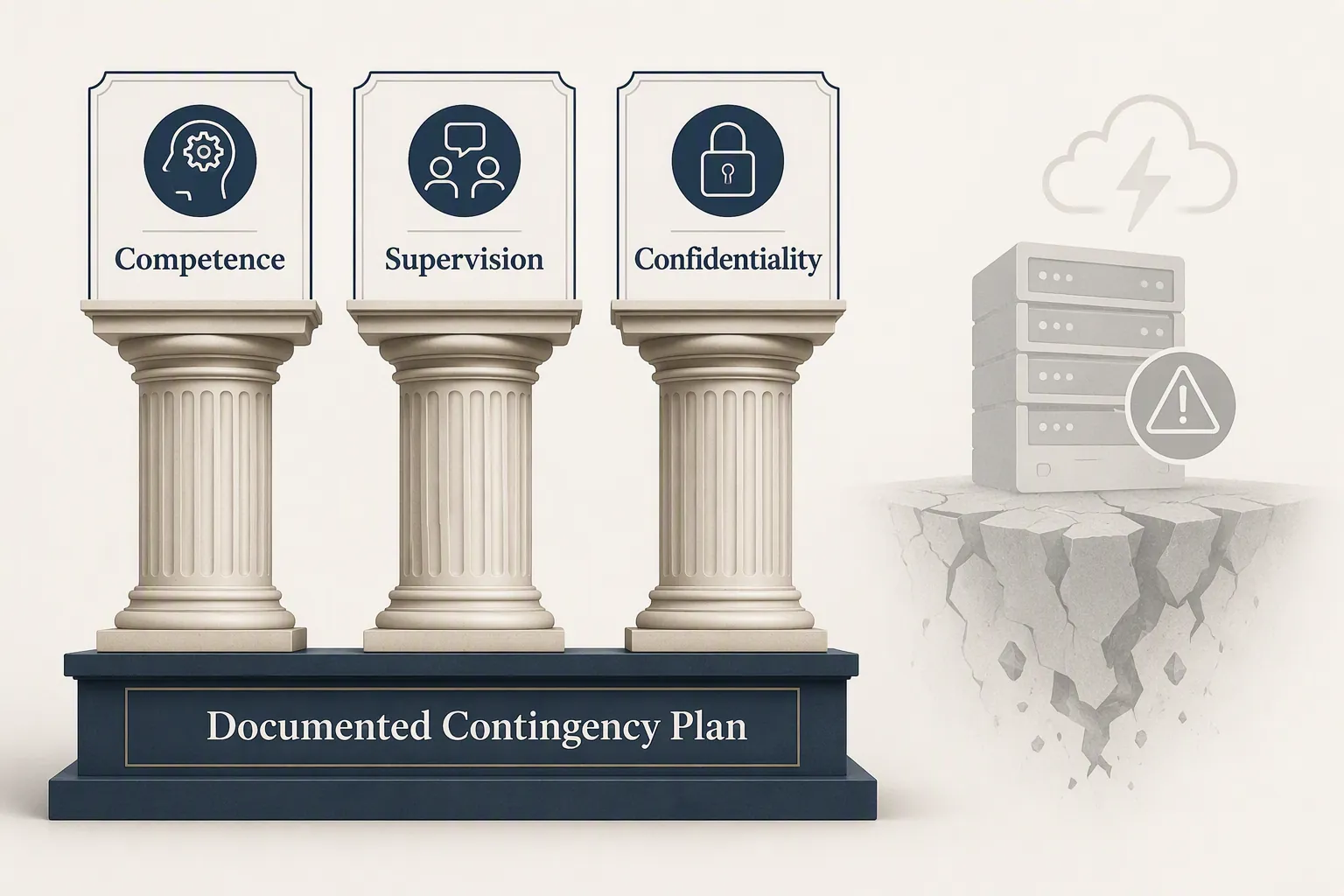
Competence: know the reliability profile before relying on the output
Competence does not require a partner to read every infrastructure note from an AI vendor. It does require the firm to know enough about the tool’s reliability profile to decide whether a Claude-assisted step needs redundancy. After five documented multi-model incidents in five months, “we had no reason to plan for Claude being unavailable” is a weaker explanation than it would have been before March. [1]
For work due tomorrow, the competence check is plain: identify whether Claude touched any draft, research memo, contract summary, privilege log, discovery response, or citation list during the July 29–30 period. Then separate tasks that were merely delayed from tasks where partial or unverified output entered the work product.
Supervision: someone must own the fallback review
Supervision is where outage excuses usually collapse. A tool failure can explain why a workflow slowed down. It does not explain why no one can say who checked the cases, who approved a fallback tool, who compared regenerated language against the source documents, or who signed off after the system recovered.
A supervising attorney does not need a beautiful post-mortem for every interruption. She does need a record adequate to show that legal judgment did not disappear into a broken handoff. The higher the deadline pressure, the more important that record becomes.
Confidentiality: emergency workarounds still count
Confidentiality risk during an outage is not limited to whether Claude itself exposed client information. The public materials cited here do not establish that client data was exposed in the July 29–30 incident. The practical concern is what the legal team did next: copied client text into an unapproved backup tool, sent drafts to a personal account to preserve momentum, used a browser plug-in with unclear retention terms, or asked a vendor account outside the client’s approved environment to complete the work.
If the only documented fact is “Claude was down,” the confidentiality review is unfinished. The firm should be able to show whether client material stayed inside approved systems while the primary tool was unavailable.
Failure modes to check before tomorrow’s filings
Nothing in the public outage record proves that a legal filing, contract review, or research memo was mishandled because of the July 29–30 Claude incident. The safer working assumption is narrower: if Claude was part of a legal workflow during the affected period, the team needs to verify whether the outage created one of the following gaps.
| Failure mode | What to check now | Duty most directly implicated |
|---|---|---|
| Work product drafted during an error window | Find document-history entries, prompt logs if retained, and human edits showing what was generated, what was discarded, and what was independently checked before use. | Competence and supervision |
| Research or citation checks deferred because Claude was unavailable | Confirm whether the deferred check was later completed in a primary legal research system or by a qualified reviewer, not merely marked complete when Claude recovered. | Competence |
| Contract review queue rerouted without documentation | Identify who moved the queue, which tool or reviewer received it, and whether the reroute changed confidentiality, privilege, or client-instruction assumptions. | Supervision and confidentiality |
| Fallback AI tool used without prior approval | Determine whether the backup system had been reviewed for data retention, training use, access controls, and client restrictions before client material was entered. | Confidentiality and supervision |
| Partial output accepted because a deadline was approaching | Look for reviewer notes confirming that quotations, citations, defined terms, exhibits, record references, and jurisdiction-specific assertions were checked by a human. | Competence and supervision |
| Recovered system treated as self-validating | Check whether work generated after service recovery was still reviewed against source documents rather than accepted because the status page turned green. | Competence |
The extra verification burden is sometimes described in industry shorthand as a “Verification Tax.” For this incident record, that phrase should stay descriptive rather than mathematical. The cited materials do not provide a formal metric for how much time legal teams lost, how many documents required re-review, or how often Claude output during the incident window was unreliable.
What a defensible record should contain
Continuity advice for Claude-dependent environments often recommends failover planning, monitoring, and alternative workflows. Deployflow’s outage guidance is useful on that operational point, but failover alone does not solve the legal problem. A backup tool that keeps lawyers moving can still create a confidentiality or supervision problem if no one approved how it would be used. [8]
For any matter that used Claude in drafting, research, review, or summarization during the July 29–30 incident, a defensible record should be able to produce at least the following:
- An incident note tying the matter-level workflow to the July 29–30 Claude status record, including whether the task was delayed, rerouted, regenerated, or completed manually.
- A list of affected work product: briefs, memos, contracts, discovery materials, diligence summaries, citation tables, or client communications where Claude output may have entered the draft.
- Human verification notes showing who checked legal authorities, quotations, record citations, contract defined terms, factual summaries, and jurisdiction-specific statements.
- Fallback approval records showing which alternate tools, vendors, or manual workflows were permitted and whether client material stayed within approved confidentiality boundaries.
- Supervisor signoff confirming that the final work product was reviewed after the interruption and not merely carried forward because the tool later became available.
Those records do not need to be elaborate. They need to answer the questions a court, client, general counsel, malpractice carrier, or disciplinary authority would ask after the fact: what did the AI system do, what did a lawyer check, what changed when the system failed, and who approved the workaround?
Where this record stops
The July 29–30 status record does not support a claim that Claude caused a bad filing, exposed client data, or made any particular legal team miss a deadline. It also does not support the opposite comfort: that a resolved status page eliminates professional-responsibility risk for work performed during the affected period.
As of July 30, 2026, with no public root-cause analysis for this specific incident in the cited materials, the defensible posture is documentation rather than panic. A firm that used Claude in legal drafting, research, or review during the affected window should be able to show how it verified the work, supervised fallback steps, and assessed confidentiality implications. If it cannot, the outage did more than interrupt productivity; it exposed the absence of a contingency plan under duties ABA Formal Opinion 512 already describes.
References
- Claude Status Page Incident History — Claude Status
- Anthropic Claude service disruptions reported worldwide — Help Net Security, March 2, 2026
- Claude Outage Currently Affecting Multiple Models — MacRumors, July 6, 2026
- CIO Insight: Business Continuity Lessons from Anthropic Claude Outage — Cloud Wars, March 5, 2026
- Claude outage June 2026 — Thoughtworks, June 2026
- Breaking Down the ABA’s Guidance on Using Generative AI in Legal Practice — Illinois Supreme Court Commission on Professionalism
- AI for Law Firms: What the 8am Legal Industry Report Tells Us About AI Use — American Bar Association, March/April 2026
- Is Claude Down? Protect Your Claude Infrastructure — Deployflow
Related records
Tool profile
What Claude's Outage Record Means for Legal WorkGoverning regulation
Browse the obligations tracker →Preventive workflow
Browse verification workflows →
Report a correction or tip
Spotted an outdated figure, a misstated fact, or a ruling this case record should reflect? Public comments are disabled for this content given the professional cost of a misreported case outcome, penalty amount, or rule text — use the structured correction channel instead.
Report a correction or tip for this record →