
Can climate attribution studies survive in court?
Attribution studies hold up in court; recurring dismissals rest on legal doctrine, not rejection of the science. Suncor before the U.S. Supreme Court is the near-term test for pending state and city climate suits and superfund statutes.
- Jurisdiction
- Germany
- Court
- Higher Regional Court of Hamm
- AI tool named
- No AI tool implicated
- Ruling date
- May 1, 2025
- Source document
- View primary court order ↗
- Last verified
- Aug 3, 2026
Lex Machina Review is an independent risk-tracking and reference resource. Nothing on this site is legal advice, and using it does not create an attorney-client relationship. Every record is reviewed against primary sources but may not reflect the most current status of a matter — always verify directly against the cited court order, rule text, or a licensed attorney before relying on it.
Companion explanation — secondary to the source document above
Risk Digest record. Last verified: Aug. 3, 2026. Legal-background reviewer: Elena Park, J.D. This analysis is for litigation-risk and legal-operations briefing purposes only; it is not legal advice and does not create an attorney-client relationship.
Primary sources used for verification include Michael Gerrard’s June 17, 2026 Sabin Center account of attribution science in climate litigation, the LSE Grantham analysis of Lliuya v. RWE, the National Academies attribution-science project page, and Callahan and Mankin’s April 2025 Nature article where discussed below. Case-count and posture statements are dated to the source cited, not generalized beyond that cutoff.
The current record is awkward in exactly the way litigators should care about. As of Michael Gerrard’s June 17, 2026 Sabin Center account, climate litigation had reached more than 3,600 cases across 62 jurisdictions, with about 60% of those cases in the United States; at the same time, no court anywhere had imposed financial liability on a country or company for greenhouse gas emissions.[1]
That split is the practical answer. Attribution evidence is no longer sitting outside the courthouse waiting to be recognized. Courts are citing it, hearing it, and in some settings accepting causal-chain arguments. But damages claims still tend to exit through legal doors: preemption, political question, standing, forum control, and other threshold doctrines. An IPCC citation is not a causation finding against a defendant. Cross-examined expert testimony is not a money judgment.
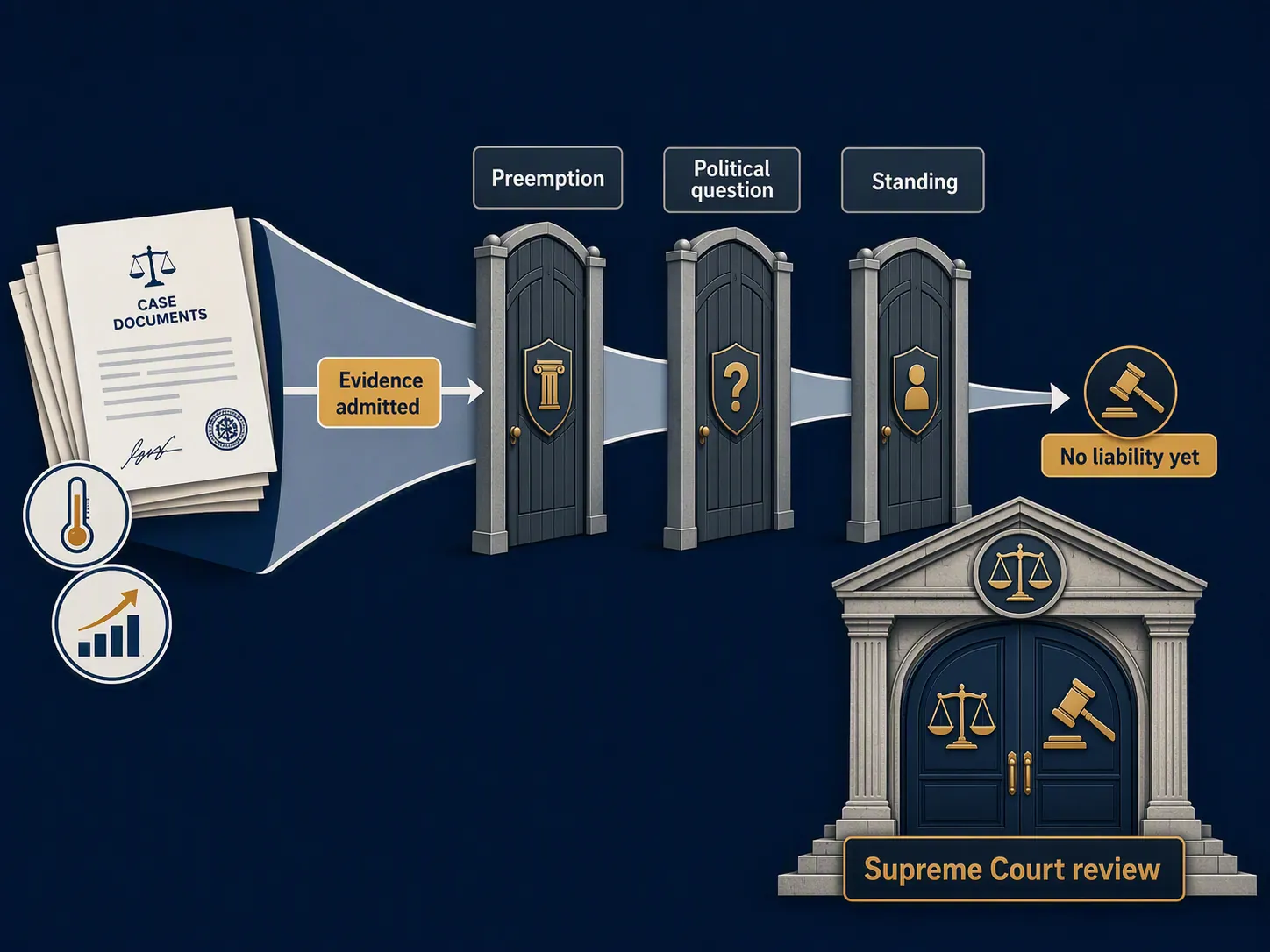
What courts have accepted is narrower than liability
Gerrard identifies at least 49 U.S. decisions citing the Intergovernmental Panel on Climate Change, four international tribunals accepting IPCC findings, and only three U.S. trials in which climate scientists were cross-examined on the stand: a 2007 Vermont vehicle-emissions challenge, Held v. Montana in 2023, and Lighthiser v. Trump in 2025, later affirmed by the Ninth Circuit.[1]
Those are meaningful developments, but they are not all the same procedural event. A decision citing the IPCC may be using an institutional scientific assessment to establish background facts about climate change. An international tribunal accepting IPCC findings may be deciding state obligations, human-rights duties, or marine-law questions. A trial with climate scientists under cross-examination tells counsel something different again: whether the testimony can survive adversarial testing in a live record.
For case strategy, the difference matters. The IPCC’s appearance in an opinion helps defeat the lazy argument that climate science is categorically too speculative for courts. It does not, by itself, allocate emissions shares, connect a defendant’s conduct to a plaintiff’s property loss, or satisfy the remedial elements of a state-law tort claim. The better reading is modest and important: climate science has become usable judicial material, while defendant-specific damages liability remains unawarded.
| Court use of attribution-related material | What it can show | What it does not show by itself |
|---|---|---|
| IPCC citations in U.S. decisions | Courts are willing to rely on mainstream climate-science assessments as record material or background authority. | A finding that any defendant caused any plaintiff’s damages. |
| International tribunal acceptance of IPCC findings | Climate findings can be incorporated into public-law reasoning at high institutional levels. | A money judgment for greenhouse gas emissions. |
| Cross-examined climate scientists at trial | Attribution testimony can be tested in adversarial proceedings. | That the plaintiff satisfied every legal element or remedial threshold. |
Lliuya is the case that prevents an easy headline
The most useful climate-liability case for counsel is not useful because it produced liability. It did not. Lliuya v. RWE is useful because it separated the causal-chain question from the plaintiff-specific risk question, and the two moved in different directions.

In May 2025, the Higher Regional Court of Hamm accepted that attribution science can establish a causal chain from a company’s greenhouse gas emissions to an increased risk of harm. It rejected RWE’s broad “drop in the ocean” defense and treated the company’s 0.38% emissions share as something to be assessed relative to other contributors, rather than as an automatic reason causation could not exist.[2]
That is the plaintiff-side legal significance of the case. A court did not wave away attribution because one emitter’s share was small in absolute terms. It allowed the causal chain to be evaluated in proportional terms. For any future pleading or expert report that depends on fractional contribution, that is a serious marker.
The ending is just as important. The plaintiff still lost after court-appointed experts assessed the glacial lake outburst flood risk to his property at roughly 1% over 30 years.[2] That finding was not a wholesale rejection of climate attribution science. It was a case-specific expert conclusion about the risk to a particular property. Flattening it into “science lost” misreads the ruling; flattening it into “liability has arrived” is no better.
For litigation-risk purposes, Lliuya is the cautionary file to keep open. It shows a court taking attribution science seriously enough to reject a categorical defense, then dismissing because the plaintiff-specific evidentiary record did not carry the requested relief. That is not a clean win for either press office. It is a reminder that admissible causation theory still has to meet the remedial facts.
Where the cases usually fail
If the science is not the usual failure point, the recurring exits need to be named without dressing them up as scientific judgments. The research record supports a narrower proposition: climate liability claims have not produced financial liability, and dismissals have been grounded in legal doctrines rather than a judicial determination that attribution science is unusable.[1]
- Clean Air Act preemption: the argument that federal statutory regulation of air pollution displaces or limits state-law routes for greenhouse-gas damages claims.
- Political question: the argument that the requested relief requires policy judgments committed to the elected branches rather than the courts.
- Standing: the argument that the plaintiff has not shown the required injury, traceability, or redressability in a form the court can adjudicate.
Those gates can dispose of a case before a court ever needs to decide whether a particular heatwave attribution study, emissions-share model, or event-linked damages calculation would support a judgment. That is why a docket loss does not automatically equal an evidentiary loss.
This is also why counsel should separate two questions at the outset of any climate-damages matter: can the attribution evidence survive challenge, and will the court reach it? The first question is increasingly answerable with expert practice, institutional assessments, and case-specific methodology. The second may be controlled by forum, statutory displacement, justiciability, and appellate doctrine.
The science is strengthening, but that does not supply the cause of action
The National Academies’ current attribution-science project is useful context because it is institutional rather than partisan. The July 2026 consensus work, conducted by a 14-member committee and updating the 2016 assessment, addresses the field’s ability to provide increasingly confident metrics on climate change’s contribution to heat waves, floods, wildfires, and droughts.[3]
That matters for evidentiary planning. Stronger event attribution can sharpen the expert’s path from general climate change to a particular event class or risk increment. It can help a court distinguish “climate change exists” from “climate change increased the probability or severity of this category of harm.” But it still does not answer who may sue, which law governs, whether a federal statute displaces the claim, or whether the requested remedy belongs in court.
The April 2025 Nature article by Callahan and Mankin pushes further rhetorically, stating in the abstract that “the scientific case for climate liability is closed.” The abstract also reports a single-study estimate that Chevron’s emissions were associated with US$791 billion to US$3.6 trillion in heat-related losses from 1991 to 2020.[4]
For a brief, that figure should be handled carefully. The article is subscription-gated, and the heat-loss range is a single-study estimate reported in the abstract, not a damages benchmark adopted by a court. It may be relevant to how expert damages theories are developing. It is not proof that a court has accepted that range, much less entered judgment on it.
Suncor is the near-term legal inflection point

The next pressure point is Suncor v. County Commissioners of Boulder County, now before the U.S. Supreme Court. The case is important less because it will decide whether attribution science is true than because it may determine which forum and doctrines control a large group of pending state and city climate damages suits, along with state climate superfund litigation. Oral argument is expected in fall 2026, with a ruling likely in late 2026 or the first half of 2027, and related cases have already been stayed.[1]
The risk scenarios are doctrinal, not meteorological:
- A broad defendant-favorable ruling could move more claims into federal-law terrain, strengthening preemption or displacement arguments and narrowing the practical value of state tort theories.
- A narrower defendant-favorable ruling could resolve forum or pleading issues without foreclosing every state-law damages pathway.
- A plaintiff-favorable ruling could leave more state and municipal claims in state-law channels, where attribution evidence may receive a fuller merits test.
- A procedural or limited ruling could keep the central liability questions alive while delaying uniform guidance for stayed and pending cases.
None of those outcomes requires the Court to conduct a seminar on attribution methods. The immediate consequence for litigants may be whether the courthouse door is state or federal, whether federal law supplies a defense before discovery deepens, and whether climate superfund statutes face the same doctrinal bottlenecks as common-law damages suits.
For docket-level tracking of individual heatwave attribution cases, see the companion Risk Digest record, Tracking the growing heatwave attribution litigation docket, current as of Aug. 3, 2026. For a separate comparison on doctrinal boundaries in climate-based challenges, see North Sea Oil Drilling Legal Challenges: 2025 Scorecard.
The present litigation posture is therefore not that courts have rejected attribution science. They have not. It is also not that improved attribution methods have made liability inevitable. They have not done that either. Climate attribution studies can survive in court; financial liability for greenhouse gas emissions still has not. The live risk for counsel is which doctrinal door Suncor leaves open or closes next.
References
- The Role of Attribution Science in Climate Litigation, Sabin Center for Climate Change Law, June 17, 2026.
- Luciano Lliuya v RWE: a major step forward for climate justice, LSE Grantham Research Institute.
- Attribution of Extreme Weather Events in the Context of Climate Change, National Academies.
- Carbon majors and the scientific case for climate liability, Nature, April 2025.
Related records
Tool profile
How Meta's AI Spending Reshapes Law Firm ProfitabilityGoverning regulation
Browse the obligations tracker →Preventive workflow
Browse verification workflows →
Report a correction or tip
Spotted an outdated figure, a misstated fact, or a ruling this case record should reflect? Public comments are disabled for this content given the professional cost of a misreported case outcome, penalty amount, or rule text — use the structured correction channel instead.
Report a correction or tip for this record →