
Delhi HC Upholds Acquittal of School Van Driver in POCSO Case
The search phrase "school van driver sexual harassment case delhi" has one docket verifiable to a primary judgment: State v. Kuldeep (2024:DHC:536-DB), where the Delhi High Court upheld the van driver's acquittal on January 30, 2024. The confirmed record covers the bench, disposition, and the POCSO Section 29 burden ruling, and flags what to re-verify before citing the case or relying on an AI summary.
- Jurisdiction
- Delhi, India
- Court
- Delhi High Court
- Judge
- Suresh Kumar Kait; Manoj Jain
- AI tool named
- No AI tool named
- Ruling date
- Jan 30, 2024
- Source document
- View primary court order ↗
- Last verified
- Aug 3, 2026
Lex Machina Review is an independent risk-tracking and reference resource. Nothing on this site is legal advice, and using it does not create an attorney-client relationship. Every record is reviewed against primary sources but may not reflect the most current status of a matter — always verify directly against the cited court order, rule text, or a licensed attorney before relying on it.
Companion explanation — secondary to the source document above

Verified case-status record
The search phrase “school van driver sexual harassment case delhi” should not be treated as a loose label for every reported school-transport abuse allegation in Delhi. The primary-source-verifiable docket in this record is State v. Kuldeep, neutral citation 2024:DHC:536-DB, decided by the Delhi High Court on January 30, 2024. A Division Bench of Justices Suresh Kumar Kait and Manoj Jain dismissed the State’s application for leave to appeal under Section 378(1)(b) of the Code of Criminal Procedure and upheld the trial court’s acquittal of the school van driver charged under IPC Sections 376(2), 354 and 506, and provisions of the POCSO Act.[1]
| Record field | Verified entry |
|---|---|
| Court | Delhi High Court |
| Bench | Justices Suresh Kumar Kait and Manoj Jain |
| Case | State v. Kuldeep |
| Neutral citation | 2024:DHC:536-DB |
| Ruling date | January 30, 2024 |
| Procedural posture | State leave-to-appeal petition under Section 378(1)(b) CrPC |
| Statutes charged | IPC Sections 376(2), 354, 506; POCSO Act |
| Outcome | Leave petition dismissed; trial-court acquittal upheld |
| Status flag | Confirmed — judgment PDF linked through the cited primary case report |
| Last verified | August 3, 2026, UTC |
That is the central answer. The verified docket is not a conviction record. It is an appellate refusal to disturb an acquittal. Anyone citing it for POCSO burden-shifting, school-transport prosecutions, or AI-assisted case retrieval should begin with the neutral citation and the judgment PDF, not with a search-result summary.
This is also a case-status verification record, not an AI-sanction event. There is no verified evidence in the materials reviewed here that any legal AI tool hallucinated State v. Kuldeep, invented its citation, or mischaracterized its outcome. The AI point is narrower: this is the sort of emotionally charged, low-context search phrase where a professional user should re-check the judgment rather than accept an automated digest.
What the Delhi High Court actually decided
The prosecution case concerned alleged incidents in 2015 involving two very young complainants, one about 3 years and 9 months old and the other about 3 years and 3 months old. The accused was described as a school van driver. The allegations were grave, and the charges placed the case inside the familiar cluster of child-safety, school transport, and POCSO litigation. The appellate decision, however, turned on what had been proved in the record, not on the emotional force of the allegation category.[1]
The trial court acquitted the accused. The State then sought leave to appeal. The High Court refused that leave, holding that the trial court had examined the evidence in a meticulous manner and that the record did not justify appellate interference with the acquittal.[1]
| Stage | What matters for citation |
|---|---|
| 2015 allegations | Allegations involving two preschool-age complainants and a school van driver |
| Trial | Acquittal by the trial court |
| State leave petition | Application under Section 378(1)(b) CrPC seeking permission to appeal the acquittal |
| Delhi High Court ruling | Leave dismissed on January 30, 2024; acquittal left undisturbed |
For readers outside India, the statutory labels need some care. POCSO refers to the Protection of Children from Sexual Offences Act, 2012. IPC refers to the Indian Penal Code, the charging statute used in this older prosecution record. CrPC refers to the Code of Criminal Procedure, under which the State sought leave to appeal. Later successor-code terminology should not be silently substituted into this docket when the judgment and charges use IPC and CrPC language.
The Section 29 POCSO point is the load-bearing holding
The most important legal point in State v. Kuldeep is not simply that POCSO contains a presumption against an accused. It is when that presumption begins to operate. Section 29 of the POCSO Act allows a court to presume that an accused has committed certain offences once the prosecution first establishes the foundational facts necessary to attract the provision. The High Court treated that threshold as real. The burden does not shift merely because the charge-sheet invokes POCSO or because the allegations are disturbing.[1]
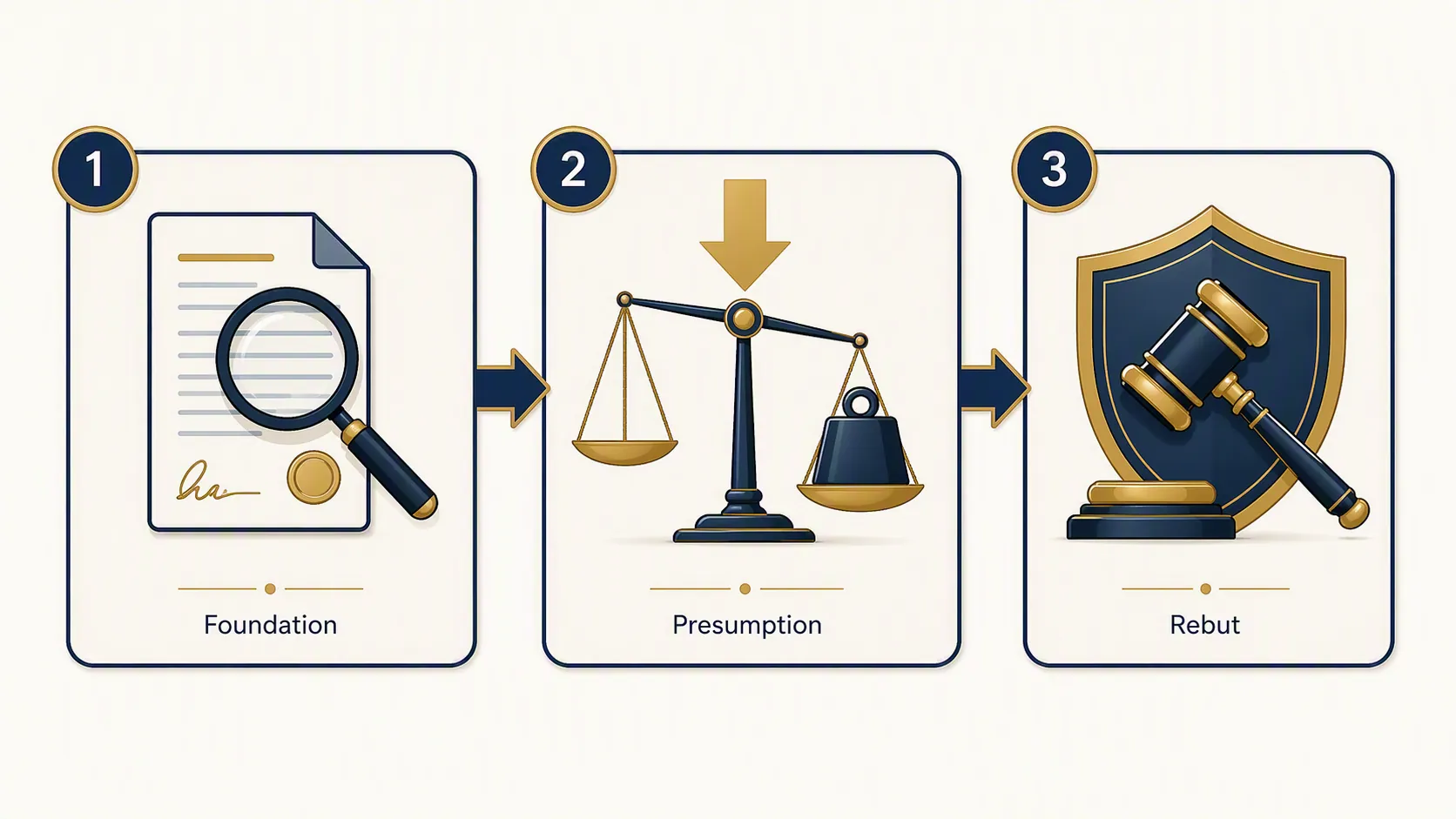
The structure is two-step. First, the prosecution must prove foundational facts. Only then does the statutory presumption shift the evidentiary burden to the accused. If the first step fails, the accused is not required to disprove a prosecution case that has not crossed the threshold.
| Step | Question the court had to answer | Effect in State v. Kuldeep |
|---|---|---|
| Foundation | Did the prosecution evidence establish facts attracting penetrative sexual assault, aggravated penetrative sexual assault, or another charged POCSO offence? | The High Court held that the Section 164 CrPC statements did not establish penetrative or aggravated sexual assault. |
| Presumption | If foundational facts were proved, did Section 29 shift the burden to the accused? | The shift did not arise in the way the State needed because the foundation was not established. |
| Appellate interference | Was the trial-court acquittal so flawed that leave to appeal should be granted? | The High Court declined leave and upheld the acquittal. |
The Court’s treatment of the complainants’ Section 164 CrPC statements is the part that a citation must not flatten. Those statements, in the Court’s assessment, were “diluted to the case to the extent of virtual exoneration,” and did not indicate penetrative sexual assault or aggravated penetrative sexual assault.[1]
The Additional Public Prosecutor’s concession also matters. The High Court recorded the APP’s concession that the case was not one of penetrative sexual assault or aggravated penetrative sexual assault. That concession sits directly inside the Section 29 analysis because it affects whether the prosecution had first proved the facts necessary to trigger the presumption it wanted to rely on.[1]
The record also notes that the accused had remained in pre-trial custody for about 16 months. That fact does not convert the acquittal into a compensation ruling or a broader declaration about false cases. It does, however, make the procedural posture harder to compress into a casual “school van driver POCSO case” label. The High Court was reviewing an acquittal after a serious prosecution, not deciding the case on a first impression or issuing a generalized school-safety advisory.[1]
Why the acquittal survived appeal
An appeal against acquittal is not the same procedural object as a trial verdict. The State first needed leave to appeal. The High Court’s dismissal of that leave petition meant the acquittal remained intact. The Court did not re-label the allegation as trivial; it found that the evidentiary record did not justify disturbing the trial court’s view.[1]
That distinction is important for professional use. A safe description is: the Delhi High Court upheld the acquittal after finding no basis to interfere with the trial court’s evaluation of evidence and after applying the Section 29 POCSO burden framework. An unsafe description is: the Court held that POCSO presumptions never apply in school van cases. The judgment does not support that broader claim.
A second unsafe description is the reverse: that POCSO Section 29 means guilt is presumed unless the accused disproves the allegation. That formulation skips the foundation step. In State v. Kuldeep, the foundation step was decisive.
Other Delhi school-transport matters should stay in a separate lane
The keyword landscape is messy because other Delhi school-bus or school-van abuse matters have been reported. They are relevant to search hygiene, but they are not coequal with State v. Kuldeep for this record because the materials reviewed here do not give them the same primary judgment-PDF status.

| Matter | Reported posture | Status for this record |
|---|---|---|
| Dev Nath | Reported Delhi High Court decision by Justice Jasmeet Singh in March 2023, upholding a 5-year term under POCSO Sections 9/10 and IPC Section 354A | Reported, unconfirmed here — secondary report only in this brief |
| Anuj | Reported October 2023 sentence by ASJ Susheel Bala Dagar of 7 years’ rigorous imprisonment under POCSO Section 10 | Reported, unconfirmed here — secondary report only in this brief |
| Civil Lines FIR | Reported July 2026 FIR-stage allegation involving POCSO Sections 8 and 10 | FIR-stage / reported, unconfirmed here — not a final adjudicated judgment |
The Dev Nath report says the Delhi High Court upheld a 5-year jail term for a school bus driver accused of sexually assaulting minor girl students.[2] The Anuj report says a Delhi school van driver received a 7-year jail term for sexually assaulting a 10-year-old girl.[3] The Civil Lines report describes an FIR-stage allegation that a Class 6 student was sexually assaulted in a school van by a driver over a period of three years.[4]
Those reports should not be merged into State v. Kuldeep. They may explain why a person searches for “school van driver sexual harassment case delhi,” but they do not change the verified disposition of the Kuldeep docket. If a brief, memo, or risk register needs to rely on Dev Nath, Anuj, or the Civil Lines FIR, the next step is to obtain the primary court record or FIR-stage materials and cite them on their own terms.
Verification note for AI-assisted research
This record should not be cited as evidence of an AI hallucination. The safer point is procedural: when a search phrase blends child-safety allegations, school transport, criminal statutes, and mixed secondary reports, the user should verify the docket before relying on an AI-generated summary.
For India-facing filings, the verification obligation is not theoretical. This site’s related record on India’s AI citation rule tracks the Supreme Court of India’s zero-tolerance approach to hallucinated AI-generated precedents in Pooja Ramesh Singh v. J&K Bank, 2026 INSC 668. That is a separate AI-citation misconduct record, not a finding about State v. Kuldeep.
A practical verification checklist for State v. Kuldeep is short:
- Confirm the neutral citation: 2024:DHC:536-DB.
- Confirm the bench: Justices Suresh Kumar Kait and Manoj Jain.
- Confirm the ruling date: January 30, 2024.
- Read the judgment PDF before quoting the Section 29 POCSO analysis.
- Describe the outcome as dismissal of the State’s leave petition and affirmance of acquittal, not as a conviction.
- Keep Dev Nath, Anuj, and the Civil Lines FIR in a separate reported/unconfirmed lane unless primary records are obtained.
This article is general legal-risk information, not legal advice. For litigation use, the judgment text, procedural history, and current law should be checked by counsel before filing, advising, or publishing a case note.
Professional-use conclusion
State v. Kuldeep is the verified primary-source docket behind this search phrase in the materials reviewed here. It is an acquittal record: the Delhi High Court dismissed the State’s leave petition and left the trial court’s acquittal undisturbed. The holding to verify is the Section 29 POCSO framework: the statutory presumption shifts only after the prosecution proves foundational facts, and the Court held that the Section 164 CrPC statements did not establish penetrative or aggravated sexual assault. Cite it only after checking 2024:DHC:536-DB and the judgment PDF.
References
- Trial Court Examined Evidence In Meticulous Manner: Delhi HC Upholds Acquittal Of School Van Driver Accused Of Sexually Assaulting Two Girls (State v. Kuldeep, 2024:DHC:536-DB) — Verdictum
- HC upholds 5-yr jail term to school bus driver for sexually assaulting minor girl students — The Hindu, March 2023
- Delhi: School van driver receives 7-year jail term for sexually assaulting 10-year-old girl — mid-day/PTI, October 2023
- Class 6 student sexually assaulted in school van by driver for 3 years in Delhi's Civil Lines — Hindustan Times, July 2026
Related records
Tool profile
How Meta's AI Spending Reshapes Law Firm ProfitabilityGoverning regulation
Browse the obligations tracker →Preventive workflow
Browse verification workflows →
Report a correction or tip
Spotted an outdated figure, a misstated fact, or a ruling this case record should reflect? Public comments are disabled for this content given the professional cost of a misreported case outcome, penalty amount, or rule text — use the structured correction channel instead.
Report a correction or tip for this record →