
Fukuoka bribery scandal's AI-deepfake defense unravels
A Risk Digest record examining the Fukuoka Prefectural Assembly bribery scandal, where Vice Speaker Masayuki Nakao's claim that incriminating audio was AI-generated collapsed after forensic voiceprint analysis confirmed its authenticity. The case introduces a novel risk pattern—'AI blamed for real evidence'—distinct from typical U.S. GenAI hallucination sanctions, with no criminal charges filed as of July 2026.
- Jurisdiction
- Japan
- Court
- Fukuoka Prefectural Assembly
- AI tool named
- AI-generated audio
- Ruling date
- Jul 30, 2026
- Source document
- View primary court order ↗
- Last verified
- Jul 30, 2026
Lex Machina Review is an independent risk-tracking and reference resource. Nothing on this site is legal advice, and using it does not create an attorney-client relationship. Every record is reviewed against primary sources but may not reflect the most current status of a matter — always verify directly against the cited court order, rule text, or a licensed attorney before relying on it.
Companion explanation — secondary to the source document above
Status frame: Fukuoka bribery allegation, not a filed criminal case
For readers tracking the Fukuoka Prefectural Assembly bribery scandal 2026 legal update, the first constraint is the most important one: this is not a court-sanction record, not a conviction, and not yet a prosecution file. As of July 30, 2026, the live legal development is the Fukuoka Prefectural Assembly’s decision to order an external-lawyer investigation, with interviews of all 87 current members scheduled to begin in August 2026; assembly leaders also declined to create a third-party committee with formal fact-finding authority.[1]
| Field | Current record |
|---|---|
| Jurisdiction | Japan; Fukuoka Prefectural Assembly |
| Matter type | Political bribery allegation involving the speakership and LDP caucus figures |
| AI issue | A deepfake or AI-generated-audio defense raised against an incriminating recording |
| Case status | Reported and investigative; no criminal charges filed as of July 30, 2026 |
| Next institutional step | External-lawyer interviews of all 87 current assembly members scheduled to begin in August 2026 |
| Use caveat | Risk-classification and source-tracking record only; not legal advice |
The narrow reason this matter belongs in an AI-risk digest is not that a Japanese bribery allegation includes a recording. It is that a public official reportedly tried to move that recording out of the evidentiary record by calling it AI-generated, and that move reportedly failed only after a forensic voiceprint analysis was obtained. That sequence is more legally useful than the scandal’s atmospherics.
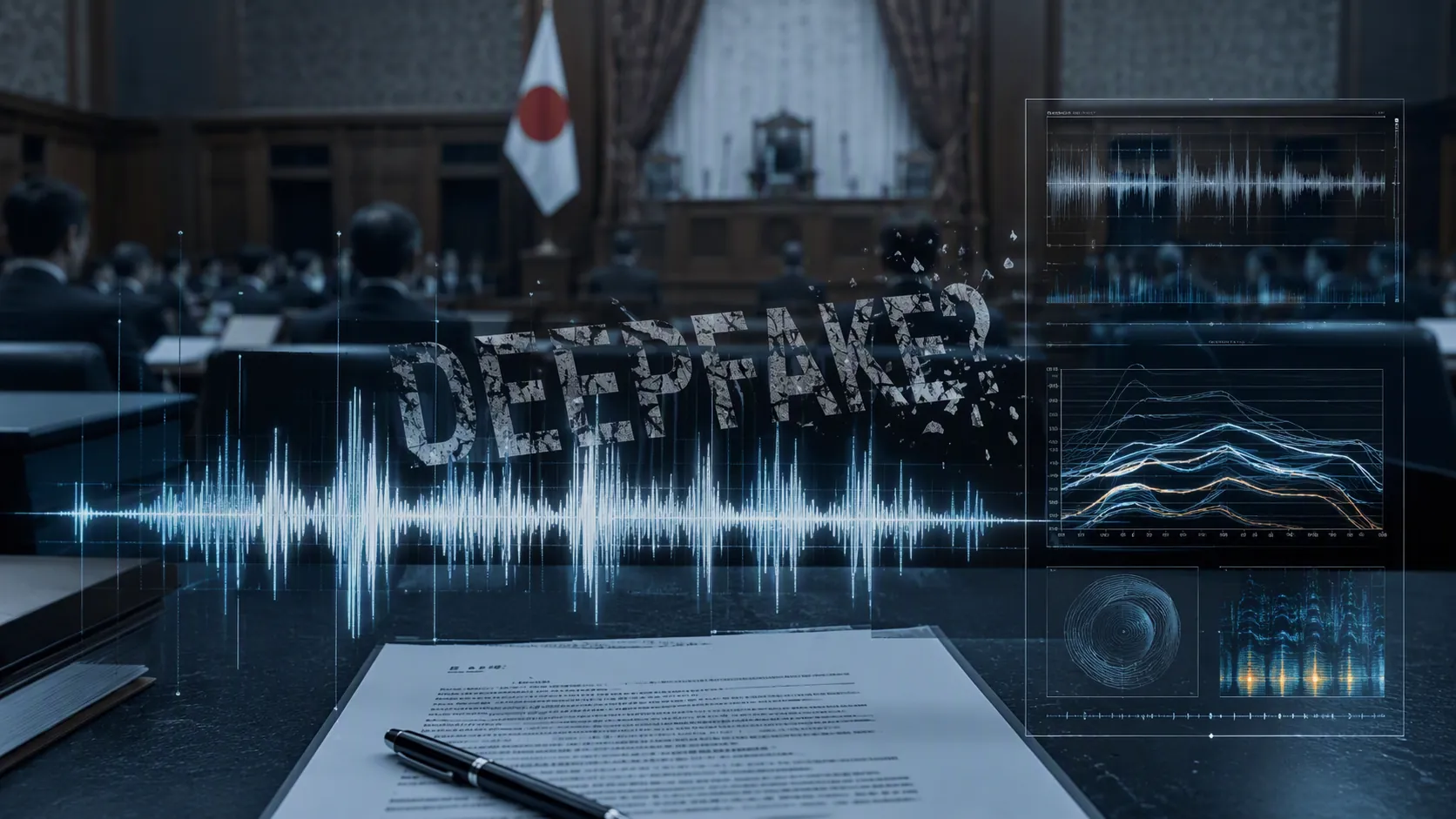
The recording did the real evidentiary work
The key sequence comes from Asahi reporting, including its Vox Populi column: Fukuoka Prefectural Assembly Vice Speaker Masayuki Nakao initially said the audio at issue was AI-generated; former Speaker Motoaki Yoshimatsu then commissioned a voiceprint analysis; the analysis reportedly confirmed the voice was Nakao’s; and Nakao retreated to, “Well, I must have said that then,” while still maintaining that no money changed hands.[2]
That is a materially different posture from a generic denial. A person can deny the legal meaning of a conversation, deny the surrounding payment allegation, or contest whether words were misunderstood. Calling the recording synthetic does something else: it attacks the authenticity of the evidentiary object itself. Once a forensic analysis reportedly linked the voice to Nakao, the dispute moved from “the recording is fake” to “the recording may be real, but the bribery allegation is still denied.”
The distinction matters because authentication is not decoration. When a recorded statement is casually labeled AI-generated, someone has to spend time, money, and institutional credibility to pull the evidence back into the category of the real. In this record, that work appears to have been done outside a courtroom and is reported secondhand through journalism, not through a filed expert report or judicial ruling. The result is still important, but it should not be inflated into a court finding.
What the payment allegations add
Yoshimatsu’s broader allegation is that he was pressed for about ¥20 million, reported as roughly $123,000, in connection with becoming assembly speaker in 2020. Asahi also reported that Yoshimatsu said he paid ¥10 million in cash directly to Nakao, then the LDP caucus secretary-general, and covered dinners, golf outings, and transportation costs.[3]
The allegation did not stand alone in the reporting. Five former speakers or vice speakers reportedly corroborated cash payments ranging from ¥3 million to more than ¥10 million each.[3] Those accounts explain why the recording mattered: it was not an isolated embarrassing fragment, but a potentially authentic piece of evidence inside a wider pay-to-play narrative.
They do not, by themselves, establish criminal liability. Several named figures, including Nakao, have denied the allegations in the reporting.[3] The current record therefore has to hold two propositions at the same time: the AI-generated-audio explanation has reportedly unraveled, and the underlying bribery allegations remain contested and uncharged.
Why this is not a standard GenAI hallucination case
Most legal-AI risk records in U.S. litigation have involved a different failure mode: lawyers or litigants submit AI-generated citations, quotations, or legal propositions that cannot be verified. The evidentiary problem there is fabrication entering the record as if it were law or fact.
The Fukuoka record points in the opposite direction. The AI claim was not used to create evidence; it was reportedly used to discredit evidence that later forensic analysis treated as authentic. That makes the risk category “AI blamed for real evidence,” not “AI created fake evidence.”
For counsel and investigators, the operational consequence is straightforward. Audio and video evidence now may face two authentication burdens: proving that an item is not synthetic, and then separately proving what the item means within the legal elements of the claim. Clearing the first burden does not automatically clear the second. In Fukuoka, the reported voiceprint result addressed the identity of the voice; it did not adjudicate whether a bribe was solicited, accepted, or paid.
The criminal-law frame is narrower than the scandal
Japan’s Penal Code bribery provisions create different exposure for the alleged recipient and the alleged giver. Under the Japan anti-corruption framework summarized by Chambers and Partners, a public official who accepts a bribe faces imprisonment of up to seven years, while a person who gives a bribe faces imprisonment of up to three years or a fine of up to ¥2.5 million under Articles 197–198.[4]
The limitation-period issue is not a footnote. The same framework identifies a five-year statute of limitations for the bribe recipient and a three-year period for the giver.[4] Because the alleged speakership-related payments date to 2020, prosecutability may turn on timing, charge theory, and any facts not yet public. The available record does not support saying that prosecution is impossible; it supports saying that limitations are a serious legal-status caveat.
That caveat is especially important because the matter has not been tested through a criminal proceeding. There is no indictment to parse, no court-authenticated recording to quote from, no judicial treatment of the voiceprint analysis, and no ruling on whether any alleged payment falls inside or outside an applicable limitation period.
The assembly investigation can clarify facts, but its design limits confidence
The assembly’s external-lawyer probe is the next formal process in view. Interviewing all 87 current members gives the inquiry breadth, and it may create a more disciplined record than the current sequence of press reports, denials, and political statements.[1]
But the refusal to establish a third-party committee with formal fact-finding authority is not a small design choice.[1] It affects what future findings can reasonably carry. An external-lawyer interview process may identify inconsistencies, preserve statements, and pressure institutional actors to answer. A body without formal fact-finding authority is less likely to resolve contested evidentiary questions with the force that regulators, prosecutors, or courts would need.
That does not make the investigation meaningless. It means later updates should separate three things that political coverage often blends together: what witnesses say in the assembly process, what outside forensic work can authenticate, and what a prosecutor or court is willing and able to use.
Related Japanese synthetic-media context
The Fukuoka matter also sits inside a broader Japanese policy turn toward synthetic media, though that context should not be mistaken for evidence in this case. In July 2026, Japan revised two election-related laws to address AI deepfakes and online libel in elections, with the changes reported as taking effect on March 1, 2027.[5]
Separately, Japan has considered voice-right protections aimed at unauthorized AI use of voices, including proposals around a “right not to be used arbitrarily” for voices of public figures.[6] That regulatory concern runs parallel to the Fukuoka record: both involve the vulnerability of voice evidence in an AI environment, but Fukuoka’s distinctive issue is a claimed synthetic defect in evidence that reportedly turned out to be authentic.
Risk classification as of July 30, 2026
As of July 30, 2026, the defensible classification is: reported Japanese political bribery allegation; no filed criminal charges; external-lawyer assembly investigation pending; AI-deepfake defense against audio evidence reportedly defeated by voiceprint analysis; underlying payment allegations denied and unproved in court.
For Lex Machina Review’s risk taxonomy, the Fukuoka record should be tracked as “AI blamed for real evidence” unless later official findings change the evidentiary posture. The current record does not prove bribery. It does show how quickly a synthetic-media claim can become a public shield, and how much turns on the people asked to verify whether the shield is real.
References
- Assembly Orders Independent Probe — Fukuoka Now, 2026
- VOX POPULI: No sympathy for LDP flippancy toward chair's extortion claims — Asahi Shimbun, July 16, 2026
- Details on golf, cash bags arise in 'pay-to-play' ploy in Fukuoka — Asahi Shimbun, July 2026
- Anti-Corruption 2026 — Japan — Chambers and Partners, updated December 2025
- 2 laws revised to combat AI deepfakes, online libel in elections — Asahi Shimbun, July 2026
- Japan mulls voice rights to protect against unauthorized AI use — Kyodo News, 2026
Related records
Tool profile
How Meta's AI Spending Reshapes Law Firm ProfitabilityGoverning regulation
Browse the obligations tracker →Preventive workflow
Browse verification workflows →
Report a correction or tip
Spotted an outdated figure, a misstated fact, or a ruling this case record should reflect? Public comments are disabled for this content given the professional cost of a misreported case outcome, penalty amount, or rule text — use the structured correction channel instead.
Report a correction or tip for this record →