
Your Evidence Is Called a Deepfake After Fukuoka — Now What?
This article presents a verification workflow for in-house counsel and litigators when a counterparty claims a real audio or video exhibit is AI-generated. Using the Fukuoka bribery scandal as a case study, it outlines the two-step authentication burden — proving the exhibit is not synthetic, then proving what it means — and explains why clearing the first does not clear the second.
- Jurisdiction
- Japan
- Court
- Fukuoka Prefectural Assembly
- AI tool named
- Generative AI (voice, unspecified)
- Ruling date
- Jul 30, 2026
- Source document
- View primary court order ↗
- Last verified
- Aug 3, 2026
Lex Machina Review is an independent risk-tracking and reference resource. Nothing on this site is legal advice, and using it does not create an attorney-client relationship. Every record is reviewed against primary sources but may not reflect the most current status of a matter — always verify directly against the cited court order, rule text, or a licensed attorney before relying on it.
Companion explanation — secondary to the source document above
The first dangerous moment is not the expert report. It is the sentence across the table: That recording is AI-generated. From that point, the holder of the exhibit can be pushed into defending the technology label before anyone has agreed what the recording is supposed to prove. This companion is meant for that moment. It sits alongside the existing Fukuoka Risk Digest record; it is not a new scandal timeline, and it is not legal advice.
The working problem is narrower and more useful: when a party calls an audio or video exhibit a deepfake, counsel has two separate files to build. One file asks whether the exhibit is synthetic, altered, or properly attributable. The other asks what the exhibit means under the legal elements of the claim. A party can lose the first fight and still contest the second.
The Fukuoka sequence: an AI denial, a voiceprint result, and a narrower retreat
The useful lesson from Fukuoka is procedural, not theatrical. In the reported sequence, former Fukuoka Prefectural Assembly member Takehiko Nakao responded to an audio recording by saying it “must have been generated by artificial intelligence.” The Asahi Shimbun’s Vox Populi column then reported that voiceprint analysis confirmed the voice was his. After that, Nakao reportedly shifted to: “Well, I must have said that then,” while still denying that any monetary transaction took place.[1]
That is the pivot lawyers should care about. The reported voiceprint result, as journalism describes it, addressed attribution of the voice. It was not a court finding, not a filed expert report in the materials provided here, and not a legal conclusion that a bribe was solicited, paid, accepted, or intended. The authentication question narrowed. The merits question did not disappear.
The surrounding allegations explain why that distinction matters. Earlier Asahi reporting described former assembly speaker Kenji Yoshimatsu’s allegation that he was shaken down for about ¥20 million, including a ¥10 million cash payment allegedly made to Nakao; Nakao denied the allegations on July 6, 2026.[2] Fukuoka Now reported that the assembly planned an independent probe using outside experts.[3] Later Asahi reporting said five former speakers or vice speakers had reportedly corroborated payments ranging from ¥3 million to more than ¥10 million, and that external lawyers were expected to interview all 87 current assembly members in August 2026.[4] Those are reported allegations and investigative steps, not adjudicated facts. The materials provided report the matter as investigative, with no criminal charges filed as of July 30, 2026.[2][3][4]
Treat the deepfake claim as a preservation event
Once the AI-generation accusation is made, the exhibit should stop moving informally. Do not email around the only file. Do not let a business sponsor “clean up” the audio for convenience. Do not accept a broad concession such as “authenticity is disputed” when the actual dispute may be attribution, continuity, metadata, editing, device origin, or interpretation.
The first response should look like evidence handling, not argument. Counsel should identify the custodian, freeze the original file or device where available, restrict access, create working copies, and record each transfer. If the recording came through a messaging application, meeting platform, phone, body recorder, or third-party source, preserve the surrounding context before it is overwritten: export logs, device information, timestamps, file names, storage locations, message threads, and any system-generated metadata that can still be retrieved.
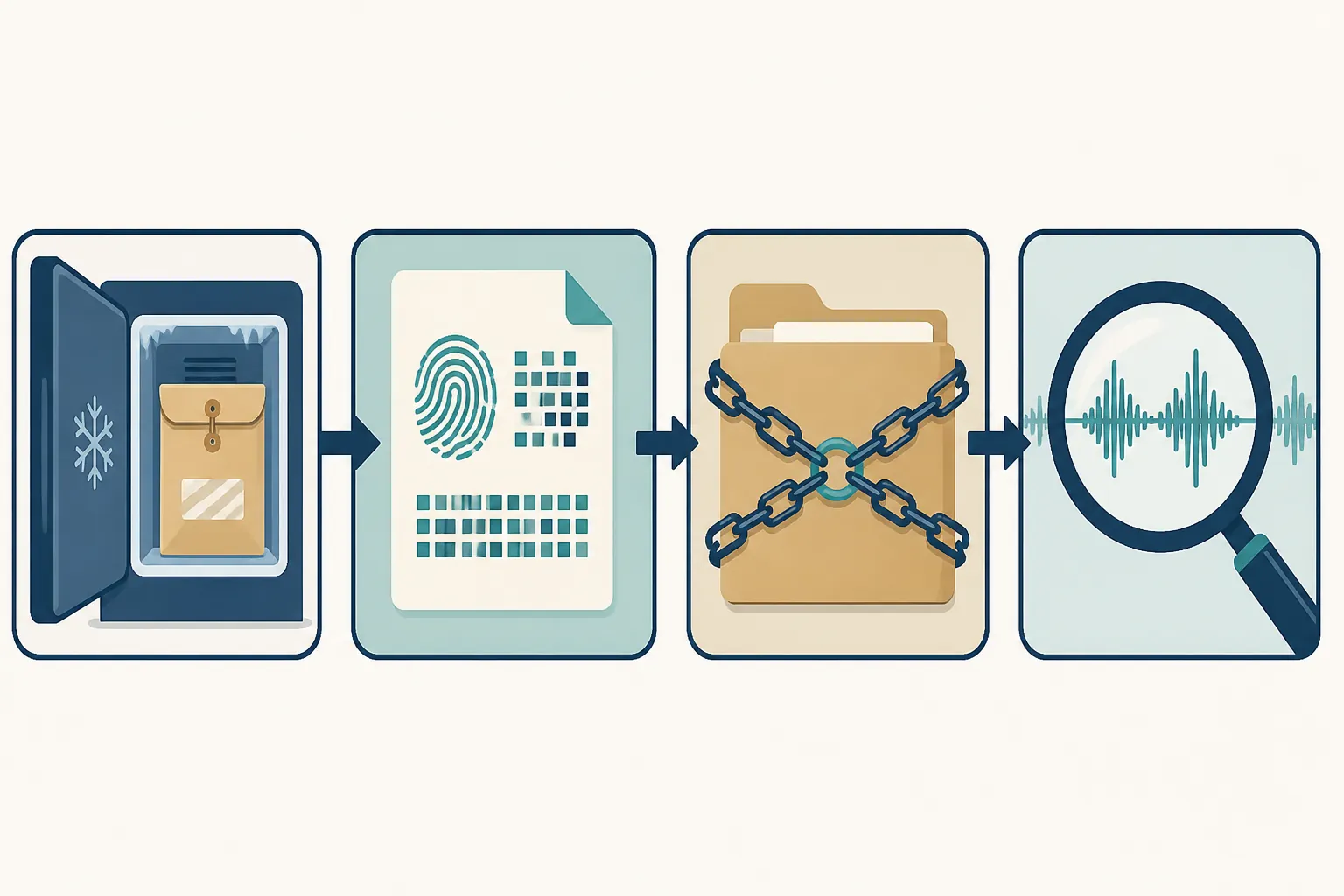
| Action | Purpose | What not to overstate |
|---|---|---|
| Freeze the original source where available | Reduce later claims that counsel altered, improved, or selectively exported the recording | Preservation does not prove the recording’s meaning |
| Create hashed forensic and working copies | Make later comparison possible if copies circulate | A hash proves file consistency, not speaker identity |
| Document chain of custody | Show who had access and when | Custody records do not rule out pre-acquisition manipulation |
| Commission independent forensic review | Test the synthetic-media claim with appropriate technical methods | A favorable review does not establish bribery, payment, solicitation, or intent |
| Separate the legal-elements memo | Analyze what the recording tends to prove if admitted or credited | Authenticity is not liability |
Preserve before interpreting
The most common early error is to jump to the sentence everyone wants to quote. In an audio dispute, the sentence matters later. First, the file matters: where it came from, whether it is complete, whether there are gaps, whether the format changed, whether the export process created artifacts, and whether anyone handled it after the accusation was made.
For an in-house team, that means assigning one owner for the exhibit and one owner for the decision record. The exhibit owner controls access and versioning. The decision-record owner keeps a contemporaneous log of preservation steps, communications with the custodian, instructions to business personnel, and any outside forensic engagement. The two roles may sit in the same legal function, but they should not be improvised in a message thread after the counterparty has already framed the evidence as fake.
- Record the date and time counsel first received the exhibit.
- Record the date and time counsel first learned of the AI-generation accusation.
- Identify the original device, account, platform, or custodian if available.
- Preserve the native file and any export history before creating review copies.
- Generate hashes for preserved files and maintain a record of hash values.
- Limit enhancements, transcriptions, clipping, and translations to marked working copies.
If the only available version is already a copy, the file is not useless. It is simply a weaker starting point. The log should say that. A defensible workflow does not pretend every exhibit has pristine provenance; it makes the provenance problem visible before someone else makes it sound fatal.
Hashing helps with integrity, not with everything
Hashing a file is a practical control because it gives counsel a way to show that the file reviewed today is the same file preserved earlier. It is especially useful once copies must be sent to outside counsel, forensic consultants, insurers, auditors, or investigative committees. But it should be described accurately. A hash does not prove that the file was never synthetic. It proves that a specific digital object has not changed since the hash was generated.
That distinction is not pedantry. If counsel tells executives that “the hash proves the recording is real,” the record has already become sloppy. The correct sentence is more limited: “The hash allows us to confirm that the preserved file and the reviewed copy match.” The synthetic-media question still needs forensic analysis and source context.
Commission forensic review without outsourcing the legal conclusion
A deepfake accusation usually requires technical review, but the engagement letter should not ask the expert to decide the case. Ask precise questions: whether the file shows signs of splicing, synthetic voice generation, re-encoding inconsistent with the claimed source, discontinuities, or artifacts that affect reliability; whether speaker-comparison methods support attribution; what source materials were used; what limitations apply; and what cannot be concluded from the available file.
Fukuoka is a useful caution. The reported voiceprint analysis was important because it undercut the broad “AI-generated” response described in the Vox Populi column. But even as reported, it did not transform the recording into a complete proof package. It did not answer whether money changed hands. Nakao reportedly continued to deny any monetary transaction after acknowledging, in substance, that he must have said the recorded words.[1]
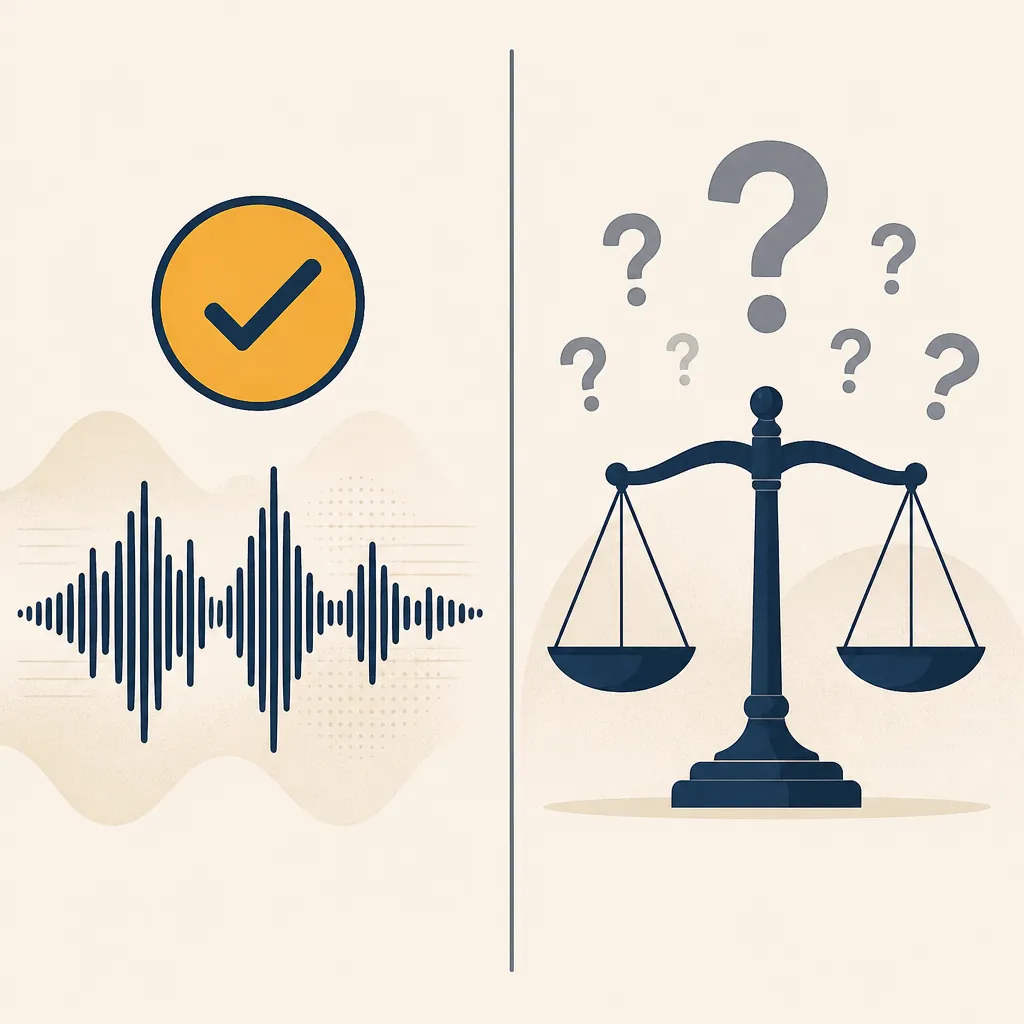
That is how the expert work should be briefed internally. “The voice is attributed to X” is not the same as “X committed the alleged act.” “No indicators of synthetic generation were found” is not the same as “the conversation has only one reasonable legal meaning.” “The file appears continuous” is not the same as “the alleged payment occurred.” These separations protect both sides of the analysis: they prevent premature concession on authenticity, and they prevent overclaiming once the authentication record improves.
The second file: what does the recording prove if it is real?
For readers tracking the Fukuoka assembly money scandal, bribery law is where the second file becomes unavoidable. The Chambers/Miura & Partners Anti-Corruption 2026 Japan guide describes Penal Code Articles 197 and 198 as the core provisions for bribery involving public officials, and it notes that a “benefit” can extend beyond cash to hospitality, travel, entertainment, and similar advantages.[5] That legal frame is why reported references to dinners, golf, “transportation money,” and cash cannot be treated as interchangeable facts. Each may matter differently depending on the alleged benefit, recipient, purpose, official function, and proof of exchange.
An authenticated recording may prove that a person said words. It may also support an inference about pressure, expectation, knowledge, or relationship. But it still has to be placed against the elements and the rest of the record. Who was speaking? To whom? About what office or function? Was the statement a demand, a boast, a joke, a threat, a coded reference, a recollection, or an ambiguous fragment? Did anything happen afterward? Is there bank, cash, calendar, travel, hospitality, or witness evidence that gives the words a legal meaning?
The Fukuoka reporting shows why this second file must not be collapsed into the first. The reported AI defense concerned whether the recording could be trusted as a recording. The broader assembly inquiry concerned whether payments or benefits were solicited, made, accepted, normalized, or denied. Asahi’s July 20 report on alleged payments by former assembly leaders and planned interviews of all 87 current assembly members speaks to that broader factual inquiry, not merely to whether one voice on one recording was genuine.[4]
Do not let authentication language swallow merits language
The safest internal language is narrow, almost disappointingly so. That is a virtue in a disputed-exhibit file.
| Careless formulation | Safer formulation |
|---|---|
| Voiceprint confirmed the bribery. | Reported voiceprint analysis attributed the voice; the alleged bribery elements remain a separate merits question. |
| The recording is authentic, so the payment happened. | The recording may be authentic; corroborating evidence is still needed for the alleged payment. |
| The AI defense failed. | The reported AI-generation claim was narrowed by voice-attribution analysis; other factual denials continued. |
| The file is hashed, so it is real. | The hash supports file integrity from the time of preservation. |
| The expert cleared the case. | The expert addressed specified technical questions within stated limitations. |
This matters in board updates and litigation correspondence. Executives often want a clean sentence. Opposing counsel often wants an overbroad one. The record should give neither side more than the evidence supports.
A working SOP for the first 72 hours
The first three days after a deepfake accusation are less about winning the argument than preventing avoidable damage. The timeline below is a recommended workflow synthesized from the Fukuoka record and general evidentiary discipline; it is not a court-mandated process.
| Timeframe | Counsel’s task | Decision point |
|---|---|---|
| Immediate | Issue a preservation instruction to custodians and stop informal circulation of the exhibit. | Can the original source, device, account, or platform still be preserved? |
| Same day | Create controlled copies, generate hashes, and start a custody log. | Which copy is forensic, which is working, and who may access each? |
| Same day | Capture the precise deepfake allegation in writing. | Is the opponent challenging speaker identity, file continuity, generation method, metadata, context, or all of them? |
| 24–48 hours | Engage independent forensic support with a scoped question list. | What can the expert test from the available source material, and what limitations should be expected? |
| 48–72 hours | Prepare a separate merits memo. | Assuming the exhibit is usable, what legal elements does it actually tend to prove? |
| Before any external position | Align language across litigation, investigation, communications, and leadership updates. | Are authenticity conclusions being overstated as liability conclusions? |
The deepfake allegation itself should also be pinned down. A vague “AI” objection can hide several different challenges. One opponent may be claiming the entire recording was generated. Another may be claiming a real voice was cloned into a false sentence. Another may be complaining about editing, missing context, transcription, translation, or chain of custody. Counsel should force the objection into categories before spending money answering the wrong one.
- If the challenge is speaker identity, prioritize comparison samples, consent and privacy constraints, and speaker-attribution methodology.
- If the challenge is generation or cloning, prioritize source files, artifacts, continuity, and the history of the file before counsel received it.
- If the challenge is editing, prioritize completeness, waveform continuity, metadata, source-device exports, and any longer recording.
- If the challenge is meaning, move it out of the forensic file and into the legal-elements file.
How to brief leadership without turning uncertainty into weakness
A good leadership update should be short, but not blunt in the wrong places. It should state what is known, what is being tested, what is preserved, and what no one should say yet. The point is not to sound tentative for its own sake. The point is to avoid creating a business record that either concedes a fake-evidence theory too early or declares victory on legal elements the forensic work never addressed.
A defensible update might say: “The counterparty has alleged that the recording is AI-generated. We have preserved the available source file, generated hashes for controlled copies, restricted circulation, and engaged independent forensic review. That review will address technical authenticity and attribution issues. Separately, legal is analyzing what the recording would prove if credited, including what additional evidence would be needed for the relevant claims.”
That sentence does not concede the exhibit is unreliable. It also does not pretend that authenticity answers every merits question. In a disputed recording matter, that balance is usually more valuable than a louder denial.
What Fukuoka should change in your evidence practice
Fukuoka is not useful because every workplace, agency, or litigation file will produce the same facts. It is useful because the sequence is clean. A recording was reportedly answered with an AI-generation claim. A reported voiceprint analysis narrowed that claim. The speaker reportedly acknowledged he must have said the words, while continuing to deny a monetary transaction.[1] The dispute did not end when the synthetic-media point weakened; it moved to what the words and surrounding evidence could prove.
That is the discipline to carry into the next matter. A deepfake denial creates two files, not one. Build the forensic-authentication file carefully enough that a real exhibit is not lost to a fashionable objection. Build the merits-meaning file separately enough that a favorable forensic result is not mistaken for proof of liability, bribery, payment, solicitation, or intent.
References
- Vox Populi column on the Fukuoka assembly recording and AI-generation claim, The Asahi Shimbun, July 16, 2026.
- Asahi report on Yoshimatsu’s ¥20 million shakedown allegation and Nakao’s denial, The Asahi Shimbun, July 8, 2026.
- Assembly Orders Independent Probe, Fukuoka Now, July 10, 2026.
- Asahi report on former assembly leaders’ alleged payments and planned interviews of current members, The Asahi Shimbun, July 20, 2026.
- Anti-Corruption 2026: Japan — Trends and Developments, Chambers and Partners / Miura & Partners, 2026.
Related records
Tool profile
How Meta's AI Spending Reshapes Law Firm ProfitabilityGoverning regulation
Browse the obligations tracker →Preventive workflow
Browse verification workflows →
Report a correction or tip
Spotted an outdated figure, a misstated fact, or a ruling this case record should reflect? Public comments are disabled for this content given the professional cost of a misreported case outcome, penalty amount, or rule text — use the structured correction channel instead.
Report a correction or tip for this record →