
Why ICE Airport Detention Counsel Face AI Citation Sanctions
The Ninth Circuit's June 2026 sanctions against two attorneys who filed fabricated AI-generated citations in an immigration appeal (its first AI-accountability ruling) and EOIR's warning that AI-hallucinated filings can trigger discipline together mark removal proceedings as the new front in AI-citation enforcement. For counsel whose cases begin at ICE airport detention, AI-generated citations now carry a verification duty that courts and the immigration agency are beginning to enforce.
- Jurisdiction
- US (Ninth Circuit)
- Court
- U.S. Court of Appeals for the Ninth Circuit
- AI tool named
- Unspecified generative AI
- Ruling date
- Jun 3, 2026
- Source document
- View primary court order ↗
- Last verified
- Aug 4, 2026
Lex Machina Review is an independent risk-tracking and reference resource. Nothing on this site is legal advice, and using it does not create an attorney-client relationship. Every record is reviewed against primary sources but may not reflect the most current status of a matter — always verify directly against the cited court order, rule text, or a licensed attorney before relying on it.
Companion explanation — secondary to the source document above
Risk Digest record
| Field | Record |
|---|---|
| Lane | Risk Digest — immigration filings, AI-generated citations, attorney discipline |
| Jurisdiction / forum | U.S. Court of Appeals for the Ninth Circuit; immigration appeal |
| Matter | In re Sethi & Rounds |
| Ruling date | June 3, 2026, as reported by Reuters [1] |
| Reported sanctions | Reprimands; $2,500 sanction against each attorney; six-month suspension from practice before the court; two-year AI-use disclosure duty [1] |
| Source status | Sanction details in this record rely on Reuters because the underlying Ninth Circuit order was not available for this update. Treat quotations and sanction mechanics as Reuters-reported until the court order is opened and checked. |
| Tool status | Unspecified generative AI. This record does not identify the tool because the available source record does not identify one. |
| Last verified | 2026-08-04 UTC, against the provided research record |
The practical finding is narrow and serious: the Ninth Circuit’s first reported AI-accountability sanctions ruling arose from an immigration appeal, and EOIR has separately warned that AI-hallucinated material in removal proceedings can create discipline exposure. For lawyers and legal researchers working around ICE airport detention, the connection is not that an airport encounter is an AI story. It is that airport detention can feed the removal pipeline, and removal filings are now one of the places where courts and the immigration agency are looking hard at fabricated authority.
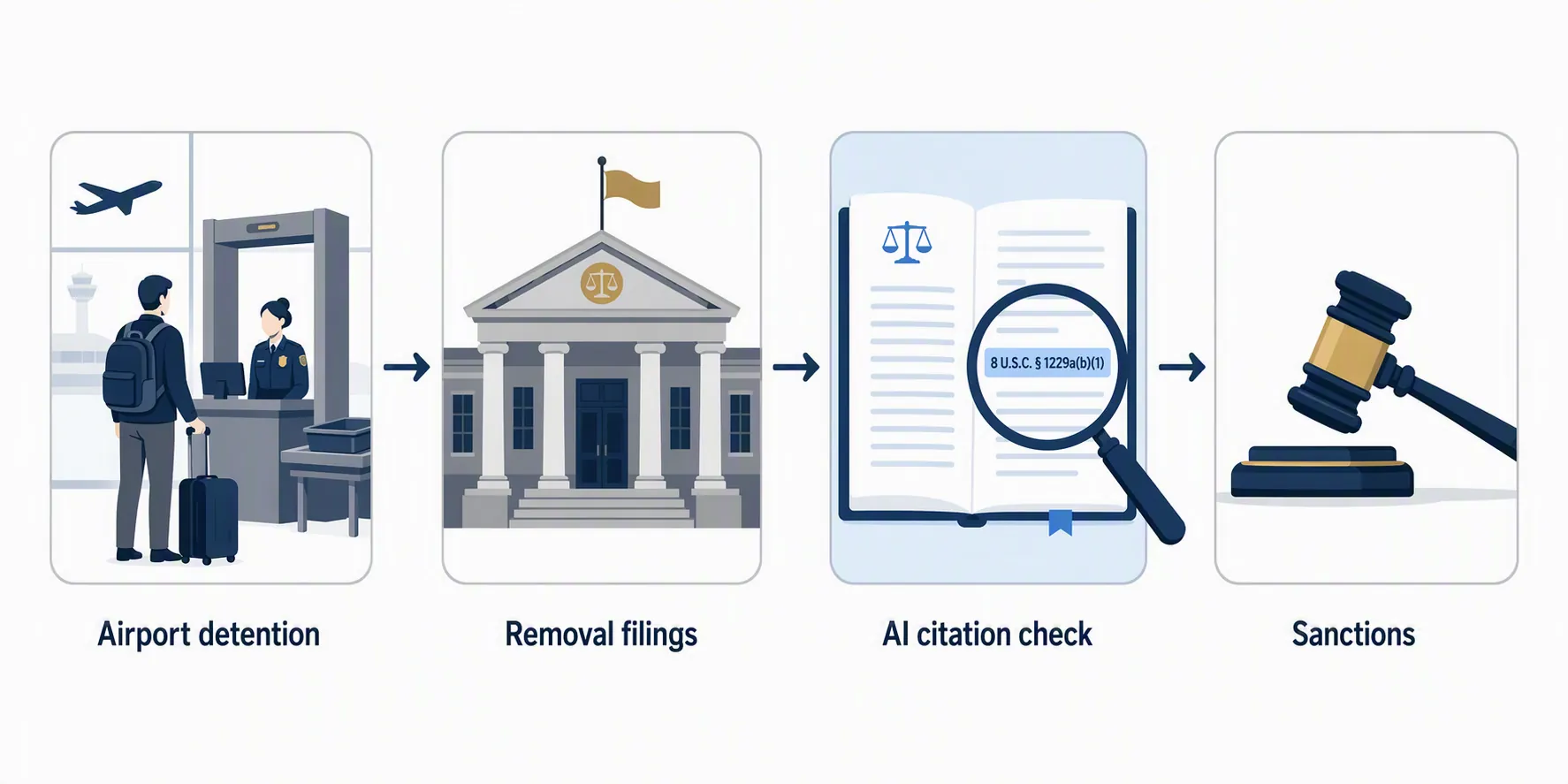
That is why this belongs beside the site’s existing ICE-airport records rather than inside a generic “AI for lawyers” file. The enforcement path already covered in What Counsel Must Verify About ICE Airport Arrests in 2026, the Fatima Ameaka immigration case record, and the airport-detention claim-verification workflow is the front end. The filing discipline problem is what can happen later, when counsel signs a brief, motion, or immigration-court submission that lets a machine-generated citation pass as checked law.
What Reuters reported in In re Sethi & Rounds
Reuters reported that the Ninth Circuit reprimanded attorneys Mike Sethi and William Rounds after briefs in an immigration case contained nonexistent, AI-generated cases. The court reportedly imposed a $2,500 sanction on each lawyer, suspended them from practice before the court for six months, and required a two-year disclosure of AI use [1].
Those numbers matter because they move the event out of the soft-warning category. A bad citation can be corrected. A sanction order, suspension from a federal appellate court, and disclosure obligation change the future handling of every filing that follows the lawyers. In risk terms, the error did not stay inside research. It became a professional-responsibility event.
The most revealing part of the Reuters account is not simply that fabricated cases appeared. It is the reported lack-of-candor finding. Reuters said the Ninth Circuit faulted counsel for a “subtle subterfuge” after correcting a filing without candidly disclosing the fabricated citations [1]. That is the moment an AI research failure becomes harder to contain. Once counsel has reason to know the authority is false, silence or half-correction can look less like workload failure and more like concealment.
The tool does not need to be named for the duty to attach. A filed brief is still the lawyer’s signed representation to the court. Appellate judges do not review the AI session history; they review the cited authority, the proposition it is offered for, and the lawyer’s response when the defect is found. That is a hard rule for detained-case practice because the filing environment is often rushed, document-poor, and high-volume. It is also why the verification step cannot be outsourced to the same system that generated the citation.
Why the two-year AI-use disclosure duty is a risk signal
The reported two-year AI-use disclosure duty is easy to underread. It is not just punishment for one defective brief. It tells future reviewers that the court wants visibility into whether generative AI touched the work product. For a risk team, that turns AI use from an informal drafting choice into a tracked filing attribute: who used it, for what part of the filing, which citations came from it, who checked them, and where the primary authority was verified.
That is also why “the associate checked Westlaw” or “the model usually gives links” is not enough as a control. The relevant control is attached to each authority. Does the case exist? Is it in the cited court? Does the quoted or paraphrased proposition appear in the opinion? Has the opinion been overruled, vacated, withdrawn, or limited? If the filing is going to an appellate court or EOIR, the answer has to be available before signature, not reconstructed after a show-cause order.
The removal-practice exposure is separate from the Ninth Circuit order
EOIR Policy Memorandum PM 25-40 is the separate agency-side reason this issue should be treated as active removal-practice exposure. The memorandum is titled “Use of Generative Artificial Intelligence in EOIR Proceedings” [2]. CLINIC’s guidance on the memorandum warns that practitioners who submit erroneous, false, or hallucinated AI-derived material in EOIR proceedings may face discipline, and it places that warning beside the existing sanctions authority in 8 CFR § 1003.102(c) for knowingly or with reckless disregard offering false evidence [3][4].
The important separation is forum. The Ninth Circuit sanction record is an appellate event. EOIR PM 25-40 is an immigration-agency practice event. Lawyers whose cases move from airport detention into removal proceedings may have filings in both systems: bond-related work, pleadings, motions before immigration judges, Board of Immigration Appeals briefing, petitions for review, emergency motions, and stay papers. The same bad citation can cross more than one gatekeeper.
| Filing setting | What the AI-citation risk looks like |
|---|---|
| Immigration court / EOIR filing | A hallucinated case, statute, regulation, or quotation may trigger agency discipline concerns if submitted as authority. |
| BIA appeal or motion | The defect can become part of the administrative record and follow the case into later review. |
| Federal petition for review | The appellate court evaluates the filed brief as counsel’s work, not as a machine-output experiment. |
| Corrected filing after discovery | Failure to disclose what was wrong, and why, can create a candor problem separate from the original citation error. |
PM 25-40 should be read directly before anyone quotes it in office policy. This record uses the memo for its existence and subject matter, and relies on CLINIC’s published summaries for the discipline characterization because extracted memo text was not available for this update. That distinction is not pedantry. It is the same discipline the filing workflow needs: source first, summary second.
Airport detention is the intake point, not the whole story
For ICE detention airport legal rights researchers, the temptation is to keep the whole inquiry at the airport: who stopped the traveler, which agency had custody, what notice was given, whether the person was treated as an applicant for admission, and what paperwork exists. Those are real questions, and the site’s ICE/CBP airport rights checklist is the right place for that front-end verification.
The sanctions issue begins after intake. A traveler detained at or after an airport encounter may enter removal proceedings. Removal proceedings produce lawyer work product under time pressure. That work product may use generative AI for drafting, issue spotting, translation support, chronology building, or legal research. The disciplinary question is not whether AI touched the file. It is whether counsel let AI-generated authority enter a filing before someone opened the primary source and read it.
A detained docket makes that question less comfortable, not less important. The person in custody may be waiting on a bond motion, emergency stay, or review deadline. The lawyer may be juggling family calls, records requests, interpreter issues, and a thin administrative file. None of that makes a nonexistent case less nonexistent. It does explain why the verification workflow has to be blunt and repeatable, not dependent on a heroic final read at midnight.
The Tenth Circuit reports are a corroborating signal, not a substitute record
A cited SSRN paper also points to a Tenth Circuit immigration hallucination line documented in “HALLUCINATED JUSTICE; AI-GENERATED CASE LAW AND ...,” covering late 2025 into early 2026 [5]. On the present record, that source is useful as corroboration that immigration-related hallucinated authority is not confined to one Ninth Circuit matter. It is not enough here to name specific Tenth Circuit cases or describe their procedural outcomes without opening the underlying orders.
Reuters also published a July 10, 2026 report about an appeals court rebuking a lawyer over “fake and hallucinated” case citations [6]. That may belong in the same broader sanctions map, but it should not be folded into the Tenth Circuit immigration line unless the order, court, and case posture are independently checked. The lesson for this record is narrower: multiple appellate signals now point in the same direction, while the Ninth Circuit immigration sanction remains the load-bearing event for this article.
What must be verified before AI-generated authority enters the filing
A workable immigration-filing control does not start by banning every AI use. It starts by refusing to treat AI output as authority. The citation is unverified until a human reviewer checks it against primary law or a reliable legal database and records that check in the file.
- Separate drafting help from legal authority. A model can suggest wording; it cannot certify that a case exists or supports the sentence.
- Create a citation queue for every AI-assisted draft. Each case, statute, regulation, administrative decision, and quotation should be pulled out for review.
- Check existence first. If the cited authority cannot be found in the relevant court, agency, official source, or trusted legal database, it does not go into the filing.
- Check the proposition second. A real case cited for a false proposition is still a filing risk.
- Log the reviewer, date, and source checked. The point is not bureaucracy; it is being able to show, before filing, that the authority was verified.
- Treat corrections as candor events. If fabricated authority was filed, the fix is not only to replace the citation. Someone must decide what the court or agency needs to be told.
For teams still choosing research tools, the site’s AI legal-research risk-tier comparison belongs in the procurement file, but tool selection is only one layer. The Ninth Circuit sanction record is about responsibility for what was filed. A better interface does not eliminate the need for a primary-source check.
Where this leaves ICE-detention and removal teams
Immigration practice is now an active AI-citation enforcement category. The strongest current record is the Ninth Circuit’s reported June 2026 sanction order in an immigration appeal; the agency-side companion is EOIR PM 25-40 and the discipline framework discussed in CLINIC’s immigration-practice guidance. Together, they point to a filing rule that is simple enough to operationalize: AI-generated citations are not legal authority until checked against primary authority.
For matters that begin with ICE or CBP airport encounters, the handoff should be explicit. The intake team verifies detention facts and documents. The removal team tracks deadlines and forum posture. The filing team verifies every authority before signature. The risk team preserves the verification trail, especially where AI was used in drafting or research. That is the workflow consequence of In re Sethi & Rounds, not a general warning about chatbots.
References
- US appeals court sanctions lawyers over AI hallucinations, lack of candor, Reuters, June 3, 2026
- Use of Generative Artificial Intelligence in EOIR Proceedings, Executive Office for Immigration Review
- I'm Sorry, I Just Hallucinated!, CLINIC, August 31, 2025
- How to Safely Incorporate AI Into Your Immigration Practice, CLINIC, December 17, 2025
- HALLUCINATED JUSTICE; AI-GENERATED CASE LAW AND ..., SSRN
- US appeals court rebukes lawyer over fake, hallucinated case citations, Reuters, July 10, 2026
Related records
Tool profile
How Meta's AI Spending Reshapes Law Firm ProfitabilityGoverning regulation
Browse the obligations tracker →Preventive workflow
Browse verification workflows →
Report a correction or tip
Spotted an outdated figure, a misstated fact, or a ruling this case record should reflect? Public comments are disabled for this content given the professional cost of a misreported case outcome, penalty amount, or rule text — use the structured correction channel instead.
Report a correction or tip for this record →