
Netflix's Idaho Murders Doc Was Built on Untested Evidence
Netflix's Idaho Murders documentary presents the case as settled, but none of its evidence was ever cross-examined because Kohberger pleaded guilty before trial — and a pro se petition filed two days before the premiere now challenges the conviction. The structural difference to keep in view: what the documentary asserts is not the same as what the un-cross-examined probable-cause record supports.
- Jurisdiction
- US-Idaho
- Court
- Ada County District Court
- Judge
- Steven Hippler
- AI tool named
- No AI tool named
- Ruling date
- Jul 23, 2025
- Source document
- View primary court order ↗
- Last verified
- Aug 3, 2026
Lex Machina Review is an independent risk-tracking and reference resource. Nothing on this site is legal advice, and using it does not create an attorney-client relationship. Every record is reviewed against primary sources but may not reflect the most current status of a matter — always verify directly against the cited court order, rule text, or a licensed attorney before relying on it.
Companion explanation — secondary to the source document above
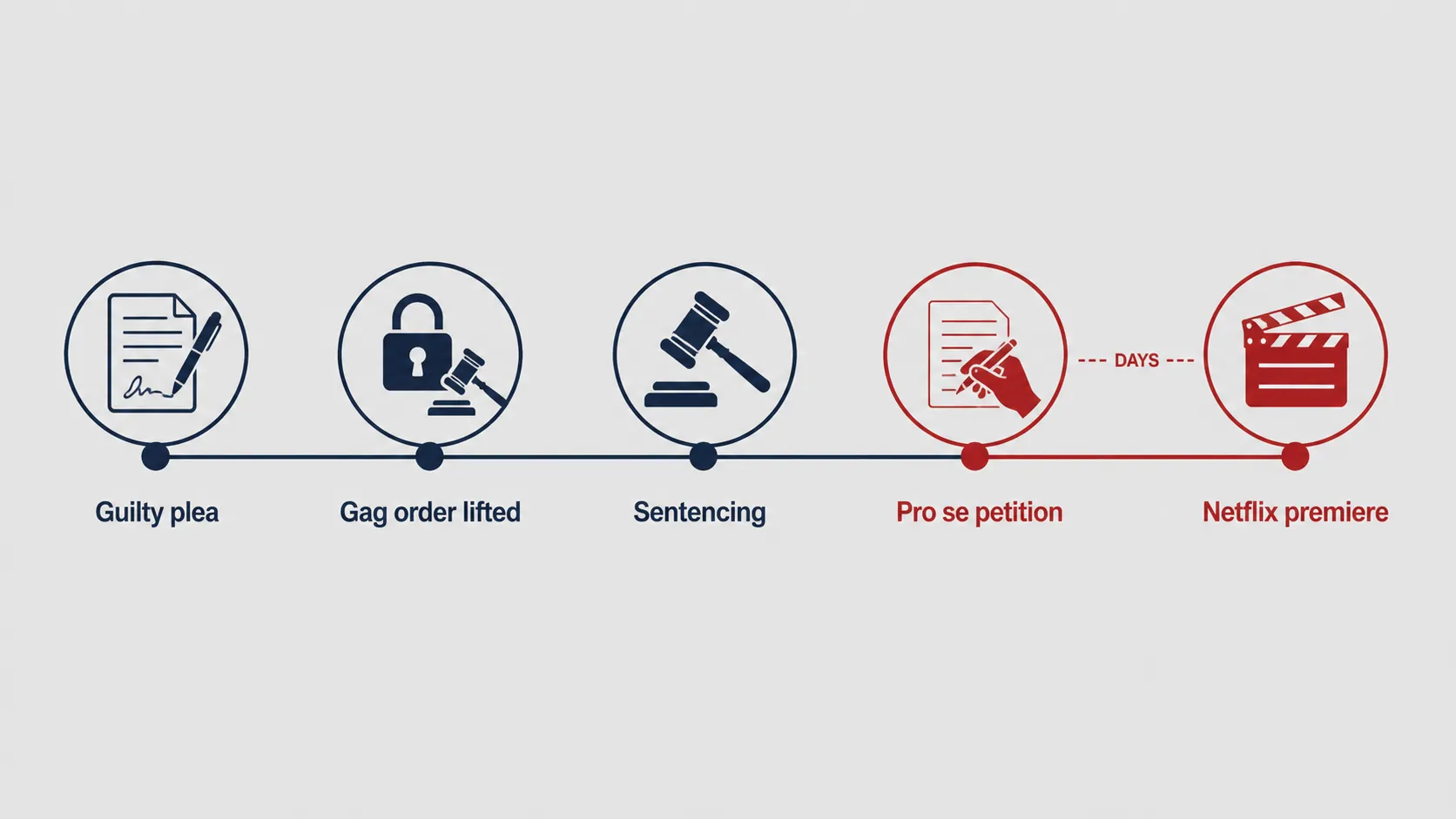
The awkward fact about Netflix’s The Idaho Murders: College Nightmare is not that it premiered after the public had forgotten the case. It premiered on July 29, 2026, two days after Bryan Kohberger filed a pro se post-conviction petition in Ada County challenging the guilty plea that made the documentary’s settled-case framing possible in the first place.[1][2]
That is the main difference between the Idaho murders Netflix documentary and the real case. It is not a clean list of “the doc says X, the court record says Y.” The deeper split is procedural: the documentary draws its confidence from a probable-cause record and from evidence released after the plea, while the criminal case never produced a trial record because Kohberger pleaded guilty on July 2, 2025, before the August 2025 trial setting.[1][2]
A plea can resolve a prosecution. It does not turn every allegation in a probable-cause affidavit into evidence a jury heard, watched being admitted, and saw tested by cross-examination. That distinction is dry until a documentary camera starts making affidavit material look like trial proof.
The timeline matters more than the montage
The case’s public evidence changed shape after the plea, not because a jury weighed it, but because the procedural reason for suppressing so much of it weakened. Kohberger pleaded guilty on July 2, 2025. On July 17, 2025, Judge Steven Hippler lifted the sweeping gag order, saying its “primary purpose … is no longer at play.” That post-plea order opened the door to releases of bodycam, Ring, and other evidentiary footage that later helped give the documentary its visual authority.[2][3]
| Date | Procedural event | Why it matters for the documentary |
|---|---|---|
| July 2, 2025 | Kohberger pleaded guilty. | The plea ended the path to a jury trial before adversarial testing of the state’s evidence. |
| July 17, 2025 | The gag order was lifted after the plea. | More footage and evidentiary material could be released publicly. |
| July 23, 2025 | Kohberger was sentenced. | The conviction became a post-sentencing plea-withdrawal problem, not a pending trial problem. |
| July 27, 2026 | Kohberger filed a pro se post-conviction petition. | The plea narrative was challenged in court before the documentary premiered. |
| July 29, 2026 | Netflix premiered the documentary. | The documentary arrived without addressing the new post-conviction filing. |
The July 23, 2025 sentencing then fixed the posture. Reports state that Kohberger received four consecutive life terms without parole plus 10 years for burglary, along with a $250,000 fine and $20,000 in restitution; those financial figures should be verified against the sentencing order before anyone treats them as the final clerical answer.[2]
By the time viewers saw the documentary, then, they were not watching a reconstruction of evidence that had survived trial. They were watching a reconstruction assembled from what had become publicly available after a plea stopped the trial machinery.
What the documentary treats as evidence had different legal status in the real case
The familiar evidentiary beats are not imaginary. The state’s probable-cause theory included knife-sheath DNA, surveillance tied to a white Hyundai Elantra, and phone activity that allegedly went dark between 2:47 a.m. and 4:48 a.m.; post-plea releases added the kind of footage that makes those claims easier to package for a screen audience.[4]

But “in the probable-cause affidavit,” “released after the plea,” and “admitted at trial after objections and cross-examination” are not interchangeable categories. A probable-cause affidavit asks whether there is enough to proceed. It is written from the state’s side of the investigation. It may include inferences, summaries, and investigative claims that have not yet been subjected to the pressures that trial imposes: foundation, relevance, reliability, expert qualification, confrontation, impeachment, and alternative explanation.
A documentary can responsibly show those materials. It can even make the state’s theory intelligible. The risk comes when editing, narration, music, and visual sequencing make the viewer feel the comfort of a verdict without showing the record that usually earns that comfort.
The knife sheath is the easiest example to overread. The presence of DNA in a probable-cause narrative is powerful viewing material. At trial, however, the defense would have had room to test collection, transfer, lab handling, statistical presentation, and the interpretive leap from a forensic association to a complete crime narrative. None of that happened before a jury because the guilty plea ended the case before that stage.
The same caution applies to the Elantra and phone evidence. Location, timing, and vehicle identification can support probable cause. They do not automatically become a litigated finding just because a documentary presents them in chronological order. Chronology is not cross-examination.
The plea made the case legally final enough to sentence, not evidentiary-final in the way viewers may assume
There is a temptation, especially after a guilty plea in a notorious case, to treat the plea as a shortcut to everything trial would have established. That is not how the record works. A guilty plea is an enormously consequential legal act. It can waive rights, support judgment, and lead to sentencing. But it also prevents the ordinary public creation of a tested trial record.
A trial would have forced each side to make choices in public. Which expert gets called. Which exhibit comes in. Which surveillance clip is authenticated. Which inference survives a judge’s ruling. Which weakness the defense can make visible. A plea bypasses that sequence. It substitutes a plea colloquy and judgment for the long, adversarial evidentiary record a jury trial would have generated.
That is why the phrase “real case” needs care here. The real case is not the documentary’s narrative, but it also is not the petitioner’s later accusations simply because they were filed. The real case is the procedural record: probable cause, guilty plea, sentencing, post-plea evidence release, and now an unresolved collateral challenge.
The July 27 petition makes the documentary incomplete, not disproven
Kohberger’s July 27, 2026 pro se petition matters because of timing and posture. It was filed two days before the Netflix premiere, and reports say the documentary had been completed before that filing, so the series does not address the plea-withdrawal development.[1][4]
The petition reportedly claims ineffective assistance of counsel, says Kohberger was “advised to lie” and “convinced to falsely confess,” and calls the state’s account a “myopic narrative” and a “work of fiction.”[1][2] Those are allegations, not findings. As of August 3, 2026, the petition remains unadjudicated, and there is no basis in the supplied record to write as if a court has accepted its claims.
That caveat is not a courtesy to Kohberger. It is the same verification rule that should apply to the documentary. A filing is not proof. A probable-cause affidavit is not a verdict. A post-plea video release is not cross-examined testimony. Each item gets only the procedural weight it has earned.
The standard also matters. Idaho Criminal Rule 33(c) permits withdrawal of a guilty plea after sentencing only to correct “manifest injustice.”[5] That is a high post-sentencing bar, and it is why a petition that is important for assessing the documentary’s completeness is not the same thing as a persuasive showing that the conviction will be disturbed.
For the detailed legal merits of that filing — including ineffective assistance and the manifest-injustice standard — see Why Kohberger’s Post-Conviction Relief Motion Likely Fails. The narrower point here is about media framing: the documentary speaks in the register of a completed account while the court file now includes an unresolved challenge to the plea that completed it.
Why the gag-order sequence changes how viewers read the footage
The July 17 gag-order ruling is not just housekeeping. It explains why a viewer in 2026 can see vivid material that was not publicly circulating in the same way before the plea. Once the court concluded that the order’s primary purpose was no longer at play, the public record could become visually richer.[3]
That visual richness creates its own evidentiary illusion. Footage feels less mediated than an affidavit. A bodycam clip seems to arrive with its own credibility. A Ring clip placed on a timeline can look like a finding. But release is not admission, and admission is not persuasion after cross-examination. The legal system has separate gates for a reason.
This is where many “documentary vs. real case” comparisons become too small. If the comparison only hunts for stray discrepancies, the larger compression goes unexamined. The documentary’s most consequential move is not necessarily a misstated detail. It is the conversion of investigative and post-plea materials into a seamless public memory of a case that no jury ever heard.
The useful question is not whether the documentary is false
A fair critique does not require saying Netflix fabricated the case, that the state’s evidence was worthless, or that Kohberger’s petition is likely to succeed. The better question is: definitive compared with what legal record?
For a true-crime audience looking for narrative closure, the documentary supplies a coherent account. For a tried case, it is missing the one thing that would have converted many of its evidentiary claims into tested proof: adversarial examination in open court.
As of August 3, 2026, it is also incomplete against the current court posture. The conviction has not been undone. The plea has not been withdrawn. The petition’s claims have not been established. But the record now contains an unresolved pro se challenge alleging that the plea narrative itself was false, and that challenge was filed before the documentary reached viewers.
So the difference to keep in view is narrow but important: the documentary presents an untested version of events drawn from a probable-cause and post-plea record, while the real case includes a guilty plea, a sentence, and an unresolved post-conviction challenge under a demanding post-sentencing standard. The publicity risk is evidentiary compression — the point at which un-cross-examined allegations become, in the public mind, the memory of a tried and verified case.
References
- Bryan Kohberger Says He Was ‘Convinced to Falsely Confess’ to Idaho Murders, Rolling Stone.
- Bryan Kohberger says he was ‘convinced to falsely confess’ in Idaho student murders, NBC News.
- Judge lifts gag order in Idaho student killings case after Bryan Kohberger’s guilty plea, PBS NewsHour / Associated Press, July 17, 2025.
- Netflix’s Bryan Kohberger Documentary Has a Big Problem, Slate.
- Idaho Criminal Rule 33. Pleas, Idaho Supreme Court.
Related records
Tool profile
How Meta's AI Spending Reshapes Law Firm ProfitabilityGoverning regulation
Browse the obligations tracker →Preventive workflow
Browse verification workflows →
Report a correction or tip
Spotted an outdated figure, a misstated fact, or a ruling this case record should reflect? Public comments are disabled for this content given the professional cost of a misreported case outcome, penalty amount, or rule text — use the structured correction channel instead.
Report a correction or tip for this record →