
Does Kohberger's plea waiver bar his post-conviction petition?
Bryan Kohberger's post-conviction petition raises a key procedural question: can a criminal defendant challenge their plea after signing an appeal waiver? This article explains the legal distinction between waived direct appeals and preserved collateral attacks under Garza v. Idaho, and why Kohberger's petition does not violate his plea agreement.
Lex Machina Review is an independent risk-tracking and reference resource. Nothing on this site is legal advice, and using it does not create an attorney-client relationship. Every record is reviewed against primary sources but may not reflect the most current status of a matter — always verify directly against the cited court order, rule text, or a licensed attorney before relying on it.
Companion explanation — secondary to the source document above
The latest court proceedings in the Bryan Kohberger case present a narrow procedural question, not a new trial scene: Kohberger signed a plea agreement that included an express waiver of his right to a direct appeal, yet he filed a pro se post-conviction petition on July 27, 2026, after sentencing coverage revived the issue of what rights remained available to him.[1]
That apparent contradiction is easier to overstate than to analyze. As of the available public reporting, no court has ruled on the petition, no hearing date has been confirmed through reliable public sources, and the full petition is not available through unauthenticated primary-source review. The reported claim details therefore come from named secondary reporting, not from a docket-level review of the complete filing.
The short answer is that the waiver likely matters if Kohberger tries to pursue a direct appeal. It does not, by itself, erase every route for attacking the plea, the waiver, or counsel’s advice about either one.
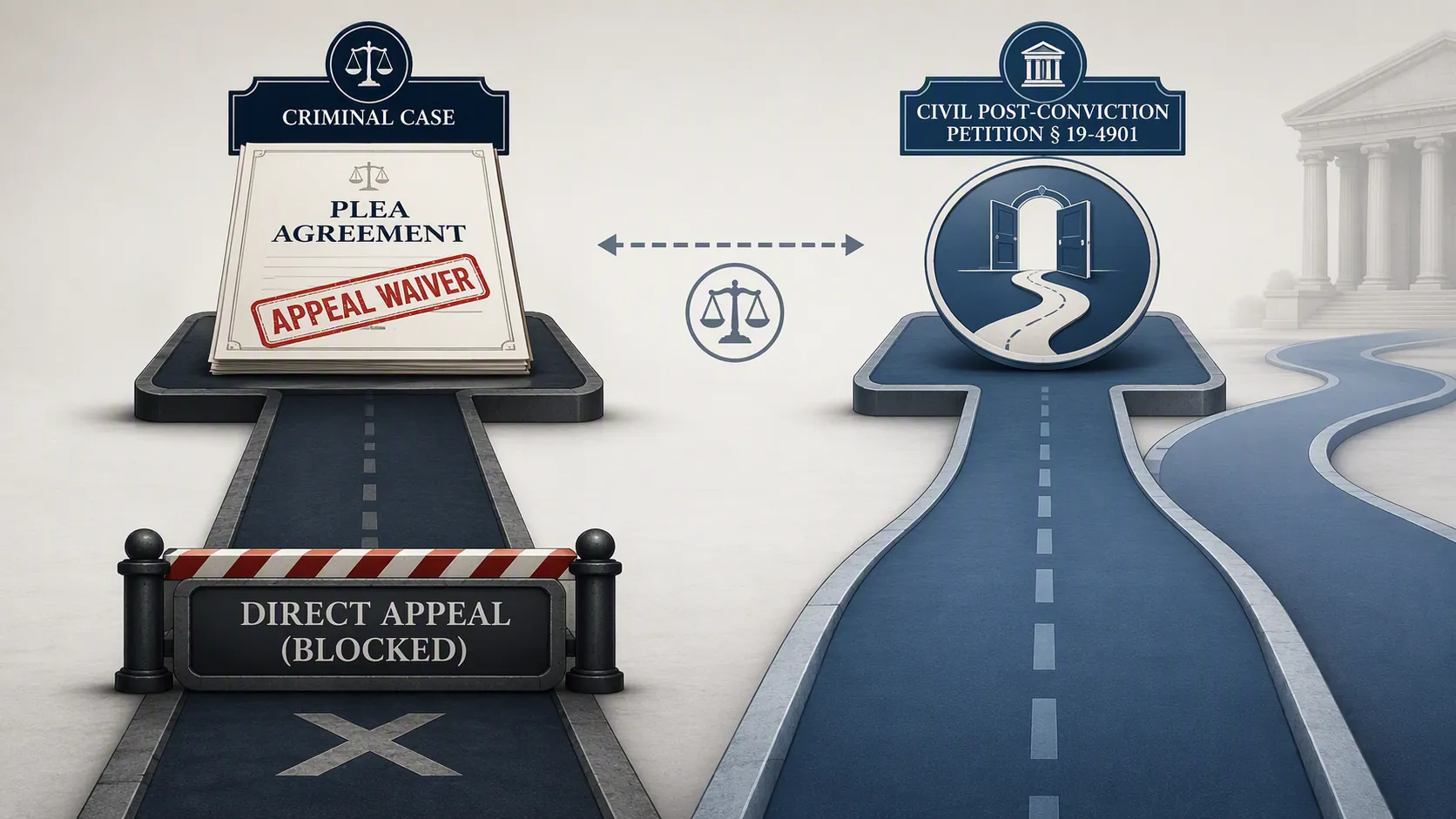
The waiver blocks one lane, not the whole courthouse
A direct-appeal waiver is usually aimed at appellate review of the conviction, sentence, or issues that could have been raised in the criminal case itself. Plea agreements use that language to buy finality. The government gives up something; the defendant gives up something; the judgment becomes less exposed to ordinary appellate challenge.
But a waiver is still part of the plea. If the defendant later says the waiver was not knowing, voluntary, or adequately advised, the waiver cannot logically be treated as conclusive proof that no challenge may be heard. That is the point Judge Steven Hippler reportedly acknowledged at sentencing: the right to appeal does not simply disappear because of a waiver, although the waiver may affect the outcome.[1]
The Supreme Court said the same thing in cleaner doctrinal form in Garza v. Idaho. Justice Sonia Sotomayor’s opinion rejected the idea that an appeal waiver is an absolute bar to every appellate claim, explaining that “no appeal waiver serves as an absolute bar to all appellate claims.”[2] That sentence does a great deal of work here. It recognizes that waiver language has legal force without pretending the words can settle every future question about validity, scope, counsel performance, or voluntariness.
That distinction is not a technicality in the pejorative sense. It is the architecture of the case. A defendant can lose a promised direct appeal issue and still retain a vehicle to argue that the plea was coerced, that counsel was constitutionally ineffective, or that the waiver itself was not validly entered. Those arguments may fail. They may be thin. They may be procedurally defective. But they are not defeated merely by pointing to the paragraph labeled “appeal waiver.”
Idaho post-conviction relief is a different procedural channel
Kohberger’s reported filing matters because it was not described as a notice of direct appeal. It was reported as a post-conviction petition under Idaho’s post-conviction framework, including Idaho Code § 19-4901, which treats post-conviction relief as a civil collateral proceeding rather than as a continuation of the criminal appeal.[3]
| Procedural route | What the plea waiver usually affects | Why the distinction matters |
|---|---|---|
| Direct appeal | Issues the defendant agreed not to appeal as part of the plea agreement | The waiver may lead the appellate court to dismiss or reject covered issues |
| Post-conviction petition | Claims attacking the validity of the plea, waiver, or counsel’s performance | The petition is a collateral civil action, so the waiver does not automatically foreclose it |
That is why the phrase “Kohberger waived his appeal” is incomplete. It is accurate as to the plea agreement’s direct-appeal language, as reported in coverage of the plea deal.[4] It is not accurate if used to mean that Idaho courts lack power to receive any later collateral filing that challenges the plea’s validity.
Post-conviction relief is not a spare appeal kept in the defendant’s pocket. It has its own pleading burdens, timing rules, standards, and defenses. A petitioner cannot simply relabel a waived appellate complaint as “post-conviction” and expect the court to review it as though the plea agreement never happened. But when the claim goes to the integrity of the plea process itself, the waiver is part of the dispute rather than a complete answer to it.
That point also keeps the pending filing in its proper scale. The petition’s reported allegations include ineffective assistance, false promises or coercion, and withheld exculpatory evidence.[1][3] Those topics matter here only because they are the kinds of allegations that attempt to attack plea validity or counsel’s advice, not because their merits can be resolved from a news account of a pro se filing.
For the factual background on those reported claims, see why Kohberger filed to undo his guilty plea. For the Idaho Rule 33(c) withdrawal framework, see Kohberger’s guilty plea withdrawal under Idaho Rule 33(c). The narrower question here is whether the waiver alone bars the collateral filing. It does not.
Why the petition is not a breach just because it exists
Calling the petition a “violation” of the plea agreement skips the first necessary question: what did the agreement waive? If it waived a direct appeal, then the cleanest consequence is that covered direct appellate claims face the waiver. It does not follow that a later civil post-conviction petition is forbidden simply because it inconveniences finality.
This is where waiver drafting and waiver advice often diverge. Plea paperwork is written broadly because prosecutors want closure and defense lawyers want certainty about the bargain. But counseling a client, insurer, institution, or internal stakeholder requires a sharper sentence: “You are waiving ordinary direct appellate review, but you may still have limited collateral remedies if the plea or waiver was not valid.”
The court may later find that Kohberger’s petition is inadequately pleaded. It may reject the allegations. It may require amendment, appoint or allow counsel, dismiss claims on procedural grounds, or narrow the case to issues not yet visible from public reporting. None of those possibilities changes the threshold point: a post-conviction petition attacking the plea or waiver’s validity is not procedurally barred merely by the existence of a direct-appeal waiver.
Expert commentary supports posture, not the rule
Legal commentators quoted after the filing have generally treated the petition as an uphill effort while still recognizing the procedural distinction. CNN reported assessments from University of Idaho law professor Samuel Newton, legal analyst Joey Jackson, and Boise criminal defense attorney Edwina Elcox on the filing’s posture and the difficulty of undoing a plea after sentencing.[5]
Experts can help evaluate litigation odds, but the rule does not come from a commentator’s confidence level. It comes from the interaction between the plea agreement, Garza, and Idaho’s civil post-conviction statute. Once those pieces are separated, the petition can be both procedurally available and substantively difficult.
That dual description is important for anyone advising on waiver language. Overstating finality creates its own risk. If counsel tells a client that an appeal waiver eliminates all future remedies, the advice may become Exhibit A in a later claim that the plea was not knowing or voluntary. If counsel understates the waiver, the client may misunderstand how little room remains for direct appellate review. The safer advice is not vaguer; it is more precise.
What remains uncertain in Kohberger’s filing
Several important points remain unresolved. The petition was filed pro se, which means later counsel could revise the strategy or frame different arguments. The full petition has not been reviewed through an open primary-source record. No court ruling has tested whether the pleaded allegations satisfy Idaho’s post-conviction standards. And no confirmed hearing date is available from reliable public reporting.
Those gaps counsel against any confident forecast. The filing may fail for reasons having nothing to do with the appeal waiver. It may be narrowed to a small set of claims. It may become procedurally cleaner if counsel appears. For a separate assessment of the petition’s likely substantive weakness, see why Kohberger’s post-conviction relief motion likely fails.
The procedural answer is narrower and steadier: Kohberger’s direct-appeal waiver likely has real force against any covered direct appeal, but it does not by itself extinguish a civil post-conviction petition that challenges the validity of the plea, the waiver, or counsel’s advice. Broad waiver language is powerful. It is not a solvent for every collateral remedy.
References
- Bryan Kohberger files petition to challenge guilty plea, conviction, NBC News, July 28, 2026
- Garza v. Idaho, 586 U.S. ___ (2019), Supreme Court of the United States, 2019
- Bryan Kohberger asks court to withdraw guilty plea in Idaho student murders, Idaho Statesman, July 27, 2026
- Bryan Kohberger sentenced in Idaho murders, CBS News
- Experts weigh Bryan Kohberger plea deal reversal, CNN, July 28, 2026
Related records
Tool profile
Browse tool evaluations →Governing regulation
Browse the obligations tracker →Preventive workflow
Browse verification workflows →
Report a correction or tip
Spotted an outdated figure, a misstated fact, or a ruling this case record should reflect? Public comments are disabled for this content given the professional cost of a misreported case outcome, penalty amount, or rule text — use the structured correction channel instead.
Report a correction or tip for this record →