
Lessons for Law Firms from the Goldstein Tax Fraud Sentencing
The Goldstein case reveals multiple red flags—firm accounts used for personal expenses, sham employees, undisclosed income—that law firm risk managers can use to audit their own internal controls before conduct escalates to criminal prosecution. This article translates the prosecution facts into specific control recommendations organized by red flag category.
- Jurisdiction
- United States
- Court
- U.S. District Court for the District of Columbia
- AI tool named
- No AI tool
- Ruling date
- Jul 26, 2026
- Source document
- View primary court order ↗
- Last verified
- Jul 26, 2026
Lex Machina Review is an independent risk-tracking and reference resource. Nothing on this site is legal advice, and using it does not create an attorney-client relationship. Every record is reviewed against primary sources but may not reflect the most current status of a matter — always verify directly against the cited court order, rule text, or a licensed attorney before relying on it.
Companion explanation — secondary to the source document above
Goldstein’s tax-fraud sentencing is the trigger for this review, not the whole story. Thomas Goldstein was sentenced to 72 months in prison, five years of supervised release, and $3,103,427 in restitution; the Department of Justice also said his bond was revoked and he was remanded immediately after sentencing.[1] For a full procedural record of the case, charges, court, and timeline, see the foundational Risk Digest entry on Goldstein’s poker tax-evasion sentencing. This companion piece is narrower: it translates the public sentencing record and indictment-stage reporting into law-firm control questions. It is not legal advice.
The useful lesson is not that a prominent lawyer gambled heavily. Gambling made the facts more visible, but the control problem would look familiar with any high-risk outside financial activity: firm accounts allegedly used for personal payments, expenses allegedly booked as legal fees, payroll and benefits allegedly extended to people who were not doing firm work, public tax liens that apparently did not create internal friction, and money moving between law firms without a serious source-and-purpose review.
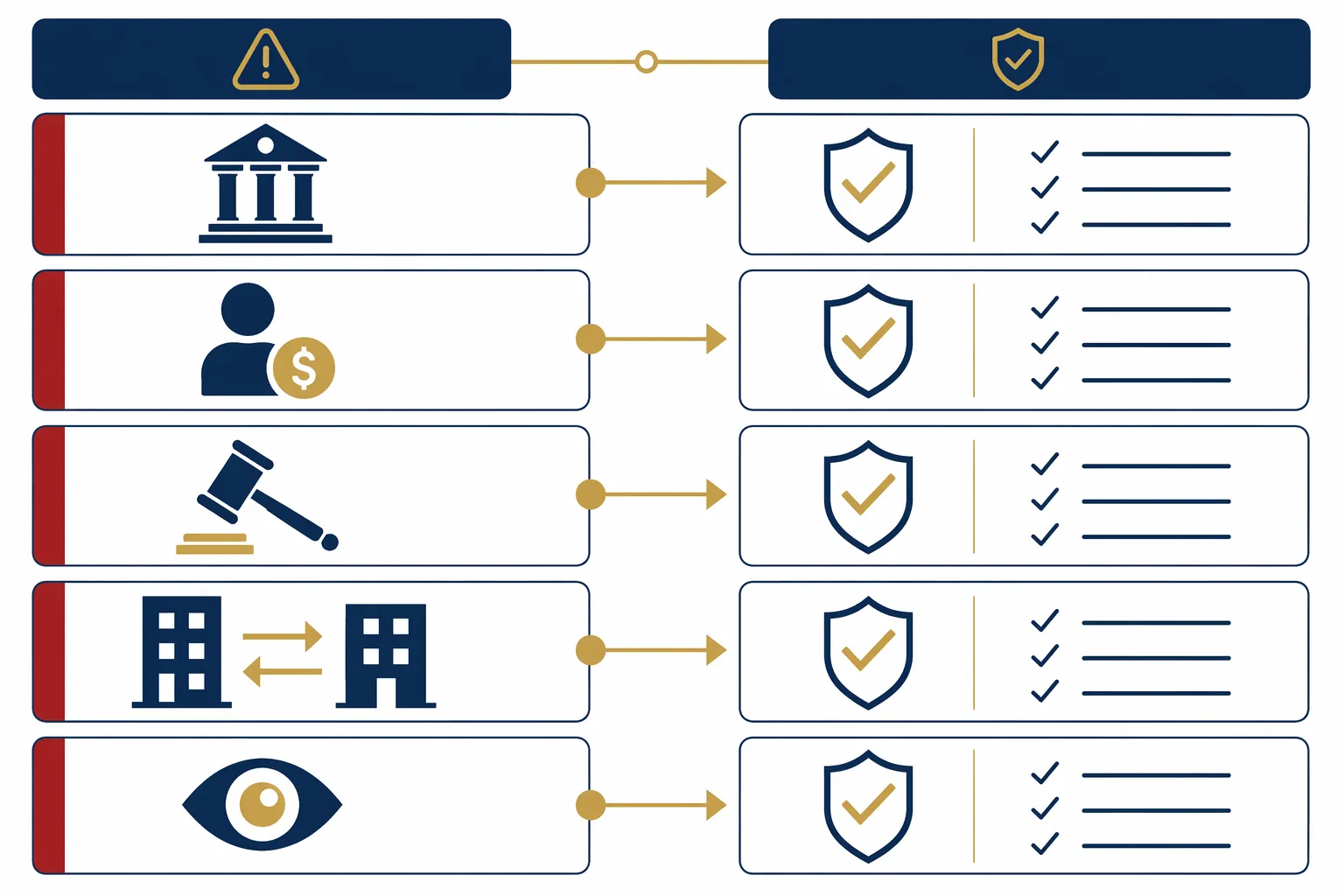
The Red Flags That Belong on a Risk Committee Agenda
The DOJ’s sentencing account establishes the core tax and mortgage-fraud findings: Goldstein concealed more than $25 million in income between 2016 and 2023, depriving the IRS of more than $9.5 million in taxes, and omitted more than $15 million in gambling debts from mortgage applications for a $2.6 million Washington, D.C. home while obtaining a $1.98 million loan.[1] AP’s sentencing coverage similarly described the conviction and sentence in the tax-evasion case, while noting the gambling-related context.[2]
Bloomberg Law’s February 2025 deep dive is important for control design, but its most operationally useful facts came from indictment-stage allegations. Those details should be treated as prosecution claims unless separately established in the sentencing record. With that boundary in place, the reporting describes alleged firm-account wires for gambling payments, legal-fee coding of personal expenses, a $500,000 poker-related investment from another law firm, and payroll or benefits arrangements for at least a dozen women who allegedly did not perform the work associated with those benefits.[3]
| Red flag category | Publicly reported fact or allegation | Control failure suggested | Verification step |
|---|---|---|---|
| Firm-account misuse | Prosecution allegations reported by Bloomberg Law described gambling payments routed through firm accounts and characterized as legal-fee expenses.[3] | Partner expenses were apparently able to pass through firm books without independent owner-level challenge. | Require partner expense review by someone outside the partner’s reporting chain, with sampling of legal-fee descriptions against invoices, client matters, and payee identity. |
| Payroll and benefits | Indictment-stage reporting described at least a dozen women allegedly placed on payroll and health benefits for work not performed.[3] | Employment status and benefits eligibility may have been treated as administrative entries rather than work-backed approvals. | Tie payroll, benefits, and contractor onboarding to documented role, supervisor, work records, and periodic recertification. |
| Public tax liens | DOJ described IRS liens on Goldstein’s Chevy Chase residence in the tax-evasion record.[1] | Public financial distress indicators did not appear to trigger a partner-risk review. | Adopt public-record escalation rules for equity partners and finance-authorized partners, with documented review rather than automatic discipline. |
| Cross-firm money movement | Bloomberg Law reported a prosecution allegation that another law firm sent $500,000 as an investment in poker winnings, deposited into Goldstein’s gambling account.[3] | Unusual inter-firm transfers may have escaped AML-style purpose, source, and beneficial-interest review. | Review non-client, non-referral, and non-settlement transfers between law firms for purpose, documentation, and personal-benefit risk. |
| Outside income and hidden accounts | DOJ said Goldstein concealed more than $25 million in income from 2016 to 2023; the record also referred to money moving through foreign accounts and cryptocurrency.[1] | Outside financial activity could remain invisible until tax enforcement exposed it. | Use annual outside-income and high-risk financial activity certifications for partners with management, billing, or trust-account authority. |
| Borrowing disclosures | DOJ said Goldstein omitted more than $15 million in gambling debts from mortgage applications while obtaining a $1.98 million loan.[1] | Personal borrowing misstatements may not directly involve the firm, but they indicate honesty and financial-pressure risk. | Define when known fraudulent borrowing, liens, or creditor actions must be escalated to firm risk leadership. |
Where Ordinary Policies Often Stop Short
Most law firms have policies for expenses, conflicts, outside business activity, payroll authorization, and professional conduct. The harder question is whether those policies apply with equal force when the actor is an owner, a founder, a major originator, or the person whose name sits on the door. That is where written controls often become etiquette.
Expense rules are a good example. A junior lawyer who submits a questionable meal receipt may trigger an administrative request within days. A powerful partner who approves a transfer, labels it as a professional expense, or asks accounting to process something unusual may receive courtesy first and scrutiny later. The Goldstein allegations are a reminder that the control should follow the transaction, not the seniority of the person requesting it.
That does not mean every partner reimbursement should be treated as suspicious. It means the firm should decide, before the crisis, which facts require verification: a payee unrelated to a client matter, repeated round-dollar transfers, payments to gambling-related counterparties, legal-fee descriptions with no file number, or personal debts passing through a firm-controlled account. Those are not character judgments. They are accounting events.
The same problem appears in payroll. Firms tend to be careful when hiring lawyers, paralegals, and staff into ordinary roles because there are interviews, supervisors, timekeeping systems, equipment requests, and performance expectations. Sham-employment risk grows in the gaps: special assistants, personal aides, short-term consultants, loosely described administrative support, or people whose benefits eligibility is processed without the same work-record trail. If the indictment allegations are correct, the failure was not merely that names appeared on payroll; it was that the payroll system did not force enough questions about what work justified salary and health benefits.[3]

Controls That Create Friction Before the Subpoena
A useful post-incident review does not ask whether the firm had a policy in a binder. It asks who would have seen the anomaly, what authority that person had, and whether the person could escalate without asking permission from the same partner whose conduct was being reviewed.
Partner Expense Review
Partner expenses should be reviewed under a standard that is independent of origination credit, title, or ownership percentage. The reviewer does not need to second-guess legitimate business development. The reviewer does need to match payment purpose to a client matter, firm business purpose, approved vendor, or documented exception.
- Flag legal-fee or professional-services descriptions that do not identify a matter, client, counterparty, or engagement.
- Require secondary approval for payments benefiting the approving partner personally.
- Sample owner expenses periodically, rather than only reviewing staff and associate submissions.
- Give accounting personnel a protected route to ask risk leadership for review without escalating through the requesting partner.
Payroll and Benefits Validation
Payroll controls fail quietly when everyone assumes someone else confirmed the work. For lawyers and regular staff, that confirmation is often embedded in ordinary operations. For unusual hires, the firm should make the work record explicit.
- Require a named supervisor who is responsible for confirming actual work performed.
- Document role, expected duties, compensation basis, and benefits eligibility before payroll entry.
- Recertify nonstandard employees, consultants, and partner-sponsored hires on a set schedule.
- Separate personal-assistance arrangements from firm employment unless the business purpose is documented and approved.
Tax Liens and Public-Record Escalation
A tax lien is not proof of professional misconduct. It is, however, a public financial-pressure signal. DOJ’s account of IRS liens on Goldstein’s residence matters for law-firm governance because it shows a point where a noninvasive review could have occurred before criminal prosecution became the firm’s first serious information event.[1]
The better policy is not constant surveillance of every lawyer’s personal life. It is a defined escalation rule for partners whose roles create firm exposure: equity partners, managing partners, finance committee members, lawyers with trust-account authority, and lawyers who can direct firm funds. If a public lien, bankruptcy filing, creditor judgment, or comparable event appears, the firm can require a confidential review of whether the issue affects client funds, firm accounts, insurance disclosures, borrowing covenants, or professional-conduct obligations.
Cross-Firm Transfers and Outside Money
The alleged $500,000 transfer from another law firm as a poker-related investment is exactly the kind of fact that can look too strange for an existing policy and therefore fall through it.[3] It is not a client settlement. It is not a referral fee in the ordinary sense. It is not a vendor payment. Because it does not fit the familiar boxes, someone has to be assigned to ask the basic questions.
- What is the business purpose of the transfer?
- Who is the beneficial recipient?
- Does the transfer relate to a client matter, a personal investment, a loan, or a side business?
- Does any lawyer have a personal financial interest that should be disclosed?
- Does the transaction create tax, conflicts, fee-sharing, AML, or professional-responsibility concerns?
Law firms are not banks, but they are not immune from money-movement risk. A boutique firm that moves funds for clients, partners, litigation expenses, investments, or inter-firm arrangements needs a lightweight version of source, purpose, and authority review. The point is not to build a bank compliance department inside every partnership. The point is to prevent firm channels from becoming convenient plumbing for personal financial activity.
Outside Income and High-Risk Activity Disclosures
DOJ said Goldstein concealed more than $25 million in income over several years.[1] A firm may not be able to verify every partner’s outside financial life, and it should not pretend that annual certifications are magic. Still, certifications force an answer to exist. They also give risk leadership a basis to ask follow-up questions when other facts appear inconsistent.
For higher-risk roles, an outside-income disclosure should cover more than board seats and conventional business ventures. It should ask about personal investment syndicates, gambling-related income, cryptocurrency activity, foreign accounts, loans from clients or lawyers, and arrangements where firm resources are used in connection with nonfirm income. A “yes” answer should not automatically be punitive. A false “no” should have consequences.
The Hierarchy Problem a Checklist Cannot Solve
It is easy, after a sentencing, to say that someone should have stopped the pattern earlier. Inside a small elite firm, the person who sees the first odd entry may be an administrator, bookkeeper, benefits manager, junior partner, or outside accountant facing a dominant lawyer whose reputation brings work, media attention, and institutional identity. That hierarchy is not an excuse for weak controls, but it explains why controls that depend on personal courage are unreliable.
A functioning partner-conduct system reduces the amount of bravery required. It gives the finance team objective triggers. It gives the managing partner a rule to enforce rather than a personal confrontation to initiate. It gives the risk committee authority to ask for documents before the issue becomes a loyalty test.
| If the firm sees this | The first question should be | Who should receive it |
|---|---|---|
| Partner expense with vague legal-fee coding | What matter, invoice, or business purpose supports the payment? | Finance reviewer and risk partner |
| Partner-sponsored employee with unclear duties | Who supervises the work and what records show it was performed? | HR, benefits lead, and operating partner |
| Public tax lien involving an equity partner | Does this affect client funds, firm finances, insurance, or professional obligations? | General counsel or risk committee chair |
| Large nonclient transfer from another law firm | What is the purpose, source, and beneficial recipient of the funds? | Finance committee and conflicts/risk team |
| Outside income inconsistent with disclosures | Was the activity disclosed, and were firm resources involved? | General counsel and managing partner |
The uncomfortable part is that partner status often weakens the very systems designed to protect the firm. Staff may assume owners can approve exceptions for themselves. Other partners may hesitate because a high-originating lawyer can make the conversation feel existential. A risk policy that does not address that social reality will look orderly on paper and perform badly in the room.
Professional Responsibility Is a Separate Track
The sentencing record should not be confused with a completed attorney-discipline outcome. As of July 26, 2026, the research materials identify a pending D.C. Bar disciplinary matter, but they do not provide a final public suspension or disbarment order specific to Goldstein.[4] D.C. Bar Rule XI Section 10 provides for automatic interim suspension after certain serious crimes, and Maryland precedent treats fraudulent tax non-filing as presumptively disbarrable, but those authorities are framework materials rather than a final discipline result in this matter.[4][5]
Risk managers tracking the professional-conduct implications should keep the tracks separate: criminal sentencing, tax restitution, bond status, licensing status, malpractice or insurance disclosures, and internal governance are related but not interchangeable. For a broader attorney-conduct framework, including Rule 8.4 analysis in a different risk context, see the Risk Digest discussion of AI hallucinations and attorney ethics. For the broader federal tax-fraud penalty framework, see the overview of tax fraud charges and legal implications.
A Prioritized Control Lens
No internal policy can guarantee that a determined partner will not deceive colleagues, tax authorities, lenders, or firm administrators. The Goldstein matter does not prove that partner criminality is common. It does show that policies are weakest where prestige, ownership status, and informal trust suppress ordinary verification.
- Start with firm money: identify every route by which a partner can direct, approve, describe, or receive firm funds.
- Then review payroll and benefits: require work-backed documentation for every nonstandard employee or partner-sponsored arrangement.
- Add public-record escalation: decide which liens, judgments, bankruptcies, or creditor actions require confidential risk review for equity partners.
- Screen unusual transfers: apply source, purpose, and beneficial-recipient review to nonclient money moving between firms or through firm accounts.
- Refresh outside-income certifications: ask about high-risk financial activity in terms specific enough to be useful.
- Protect escalation: make sure the person who sees the anomaly can reach risk leadership without seeking approval from the partner involved.
That is the practical value of the case for a law-firm risk committee. The lesson is not to moralize after sentencing. It is to find the places where partner discretion has quietly become exemption, and to put verification back into the workflow before the next administrator, benefits manager, or risk partner is left reconstructing the file after the fact. Readers needing the full case metadata can return to the Goldstein sentencing record; readers tracking discipline and professional-responsibility implications should pair it with the professional-responsibility framework.
References
- Prominent Attorney Sentenced to Prison for Tax Evasion and Mortgage Fraud, Department of Justice, Press Release 26-852
- Thomas Goldstein Supreme Court Blog Tax Evasion, AP News
- Gambling With the Law: How SCOTUSblog’s Goldstein Risked It All, Bloomberg Law, February 2025
- Pending Cases, D.C. Bar
- Attorney Grievance Commission v. Worsham, Maryland Courts, 2014
Related records
Tool profile
How Meta's AI Spending Reshapes Law Firm ProfitabilityGoverning regulation
Browse the obligations tracker →Preventive workflow
Browse verification workflows →
Report a correction or tip
Spotted an outdated figure, a misstated fact, or a ruling this case record should reflect? Public comments are disabled for this content given the professional cost of a misreported case outcome, penalty amount, or rule text — use the structured correction channel instead.
Report a correction or tip for this record →