
Can governments stop Microsoft's AI data center buildout?
A distinct regulatory track now shapes Microsoft's AI data center buildout: moratoriums, bans, and grid conditions with different legal force, from New York's one-year permit pause to Amsterdam's 2030 bar. This jurisdiction-by-jurisdiction tracker flags each restriction's status and separates binding obligations from Microsoft's voluntary Community-First commitments.
- Jurisdiction
- US-NY, US-CA, US-ME, US-WI, NL, IE, DK, AU
- Court
- Various state, municipal, and grid authorities
- AI tool named
- Microsoft AI data center infrastructure
- Ruling date
- Jul 14, 2026
- Source document
- View primary court order ↗
- Last verified
- Aug 4, 2026
Lex Machina Review is an independent risk-tracking and reference resource. Nothing on this site is legal advice, and using it does not create an attorney-client relationship. Every record is reviewed against primary sources but may not reflect the most current status of a matter — always verify directly against the cited court order, rule text, or a licensed attorney before relying on it.
Companion explanation — secondary to the source document above
Last verified: 2026-08-04 UTC. This tracker is for general information and is not legal advice. Status flags below distinguish enacted restrictions, vetoed or pending proposals, operator policies, reported permitting strategies, and voluntary corporate commitments; local counsel should verify the current instrument before relying on it for siting, procurement, or investment decisions.
For anyone tracking the legal implications of Microsoft’s AI data center infrastructure, the answer to the immediate question is narrow but important: governments can stop or condition particular data center projects in particular places, but the legal force depends on the instrument. A one-year state permit pause, a permanent city ban, a grid-connection condition, and a corporate pledge are not interchangeable.
| Jurisdiction / authority | Instrument or action | Trigger or scope | Status as of 2026-08-04 UTC | Practical legal effect |
|---|---|---|---|---|
| New York / state and Department of Environmental Conservation | One-year moratorium directing DEC to withhold new discretionary permits | Facilities of 50 MW or more | Enacted restriction, reported July 2026 [1] | A project needing a new discretionary DEC permit in the covered class faces a state permit gate; this is not merely a political proposal. |
| Monterey Park, California / city voters | Permanent city ban adopted by ballot initiative | Data centers within the city | Enacted municipal ban by June 2026 ballot initiative [1] | A land-use prohibition at the municipal level; it blocks the use in that city rather than regulating Microsoft as a company. |
| Maine / state legislature and governor | Proposed 18-month moratorium vetoed by governor | Facilities of 20 MW or more | Vetoed; not in force on this record [1] | Relevant to political risk, not an operative siting bar unless a new measure is enacted. |
| Amsterdam / municipal authority | Bar on new data centers until at least 2030 | New data centers in Amsterdam | Binding local restriction, industry-wide, not identified as Microsoft-specific [1] | A hard local bar for new projects within the covered geography. |
| Dublin, Ireland / grid operator policy | Connection freeze ended in December 2025 only for projects with on-site power generation | Projects seeking grid connection in the Dublin area | Operator policy, industry-wide, not identified as Microsoft-specific [1] | Controls access to the grid rather than zoning; a project may be legally permitted on land but still unable to connect on ordinary terms. |
| Denmark / national policy proposal | Draft grid-priority law | Grid access or priority for large loads, as reported | Draft / pending; not identified as Microsoft-specific [1] | A legislative risk signal, not a current binding obligation on this record. |
| Australia / planned rules | Planned data center rules | Industry context, details pending in the cited record | Planned / pending; not identified as Microsoft-specific [1] | A watch item for future compliance design, not yet an enacted restriction on this record. |
| Netherlands / reported permitting strategy | Reported January 2026 approval strategy splitting a project into three towers below the Dutch hyperscale threshold | Dutch hyperscale threshold; three reported sub-threshold towers | Reported by Reuters; primary approval record not supplied here [1] | Legally interesting because thresholds can shape project architecture, but it should not be treated as a confirmed precedent beyond the reported record. |
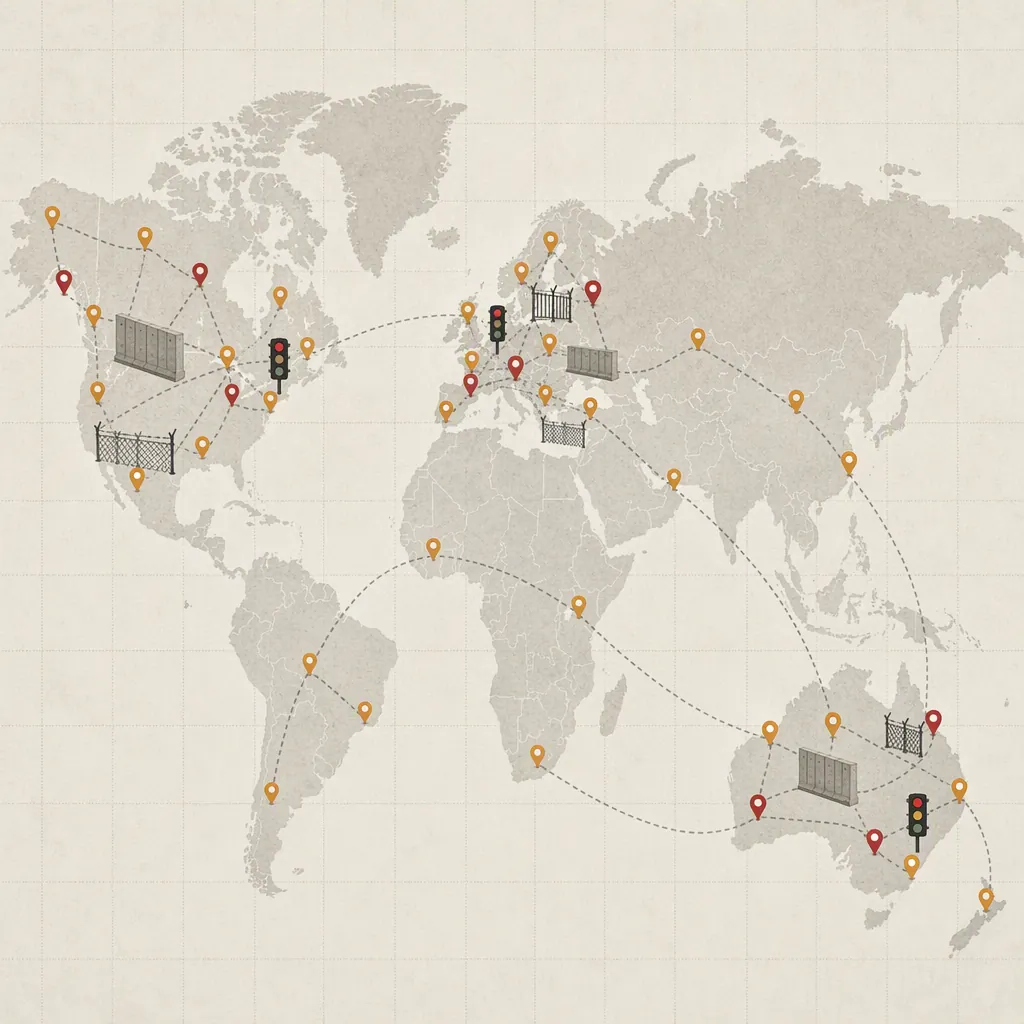
The instrument matters more than the announcement
The records above do not describe one global crackdown. They describe several different legal tools that happen to converge on the same infrastructure category. The distinction is not academic. It determines who can enforce the rule, what Microsoft or another operator can appeal, and whether a project is blocked at the permit counter, the zoning map, the grid queue, or the rate case.
- An enacted moratorium temporarily withholds a government approval. New York’s record is the cleanest example in this file because the operative verb is “withhold,” the agency is DEC, and the threshold is stated as 50 MW or more [1].
- A permanent municipal ban changes the local land-use baseline. Monterey Park’s ballot initiative is narrower geographically than a state moratorium, but stronger inside the city because the restriction is not temporary on the cited record [1].
- A vetoed bill is not a restriction. Maine’s proposed 18-month moratorium for 20 MW-plus facilities matters for political due diligence, but the governor’s veto keeps it out of the binding-obligation column [1].
- A grid-operator condition may be more decisive than a land-use approval. Dublin’s December 2025 shift allowed connections only for projects with on-site generation; that is a power-access rule, not a citywide zoning ban [1].
- A draft or planned statute belongs in the watch list, not the compliance register. Denmark and Australia should be monitored, but the cited record does not make them current Microsoft-specific obligations [1].
- A voluntary corporate commitment is not self-enforcing just because it is specific. It becomes legally durable when carried into a tariff, permit condition, development agreement, water contract, tax agreement, or other enforceable instrument.

New York: a state permit pause with a megawatt threshold
New York is the record to read first because it reaches the state permitting process directly. Reuters reported in July 2026 that the state imposed a one-year moratorium directing the Department of Environmental Conservation to withhold new discretionary permits for facilities of 50 MW or more [1].
That wording does several things. It gives the restriction an agency home. It identifies a threshold. It also limits the practical conclusion: the pause matters where a covered facility needs a new discretionary DEC permit. It does not, from this record alone, prove that every data center activity in New York is frozen, that the moratorium is permanent, or that Microsoft is singled out by name.
For project diligence, the first question is therefore not whether the facility is “AI-related.” It is whether the proposed load and permitting path put it inside the 50 MW-plus category and inside DEC’s discretionary approval process. If the answer is yes, a procurement commitment that assumes normal permitting speed is carrying a real regulatory timing risk.
Monterey Park: a city can make the answer no
Monterey Park supplies the clearest municipal example in the cited record. By June 2026 ballot initiative, the city became the first U.S. city to permanently ban data centers, according to Reuters [1]. The legal effect is geographically small and locally severe: inside that city, the use is barred.
That is different from a temporary permit pause. A city ban does not need to supervise every later water, power, or emissions condition if the land use itself is prohibited. It also means the analysis is municipal, not corporate. The ban is not a global restraint on Microsoft, OpenAI, Amazon, Google, or any other buyer of compute capacity. It is a local rule that can make a particular parcel unavailable for the prohibited use.
The lesson for site selection is blunt: once the ordinance line is crossed, mitigation promises may be irrelevant unless the local law contains a path for amendment, repeal, variance, or judicial challenge. The research file here does not supply those later procedural paths for Monterey Park, so the tracker should stop at the verified status: permanent city ban on the cited record.
Maine shows why proposed moratoriums need a separate column
Maine should not be grouped with New York or Monterey Park as if all three imposed live restrictions. The cited record says Maine’s governor vetoed an 18-month moratorium that would have applied to facilities of 20 MW or more [1]. A vetoed bill can still influence negotiations, utility planning, and public hearings. It does not itself create a binding permit bar.
This is where many data center restriction maps become misleading. They count introduced bills, enacted moratoriums, ballot ordinances, and grid policies together. Counsel cannot. A veto changes the legal answer even if the political controversy remains.
Amsterdam and Dublin: European constraints can sit outside ordinary land-use law
Amsterdam’s record is a hard local bar: new data centers are barred until at least 2030, according to Reuters [1]. That belongs in the same practical family as a municipal land-use stop, even though the local legal mechanics differ by jurisdiction. The compliance conclusion is straightforward enough for a tracker: new projects in the covered area face a local prohibition through the reported period.
Dublin is different. Reuters reported that Ireland’s grid operator ended a Dublin connection freeze in December 2025 only for projects with on-site power generation [1]. That is not a ban on owning land or applying for a building approval. It is a condition on power access. For a hyperscale facility, however, a connection condition can be just as consequential as a zoning denial. A data center without a viable power path is not a buildable project in any commercial sense.
Denmark and Australia sit one step further back in the file. Denmark’s draft grid-priority law and Australia’s planned rules are relevant to forward-looking contract and location review, but the cited record labels them as pending or planned context, not enacted Microsoft-specific restrictions [1]. They should be watched, not treated as present prohibitions.
The Netherlands threshold-split report is a warning about rule design
The Dutch item is not a conventional restriction record. Reuters reported that a January 2026 approval in the Netherlands was engineered by splitting a project into three towers, each below the Dutch hyperscale threshold [1]. The research file does not include the primary approval record, so the safest treatment is as a reported strategy rather than a verified doctrinal precedent.
Still, it is legally instructive. Thresholds make administration possible, but they also invite structuring. If a rule regulates “hyperscale” facilities only above a defined size, the next question will be whether multiple adjacent or related components should be aggregated. Regulators who do not answer that question in the instrument may find themselves litigating form over substance later.
Microsoft’s Community-First plan is a legal strategy, but not automatically a legal obligation
Microsoft’s January 13, 2026 Community-First AI Infrastructure announcement should be read as a response to this regulatory environment, not as a substitute for it. The company committed to covering full power costs through utility rates, rejecting local property-tax breaks, improving water intensity by 40% by 2030, and replenishing more water than it uses in each data center district [2][3].
Those promises matter because they line up with the pressure points in the tracker: power, taxes, water, and local trust. They do not all have the same enforceability. A “full power costs” commitment becomes concrete when a public utility commission approves a rate design, a tariff assigns costs, or a utility contract allocates responsibility. A no-tax-breaks position becomes concrete when a development agreement, incentive package, or local tax record shows that the benefit was not taken. A water replenishment pledge becomes enforceable only to the extent it is built into a permit, contract, mitigation agreement, or other binding document.
Microsoft pointed to Wisconsin’s “Very Large Customers” rate structure as the model and said it had contracted for 7.9 GW of new generation in the MISO region [2]. Those are not minor public-relations details. They show the company trying to move hyperscale load out of the ordinary residential-rate anxiety channel and into a more administrable tariff and generation-planning framework.
The rate anxiety is not speculative as a political matter. GeekWire reported that three Democratic senators opened a December 2025 probe into whether tech giants were raising residential electricity bills, and it tied that inquiry to 12% to 16% residential price increases in Virginia, Illinois, and Ohio over the prior year, citing U.S. government data [3]. That does not prove that Microsoft caused those increases. It does explain why rate design has become part of the legal strategy.
Power costs are becoming a siting condition by another name
A county board can say no through zoning. A state environmental agency can pause discretionary permits. A grid operator can condition connection. A utility commission can decide who pays for the infrastructure needed to serve a very large load. For Microsoft, the last category may be the most repeatable legal battlefield because it follows the company across jurisdictions even where no data center moratorium exists.
The practical concern is cost shifting. If new generation, transmission upgrades, capacity obligations, or reliability measures are built to serve hyperscale demand, the regulatory question is whether those costs sit with the hyperscale customer, the utility’s general rate base, or some combination approved by the relevant commission. Microsoft’s stated willingness to cover full power costs is therefore legally meaningful only when the rate instrument shows how “full” is measured.
That is why the Wisconsin model deserves more attention than a generic pledge. A “Very Large Customers” rate class can create an administrable box for loads whose size would otherwise blur into systemwide planning. The cited Microsoft material does not make that model binding everywhere; it shows the kind of tariff architecture Microsoft wants regulators to accept [2].
Transparency has moved from courtesy to litigation risk
Microsoft also said it would end nondisclosure agreements with local governments, a change the company described in a Microsoft Local post [4]. In a data center siting dispute, that is not a soft reputational point. NDAs affect what municipal clerks can release, what residents can test against public records laws, and what local officials can explain before a vote.
The Racine, Wisconsin transparency dispute shows the point. Wisconsin Public Radio reported on a lawsuit seeking to force release of projected water use by Microsoft data centers, and Midwest Environmental Advocates describes the matter as a legal action demanding transparency about environmental impacts [5][6]. That suit is a records-access fight, not a data center ban. But records-access fights can shape the permitting atmosphere in which water, sewer, and land-use approvals are later judged.
For readers tracking the broader nuisance, environmental, land-use, and enforcement docket, this article is the restriction-side complement to Why Microsoft’s AI data center buildout is a legal docket. A July 2026 WilmerHale client alert described an emerging wave of nuisance, environmental, and land-use litigation around data centers and, citing DOE national laboratory work, reported a projection that data centers could account for 6.7% to 12% of U.S. electricity use by 2028 [7]. That projection is not a Microsoft-specific legal obligation; it is part of the reason agencies and utility commissions are being asked to make the load visible.
What a restriction tracker can and cannot answer
A tracker can answer whether a named authority has changed a project’s legal path. It can say that New York has a one-year 50 MW-plus permit pause on the cited record, that Monterey Park has a permanent municipal ban, that Maine’s moratorium was vetoed, that Dublin’s grid access now turns on on-site generation, and that Amsterdam bars new data centers until at least 2030 [1].
It cannot answer whether governments can “stop Microsoft” in the abstract. Microsoft can move projects, restructure loads, contract for generation, accept a special rate class, decline tax incentives, disclose more local information, or build commitments into enforceable agreements. Those adaptations may reduce opposition, but they do not erase the underlying public-law gates.
The clean legal conclusion is narrower and more useful: governments already can slow, ban, or condition AI data centers in specific places when they use a binding instrument. Microsoft’s Community-First plan and rate-design moves are meaningful because they respond to permitting, tariff, tax, water, transparency, and grid pressures. They become enforceable when they are embedded in a statute, ordinance, tariff, permit condition, contract, or operator rule.
For record-level dispute tracking, filter the underlying litigation and public-records matters in Risk Digest; for penalty caps, EU AI Act obligations, and the broader Microsoft docket, use the companion Microsoft AI data center legal-docket reference.
References
- Where are authorities restricting data centres amid AI boom — Reuters, July 14, 2026.
- Building Community-First AI Infrastructure — Microsoft On the Issues, January 13, 2026.
- Microsoft responds to AI data center revolt, vowing to cover full power costs and reject local tax breaks — GeekWire, January 13, 2026.
- Putting communities first: Our decision to end NDAs with local governments — Microsoft Local.
- Lawsuit seeks to force release of projected water use by Microsoft data centers — Wisconsin Public Radio.
- Demanding transparency about the environmental impacts of data centers — Midwest Environmental Advocates.
- Data Centers in Court: The Emerging Wave of Nuisance, Environmental, and Land Use Litigation — WilmerHale, July 13, 2026.
Related records
Tool profile
How Meta's AI Spending Reshapes Law Firm ProfitabilityGoverning regulation
Browse the obligations tracker →Preventive workflow
Browse verification workflows →
Report a correction or tip
Spotted an outdated figure, a misstated fact, or a ruling this case record should reflect? Public comments are disabled for this content given the professional cost of a misreported case outcome, penalty amount, or rule text — use the structured correction channel instead.
Report a correction or tip for this record →