
Minnesota Water Cyberattack Legal Risk Hinges on Attribution
Formal attribution is the decisive legal question in the July 2026 Minnesota water facility cyberattack. If Iran's involvement is confirmed, utilities face hostile-or-warlike-action exclusion fights with insurers bearing the burden of proof; absent customer-data access, plaintiffs pivot to operational-disruption and municipal-immunity claims.
- Jurisdiction
- US-Minnesota
- Court
- No court proceeding
- AI tool named
- None
- Source document
- View primary court order ↗
- Last verified
- Aug 4, 2026
Lex Machina Review is an independent risk-tracking and reference resource. Nothing on this site is legal advice, and using it does not create an attorney-client relationship. Every record is reviewed against primary sources but may not reflect the most current status of a matter — always verify directly against the cited court order, rule text, or a licensed attorney before relying on it.
Companion explanation — secondary to the source document above
The legal record today is operational, not adjudicative
As of Aug. 4, 2026, the Minnesota water facility cyberattack is not yet a litigation record. There are no court filings, penalties, or sanctions tied to this specific incident in the available record. That matters because the legal implications are not fixed by the public phrase “Iran-linked” or by the number of affected utilities. They turn on a narrower fork: whether formal attribution can support an insurance exclusion, and what claims remain if attribution never reaches that level.
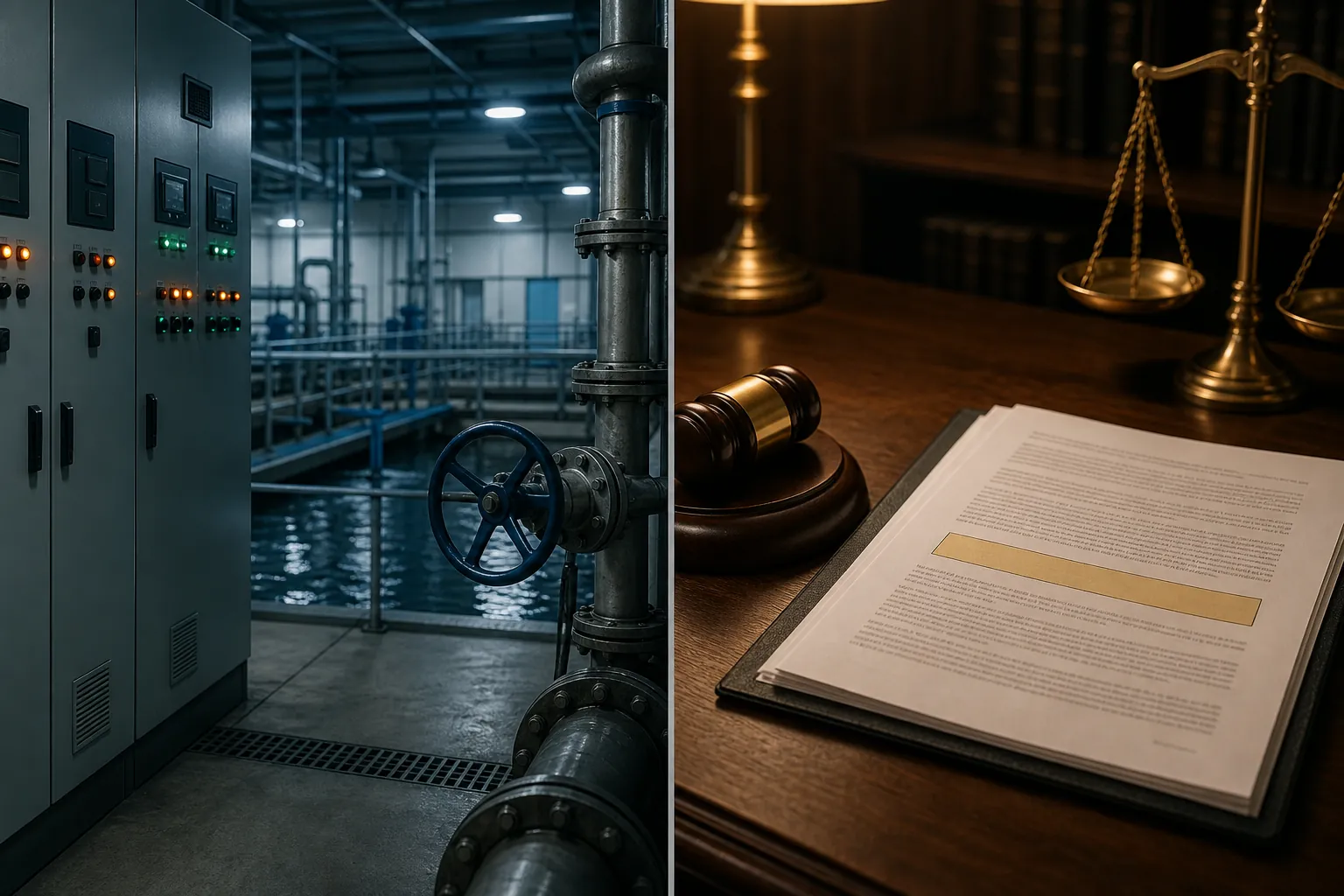
The operational facts are concrete enough to create claims-notice, coverage, privilege, and public-authority problems. CISA’s July 30 alert described activity targeting internet-facing operational technology in the water and wastewater sector, including changed passwords and IP addresses on programmable logic controllers, boil-water notices, and sustained manual operations after the intrusions. [1] The FBI and EPA public service announcement the same day likewise described malicious actors targeting internet-facing PLCs and causing operational disruptions. [2]
Reuters reported Minnesota officials disclosed a coordinated cyberattack on more than 30 local water systems, with Minnesota IT Services CISO John Israel putting the range at approximately 36 systems; the named affected communities included Plymouth, South St. Paul, Maple Plain, and Braham. [3] Those numbers establish scope. They do not, by themselves, establish who did it, whether a sovereign-directed exclusion applies, whether any resident has a viable damages theory, or whether a regulator will find a utility failed a cybersecurity duty.
That distinction frames the legal question because the exposure that is real today is not the same as the exposure that could exist after a formal attribution finding. Today’s file contains disrupted operations, public notices, manual workarounds, incident response, and preliminary public blame. A later file may contain classified indicators, agency conclusions, sanctions designations, or criminal allegations. Coverage counsel should not treat those as the same evidentiary object.
| Record item | What it supports now | What it does not yet prove |
|---|---|---|
| CISA and FBI/EPA notices describing targeting of internet-facing PLCs | Operational disruption, claims-notice triggers, incident-response documentation, and cyber-risk controls relevant to underwriting and coverage | A court-ready finding that Iran, an Iranian state organ, or a sovereign-directed actor caused a particular loss |
| Reuters reporting on 30-plus systems and an approximately 36-system range | A multi-utility incident with named affected municipalities and potential aggregation questions | A single legal cause, a unified damages model, or a confirmed common defendant |
| Public reporting and political statements about Iran-linked suspicion | A reason insurers and insureds will preserve attribution evidence | A completed hostile-or-warlike-action exclusion defense |
| Reported absence of customer-data access and water-quality compromise for South St. Paul and no reported water-use changes by affected state cities | A weaker fit with ordinary consumer data-breach negligence pleadings | No liability at all; operational-disruption and notice-based theories remain possible |
The broader negligence, privilege, and response map belongs in the companion record on litigation risk from Iran-suspected water cyberattacks. The base four-front overview is separately tracked in Legal Implications of the Minnesota Water Cyberattack. This piece stays on the coverage-attribution fork because that is where one missing fact can change the entire insurance posture.
Preliminary attribution is not a coverage conclusion
Public attribution is unsettled. CBS News reported that U.S. officials were investigating whether Iran was behind the Minnesota water-system cyberattack. [4] TIME reported the political blame exchange around the incident, including President Trump blaming Minnesota Gov. Tim Walz and Walz blaming federal CISA cuts. [5] Those statements may shape public accountability. They do not answer the insurance question.
For coverage purposes, “suspected Iran-linked actors” is a starting notation, not a completed defense. A hostile-or-warlike-action exclusion is not activated merely because an incident involves critical infrastructure, foreign tooling, or a politically convenient adversary. The insurer still has to connect the policy language to the loss and prove the exclusion applies under the governing burden.
That is where the NotPetya coverage fights remain instructive. The Yale Law Journal essay on Mondelez v. Zurich explains the hostile-or-warlike-action exclusion problem in cyber insurance: the insurer seeking to avoid coverage bears the burden of proving that the exclusion applies, and attribution evidence can be technically ambiguous, classified, or difficult to translate into civil proof. [6] In the Minnesota water context, that means a carrier cannot simply point to public reporting about Iran-linked suspicion and stop. It would need evidence sufficient to prove that the relevant exclusion covers the actor, conduct, and loss at issue.
What formal attribution would change
Formal attribution would not automatically end the coverage analysis, but it would make the exclusion fight live. If investigators tie the PLC intrusions to Iran, an Iranian state organ, or a sufficiently state-directed group, insurers will look closely at hostile-or-warlike-action language, war exclusions, cyber-terrorism wording, state-backed cyber endorsements, aggregation provisions, waiting periods, notice conditions, and sublimits. The fight would then move from “who is suspected?” to “what does this policy exclude, and what proof can the insurer use?”
The insurer’s burden is not a paperwork detail. In a denial case, the carrier would have to prove the exclusion by the applicable standard, commonly framed in the Yale analysis as a preponderance problem in civil coverage litigation. [6] A utility’s counsel would then test whether the evidence actually proves sovereign perpetration or direction, whether the hostile or warlike character of the activity fits the policy wording, and whether the claimed losses were caused by excluded conduct rather than by covered cyber interruption, restoration, extra expense, crisis management, or public-relations costs.
This is also where classified or intelligence-derived attribution becomes awkward. A public agency may have good reasons to speak cautiously. An insurer may have strong incentives to cite that caution as enough. A court, however, will need admissible proof tied to the policy. Technical indicators, shared infrastructure, actor naming conventions, intelligence assessments, and government statements do not always collapse into one clear legal proposition. The Minnesota record should be preserved with that gap in mind.
The operational record matters even in the attribution fight because it defines the loss. CISA’s description of changed PLC passwords and IP addresses, boil-water notices, and manual operations points toward interruption, extra expense, restoration, and public-authority consequences rather than a simple theft-of-data event. [1] The FBI/EPA notice similarly frames the activity as PLC-targeted disruption in water and wastewater systems. [2] If a carrier later asserts a hostile-or-warlike-action exclusion, the insured will want a clean separation between the technical incident timeline, mitigation expenses, water-quality decisions, public notices, and any later intelligence conclusion.
The Mondelez lesson is about proof, not labels
Mondelez v. Zurich is often invoked as shorthand for cyberwar exclusions, but the useful lesson is narrower. The Yale essay treats the dispute as a proof problem: when an insurer invokes a hostile-or-warlike-action exclusion after a major cyber event, the insurer must establish the facts necessary to bring the loss within the exclusion, and attribution is often the hardest fact to prove in an ordinary civil forum. [6]
That proof problem has several layers in the Minnesota water incident. First, the actor has to be identified with enough precision to matter under the policy. “Iran-linked” may mean state-directed, state-tolerated, ideologically aligned, opportunistically reusing infrastructure, or simply suspected based on incomplete indicators. Those are different legal facts.
Second, the conduct has to fit the exclusion’s verbs and modifiers. Policies do not all use the same language. Some exclusions focus on war, invasion, hostilities, or acts by military forces. Others use broader hostile-or-warlike-action wording or newer state-backed cyber language. A PLC intrusion that changes passwords and forces manual operation is serious. Whether it is “warlike” within a policy is not settled by its seriousness.
Third, the exclusion has to reach the claimed loss. A water utility may submit costs for emergency labor, forensic work, system restoration, overtime, outside counsel, public communications, boil-water-notice administration, temporary controls, or business-interruption-type losses. The carrier may argue all of those losses flow from excluded hostile activity. The insured may argue some losses fall within separate grants of coverage or were incurred before any excluded cause can be proved. Those positions will depend on policy wording and the claim file, not on public commentary.
Fourth, the aggregation question is unresolved on the public record. Reuters’ 30-plus and approximately 36-system range helps show breadth, but it does not decide whether claims are one occurrence, multiple occurrences, a coordinated campaign, separate intrusions, or distinct losses for deductible and limit purposes. [3] Counsel should expect insurers to ask whether the affected systems share actor, method, timing, vulnerabilities, vendors, or command infrastructure. Insureds should expect to answer with evidence, not adjectives.
If attribution stalls, the claim file still moves
Unsettled attribution does not mean legal stasis. Municipalities and utilities still have to preserve logs, notify carriers, retain incident-response vendors, coordinate with state and federal authorities, make water-safety decisions, and decide what to tell residents. Insurers still have to reserve rights, investigate coverage, and avoid treating a suspicion as a denial ground before the evidence can carry it.
For insureds, the practical risk is that the same facts serve different legal audiences. The engineering team wants a technical timeline. The mayor or city administrator wants a public account. The carrier wants cause, cost, and mitigation proof. Regulators may want evidence of cyber controls. Plaintiffs’ lawyers will look for delay, inconsistent public statements, avoidable service interruption, or unnecessary boil-water burdens. The file should be built so those audiences can be served without casually waiving privilege or overstating attribution.
- Separate confirmed operational facts from reported attribution claims in board materials, public statements, and carrier notices.
- Track each cost category against policy grants: forensics, restoration, manual operations, overtime, outside counsel, communications, water testing, and public-notice work.
- Preserve the pre-incident control record for internet-facing PLCs, including credential practices, remote access, segmentation, patching, vendor support, and prior warnings.
- Avoid describing the event as state-sponsored in claim submissions unless the utility can identify the source and status of that attribution.
- Document why manual operations, boil-water notices, or service decisions were made at the time, not after the fact.
The compliance and enforcement posture is tracked separately in the site’s water utility cyber compliance record and the broader Iran water-attacks U.S. legal-response chronology. For coverage purposes, the immediate point is simpler: a carrier may reserve on hostile-or-warlike-action wording, but the denial case depends on proof that does not yet appear in the public record.
Why American Water is the wrong template for this incident, at least for now
The American Water litigation is useful mainly as a contrast. Menichini v. American Water Works Company, Inc. was filed in the District of New Jersey on Oct. 14, 2024, after American Water disclosed a cyberattack; the complaint followed the familiar consumer data-breach path, alleging negligence and related theories based on compromised personal information. [7] That is not the shape of the Minnesota water record as currently reported.
For South St. Paul, Reuters reported city officials said no resident or customer data was accessed, and the available reporting does not show water-use changes ordered by affected Minnesota cities. [3] That does not eliminate plaintiff risk. It narrows it. Without confirmed customer-data access or water-quality compromise, plaintiffs have a harder time using the standard data-breach negligence template: identity-theft risk, credit-monitoring costs, loss of privacy, and failure to protect personal information.
The more plausible civil-liability questions, if filings come, would arise from operational disruption. Did a utility’s control environment leave internet-facing PLCs exposed in a way plaintiffs can frame as unreasonable? Did a boil-water notice impose compensable costs? Did a business lose revenue because of water-use uncertainty? Did residents pay rates for service they claim was impaired? Did a municipal defendant have immunity or statutory defenses? Those questions are fact-intensive and local. They are not answered by the American Water pleadings.
The municipal posture is also different. American Water is an investor-owned utility defendant in a consumer data-breach suit. Minnesota municipal water systems bring public-entity defenses, public-duty arguments, emergency-response records, ratepayer issues, and local governance facts into view. The available record does not support Minnesota-specific statutory claims here, so the safer legal conclusion is categorical rather than jurisdictional: public water systems will fight a different liability battle from a private data-breach defendant.
The thin AI angle should stay thin
This incident should not be forced into an AI-filing-risk frame. The current legal record is about operational technology, public water systems, coverage exclusions, attribution proof, and possible service-disruption liability. Unless later filings introduce AI-generated representations, sanctions issues, or tool-specific evidence, AI is peripheral to the Minnesota coverage analysis.
That restraint matters because mislabeling the incident as an AI case would obscure the actual burden dispute. The hard legal question is not whether attackers used modern tools somewhere in the reconnaissance chain. It is whether an insurer can prove the facts required by a hostile-or-warlike-action exclusion and whether plaintiffs can plead injury without the usual data-breach facts.
Where the legal risk sits on Aug. 4
The present legal exposure falls into two tracks. The insurance track is attribution-sensitive. If formal investigators tie the PLC intrusions to Iran or state-directed Iranian activity, hostile-or-warlike-action exclusions become central, but the carrier still carries the burden of proving the exclusion applies. If attribution remains public, disputed, or classified beyond practical use in civil coverage litigation, insurers may reserve rights but will have a harder time converting suspicion into denial.
The civil-liability track is injury-sensitive. The reported absence of customer-data access and water-quality compromise pushes plaintiffs away from the American Water data-breach model and toward service interruption, boil-water-notice costs, ratepayer theories, regulatory injury, or public-entity duty arguments. Those claims may still be pleaded, but they will require different facts from the ordinary consumer breach complaint.
The Minnesota water attack’s most important legal question is therefore not whether Iran did it in the public-commentary sense. It is whether formal attribution can carry the burden required to activate hostile-or-warlike-action exclusions. Until that proof exists, the more immediate plaintiff-side exposure is likely to develop around operational disruption and municipal defenses, not around the American Water data-breach template.
References
- CISA Urges Water and Wastewater Systems Sector to Protect OT Against Activity Targeting PLCs — Cybersecurity and Infrastructure Security Agency, July 30, 2026.
- Malicious Cyber Actors Targeting Water and Wastewater Sector Internet-Facing Programmable Logic Controllers Causing Operational Disruptions — Federal Bureau of Investigation, July 30, 2026.
- Minnesota IT officials disclose coordinated cyberattack on more than 30 local water systems — Reuters, July 28, 2026.
- U.S. investigating Iran cyberattack on Minnesota water systems — CBS News.
- What to Know About the U.S. Water Systems Cyberattacks — TIME, Aug. 2, 2026.
- Prove It! Judging the Hostile-or-Warlike-Action Exclusion in Cyber-Insurance Policies — The Yale Law Journal.
- American Water Data Breach Lawsuit Filed in New Jersey Over 2024 Cyberattack — ClassAction.org.
Related records
Tool profile
Browse tool evaluations →Governing regulation
Browse the obligations tracker →Preventive workflow
Browse verification workflows →
Report a correction or tip
Spotted an outdated figure, a misstated fact, or a ruling this case record should reflect? Public comments are disabled for this content given the professional cost of a misreported case outcome, penalty amount, or rule text — use the structured correction channel instead.
Report a correction or tip for this record →