
No Foul Play Statement in Waddell Case Creates Legal Risk
This article examines the legal significance of Cailen Waddell's 'no foul play' statement regarding his wife Elizabeth's disappearance in Grenada, analyzing how the statement, issued amid circulating AI-generated deepfakes, creates compound risks for investigative triage, evidence preservation, and future admissibility in US proceedings.
- Jurisdiction
- Grenada
- Court
- Royal Grenada Police Force
- AI tool named
- Deepfake AI
- Ruling date
- Jul 29, 2026
- Source document
- View primary court order ↗
- Last verified
- Jul 31, 2026
Lex Machina Review is an independent risk-tracking and reference resource. Nothing on this site is legal advice, and using it does not create an attorney-client relationship. Every record is reviewed against primary sources but may not reflect the most current status of a matter — always verify directly against the cited court order, rule text, or a licensed attorney before relying on it.
Companion explanation — secondary to the source document above
On July 29, 2026, Cailen Waddell publicly said of his missing wife Elizabeth Waddell: “We join authorities in believing there was no foul play.” The sentence matters precisely because it does less than many readers may want it to do. It is not an official finding, not a closure order, and not a direction to stop submitting information. The Royal Grenada Police Force was still treating the matter as an active missing-person inquiry, even after hundreds of hours of search activity had failed to locate her.[1][2]
| Risk Record | Current Entry |
|---|---|
| Statement date | July 29, 2026 |
| Speaker | Cailen Waddell, husband of Elizabeth Waddell |
| Exact operative language | “We join authorities in believing there was no foul play.” |
| Official posture | RGDF active missing-person inquiry; not closed |
| AI-contamination caveat | AI-generated or fabricated public material had already been documented in public coverage, but no official source has confirmed that it affected the Grenada investigation |
| Jurisdiction caveat | Grenadian procedure controls the Grenada inquiry; US evidence doctrine is relevant only if later US-facing litigation, insurance, estate, civil, or related proceedings arise |
| Last verified | July 31, 2026, UTC |
| Related internal context | See prior coverage on Waddell AI misinformation and cross-border legal steps for US citizens missing abroad |
The useful legal question is therefore narrow: what happens when a spouse’s nonbinding public alignment with authorities enters a public record that already includes synthetic or fabricated material? The answer is not that the statement is suspicious. It is not that authorities are wrong. It is that public language can change what people think is still worth preserving, reporting, or authenticating.
That distinction matters in this case because the AI-misinformation environment was not hypothetical. Earlier coverage of AI misinformation in the Waddell disappearance documented the contamination issue before the July 29 statement existed. Separately, cross-border legal protocol for US citizens missing abroad remains relevant because a Grenada investigation does not become a US evidence problem merely because the missing person is American.
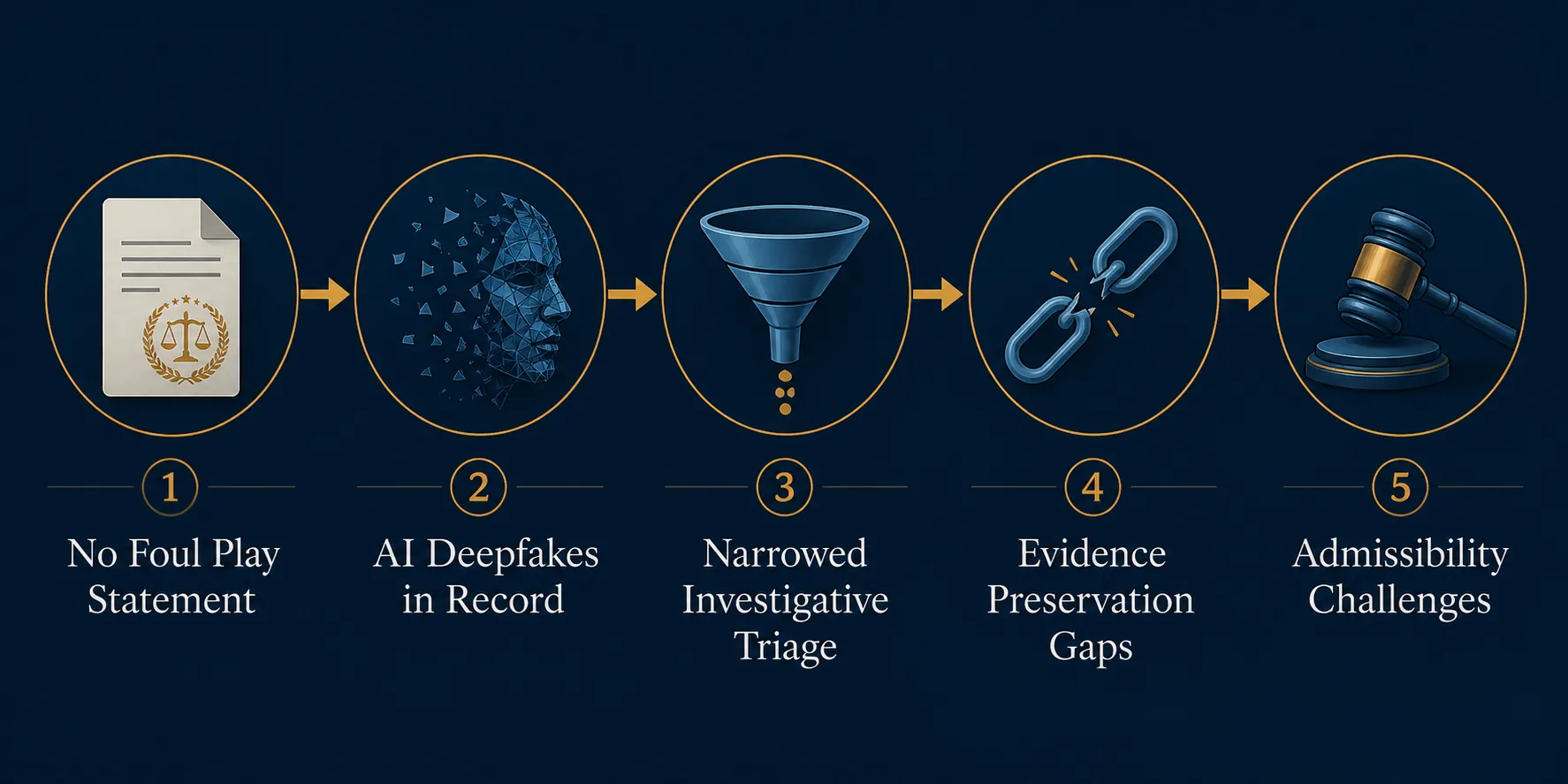
What the statement can and cannot do
The core Waddell facts are limited. Elizabeth Waddell, 44, was last seen in Grenada on July 22, 2026. Reported timelines place her at a jetty on surveillance video at 11:36 a.m., swimming at 12:04 p.m., and reported missing at 5:50 p.m.[1][2] Those facts may matter to search operations, public appeals, and later reconstruction. They do not convert a family member’s public belief into a legal determination.
A spouse can express confidence in an official assessment. A spouse can urge calm. A spouse can also be quoted in a way that the public treats as stronger than it is. The quoted “no foul play” formulation does not bind RGDF, does not waive investigative options, and does not authenticate any particular digital artifact. It is an opinion aligned with authorities as described in public reporting, while the official inquiry remains active.[1][2]
The legal risk begins downstream. A volunteer who saw a short video, a tourist who took a beach photo, a local resident who noticed a social post, or a platform moderator deciding whether to preserve an upload may read “no foul play” as a relevance signal. Some will still report what they saw. Some may not. That is not misconduct; it is ordinary triage under uncertainty. But once AI-generated material has circulated publicly, ordinary triage becomes more fragile.
The risk is not accusation; it is narrowing
Missing-person investigations depend on relevance judgments made by people who are not lawyers. They decide whether a screenshot is worth forwarding, whether a hotel-camera timestamp is worth mentioning, whether a deleted post is worth trying to recover, or whether an odd direct message is merely internet noise. Public “no foul play” language can make those judgments narrower.
That narrowing can occur without anyone acting improperly. Investigators may still keep the file open. Counsel may still issue preservation requests. Family members may still cooperate. The problem is that a public sentence can create a social filter before evidence ever reaches a formal custodian.
- Public-lead reporting may decline if witnesses assume officials no longer need marginal observations.
- Social-media preservation may weaken if users delete, overwrite, or stop archiving posts they think are unrelated.
- Platform evidence may become harder to reconstruct if URLs, account names, captions, comments, or upload times are not captured early.
- Later authentication may become more expensive if real images, synthetic images, edited reposts, and screenshots circulate together.
None of that proves the Waddell investigation has been contaminated by AI evidence. The defensible point is anticipatory: once synthetic material is already part of the public record, any statement that appears to reduce investigative uncertainty can affect what third parties choose to retain or ignore.
Florida shows the harm pathway
The Florida deepfake-text case is the cleaner warning, not because it tells us what happened in Grenada, but because it shows how fabricated digital material can become operational before verification catches up. In 2025, Melissa Sims said AI-generated deepfake text messages led to her arrest; charges were dropped after eight months when the evidence had not been verified.[3]
That is the concrete failure mode: fabricated content was acted on before its provenance was resolved. The legal injury was not limited to courtroom admissibility. It began earlier, at the point where unverified material shaped official action. A missing-person file with synthetic public material carries a similar category of risk even if the facts, jurisdiction, and procedural posture are different.
The Florida case should not be stretched into a claim that Grenadian authorities relied on AI-generated content in the Waddell matter. The public record supplied here does not support that. Its value is narrower and more important: it proves the route by which AI-fabricated evidence can move from public artifact to investigative consequence before anyone has confirmed authenticity.
Two different AI-evidence failures
The Florida deepfake-text matter and Mendones v. Cushman & Wakefield belong in the same risk file, but not for the same reason. Florida is a pre-litigation reliance problem: allegedly fabricated digital content affected criminal process before verification. Mendones is a litigation-integrity problem: in September 2025, terminating sanctions were imposed after AI-generated video and images were submitted as authentic evidence in litigation.[4]
| Failure mode | What fails first | Why it matters here |
|---|---|---|
| Florida deepfake-text case | Investigative reliance before verification | Shows how fabricated digital material can trigger real-world process before authenticity is resolved |
| Mendones sanctions | Courtroom submission and litigation integrity | Shows the sanction risk when AI-generated images or video are represented as authentic evidence |
That split matters for the Waddell statement. The immediate concern is not a trial exhibit; it is earlier. It is whether public framing affects which leads are treated as live, which posts are saved, and which digital artifacts remain available long enough to be tested. If the matter later produces US-facing insurance, estate, civil, or related proceedings, the litigation problem arrives later, with authentication disputes layered on top of whatever was or was not preserved.
US doctrine should be handled carefully here. Grenadian criminal procedure and evidence rules are not US federal or state rules. A US admissibility discussion is conditional: it becomes relevant if a US court, insurer, estate proceeding, civil litigant, or related forum later needs to assess digital material connected to the disappearance.
Detection tools will not clean the record by themselves
One tempting response is to assume that questionable media can simply be run through an AI detector later. Courts are being warned against that shortcut. National Center for State Courts bench-card guidance states that AI-detection tools remain unreliable after basic post-processing, which is exactly the kind of alteration that reposting, compression, cropping, screenshotting, or platform migration can introduce.[5]
That warning shifts attention back to preservation. The valuable material is often not only the image or text itself, but the surrounding record: original URL, account history, upload time, device metadata where available, platform logs, comment threads, takedown history, and the path by which a screenshot reached an investigator, lawyer, journalist, or family member. If public “no foul play” language causes people to treat borderline items as irrelevant, the later authenticity problem gets harder before any expert is retained.
Proposed Federal Rule of Evidence 707 points in the same general direction, though it should not be cited as enacted law. Public comment closed in February 2026, and the proposal would subject machine-generated evidence to Rule 702-style expert reliability standards.[6] As a signal, it reflects a movement toward more explicit reliability screening for machine-generated material. As law, its status must be verified at the time any party tries to rely on it.
The sanctions environment is also no longer theoretical. Norton Rose Fulbright reported that US generative-AI sanctions exceeded $145,000 in Q1 2026 and identified more than 1,148 documented hallucination cases in the United States.[7] Those figures concern litigation misuse and hallucinated authorities, not the Waddell investigation. They still reinforce the same practice point: courts and opposing parties are increasingly less tolerant of digital material whose provenance and reliability cannot be explained.
What should be preserved while the inquiry remains active
The safest reading of the July 29 statement is limited. It expresses a husband’s public belief aligned with authorities. It does not erase the need to preserve potentially relevant material. Preservation does not require treating every rumor as credible; it requires keeping enough of the record so credibility can be assessed later.
- Original posts and reposts about the disappearance, including captions, URLs, timestamps, account names, and visible engagement history.
- Screenshots or screen recordings, paired where possible with the source page or platform location from which they were captured.
- Messages sent to family members, journalists, investigators, volunteers, or counsel that purport to show sightings, admissions, threats, or location evidence.
- Platform notices, takedown records, deletion dates, and moderation messages relating to suspected fabricated content.
- Chain-of-custody notes showing who received a digital item, when it was received, and what was done to it before review.
For lawyers and risk managers, the point is not to flood investigators with speculative AI claims. It is to avoid a future record in which everyone remembers seeing questionable material but no one can identify the original upload, capture the metadata, or distinguish a fabricated item from a degraded copy of a real one.
Why the statement still matters
Cailen Waddell’s “no foul play” statement does not close the Waddell case. It does not prove AI-generated material affected the Grenada investigation. It should not be treated as hidden evidence, a waiver, or a command to stop reporting information.
It is legally meaningful for a narrower reason. The statement entered the public record while the official inquiry remained active and while synthetic material about the disappearance remained part of the public environment. In that setting, a nonofficial sentence can influence what gets ignored, preserved, challenged, or admitted later. That is enough to make it a risk event, even if it is not an evidentiary finding.
References
- Liz Waddell Husband of American Missing in Grenada Believes No Foul Play, Newsweek
- Liz Waddell husband, authorities suspect no foul play in disappearance of Cary woman, ABC11
- No verified evidence: Woman says AI-generated deepfake text sent her to jail, 6abc WPVI
- Mendones v. Cushman & Wakefield
- AI-Generated Evidence: Threat to Public Trust in Courts, National Center for State Courts
- New Evidence Rule 707 Would Set Standards for AI-Generated Courtroom Evidence, Barnes & Thornburg, 2025
- AI in litigation: update on Gen AI sanctions in 2026, Norton Rose Fulbright
Related records
Tool profile
How Meta's AI Spending Reshapes Law Firm ProfitabilityGoverning regulation
Browse the obligations tracker →Preventive workflow
Browse verification workflows →
Report a correction or tip
Spotted an outdated figure, a misstated fact, or a ruling this case record should reflect? Public comments are disabled for this content given the professional cost of a misreported case outcome, penalty amount, or rule text — use the structured correction channel instead.
Report a correction or tip for this record →