
Skilled Trade Jobs Are the AI Boom's Critical Path
AI infrastructure investment is outrunning the skilled-trade workforce that must physically build it. This demand-vs-supply picture, with its contract, schedule, and safety consequences, gives owners, developers, and investors a basis for pricing that gap before committing capital.
- Jurisdiction
- US/global
- Court
- No court (non-legal analysis)
- AI tool named
- AI construction management tools
- Ruling date
- Aug 2, 2026
- Source document
- View primary court order ↗
- Last verified
- Aug 2, 2026
Lex Machina Review is an independent risk-tracking and reference resource. Nothing on this site is legal advice, and using it does not create an attorney-client relationship. Every record is reviewed against primary sources but may not reflect the most current status of a matter — always verify directly against the cited court order, rule text, or a licensed attorney before relying on it.
Companion explanation — secondary to the source document above
The skilled-trade construction jobs story around the AI boom usually gets treated as a hiring story. It is more useful as a delivery-risk story. AI infrastructure capital can be approved in a board cycle, and server procurement can move on a commercial timetable. A data center still has to pass through electricians, linemen, HVAC technicians, welders, pipefitters, crane operators, concrete crews, safety managers, inspectors, and the supervisors who keep those crews from colliding with one another on a compressed site.
That is where the current AI buildout becomes less like a technology cycle and more like a project-controls problem. The limiting question is not only whether the capital is available or whether the grid can ultimately serve the load. It is whether the craft workforce exists, in the right region, at the right experience level, on the date assumed in the schedule. If it does not, the miss becomes delay, rework, premium labor, claims, safety exposure, and capital governance evidence that boards and investors should have asked for before the next tranche was approved.
This is an infrastructure-delivery and contracting-risk analysis, not legal advice. It also sits next to the broader AI-capex governance problem: when capital plans depend on physical delivery, the evidence supporting those plans has to include labor availability, not just demand forecasts and financing assumptions. That is the practical bridge to questions such as director liability around AI spending and disclosure-quality review of AI infrastructure commitments.

Capital is scaling faster than crews can be formed
The demand side is not speculative. Swinerton, summarizing ENR Top 400 contractor data, reported that Top 400 contractors generated $671.4 billion in 2025 revenue, up 11.8% year over year, with AI and cloud investment identified as a driver of the construction surge and the labor gap described as a “craft ceiling.” The underlying ENR article was not accessed here, so that figure should be treated as Swinerton’s account of ENR’s self-reported contractor data, not as independently recompiled revenue analysis. Still, it is a useful signal: the AI/cloud buildout is already large enough to show up in the revenue profile of major contractors, while the workforce constraint is appearing in the same breath as the growth story.[1]
PwC’s construction-labor analysis puts a sharper edge on the site-level requirement: a single 250,000-square-foot data center can require about 1,500 skilled tradespeople. The same analysis notes that the average U.S. electrical lineman is 52, that a full apprenticeship takes four years, that hyperscalers are seeking power delivery in roughly 18 months, and that more than 80,000 electricians are needed annually while only a small fraction graduate from apprenticeships.[2]
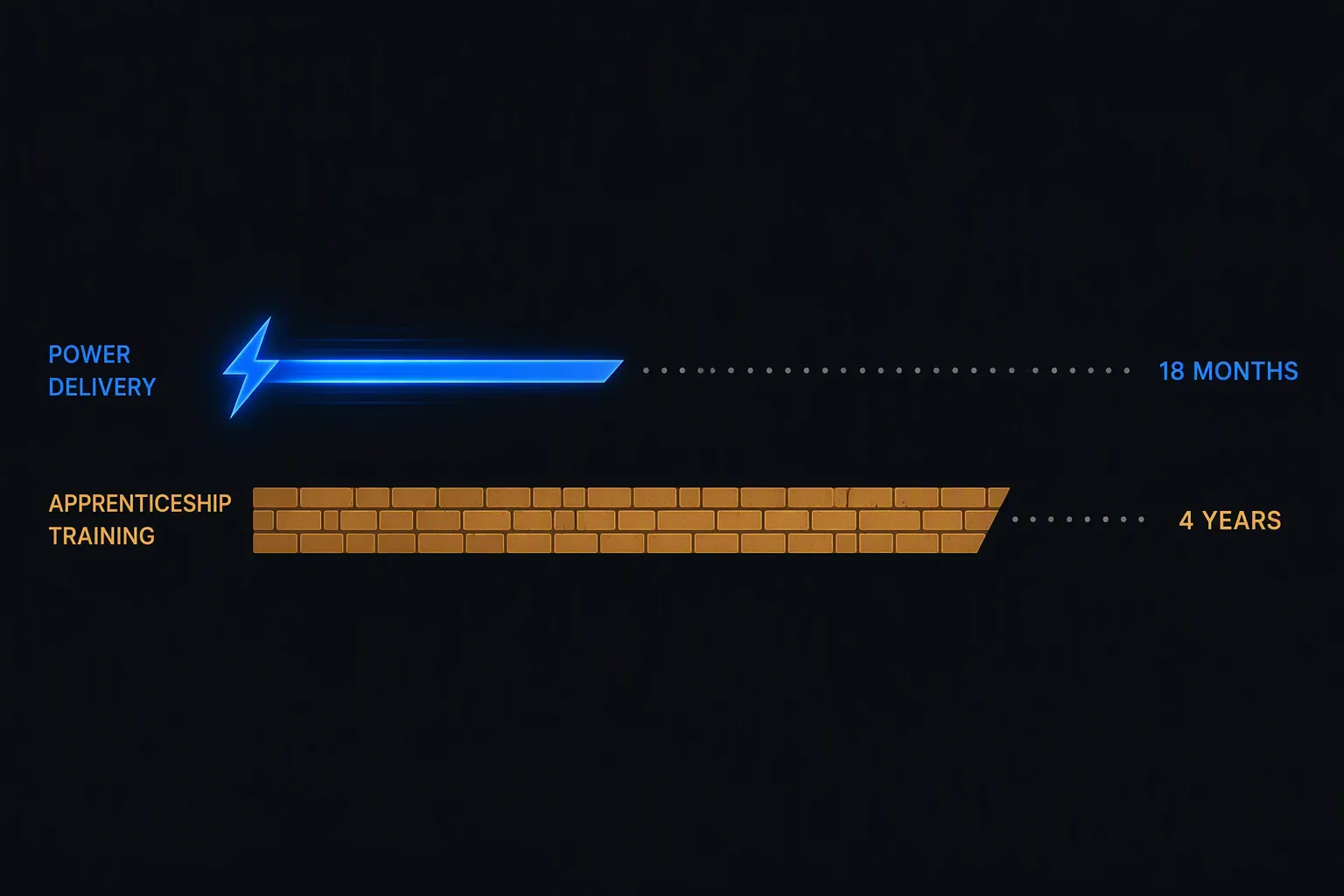
That four-year apprenticeship is not a soft constraint. It is a physical calendar embedded inside the delivery date. Owners can compress procurement, phase design packages, pay overtime, or split work among more subcontractors. They cannot convert an inexperienced worker into a journey-level electrician on an 18-month power-delivery promise without moving risk somewhere else.
BRG’s ThinkSet analysis widens the lens from a single site to the national queue. It cites nearly 3,000 U.S. data center projects under construction or planned, with projects requiring 1,500 to 3,000 workers at peak and the largest reaching up to 4,000. BRG also cites one projection of about 4.7 million temporary construction jobs associated with the buildout. Those numbers should not be blended into a single labor-deficit estimate; they describe different pieces of the demand picture. Taken together, they show why the problem is not a few hard-to-fill postings but a peak-workforce coordination problem across regions, trades, and simultaneous project schedules.[3]
The pressure is not confined to the United States. DCD’s coverage of Turner & Townsend’s Global Construction Market Intelligence 2026 reports that 71% of markets are in labor shortage, that data centers are the most constrained construction sector globally, that more than 70% of 112 markets show tightening or overstretched contractor capacity, and that North America carries the highest regional construction labor costs.[4]
| Evidence point | What it measures | Why it matters for delivery risk |
|---|---|---|
| About 1,500 skilled tradespeople for one 250,000-square-foot data center | Site-level craft demand | A single project can consume a large local trade pool before counting competing work. |
| Four-year apprenticeship versus roughly 18-month power-delivery expectations | Training timeline versus owner schedule expectation | The workforce pipeline cannot be expanded at the same speed as a capital plan. |
| 1,500–3,000 workers at peak, up to 4,000 on the largest projects | Peak labor loading | The hardest moment is not average staffing; it is the period when many trades must be on site at once. |
| 71% of markets in labor shortage; data centers most constrained globally | Market-wide contractor and labor capacity | Owners are competing against each other and against non-data-center construction in already tight markets. |
The supply bottleneck is electrical first, but not electrical only
Electrical labor gets the attention for good reason. Data centers are power-dense facilities, and electrical work sits on the critical path from utility interconnection through switchgear, backup systems, cable pulling, testing, commissioning, and turnover. A shortage of qualified electricians and linemen does not remain an HR issue; it becomes an energization issue.
PwC’s figures make the timing problem blunt. If the average U.S. electrical lineman is 52 and a full apprenticeship takes four years, the sector is trying to expand capacity while also replacing experienced workers and meeting customer expectations that can be measured in months.[2] That is a poor match for schedules written around immediate crew availability.
IEEE Spectrum’s read of Bureau of Labor Statistics data adds supporting labor-market context: the U.S. may need about 400,000 more construction workers by 2033 and roughly 17,500 more electrical and electronics engineers. That does not prove how many workers will be available for data centers specifically, but it does show that the AI infrastructure buildout is entering a broader construction labor market that already needs more people.[5]
Nor can owners treat “electricians” as the entire constraint. Mechanical systems, cooling, pipefitting, welding, controls, concrete, steel, roofing, fire protection, logistics, quality assurance, and safety all have to sequence correctly. A project can have switchgear on site and still lose time because the wrong craft is short in the wrong week. It can have bodies on site and still lose time if the supervision ratio is too thin or if inspection hold points stack up behind crews that were assembled too quickly.
Vendor hiring data is useful only if it stays in its lane
Staffing and hiring-platform data can help show where employers are looking, but it should not be mistaken for verified labor supply. Randstad reported that, since late 2022, postings rose 107% for robotics technicians, 67% for HVAC roles, 18% for electricians, and 30% for construction roles, with skilled-trade postings growing 27%, 19 percentage points above desk roles. That is directional evidence of employer intent from a staffing firm with a commercial position in the labor market; it does not prove that workers were hired, trained, retained, or available in the regions where data center projects are scheduled.[6]
Fortune, citing IBEW-related figures, reported that electrical work can account for 45% to 70% of data center construction cost and that the U.S. needs about 300,000 new electricians this decade while replacing roughly 200,000 retirees. Those figures are useful for understanding why wage pressure and electrician availability matter so much to data center economics, but they should remain attached to their source and horizon rather than being merged with PwC’s annual electrician-need figure or BRG’s temporary construction-job projection.[7]
Skillit has also reported, from its own construction hiring-platform data, that data center roles carry a 32% wage premium and an average of about $81,800. That is a cost-escalation signal from a platform dataset, not a market-wide wage census. It supports the practical point that projects are bidding against each other for scarce craft labor, but it does not establish how many qualified workers can actually be mobilized.[8]
How a craft shortage becomes contract risk
The workforce gap converts into risk through ordinary project mechanics. A schedule assumes a sequence. That sequence assumes crew sizes, productivity, inspections, material availability, and handoffs among trades. When the assumed crews are unavailable, underexperienced, or split across too many sites, the delay does not stay neatly inside the labor budget.
BRG identifies the transmission channels directly: delay claims among owners, general contractors, and subcontractors are becoming more common; budget disputes are straining fixed-price arrangements; safety risk rises as larger and less-experienced crews are assembled quickly; and the labor gap spills over onto municipal, hospital, and highway projects.[3]
Those are not separate risks. They feed one another. A subcontractor that cannot staff to the baseline schedule may seek relief or accelerate with premium labor. A general contractor under a fixed-price or guaranteed-maximum-price structure may contest whether the labor condition was foreseeable, owner-caused, market-driven, or within subcontractor responsibility. An owner that promised capacity to a tenant, cloud customer, or financing counterparty may treat the same delay as a missed commercial milestone. The same shortage can sit simultaneously in the schedule narrative, the change-order log, the contingency draw, and the claims file.
Safety deserves its own attention because it is where schedule optimism can become bodily risk. BRG’s warning about larger, less-experienced crews being assembled quickly should not be reduced to a generic “labor shortage” phrase.[3] A fast-growing site needs foremen, competent persons, lift planning, lockout/tagout discipline, confined-space procedures where applicable, energized-work controls, and enough experienced workers to correct unsafe shortcuts before they become incidents. Labor quantity and labor maturity are different variables.
The spillover matters, too. Data centers do not draw from a separate craft universe. When a large campus absorbs electricians, welders, operators, and mechanical trades in a region, public projects and social infrastructure can feel the same shortage. BRG specifically points to spillover effects on municipal, hospital, and highway work.[3] A private AI schedule can therefore become a public-sector procurement problem if the local labor pool was already thin.
The mitigation playbook helps, but it does not repeal the apprenticeship floor
There are real pressure valves. Modular and offsite fabrication can shift work from a congested site to a more controlled environment. BIM-to-field workflows can reduce clashes and make installation packages more buildable. Better workforce logistics and housing can widen the practical labor radius for remote or high-demand sites. Compressed training and modular credentialing can move some workers into defined tasks faster. Robotics and AI construction-management tools can help with layout, progress tracking, safety monitoring, documentation, and coordination.
PwC describes several of these responses, including offsite and modular fabrication, digital construction, compressed training, modular credentialing, early robotics adoption, and large training initiatives. It also cites Siemens’ target of 32,000 apprenticeships and 200,000 electricians by 2030.[2] BRG likewise points to AI construction-management tools as part of the response to delivery pressure.[3]
The important distinction is between reducing labor intensity and eliminating labor dependency. Prefabricated assemblies still need design coordination, shop labor, transport, receiving, setting, connection, inspection, testing, and commissioning. Digital tools can expose a sequence problem earlier, but they do not create a journey-level electrician. Robotics can take over specific tasks at the margin, but the current evidence does not support treating robots as a substitute workforce for the near-term data center queue.
Owners should like these mitigations. They should also price them honestly. A modular strategy may reduce site congestion while adding supplier, transport, and interface risk. Compressed credentialing may help with defined scopes while increasing the need for supervision. Workforce housing may make a remote project feasible while adding cost and community considerations. AI project-management software may improve visibility while making delay evidence more detailed and harder to ignore later.
What should be priced before the next AI infrastructure commitment
A credible AI data center plan should not stop at land, power, interconnection, equipment, and financing. It should show the craft-labor basis for the schedule. That means identifying the trades on the critical path, the expected peak headcount, the local and regional supply assumptions, the apprenticeship and supervision constraints, the competing projects drawing from the same labor pool, and the contract mechanism that allocates the consequences if those assumptions fail.
- For owners and developers: test whether the delivery date assumes labor availability that the market cannot support, and whether contingency reflects premium labor, resequencing, and delayed turnover.
- For general contractors: document the labor assumptions behind baseline schedules, subcontractor buyout, acceleration options, and safety staffing.
- For subcontractors: avoid absorbing open-ended labor-market risk in fixed-price scopes without clear schedule, access, acceleration, and change-order protections.
- For investors and boards: ask whether capex approvals include labor-delivery evidence or only demand-side AI growth assumptions.
- For disclosure and governance teams: treat craft labor as part of the factual record behind AI infrastructure commitments, especially where delays could affect revenue timing, customer commitments, or financing assumptions.
That last point is where the construction issue becomes a governance issue. AI infrastructure spending can create securities and disclosure questions when public claims about AI growth, capacity, or resilience outrun the operational facts underneath them. The same logic appears in broader AI-risk contexts, including AI securities litigation theories tied to business damage and disclosure failures. In the data center buildout, craft labor is one of the facts that determines whether a capital plan is executable.
The AI boom is creating skilled trade construction jobs. That is the least interesting part of the risk analysis. The harder question is whether enough qualified workers can be mobilized on the schedule that owners, hyperscalers, developers, contractors, and investors have already started to underwrite. A four-year apprenticeship does not move because a board approved capex. If the craft ceiling is not priced into schedules, fixed-price risk, safety assumptions, contingency, and capex governance, it will be priced later in delay claims, budget disputes, missed milestones, and a more expensive record of what the project team should have known.
References
- AI Construction Surge: $671 Billion Industry Growth Meets Skilled Labor Shortage — What Owners and Developers Must Know, Swinerton
- AI is putting pressure on engineering and construction labor, PwC
- The Data Center Labor Shortage: A Hidden Bottleneck for AI Infrastructure, BRG ThinkSet
- AI demand is increasing labor shortages and skills pressure in data center construction: report, Data Center Dynamics
- AI Data Centers Need Engineers, Electricians, and Construction Workers, IEEE Spectrum
- AI can’t build data centers: global demand for skilled trades soars in the AI era, Randstad, 2026
- AI data center boom fuels six-figure trade jobs for electricians, technicians and construction workers, Fortune, March 20, 2026
- Job Opportunities in Data Center Construction, Skillit
Related records
Tool profile
How Meta's AI Spending Reshapes Law Firm ProfitabilityGoverning regulation
Browse the obligations tracker →Preventive workflow
Browse verification workflows →
Report a correction or tip
Spotted an outdated figure, a misstated fact, or a ruling this case record should reflect? Public comments are disabled for this content given the professional cost of a misreported case outcome, penalty amount, or rule text — use the structured correction channel instead.
Report a correction or tip for this record →