
Sophie Cunningham’s Title IX Defense and the WNBA’s Legal Void
The Supreme Court's June 2026 ruling on transgender athletes resolves the question for school sports but leaves professional leagues like the WNBA in a legal gray zone. This article examines how Sophie Cunningham's Title IX comments highlight that enforcement gap and the litigation risk it creates for the league and players.
- Jurisdiction
- United States
- Court
- Supreme Court of the United States
- Judge
- Brett Kavanaugh
- AI tool named
- None
- Ruling date
- Jun 30, 2026
- Source document
- View primary court order ↗
- Last verified
- Jul 26, 2026
Lex Machina Review is an independent risk-tracking and reference resource. Nothing on this site is legal advice, and using it does not create an attorney-client relationship. Every record is reviewed against primary sources but may not reflect the most current status of a matter — always verify directly against the cited court order, rule text, or a licensed attorney before relying on it.
Companion explanation — secondary to the source document above
Sophie Cunningham’s most legally revealing sentence was not the one that generated the loudest reaction. It was the cleaner one: “That’s why you have Title IX. If Title IX and women’s sports weren’t protected, then you wouldn’t hear about any type of women in sport.” She said it on July 22, 2026, while defending her earlier comments about transgender athletes and women’s sports. [1]
That line lands differently after the Supreme Court’s June 30 ruling in West Virginia v. B.P.J. and Little v. Hecox. For school-sponsored sports, Cunningham’s instinct now has much stronger legal support than it had before. But the controversy around Cunningham’s comments, Adidas, transgender-athlete policy, and the WNBA is not only a school-sports question. The harder issue is whether a Title IX holding can be carried into a private professional league as if the jurisdictional work has already been done.
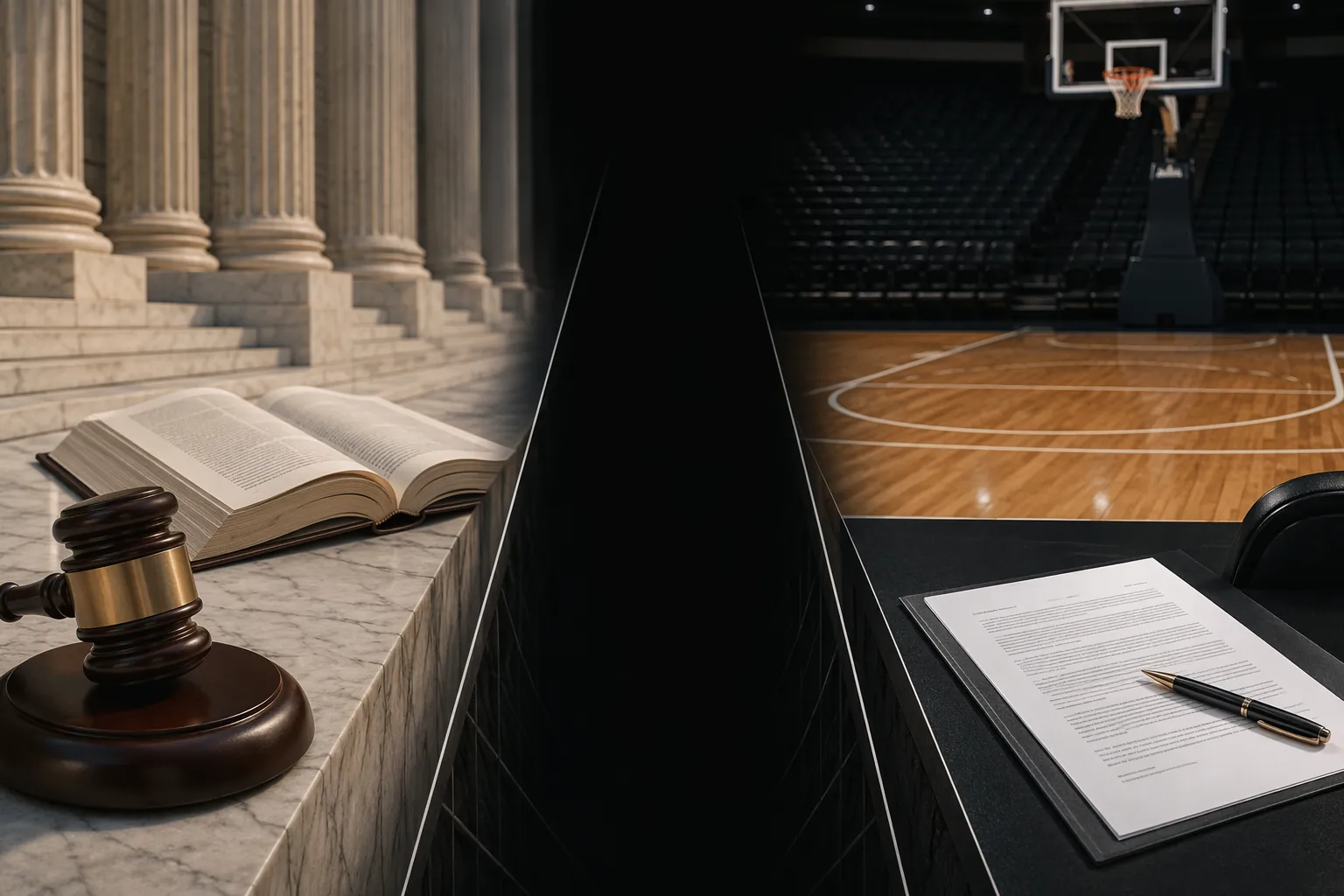
It has not. Title IX is not a general-purpose sports eligibility code. It is a federal statute tied to education programs and activities receiving federal financial assistance. The WNBA sits in a different legal room: professional basketball, private league governance, labor relations, player licensing, employment law, and a collective bargaining agreement whose key eligibility sentence appears to do much less work than the public debate wants it to do.
What the Supreme Court actually decided
The June 30 decision, as summarized by SCOTUSblog and Ogletree Deakins, held that states may bar transgender athletes from girls’ and women’s K–12 and collegiate sports without violating Title IX or the Equal Protection Clause. Justice Brett Kavanaugh wrote the majority opinion. The Court held 9-0 that the challenged laws did not violate Title IX and 6-3 that they did not violate Equal Protection. Justice Sonia Sotomayor dissented from the Equal Protection holding, focusing in part on overbreadth. [2][3]
On Title IX, Kavanaugh’s opinion treated “sex” according to its ordinary meaning in the 1970s and concluded that the statute permits sex-separated athletic teams based on biological sex. On Equal Protection, the majority accepted the states’ asserted interest in preserving female athletic opportunities and treated the challenged classifications as constitutionally permissible in that setting. [2][3]
There is a practical reason lawyers will keep emphasizing the words “in that setting.” The ruling was about school-sponsored sports. It was not a WNBA eligibility case. It was not a private-employer case. It was not a collective-bargaining case. It did not interpret a professional league constitution, a player contract, a union licensing policy, or a CBA clause.
Nor did the Court quietly import Bostock into every sports eligibility dispute. Justice Neil Gorsuch’s concurrence, as described by Ogletree Deakins, expressly limited Bostock’s relevance outside its employment-discrimination context. [3]
That matters because the professional-sports question is not simply whether the WNBA may look at the school-sports ruling and draw an analogy. Of course it may. The question is what legal source would govern if the league, the players’ union, a player, a sponsor, or an excluded athlete had to defend a rule in an actual forum.
A note on sourcing is necessary here because the distinction is too important to hide. The Supreme Court slip opinion was not directly available in the materials used for this article. The account of the holding and opinions relies on SCOTUSblog’s ruling analysis and Ogletree Deakins’ legal summary, with SCOTUSblog’s earlier case explainer providing procedural context. [2][3][4]
The WNBA’s separate problem
The WNBA’s reported CBA language is short enough to sound decisive and thin enough to create trouble. Multiple outlets have cited the eligibility formulation as: “only players who are women are eligible to play in the WNBA.” Those same reports have not identified a definition of “woman” in the league’s governing language or an explicit provision addressing transgender athletes. [5][6]
That sentence should be handled carefully. The CBA text was not directly verified in the materials used here; the quoted formulation comes through consistent secondary reporting. Still, if that is the operative language, it does not answer the hard enforcement questions. It identifies a category. It does not say how the category is determined, who determines it, what evidence is required, whether there is an appeal process, how medical privacy is protected, whether existing player rights are affected, or how the rule interacts with federal, state, and labor-law obligations.
| School-sports ruling | WNBA governance question |
|---|---|
| Title IX and Equal Protection claims against state school-sports bans | Private professional-league eligibility under a CBA and league policy |
| K–12 and collegiate athletic participation | Professional roster eligibility, employment consequences, and union representation |
| State laws and educational institutions | League, teams, WNBPA, players, sponsors, and licensing partners |
| Court-approved biological-sex line in the school context | Undefined CBA term if “women” is not further specified |
The difference is not academic. A university compliance officer can now point to the Supreme Court’s Title IX and Equal Protection analysis when applying a state school-sports law. A WNBA lawyer has to begin somewhere else. The league’s authority comes from its governing documents, its labor relationship with the WNBPA, applicable employment law, state-law exposure, and whatever eligibility policy the league can actually administer.
That is why Cunningham’s Title IX defense is rhetorically stronger than it is operationally complete. It names the statute that just won at the Supreme Court in the school-sports setting. It does not supply the WNBA with a finished professional-league rule.
The pressure around the league is real, but the WNBA case is still hypothetical
The broader sports-policy environment is moving toward sex-assigned-at-birth eligibility lines. After the ruling, 27 states had bans aligned with the Court’s holding, and Kavanaugh’s opinion referenced similar biological-sex lines drawn by the NCAA, USOPC, and IOC. [2]
That landscape creates pressure on the WNBA, but it does not decide the WNBA’s legal position. State school-sports bans do not become professional-league CBA terms by osmosis. NCAA or Olympic rules may influence the conversation, but they do not substitute for the WNBA’s own eligibility text, bargaining history, enforcement process, or statutory exposure.
The New Hampshire litigation illustrates the immediate chilling effect of the Supreme Court ruling in school-sports disputes. Two transgender girls dropped their lawsuit challenging President Trump’s executive order in New Hampshire on July 10, 2026, days after the Court’s decision. [3]
That is a meaningful signal for school litigation. It is not proof that a WNBA eligibility dispute would collapse the same way. Different defendant, different forum, different legal instruments, different remedies.
The most important limiting fact is also the easiest one to lose in the argument: no trans woman has played in the WNBA. Former WNBA player Layshia Clarendon came out as transgender and nonbinary during their career, but the specific scenario driving the current dispute—a trans woman seeking or holding a WNBA roster spot—has not occurred in league history, according to the reporting available in the materials. [5]
That does not make the governance issue fake. It does make it premature to write as though the league is already enforcing a disputed exclusion against an actual WNBA player. The legal void is visible because the words are underdeveloped, not because a live eligibility case has already tested them.
Institutional behavior is already more cautious than the public argument
The Indiana Fever did not adopt Cunningham’s statement as a team position. The club’s July 22 response was a model of liability-managed distance: “Our players are thoughtful adults with their own perspectives and voices, and those views are their own. We are committed to welcoming fans from every background and treating everyone with respect.” [5][6]
That sentence does several things at once. It preserves the player’s right to speak. It refuses to make the comment the franchise’s legal position. It reassures fans without adopting a detailed eligibility policy. It also keeps the team from saying something that league counsel, union counsel, or a future sponsor could be forced to parse later.
The WNBPA’s licensing posture is an even sharper signal because it touches money, image rights, and labor-management sensitivity rather than abstract values. Reporting from OutKick/Fox News, based on Jennifer Sey’s account, said the union’s licensing committee declined to commercialize Cunningham’s pointing-meme image, describing it as “derogatory,” while clarifying that Cunningham could license her own image independently. [7]
That distinction is easy to underestimate. A union can decline to turn a member’s viral image into group-licensed merchandise without prohibiting the member from pursuing her own commercial opportunity. But the decision still signals that the controversy is no longer confined to speech. It has entered the machinery of player marketability, union licensing authority, collective identity, and reputational risk.
For the league, that is the part worth watching. A public debate can remain general. A licensing decision has to identify a decision-maker, a standard, a reason, and a boundary. The same would be true of any eventual eligibility rule. Someone would have to decide what the words mean and live with the consequences of administering them.
Why Title IX cannot do all the work
Title IX remains central to the school-sports question because Congress tied the statute to educational programs receiving federal funds. That is why the ruling’s school-level application can be discussed with more confidence than the WNBA layer.
Professional basketball asks a different set of questions. If the WNBA adopted or enforced a biological-sex eligibility rule, the dispute would likely turn on the league’s governing authority, the CBA, the WNBPA’s role, employment-discrimination arguments, state-law conflicts, medical-privacy concerns, and the design of whatever process the league used. The Supreme Court’s Title IX reasoning would be relevant background. It would not be the whole answer.
The cleanest way to see the gap is to separate a holding from an analogy. The holding says states may maintain certain sex-based eligibility rules in K–12 and collegiate sports without violating Title IX or Equal Protection. The analogy says a professional women’s league may have stronger arguments for sex-based eligibility after that ruling. The first proposition is law from the case. The second is litigation positioning. [2][3]

That distinction is also why public-opinion numbers add less than they appear to add. Polling may explain why Cunningham’s comments found support and why brands, teams, and unions react carefully. It does not answer which legal standard governs a private professional league’s eligibility rule. For that, the better evidence is institutional behavior: the Fever’s distancing statement, the union’s licensing decision, and the unresolved CBA language.
The Adidas angle does not change the legal forum
The Adidas controversy gives the story its commercial velocity, but it does not convert the underlying eligibility question into a Title IX case. Athlete endorsements and public campaigns can increase reputational exposure. They can also make a player’s speech feel like part of a broader institutional position, even when the team or league has not adopted it.
That is precisely why team communications staff tend to write statements like the Fever’s. They are not just trying to sound neutral. They are trying to avoid turning a player’s market-facing speech into an admission, policy commitment, or league position that later has to be reconciled with a CBA clause or discrimination claim.
Cunningham’s directness is not the legal problem. Candor is often easier to assess than corporate fog. The problem is the false comfort created when a legally accurate school-sports phrase is repeated in a professional-league setting without identifying the governing instrument.
The void the WNBA has not filled
If the reported WNBA eligibility sentence is the operative language, the league has a category but not a public framework. A developed framework would have to answer questions the current public record does not answer:
- Whether “women” is defined by sex assigned at birth, gender identity, documentation, medical criteria, or another standard.
- Who decides eligibility: the league office, teams, an independent panel, medical personnel, or a collectively bargained process.
- What procedural protections apply before a player is denied eligibility or removed from competition.
- How the league protects medical privacy while administering any eligibility standard.
- How the WNBPA represents current players whose views, commercial interests, or eligibility interests may conflict.
None of those questions is answered by saying “Title IX.” None is answered by pointing to the existence of state school-sports bans. And none is answered by the fact that the Supreme Court’s ruling makes biological-sex eligibility rules easier to defend in the educational context.
This is where a broader tracker of transgender-athlete sports policy is useful but still incomplete for the WNBA. The policy map shows pressure moving across jurisdictions and governing bodies. It does not supply the missing professional-league mechanism.
The same caution applies to comparisons with nonbinary-athlete disputes. Binary eligibility systems create recurring governance problems across sports, as the Nikki Hiltz legal-patchwork analysis shows, but each sport still has to answer through its own authority structure.
What Cunningham’s line now proves, and what it does not
Cunningham’s Title IX defense is not frivolous. After June 30, it is much easier to say that federal law permits sex-based eligibility lines in school-sponsored girls’ and women’s sports. Anyone evaluating the accuracy of her school-sports claim has to account for that change, and the detailed Supreme Court ruling breakdown is the right place to start.
For the WNBA, the unresolved point is not whether the league has arguments. It is that its public legal architecture remains underdeveloped for the controversy now being placed on it.
That is the risk exposed by the current controversy: a phrase that sounds settled in one legal domain can become unstable when moved into another. Title IX can explain why Cunningham’s school-sports position has gained force. It cannot, by itself, define WNBA eligibility, bind the WNBPA, resolve licensing disputes, protect teams from employment-law exposure, or tell a private league how to administer a rule it has not publicly developed.
The June 30 ruling strengthened the rhetorical foundation for sex-assigned-at-birth eligibility rules in educational athletics. It did not close the WNBA’s legal void. If anything, Cunningham’s Title IX line makes that void easier to see: a professional league may have an eligibility sentence, but without a defined enforcement framework, the hard questions move from constitutional doctrine to labor governance, employment exposure, licensing control, and institutional risk.
References
- Indiana Fever’s Sophie Cunningham reacts to backlash to transgender athletes comment — Indianapolis Star, July 22, 2026, https://www.indystar.com/story/sports/basketball/wnba/fever/2026/07/22/indiana-fever-sophie-cunningham-protecting-womens-sports-reaction-title-ix-transgender-athletes/91017031007/
- Court rules that states can exclude transgender athletes from girls’ and women’s sports teams — SCOTUSblog, June 30, 2026, https://www.scotusblog.com/2026/06/court-rules-that-states-can-exclude-transgender-athletes-from-girls-and-womens-sports-teams/
- Supreme Court Allows State Bans on Transgender Students in Women’s and Girls’ Sports — Ogletree Deakins, https://ogletree.com/insights-resources/blog-posts/supreme-court-allows-state-bans-on-transgender-students-in-womens-and-girls-sports/
- The transgender athlete cases: An explainer — SCOTUSblog, January 2026, https://www.scotusblog.com/2026/01/the-transgender-athlete-cases-an-explainer/
- Sophie Cunningham sparks backlash with ‘biological men’ comments about transgender athletes — LA Times, July 23, 2026, https://www.latimes.com/sports/story/2026-07-23/sophie-cunningham-biological-men-transgender-womens-sports-fever-wnba
- Sophie Cunningham defends trans comments, cites Title IX — The Athletic, July 22, 2026, https://www.nytimes.com/athletic/7464960/2026/07/22/sophie-cunningham-trans-comments-womens-sports/
- Jennifer Sey reveals alleged communication in Sophie Cunningham recruitment pitch with XX-XY Athletics — Fox News, https://www.foxnews.com/outkick-sports/jennifer-sey-reveals-alleged-communication-sophie-cunningham-recruitment-pitch-xx-xy-athletics
Related records
Tool profile
Browse tool evaluations →Governing regulation
Browse the obligations tracker →Preventive workflow
Browse verification workflows →
Report a correction or tip
Spotted an outdated figure, a misstated fact, or a ruling this case record should reflect? Public comments are disabled for this content given the professional cost of a misreported case outcome, penalty amount, or rule text — use the structured correction channel instead.
Report a correction or tip for this record →