
Superpotent Thyroid Tablets Recalled? Symptoms and Rights
Vitruvias recalled one lot of Thyroid Tablets USP 30 mg (Lot 504950) over potential superpotency. This record helps patients confirm whether their bottle is affected, recognize hyperthyroidism symptoms that warrant attention or emergency care, and understand what legal rights the recall notice actually creates.
- Jurisdiction
- us-federal, us-state
- Court
- No court identified
- AI tool named
- No AI tool implicated
- Ruling date
- Aug 24, 2026
- Source document
- View primary court order ↗
- Last verified
- Aug 26, 2026
Lex Machina Review is an independent risk-tracking and reference resource. Nothing on this site is legal advice, and using it does not create an attorney-client relationship. Every record is reviewed against primary sources but may not reflect the most current status of a matter — always verify directly against the cited court order, rule text, or a licensed attorney before relying on it.
Companion explanation — secondary to the source document above
Start with the bottle, not the lawsuit. The Vitruvias recall identified one product: Thyroid Tablets USP 30 mg, NDC 69680-166-00, Lot 504950, with an expiration date of 9/30/2026. The company announcement said 3,655 units were released and 1,955 were sold; distribution occurred from January 31 through September 30, 2025. Vitruvias announced the recall on August 21, 2026, and FDA published it on August 24, 2026. As of that announcement, the company said it had not received adverse-event reports related to the recall. [1]
Last verified: August 26, 2026. This record is for safety and evidence-preservation purposes only. It is not medical advice, legal advice, or a substitute for calling your prescriber, pharmacist, poison control, emergency services, or a lawyer when your situation requires one.
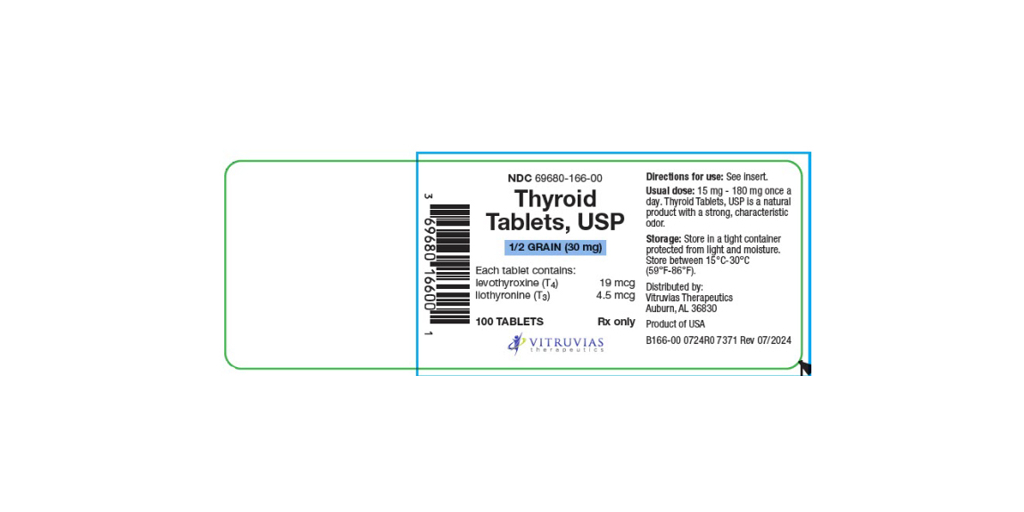
How to tell whether your bottle is in the Vitruvias recall
A thyroid recall can feel broad because the medicine is common and the symptoms are unsettling. This one is narrow. A bottle is in scope only if the identifying information matches the recalled product and lot. Do not rely on the color of the tablets, the pharmacy name, or a memory of when the prescription was filled.
| Check this field | Recalled Vitruvias information |
|---|---|
| Drug and strength | Thyroid Tablets USP 30 mg |
| NDC | 69680-166-00 |
| Lot | 504950 |
| Expiration date | 9/30/2026 |
| Distribution window stated in the notice | January 31–September 30, 2025 |
| FDA publication date | August 24, 2026 |
If your label is intact, look for the NDC, lot number, and expiration date on the prescription bottle or any manufacturer packaging the pharmacy gave you. If the pharmacy label covers part of the manufacturer label, do not peel or damage it until you have photographed both sides. Take clear photos now, before the bottle is thrown away, refilled, or mixed with another supply.
If the lot number is missing from the bottle, call the dispensing pharmacy and ask for the fill record tied to that prescription. Give the pharmacist the drug name, strength, NDC if available, fill date, prescription number, and your name and date of birth. A refill in the distribution window does not prove the bottle is recalled, but it gives the pharmacist a sensible starting point for checking inventory and dispensing records.
Keep the bottle until the lot question is resolved. If the medicine is from Lot 504950, keep the bottle, cap, remaining tablets, label, paperwork, and receipt together. Those items matter for both medical review and any later claim.
Do not stop thyroid medicine on your own
The recall concern is potential superpotency, meaning a patient could receive more active thyroid hormone effect than intended. That matters because too much thyroid hormone can push a person toward hyperthyroid or thyrotoxic symptoms. It does not mean every person with a matching bottle has been injured, and it does not mean the safest move is to abruptly stop treatment.
FDA’s general drug-recall guidance says consumers can generally continue taking Class II or Class III recalled medicines unless their health care provider says otherwise, and it specifically warns that stopping thyroid medicine can be more harmful than continuing it. The Vitruvias company announcement did not state a recall class in the notice, so the practical instruction is narrower: call your prescriber or pharmacist promptly, and do not change the dose or stop the medication unless a clinician tells you to. [1][2]
Symptoms to watch for after possible excess thyroid hormone
The FDA-listed symptoms for this recall are the ones to put in front of the patient, not in a footnote: weight loss, heat intolerance, fatigue, nervousness, muscle weakness, hypertension, chest pain, rapid heart rate, and heart rhythm disturbances. The notice also identifies elderly people, pregnant women, and infants as groups at particular risk from excessive thyroid hormone. [1]
Some symptoms can be easy to misread. Fatigue may look like undertreatment, overexertion, poor sleep, anxiety, or something unrelated. Nervousness may be dismissed as ordinary stress. Heat intolerance may not be obvious until someone notices they are sweating when others are comfortable. That is why the pattern matters: a faster heart rate, shakiness, heat intolerance, unexplained weight change, blood-pressure changes, and new weakness together deserve a call to the prescriber, especially if they appear after taking tablets from the recalled lot.
Clinical references describe thyrotoxicosis as a state caused by excess thyroid hormone, and tachycardia is commonly defined as a heart rate above 100 beats per minute. Severe thyrotoxicosis can progress to thyroid storm; Cleveland Clinic identifies a heart rate above 140 beats per minute, fever, and confusion among warning signs. [3]
Treat severe symptoms as urgent. Chest pain, fainting, severe shortness of breath, a very rapid heart rate, new or worsening rhythm disturbance, fever, confusion, or severe weakness should not wait for a routine appointment. If those are happening now, use emergency care rather than trying to solve the recall question first.
For less severe symptoms, the useful next step is organized communication. Tell the clinician the exact product, NDC, lot, expiration date, when you started taking that bottle, the dose schedule, what changed, and when symptoms began. Do not guess at causation. Give the prescriber enough information to decide whether labs, dose adjustment, replacement medication, or closer monitoring are needed.
Medication-dose related hyperthyroidism is not handled by panic; it is handled by correcting the dose under supervision and rechecking. MedlinePlus describes factitious hyperthyroidism as hyperthyroidism caused by taking too much thyroid hormone medicine and notes that the condition usually resolves when the dose is corrected, with thyroid tests rechecked in 2 to 4 weeks. [4]
A simple symptom note is better than a dramatic one
If you are monitoring at home while waiting for clinician guidance, write down the date and time, the dose taken, the symptom, the approximate duration, and any objective measurement you actually have, such as a pulse reading, blood-pressure reading, temperature, lab result, urgent-care note, or emergency-room discharge paper. A short note made the day symptoms occur is more useful than a long reconstruction made months later.
What legal rights the recall may create
Recall, symptoms, and legal rights are three different questions. The recall notice helps identify a possible product problem. Symptoms help decide whether medical review is needed. Legal rights depend on proof that a person used the affected product, suffered a compensable harm, and can connect the harm to the product under the law that applies in that state.
A recall is not an automatic payout and is not, by itself, a liability admission. Attorney guidance on drug-recall lawsuits commonly separates the recall from the proof questions that follow: defect, exposure, causation, injury, damages, available defendants, and deadlines. It also notes that recall evidence may face limits in court under rules concerning subsequent remedial measures. [5]
As of this record’s August 26, 2026 verification, no active class action or filed lawsuit tied to the 2026 Vitruvias recall was found. That can change, but it should not be assumed. If the situation moves from concern to possible injury claim, the site’s counsel-facing record on who can be sued after the Vitruvias thyroid recall is the better place to track defendant and liability-map issues. This patient-facing record stays with the bottle, the symptoms, and the evidence.

What to preserve if injury is suspected
- The prescription bottle, cap, label, remaining tablets, and any manufacturer packaging.
- Photos showing the NDC, lot number, expiration date, pharmacy label, prescription number, and fill date.
- Pharmacy receipts, refill records, insurance explanation-of-benefits records, and prescription history.
- Messages with the pharmacy, prescriber, insurer, manufacturer, or FDA MedWatch, including any report ID.
- A symptom timeline with dates, doses, pulse or blood-pressure readings if available, lab results, medical visits, diagnoses, and out-of-pocket costs.
- Records showing missed work, caregiving costs, travel for care, medication replacement, or other claimed losses.
Do not mail away or discard the bottle before you have been told exactly what will be documented, copied, photographed, or retained. If a pharmacy or company representative asks for the product back, ask what written confirmation you will receive showing the product name, NDC, lot, expiration date, quantity returned, and date of return.
Deadlines and expectations
Filing deadlines are state-specific. Attorney guidance commonly describes drug-injury limitation periods as often falling in a 2- to 4-year range, with discovery rules affecting when the clock begins in some cases. That is a reason to get advice promptly if there is a serious injury, not a reason to assume a claim exists. [5]
The closest public thyroid-superpotency precedent is not a promise of what Vitruvias cases would look like. Acella Pharmaceuticals recalled certain NP Thyroid lots in 2020 after testing found some tablets contained up to 115% of the labeled amount of liothyronine, and FDA described that recall as Class I. [6] Later coverage of Faulkner v. Acella reported an estimated $41,473,000 settlement across about 1.2 million class members, with individual prescription-based payments estimated around $10 to $50 for prescriptions dispensed from May 12, 2018 through April 30, 2021. [7]
That Acella resolution is useful mainly for calibration. It was an economic-loss class settlement reported in another manufacturer’s recall history, not proof that a person exposed to the Vitruvias lot has a personal-injury claim. Personal-injury value, if any, turns on medical records, symptom severity, causation, treatment, duration, and state law.
The order to follow now
- Verify the bottle against the recalled product details: Thyroid Tablets USP 30 mg, NDC 69680-166-00, Lot 504950, expiration 9/30/2026.
- If the lot is unclear, ask the pharmacy to check the fill and dispensing records.
- Do not stop or change thyroid medication unless your prescriber tells you to.
- Watch for the FDA-listed symptoms, especially rapid heart rate, rhythm changes, chest pain, hypertension, heat intolerance, weight loss, nervousness, fatigue, and muscle weakness.
- Use emergency care for severe symptoms such as chest pain, fainting, a very rapid heart rate, fever, confusion, or severe shortness of breath.
- If injury is suspected, preserve the bottle, records, photos, medical notes, and symptom timeline before pursuing any claim.
- Use legal resources only after the safety steps are underway and the evidence is preserved.
References
- Vitruvias Therapeutics, Inc Issues Nationwide Recall of One Lot of Thyroid Tablets, USP 30 mg Due to Potential Super Potency, U.S. Food and Drug Administration, August 24, 2026.
- Understanding Drug Recalls: What to Know and What to Do, U.S. Food and Drug Administration.
- Thyrotoxicosis, Cleveland Clinic.
- Factitious hyperthyroidism, MedlinePlus.
- Can You Sue After a Drug Recall? What the Law Actually Says, 2keller.
- Acella Pharmaceuticals, LLC Issues Voluntary Nationwide Recall of Certain Lots of NP Thyroid® Thyroid Tablets, USP Due to Super Potency, U.S. Food and Drug Administration.
- Acella Pharmaceuticals Hit with Class Action Over Alleged Sale of Defective Thyroid Medication, ClassAction.org.
Related records
Tool profile
How Meta's AI Spending Reshapes Law Firm ProfitabilityGoverning regulation
Browse the obligations tracker →Preventive workflow
Browse verification workflows →
Report a correction or tip
Spotted an outdated figure, a misstated fact, or a ruling this case record should reflect? Public comments are disabled for this content given the professional cost of a misreported case outcome, penalty amount, or rule text — use the structured correction channel instead.
Report a correction or tip for this record →