
Which T-Mobile Outage Compensation Claims Are Worth Filing
No formal compensation program has been announced for the July 27 T-Mobile outage; the realistic claim is a bill credit in the user-reported $10–$80 range won through support negotiation, not damages or an FCC award. The record verifies what each claim route — FCC complaints, arbitration, small claims — can actually deliver and what evidence subscribers should preserve.
- Jurisdiction
- United States
- Court
- FCC / state small claims courts
- AI tool named
- No AI tool implicated
- Ruling date
- Jul 27, 2026
- Source document
- View primary court order ↗
- Last verified
- Jul 31, 2026
Lex Machina Review is an independent risk-tracking and reference resource. Nothing on this site is legal advice, and using it does not create an attorney-client relationship. Every record is reviewed against primary sources but may not reflect the most current status of a matter — always verify directly against the cited court order, rule text, or a licensed attorney before relying on it.
Companion explanation — secondary to the source document above
This article is general information, not legal advice. Before filing anything, have a licensed attorney review the live T-Mobile terms, the current arbitration clause, any billing-dispute deadline, and the small-claims rules in your state.
The narrow verified record is this: T-Mobile outage reports surged on July 27, 2026, beginning around 4 p.m. ET, with users reporting SOS mode and loss of service; Downdetector reports peaked above 64,000, with more than 140,000 total reports noted in coverage of the incident.[1] The disruption also reached customers using T-Mobile’s network through MVNOs including Mint Mobile, Boost Mobile, Google Fi, and Metro, and restoration was reported overnight into July 28, with time references ranging from about 11:30 p.m. ET to 1:57 a.m. ET depending on the report.[1][2]
The practical ceiling matters just as much as the outage itself. In the sourced record available here, T-Mobile had not announced a formal July 27 compensation program or disclosed a public cause as of July 28–29, 2026.[1][2] The money consumers have reported is not a company-confirmed schedule. It is an ad hoc support result: some users reported initial offers around $5 to $10, others reported about $20 after pushing back, and one report described an $80 package structured as $20 upfront plus $10 per month for six months.[3][4]
That distinction controls the T-Mobile network outage compensation legal claim process. For an ordinary one-day service interruption, the realistic claim is a modest bill credit requested through support. FCC complaints, arbitration, and small claims exist, but they do not turn a temporary outage into automatic damages. The analysis changes if the customer can document a failed 911 call, a medical or safety consequence, or actual out-of-pocket losses caused by the outage.
What can actually produce money right now
The only route currently visible in the public record as producing money for ordinary affected subscribers is support negotiation. The reports are uneven, but they follow a familiar pattern: a subscriber contacts T-Mobile, states the date and symptoms, asks for an outage credit, receives a small offer or no offer, and sometimes obtains a larger courtesy credit after pointing to duration, multiple affected lines, or failed escalation.[3][4]
Do not treat those reports as a policy. A $20 screenshot is not a tariff, a contract amendment, or a compensation program. It is evidence that support agents have discretion, and that some customers have persuaded T-Mobile to apply a courtesy credit. The same coverage notes prior outage-credit examples, including Verizon’s reported $20 credit after a January 2026 outage and T-Mobile’s reported $10 to $75 per-account credits after a May 28–June 2, 2026 Fiber outage, but those are precedents in customer relations, not binding July 27 rules.[1][2]
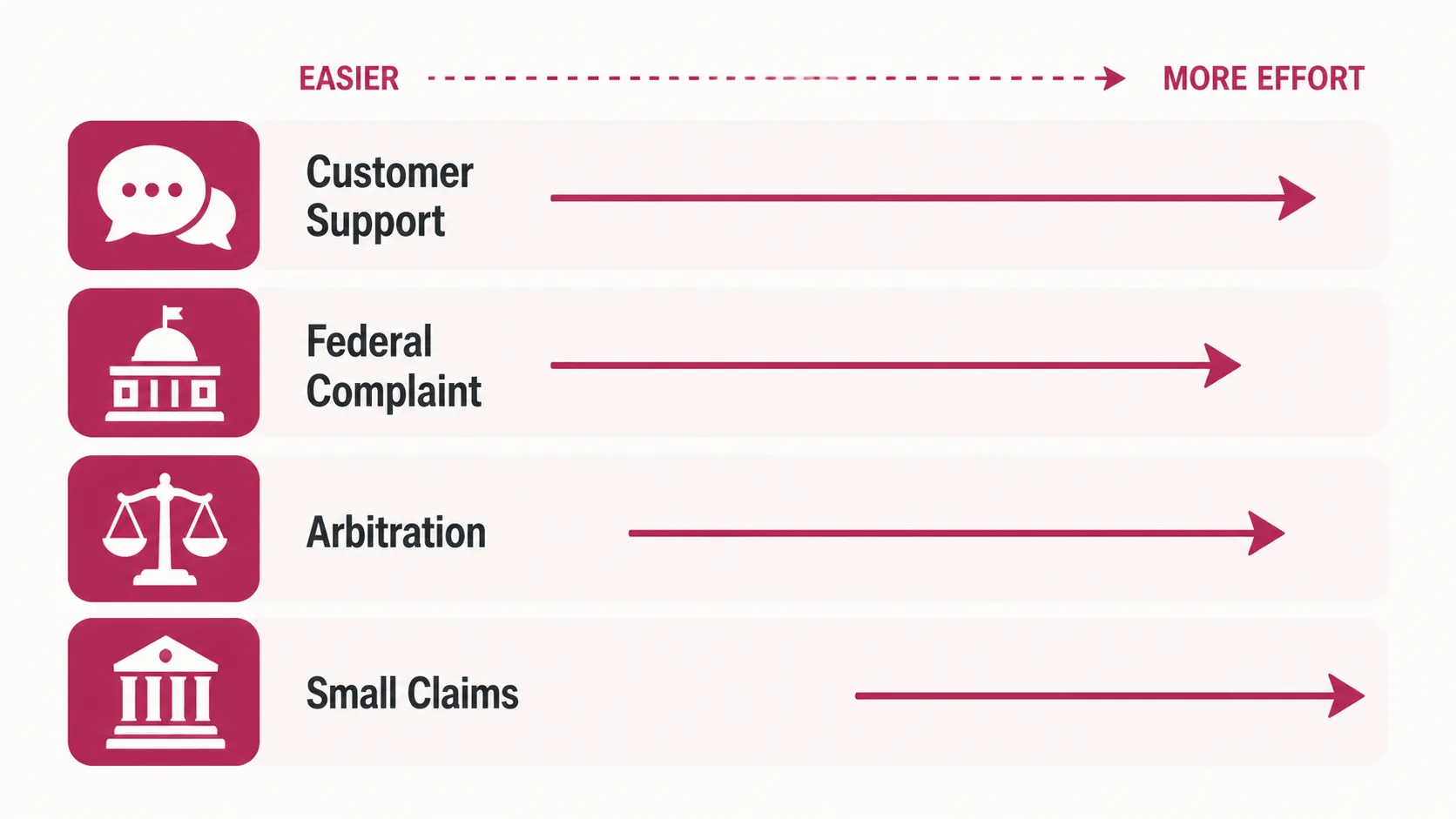
| Route | What it can realistically produce | Friction | When it may be worth using |
|---|---|---|---|
| Support request or escalation | Ad hoc bill credit; user-reported July 27 figures range from about $10 to $80, with no company-confirmed schedule.[3][4] | Low | Ordinary outage inconvenience, especially if multiple lines were affected |
| FCC informal complaint | Written carrier response; no consumer money award through the informal complaint process.[5] | Low to moderate | Creating a record, forcing a written response, or documenting 911/safety facts |
| T-Mobile Notice of Dispute, then AAA arbitration | Individual claim resolution if the dispute survives the notice process; consumer AAA filing fee reported as $225 in the cited guide.[6] | High for a small outage credit | Documented losses, serious safety facts, or coordinated strategy after counsel review |
| Small claims | Possible money judgment if state-law proof and forum rules support it | Varies by state and court | Documented losses that exceed the time, filing fee, and hearing burden |
Start with support, but make it a record
A support request should not read like a lawsuit threat. It should read like a clean billing record: identify the affected line or lines, the outage date, the approximate hours without usable service, the symptoms such as SOS mode or failed calls, and the specific credit requested. If the first response is a token amount, ask whether the agent can review the account for a higher courtesy credit because the interruption affected the paid service across a defined time window.
For many subscribers, the rational stopping point is the first acceptable credit. If the account receives $10 or $20 and there is no documented loss beyond inconvenience, further escalation can quickly cost more time than the disputed amount. If multiple lines lost service, or a subscriber had to buy temporary connectivity, the ask should separate the bill-credit request from reimbursement for actual costs.
Keep the chat transcript before the window closes. If the carrier denies a credit, the denial is still useful. If the carrier offers one, the transcript should show whether it is a one-time credit, a recurring promotional credit, or a conditional promise that can disappear from the next bill.
The FCC route forces an answer, not a payout
An FCC informal complaint is free and can be filed without a lawyer. The FCC serves the complaint on the provider, and the provider must respond in writing within 30 days.[5] That is useful when a subscriber wants a written carrier position, wants to preserve a safety-related record, or has been unable to get a meaningful response through normal support.
It is not a payout channel. The informal complaint process does not award damages to consumers; it creates a regulatory complaint record and requires a response.[5] That is still worth something, especially where a customer alleges failed emergency access or a pattern of unresolved account handling. It is just not the same thing as compensation.
The distinction is easy to miss because FCC outage enforcement numbers are large. In the June 15, 2020 T-Mobile outage, the FCC said there was a “complete failure” of more than 23,000 911 calls and later announced a $19.5 million consent decree.[7] The FCC also announced a $17.5 million penalty tied to August 2014 outages.[8] Those enforcement outcomes set regulatory expectations for network reliability and emergency calling; they do not mean July 27 subscribers have an automatic private payment claim.
There is also no published count in the sourced record of failed 911 calls for the July 27 outage. The 23,000-plus figure belongs to the 2020 event, not this one.[7] A July 27 customer who personally experienced a 911 failure should document it carefully, but the public record does not support treating 911 failure as a verified general feature of the July 27 outage.
For a deeper look at why FCC enforcement and private recovery are different tracks, see the site’s related 911-outage analysis, Who Can Sue Spectrum for the Kalamazoo 911 Outage.
Arbitration exists, but the economics are the problem
The available secondary summaries of T-Mobile’s dispute terms describe a process that channels many disputes into individual binding arbitration or small claims, includes a class-action bar, allows a 30-day opt-out from arbitration, and requires a Notice of Dispute to T-Mobile Customer Relations, P.O. Box 37380, Albuquerque, NM 87176-7380, followed by a 60-day waiting period before arbitration.[6] The same summaries describe AAA consumer arbitration and a $225 consumer filing fee.[6]
Those details should be verified against the live T-Mobile terms before publication or filing. The available source record flags an authentication wall around the terms page and inconsistent snippets on billing-dispute deadlines. That is not a technicality. A missed notice address, outdated deadline, or stale arbitration clause can decide whether a filing is procedurally valid.
For a one-day outage credit, arbitration usually does not pencil out. A reported $10 to $80 credit range is smaller than the filing friction, before counting time spent drafting the notice, waiting 60 days, organizing proof, and managing the arbitration. Arbitration becomes more coherent where the customer has documented losses, emergency-call facts, or a coordinated strategy in which volume changes the carrier’s cost calculation.
The Oddo price-lock dispute is relevant for that last point, but only for that point. Coverage of Oddo et al. v. T-Mobile describes a New Jersey federal case tied to alleged broken written rate promises and a mass-arbitration strategy.[9] That architecture may create leverage in a broad pricing dispute. It does not prove that an individual July 27 outage claimant should start arbitration over a small courtesy credit.
Small claims is for losses you can prove, not annoyance you can describe
Small claims remains available in many consumer disputes, but it is local: filing fees, service rules, hearing procedures, evidence requirements, and dollar caps vary by state. Secondary guides describe T-Mobile disputes as potentially going to small claims in the consumer’s billing-address county, but that procedural point should also be checked against the live terms and local court rules.[6][10]
The ordinary outage-inconvenience case is weak on economics even before the merits. A claimant has to identify a legal theory, prove the outage affected the account, show causation, and justify a dollar amount. “My phone was unusable for the evening” may be true and still be worth less than the cost and time of filing.
The calculus changes when the claimant has receipts or safety facts. A rideshare driver who bought temporary connectivity, a small business that paid for backup service, or a caregiver who can document failed emergency communication has a different record than a subscriber seeking a prorated day of service. The point is not that those claims automatically win. It is that they have something a court can measure.
Why past big numbers do not create July 27 compensation
Consumer money in major T-Mobile matters has historically arrived through different machinery: class settlements, FTC refund programs, and goodwill credits. The 2021 T-Mobile data-breach settlement, for example, was a class settlement with a $350 million settlement fund and a separate $150 million commitment for data security.[11] The FTC’s T-Mobile cramming matter involved a refund program in which the FTC distributed more than $24.3 million to consumers from a broader settlement.[12]
Those examples matter because they show what is missing here. There is no announced July 27 settlement fund, no enacted automatic-refund statute, no FCC consumer-distribution order, and no company-published outage-credit table in the available record. A subscriber can ask for a credit, complain, preserve proof, and pursue a formal claim where the facts justify it. But the public record does not support promising damages.
What the law does not yet provide
The proposed Outage Refund Guarantee Act would create a more mechanical rule: an automatic credit of one-thirtieth of a customer’s monthly bill for each four-hour block of a network outage. Senator Ben Ray Luján announced the bill as introduced legislation.[13] Introduced is not enacted. It is useful as a policy marker, not as a July 27 remedy.
Preserve the claim before choosing the route
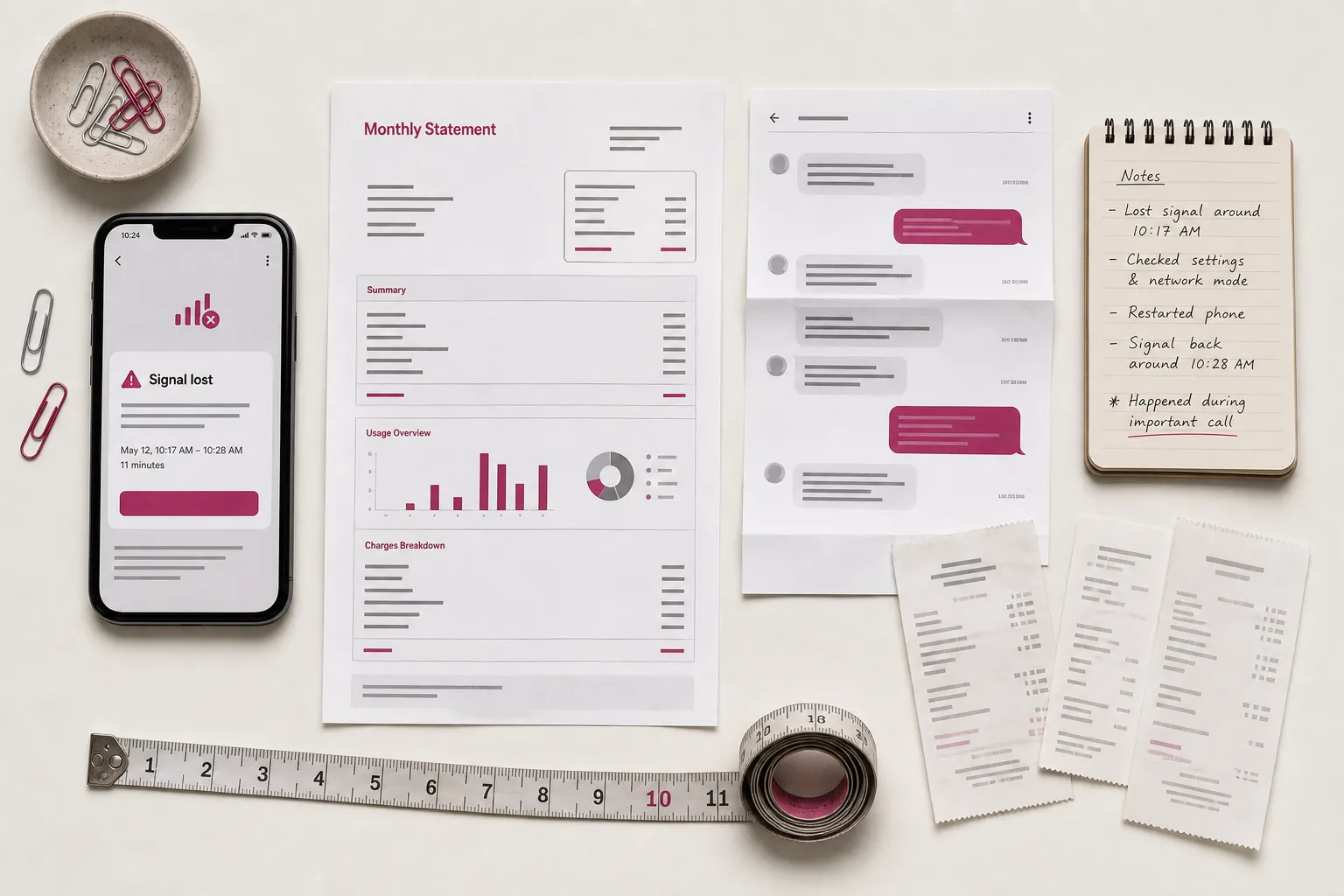
Do the preservation work before deciding whether the route is worth it. The value of an outage claim depends less on outrage and more on what can be shown after the support chat ends.
- Save the bill covering July 27 and any later bill showing a credit or denial.
- Screenshot SOS mode, outage notices, failed-call logs, and timestamps if they are still available.
- Download or copy support chats before closing the window.
- Keep call logs and notes identifying which lines were affected and when service returned.
- Preserve written rate promises, plan terms, or account representations if the dispute overlaps with billing or price-lock issues.
- Keep receipts for actual losses, including temporary connectivity, replacement communications, or business expenses tied to the outage.
- If 911 or emergency access failed, write down the time, location, device, attempted number, result, and any alternative action taken.
File a support request if a modest credit is worth the time. Use an FCC informal complaint if the goal is a written response or a regulatory record. Reserve arbitration or small claims for documented losses, 911-related harm, or a coordinated strategy where the economics change. Save the records first.
References
- Will T-Mobile customers affected by outage get account credits? SOS mode, service issues, Providence Journal, July 28, 2026.
- T-Mobile Outage Drags Down Mint, Boost, Google Fi; Root Cause Still Hidden, TechTimes, July 28, 2026.
- How to Get a Credit from T-Mobile After This Week’s Outage, TmoNews, July 2026.
- T-Mobile will give you $20, or maybe more, for your outage troubles, Android Police.
- Filing an Informal Complaint, Federal Communications Commission.
- Arbitration Against T-Mobile FAQ Guide, Dilendorf Law Firm.
- FCC Reaches $19.5M Settlement with T-Mobile in 911 Outage Investigation, Federal Communications Commission.
- T-Mobile to Pay $20M After Outage Led to Failed 911 Calls, Courthouse News Service.
- T-Mobile Abandoned Written Rate Promises to Millions. What Customers Can Do, TechTimes, July 16, 2026.
- How to Sue T-Mobile, JusticeDirect.
- T-Mobile 2021 Data Breach, Keller Rohrback.
- T-Mobile Refunds, Federal Trade Commission.
- Luján Introduces Legislation to Refund Customers for Network Outages, Office of Senator Ben Ray Luján.
Related records
Tool profile
How Meta's AI Spending Reshapes Law Firm ProfitabilityGoverning regulation
Browse the obligations tracker →Preventive workflow
Browse verification workflows →
Report a correction or tip
Spotted an outdated figure, a misstated fact, or a ruling this case record should reflect? Public comments are disabled for this content given the professional cost of a misreported case outcome, penalty amount, or rule text — use the structured correction channel instead.
Report a correction or tip for this record →