
Todd Blanche Confirmed as Deputy Attorney General
Verified Senate roll-call record confirms Todd Blanche as Deputy Attorney General by a 52–46 vote on March 5, 2025. That closed record — not the pending AG nomination — is the operative fact for who currently controls DOJ AI and digital-asset enforcement, including DOJ's named-party role in Lnu v. Blanche.
- Jurisdiction
- US Federal
- Court
- U.S. Court of Appeals for the Ninth Circuit
- Judge
- Paez, Bea, and Forrest
- AI tool named
- Westlaw, Lexis
- Ruling date
- Jun 3, 2026
- Source document
- View primary court order ↗
- Last verified
- Aug 2, 2026
Lex Machina Review is an independent risk-tracking and reference resource. Nothing on this site is legal advice, and using it does not create an attorney-client relationship. Every record is reviewed against primary sources but may not reflect the most current status of a matter — always verify directly against the cited court order, rule text, or a licensed attorney before relying on it.
Companion explanation — secondary to the source document above
The controlling record for “todd blanche confirmation deputy attorney general” is not a nomination headline. It is Senate Record Vote 105: on March 5, 2025, the Senate confirmed Todd Blanche to be Deputy Attorney General by a 52–46 vote, with Senators Kelly and Lummis not voting, on a nomination submitted “vice Lisa O. Monaco, resigned.”[1] He was sworn in the next day.[2]
That closed Deputy Attorney General record has to be kept separate from two later status points. Blanche later became Acting Attorney General on April 2, 2026, according to DOJ’s current leadership page.[3] His separate Attorney General nomination, submitted in 2026, remains an unresolved proceeding, with public reporting and opposition materials addressing that later nomination rather than undoing the completed 2025 DAG confirmation.[4][5][6]
For enforcement-risk work, that distinction is not cosmetic. The office determines who approves exceptions, who supervises policy instruments, who appears in federal captions, and which record should be cited when a memo asks who controls DOJ posture today.
The Confirmation Trail Is Closed
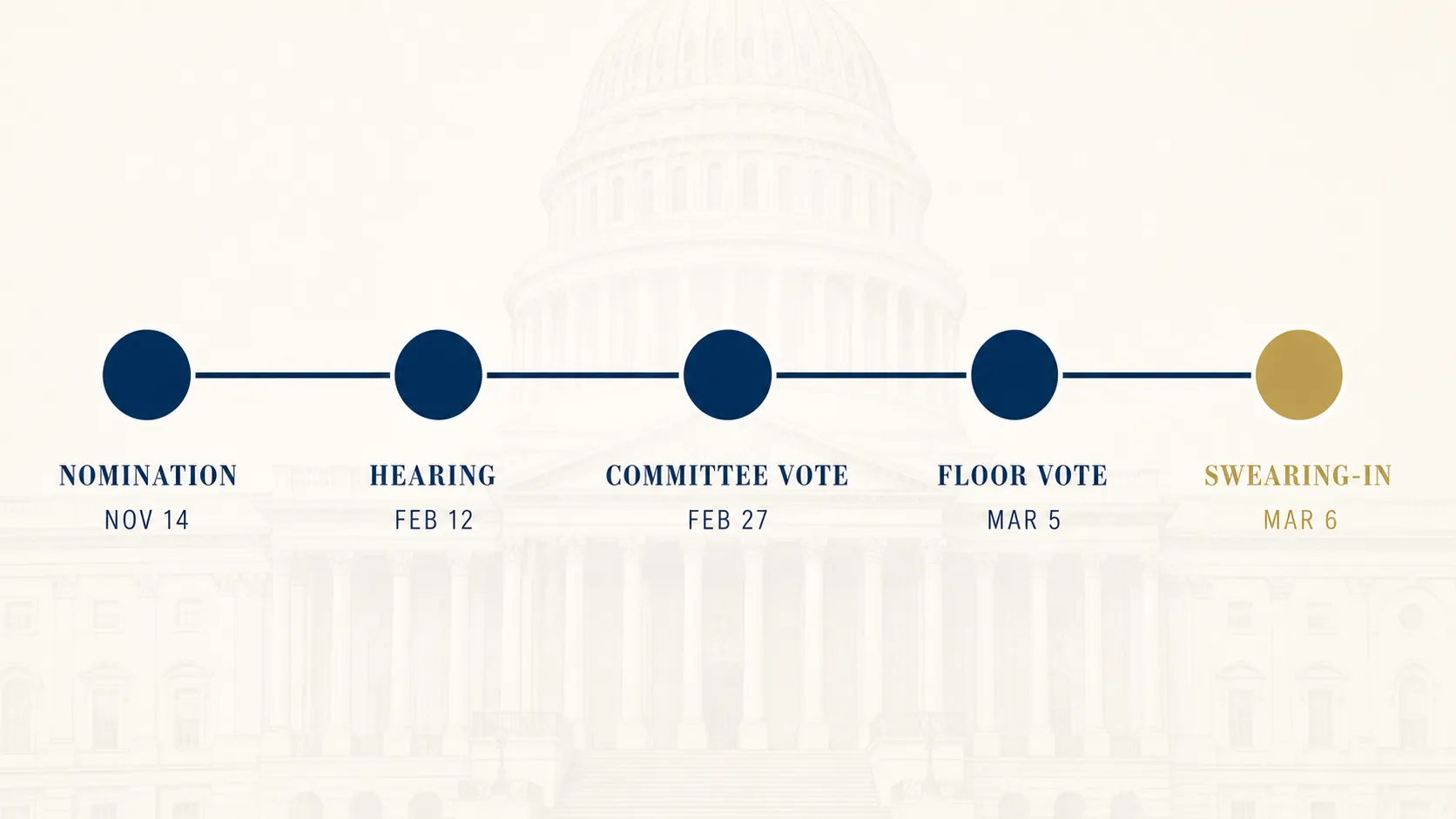
The audit trail is unusually tidy. The nomination was received on November 14, 2024. The Senate Judiciary Committee held its nomination hearing on February 12, 2025. The committee reported the nomination favorably by a 12–10 vote on February 27. The full Senate confirmed Blanche on March 5 by the 52–46 roll call, and the swearing-in followed on March 6.[1][2][7]
| Event | Verified Record | Why It Matters |
|---|---|---|
| Nomination | Submitted November 14, 2024, vice Lisa O. Monaco, resigned | Identifies the office and vacancy being filled |
| Judiciary hearing | Held February 12, 2025 | Shows committee-stage consideration |
| Committee action | Reported 12–10 on February 27, 2025 | Shows the nomination advanced to the floor |
| Floor vote | Confirmed 52–46 on March 5, 2025 | Creates the controlling Senate confirmation record |
| Swearing-in | March 6, 2025 | Marks entry into the confirmed DAG office |
The Senate roll-call page is the source to cite for the confirmation result because it answers the narrow administrative question directly: whether the Senate confirmed the nominee, for which office, on what vote, and on what date.[1] Congress.gov supplies the nomination metadata, including the vacancy description and committee sequence.[2] The Judiciary Committee notice supplies the hearing record.[7]
A source conflict should be handled the same way any other source conflict is handled: use the governing record for the legal status. If a biography or encyclopedia-style entry compresses the timing into a phrase such as service “since January 2025,” that phrasing should not be imported into a compliance memo as confirmation status. The Senate record says the confirmation vote occurred on March 5, 2025.[1]
Why the DAG Record Controls the Enforcement Question
The Deputy Attorney General record matters because DOJ policy does not move only through speeches and nominations. It moves through memoranda, approval gates, task-force supervision, litigation positions, and named-party substitutions. Blanche’s confirmed DAG tenure is therefore the record that connects the personnel question to current federal AI and digital-asset enforcement posture.
The most concrete digital-asset instrument is the April 7, 2025 memorandum titled “Ending Regulation by Prosecution.” The memorandum announced that DOJ was disbanding the National Cryptocurrency Enforcement Team and directed prosecutors away from using criminal enforcement to impose regulatory frameworks on digital assets, while preserving enforcement involving fraud, money laundering, hacking, terrorism finance, narcotics, organized crime, sanctions evasion, and other illicit-finance conduct.[8]
That is a narrower point than “crypto enforcement ended.” The memo changes emphasis and approval architecture. It does not make fraud, hacking, laundering, sanctions, or illicit-finance exposure disappear. It also matters that the memo routes exceptions through DAG-level approval, which is precisely why the identity and confirmed status of the Deputy Attorney General are operational facts rather than background biography.[8]

For legal-tech buyers and counsel, the useful reading is practical. A platform, exchange, wallet provider, or AI-enabled compliance vendor should not treat the memo as a general non-enforcement promise. The preserved categories are exactly the categories that tend to generate subpoena, AML, sanctions, cybersecurity, and victim-fraud issues. The altered question is who must approve edge-case criminal theories and how far a line prosecutor can go before the issue becomes a Main Justice control question.
AI Policy Now Sits in the Same Control File
Executive Order 14365, issued December 11, 2025, directed the Attorney General to establish an AI Litigation Task Force within 30 days to challenge state AI laws that the administration views as obstructing national AI policy. The same order directed Commerce to evaluate state AI legal regimes by March 11, 2026, and tied federal funding consequences to certain state AI regulatory choices, including through BEAD and discretionary-grant mechanisms.[9]
Because Blanche is listed by DOJ as Acting Attorney General as of April 2, 2026, the task-force supervision question is no longer only a DAG question.[3] But the same source discipline applies: Acting AG status is a later administrative fact, separate from the completed DAG confirmation and separate again from the pending Attorney General nomination.
That sequencing matters in client work. A federal AI-risk tracker should not say “pending nominee controls DOJ AI enforcement” when DOJ’s own leadership record identifies Blanche as Acting Attorney General and the Senate record separately confirms the DAG office he previously occupied. If the question is the open Attorney General nomination, use an AG nomination tracker such as Why Todd Blanche’s Nomination Is Postponed, Not Blocked. If the question is current enforcement control, start with the closed DAG confirmation record and DOJ’s Acting AG page.
What the Digital-Asset Memo Actually Changes
The April 2025 DOJ memo is easy to overread because its title is broad. Its operational content is more useful than its headline. It tells prosecutors not to use criminal enforcement as a substitute for digital-asset regulation; it disbands a specialized crypto enforcement unit; and it preserves ordinary criminal enforcement when digital assets are used in conduct DOJ already treats as criminal.[8]
| Issue | What the Memo Supports | Risk Reading |
|---|---|---|
| Regulation by prosecution | DOJ moves away from using criminal cases to create digital-asset regulatory rules | Regulatory theory alone is a weaker enforcement signal |
| Specialized crypto unit | National Cryptocurrency Enforcement Team is disbanded | Centralized crypto-enforcement branding is reduced |
| Fraud and illicit finance | Fraud, money laundering, hacking, sanctions evasion, terrorism finance, narcotics and organized-crime uses remain in scope | Core criminal exposure remains active |
| Exceptions | Certain actions require DAG-level approval | Leadership identity and office status affect escalation analysis |
This is where a confirmation record becomes a business-control record. If a matter is ordinary fraud, laundering, sanctions, hacking, or illicit finance, the memo does not supply a safe harbor. If a matter depends on a novel criminal theory that resembles regulation by prosecution, the memo makes approval structure and DOJ leadership more important. That is a different answer, and it is the one the document supports.
Lnu v. Blanche Makes the Office Visible in Court
The court-candor issue enters the record through caption and consequence. On June 3, 2026, the Ninth Circuit issued a published precedential opinion in Lnu v. Blanche, No. 24-4790, with Judges Paez, Bea, and Forrest on the panel.[10] The caption matters because DOJ leadership is not merely a policy abstraction there; the office appears as the named respondent in an appellate AI-hallucination sanctions opinion.
The Ninth Circuit imposed $2,500 in personal sanctions, six-month suspensions, order-distribution obligations, and a two-year certification requirement for future filings involving AI use. The opinion held that the relevant rules were violated “at the point of signing and filing,” not only after a later failure to correct the record.[10]
The opinion also cited empirical work by Magesh and coauthors reporting hallucination rates of 17% for Westlaw and 33% for Lexis on the tested 2024 legal queries.[11] Those figures do not prove that every AI-assisted filing is defective, and they do not measure every product in every workflow. They do support the narrower institutional point: court-facing AI use requires verification before filing, because the filing act itself can create the violation.
For a fuller incident-by-incident sanctions tracker, use AI Hallucination Sanctions in 2026: The Enforcement Wave by the Numbers. The point here is narrower: Lnu is one of the records that makes DOJ leadership legally visible in the AI-candor file.
Daghra Is a DOJ-Side Warning Signal, Not a Second Biography
Daghra v. Hinkley belongs in the same tracker for a different reason. On July 16, 2026, Chief Judge Hala Y. Jarbou of the Western District of Michigan criticized an Assistant U.S. Attorney’s filing for allegedly citing a nonexistent Sixth Circuit case in an ICE detention matter, with Bloomberg Law reporting the judge’s AI-use concern.[12]
That episode is not evidence that every DOJ filing has an AI problem. It is a DOJ-side control signal: the same department that supervises AI enforcement and digital-asset policy also has to manage ordinary court-filing verification. The risk is not only what DOJ asks courts to do about AI. It is also what DOJ’s own lawyers put into court records.
The detailed filing-control discussion belongs in Judge Warns DOJ Over AI Hallucination in ICE Detention Filing. For this record, Daghra is relevant because it reinforces why DOJ enforcement posture and court-candor discipline should not be tracked in separate universes.
Where the Pending AG Nomination Fits
The pending Attorney General nomination is relevant only if the memo is asking about future confirmation status, Senate timing, or political objections to the later nomination. Public materials from Alliance for Justice, NPR, and the New York City Bar address that separate AG nomination fight, including opposition arguments and hearing coverage.[4][5][6] They do not change the completed March 2025 Deputy Attorney General confirmation vote.
That is the clean way to handle contested political material. Attribute it, link it, and keep it in the proceeding it concerns. A risk memo that collapses the pending AG nomination into the confirmed DAG record will misstate both. For senator-by-senator status, use Which Key Senators Decide Todd Blanche’s DOJ Nomination? or What Deadlines Actually Bind Todd Blanche’s Acting AG Tenure? rather than rewriting the DAG confirmation file.
The Practical Control Record
For current U.S. federal AI and digital-asset enforcement tracking, the usable control record is this: Blanche was confirmed Deputy Attorney General on March 5, 2025, by Senate Record Vote 105, and sworn in on March 6.[1][2] DOJ identifies him as Acting Attorney General as of April 2, 2026.[3] The later Attorney General nomination remains a separate pending proceeding, not a substitute for the closed DAG confirmation record.[4][5][6]
From there, the legal-risk file should attach the instruments that actually affect conduct: the April 2025 DOJ digital-assets memo, EO 14365’s AI Litigation Task Force structure, Lnu v. Blanche for appellate AI-candor sanctions, and Daghra for a DOJ-side filing-control signal.[8][9][10][12] This is a U.S.-only regulatory and litigation-risk record, not legal advice.
References
- U.S. Senate Roll Call Votes 119th Congress - 1st Session, Vote 105, U.S. Senate, March 5, 2025.
- PN12-5 - Nomination of Todd Blanche for Department of Justice, 119th Congress, Congress.gov.
- Meet the Acting Attorney General, U.S. Department of Justice.
- Todd Blanche, Alliance for Justice.
- 5 takeaways from Todd Blanche's Senate confirmation hearing, NPR, July 15, 2026.
- Oppose Todd Blanche Attorney General Nomination, New York City Bar Association.
- Nominations, Senate Judiciary Committee, February 12, 2025.
- Ending Regulation By Prosecution, U.S. Department of Justice, April 7, 2025.
- Eliminating State Law Obstruction of National Artificial Intelligence Policy, The White House, December 11, 2025.
- Lnu v. Blanche, No. 24-4790, U.S. Court of Appeals for the Ninth Circuit, June 3, 2026.
- Legal RAG Hallucinations, Magesh et al., 22 Journal of Empirical Legal Studies 216, 2025.
- DOJ Called Out by Judge for Alleged AI Use, Fake Case Citation, Bloomberg Law, July 16, 2026.
Related records
Tool profile
Browse tool evaluations →Governing regulation
Browse the obligations tracker →Preventive workflow
Browse verification workflows →
Report a correction or tip
Spotted an outdated figure, a misstated fact, or a ruling this case record should reflect? Public comments are disabled for this content given the professional cost of a misreported case outcome, penalty amount, or rule text — use the structured correction channel instead.
Report a correction or tip for this record →