
Tracking Transgender Athlete Lawsuits After the B.P.J. Ruling
A structured, filterable docket of all major transgender-athlete lawsuits after the Supreme Court's June 30, 2026 ruling in West Virginia v. B.P.J., with current status, jurisdiction, and links to primary court orders. Counsel can assess whether a ban-enforcement or inclusion-policy risk applies in their jurisdiction.
- Jurisdiction
- US federal and state
- Court
- U.S. Supreme Court
- Judge
- Kavanaugh
- AI tool named
- No AI tool implicated
- Ruling date
- Jun 30, 2026
- Source document
- View primary court order ↗
- Last verified
- Aug 3, 2026
Lex Machina Review is an independent risk-tracking and reference resource. Nothing on this site is legal advice, and using it does not create an attorney-client relationship. Every record is reviewed against primary sources but may not reflect the most current status of a matter — always verify directly against the cited court order, rule text, or a licensed attorney before relying on it.
Companion explanation — secondary to the source document above
Risk Digest classification: litigation docket / institutional eligibility risk. Page last updated: Aug. 3, 2026, UTC. This is not legal advice. No named legal-review signal is listed for this page; the useful audit trail here is the linked order, opinion, or case page for each record. Each docket entry below carries its own last-verified date, because these lawsuits are now moving faster than headline summaries can safely track.
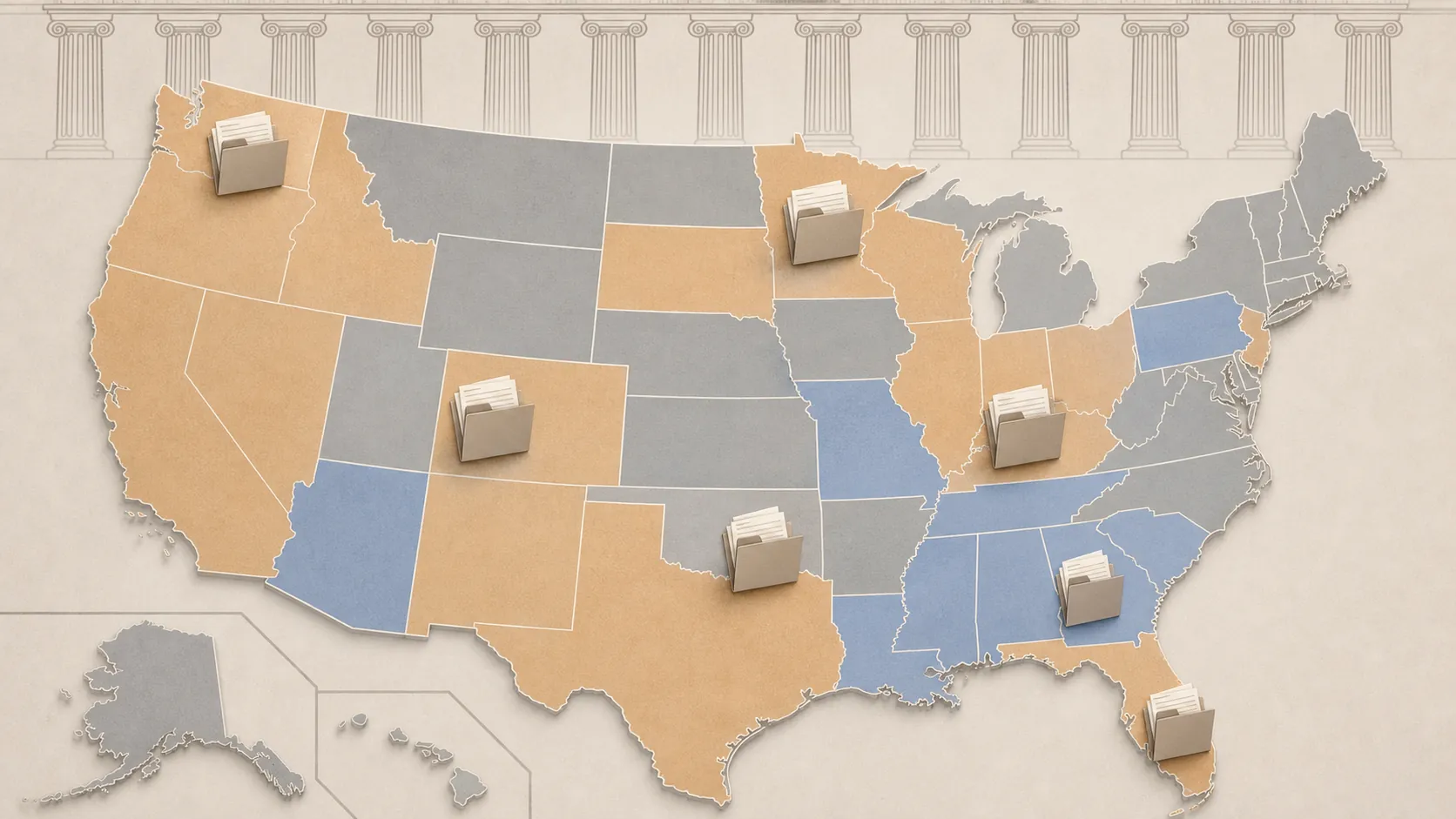
The anchor is the Supreme Court’s June 30, 2026 decision in West Virginia v. B.P.J. The Court held unanimously that West Virginia’s law did not violate Title IX and, by a 6-3 vote, that it did not violate the Equal Protection Clause; Justice Kavanaugh wrote that “the States may maintain women’s and girls’ sports for biological females.” [1]
That holding matters a great deal for state ban-enforcement cases. It does not, by itself, answer every institutional question now landing on counsel’s desk. It did not decide whether an inclusive policy in Connecticut or California violates federal law, and it did not decide whether the NCAA is a Title IX funding recipient on the theory preserved in the Gaines litigation. NCLR’s post-ruling analysis makes the same threshold point: the decision resolved the permissibility of state restrictions before the Court, not every transgender-athlete dispute in the country. [2]
For the state-by-state eligibility rules themselves, use the companion Transgender Athlete Eligibility Rules by State After B.P.J. tracker. This page is the procedural counterpart: what is live, what has been withdrawn, what remains blocked, and what category of risk the record actually creates.
Post-B.P.J. docket records
Baseline state counts should be handled as context, not as case status. MAP counted 27 state-law bans, two additional state-regulation bans in Alaska and Virginia, and 21 states plus five territories and D.C. without bans as of July 31, 2026. [3] SCOTUSblog described the landscape differently, referring to 25 other states plus Idaho and West Virginia. [4] That variance is not a reason to blend numbers; it is a reason to cite the tracker being used and then check the jurisdiction-specific rule and docket.
| Record | Jurisdiction / court | Judge if known | Current posture | Current risk signal | Source and last verified |
|---|---|---|---|---|---|
| West Virginia v. B.P.J. / Little v. Hecox | U.S. Supreme Court | Opinion by Justice Kavanaugh | Decided June 30, 2026; Title IX holding unanimous, Equal Protection holding 6-3. | State-law bans are not categorically invalid under Title IX or Equal Protection on the theory before the Court. This is the anchor record for ban-enforcement analysis, not a blanket disposition of inclusion-policy or NCAA funding-recipient claims. | Supreme Court slip opinion [1]. Last verified Aug. 3, 2026. |
| Tirrell & Turmelle v. Edelblut | District of New Hampshire | Not identified in reviewed records | Voluntarily withdrawn after the Supreme Court ruling. | The withdrawn challenge no longer blocks enforcement on its own. Do not confuse this withdrawal with the separate limited New Hampshire injunction protecting an individual plaintiff. | AP report on withdrawal [5]. Last verified Aug. 3, 2026. |
| Doe v. Horne | District of Arizona / Ninth Circuit posture reported | Not identified in reviewed records | Injunction against Arizona’s ban had been affirmed in September 2024; later post-B.P.J. dismissal reporting was not confirmed by a docket order in the reviewed records. | Treat as a previously blocked-ban record requiring a fresh docket pull before advising that enforcement has opened. A headline alone is not enough to dissolve an injunction. | Cronkite News / Arizona PBS context [6]. Last verified Aug. 3, 2026. |
| Roe v. Utah High School Activities Association | District of Utah | Not identified in reviewed records | Identified in the reviewed records as a ban previously enjoined in whole or part. | Still a blocked-ban caution record unless a later order modifies or dissolves the injunction. Counsel should check the district docket before enforcement advice. | MAP litigation/map context [3]. Last verified Aug. 3, 2026. |
| Barrett v. Montana | District of Montana | Not identified in reviewed records | Identified in the reviewed records as a ban previously enjoined in whole or part. | Still a blocked-ban caution record unless a later order modifies or dissolves the injunction. Do not infer statewide enforceability from B.P.J. alone. | MAP litigation/map context [3]. Last verified Aug. 3, 2026. |
| New Hampshire individual-plaintiff injunction | District of New Hampshire | Not identified in reviewed records | Limited injunction remains in place for an individual plaintiff, distinct from the withdrawn Tirrell & Turmelle challenge. | New Hampshire is not cleanly summarized by saying “the case was dismissed.” One record was withdrawn; a separate individualized injunction still matters for that student’s eligibility. | MAP notes and AP withdrawal reporting [3][5]. Last verified Aug. 3, 2026. |
| Soule v. Connecticut Association of Schools / CIAC | Second Circuit remand to District of Connecticut | Not identified for current district-court posture | Second Circuit remanded on Dec. 15, 2023. Current district-court posture requires docket verification before any characterization. | Inclusion-policy challenge. B.P.J. permits states to restrict; it does not decide that an inclusive athletic association policy violates Title IX or Equal Protection. | Second Circuit opinion [7]. Last verified Aug. 3, 2026, with district-court status expressly unverified here. |
| California inclusive-policy challenges | California state-court litigation | Not identified in reviewed records | Pending inclusion-policy category identified in the reviewed materials; no specific order was available for record-level characterization. | Inclusion-policy risk, not ban-enforcement risk. Treat as unresolved and verify the state-court record before advising a school or association. | No primary court order was available in the materials reviewed. Last verified Aug. 3, 2026, as limited by available sources. |
| Gaines v. NCAA | Northern District of Georgia | Judge Tiffany R. Johnson | Sept. 25, 2025 order dismissed most claims but allowed a narrow Title IX funding-recipient theory to proceed based on the NCAA’s Department of Defense concussion-research partnership; a 90-day discovery window was reported. | College-sports funding-recipient risk. B.P.J. supplies statutory backdrop, but it does not resolve whether the NCAA is a covered recipient on the preserved theory. | Ogletree Deakins analysis and USA Today report [8][9]. Last verified Aug. 3, 2026. |
The two tracks after the ruling
The cleanest way to read the post-ruling docket is to separate ban-enforcement risk from inclusion-policy risk. The same student-athlete subject matter appears in both categories, but the institutional questions are different.
Ban-enforcement risk
Ban-enforcement risk is the Monday-morning question for a district or athletic association in a state with a restriction: may the institution apply the state rule now, or is some injunction still in the way? B.P.J. changes the federal constitutional and Title IX baseline for that question. A state ban is no longer vulnerable simply because a court treats this category of restriction as forbidden by Title IX or Equal Protection under the theories rejected in B.P.J. [1]
That does not make every enforcement file green. New Hampshire shows the trap. A voluntary withdrawal after the Supreme Court ruling is procedurally significant, but it is not the same thing as a universal dissolution of every order affecting every plaintiff. The AP-reported Tirrell and Turmelle withdrawal sits beside a limited injunction for a separate individual plaintiff. [5][3]
Arizona is the other caution flag. The records cited here support that Doe v. Horne was an enjoined-ban record, with the injunction affirmed in September 2024. [6] The reviewed sources also flag dismissal reporting as unconfirmed. That is not enough to mark the case terminated. Before advising that Arizona enforcement is open, counsel should pull the current district-court docket and identify the order, if any, that dismissed the case or dissolved the injunction.
Utah and Montana belong in the same operational bucket until a current order says otherwise. B.P.J. supplies a powerful merits answer for states defending bans, but an injunction does not disappear because a merits headline changed. Someone still has to move, obtain relief, or point to an order that already did that work.
Inclusion-policy risk
Inclusion-policy risk runs in the opposite direction. These cases challenge policies that permit participation by transgender athletes, often in states or associations that have not adopted a categorical ban. B.P.J. says states may maintain girls’ and women’s teams for biological females under Title IX and Equal Protection; it does not say that an inclusive policy is unlawful. [1][2]
That distinction matters most for Soule v. CIAC. The Second Circuit remanded the case on Dec. 15, 2023. [7] Available case summaries conflict over the later district-court posture. So the honest status is narrow: Soule is an inclusion-policy record whose current district-court posture must be verified before anyone describes it as live, dismissed, or revived.
California should be treated the same way at the category level, but with even less record-level detail from the records reviewed here. Available summaries identify state-court challenges to inclusive policy. They do not include a controlling order. That means California can be flagged as unresolved inclusion-policy litigation, not summarized as if it had the same posture as Connecticut, West Virginia, Idaho, or New Hampshire.
College-sports litigation is adjacent, not disposed of
Gaines v. NCAA should not be folded into the state-ban pile. The Northern District of Georgia order reported on Sept. 25, 2025 dismissed most claims but preserved a narrow Title IX theory tied to whether the NCAA can be treated as a funding recipient through a Department of Defense concussion-research partnership; reporting also described a 90-day discovery window. [8][9]
That preserved theory asks a different institutional question from B.P.J. A state defending a statute and the NCAA defending its eligibility framework do not stand in the same procedural shoes. B.P.J. may shape statutory arguments, but it does not decide recipient status, NCAA governance, or the consequences for college policies. For related NCAA litigation, see the Heinecke v. NCAA lawsuit details record.
What counsel should verify before acting on a headline
- Start with jurisdiction. A B.P.J.-consistent state ban and an active district-court injunction can coexist until the injunction is modified, dissolved, or limited by order.
- Identify the track. Ban-enforcement records ask whether a restriction may now be applied; inclusion-policy records ask whether permitting participation creates liability. Those are not interchangeable questions.
- Do not treat a voluntary dismissal as broader than the parties and claims dismissed. New Hampshire is the standing example in the reviewed records.
- For Arizona, verify the post-B.P.J. docket before describing the injunction as dissolved or the case as terminated. The reviewed records do not contain the necessary order.
- For Soule, verify the current district-court docket before adopting either side’s public description of the posture.
- For NCAA matters, keep the funding-recipient issue separate from the state-ban constitutional holding.
- Use one state-count baseline at a time. This page uses MAP’s July 31, 2026 count for rule-map context and flags that other public summaries count differently.
The practical post-B.P.J. question is therefore not “did the Supreme Court end transgender-athlete litigation?” It is whether the particular institution sits in a jurisdiction where enforcement has opened, where an injunction still blocks action, where an inclusion-policy challenge remains unresolved, or where a college-sports Title IX recipient theory is still being litigated.
References
- West Virginia v. B.P.J., No. 24-43 — Supreme Court of the United States, June 30, 2026
- What the Supreme Court Did Not Decide in West Virginia v. B.P.J. — NCLR
- Bans on Transgender Youth Participation in Sports — Movement Advancement Project
- Court rules that states can exclude transgender athletes from girls’ and women’s sports teams — SCOTUSblog, June 2026
- Transgender girls withdraw lawsuit challenging Trump order, New Hampshire sports ban — AP News, July 2026
- Supreme Court upholds transgender athletes ban — Cronkite News / Arizona PBS, June 30, 2026
- Soule v. Connecticut Association of Schools, Inc. — U.S. Court of Appeals for the Second Circuit, Dec. 15, 2023
- Federal Court Narrows But Does Not End Debate Over Transgender Athletes and Title IX in College Sports — Ogletree Deakins
- Riley Gaines lawsuit against NCAA: Title IX claims can proceed — USA Today, Sept. 26, 2025
Related records
Tool profile
How Meta's AI Spending Reshapes Law Firm ProfitabilityGoverning regulation
Browse the obligations tracker →Preventive workflow
Browse verification workflows →
Report a correction or tip
Spotted an outdated figure, a misstated fact, or a ruling this case record should reflect? Public comments are disabled for this content given the professional cost of a misreported case outcome, penalty amount, or rule text — use the structured correction channel instead.
Report a correction or tip for this record →