
Trump Lawyers Sanctioned in IRS Lawsuit for Bad Faith
Primary-sourced Risk Digest record for the S.D. Fla. ruling that found Trump v. IRS plaintiffs acted in bad faith: Judge Williams sanctioned lead counsel under Rule 11 and inherent authority, referred Alejandro Brito to the Florida Bar, barred Daniel Z. Epstein for a year, and notified the New York and D.C. bars as to Todd Blanche and Stanley Woodward. Includes docket links, the pending fee motion, and Eleventh Circuit appeal status flags.
- Jurisdiction
- US Federal
- Court
- U.S. District Court for the Southern District of Florida
- Judge
- Kathleen M. Williams
- AI tool named
- None identified
- Penalty amount
- pending
- Ruling date
- Jul 13, 2026
- Source document
- View primary court order ↗
- Last verified
- Aug 1, 2026
Lex Machina Review is an independent risk-tracking and reference resource. Nothing on this site is legal advice, and using it does not create an attorney-client relationship. Every record is reviewed against primary sources but may not reflect the most current status of a matter — always verify directly against the cited court order, rule text, or a licensed attorney before relying on it.
Companion explanation — secondary to the source document above
For the query “trump lawyers sanctioned irs lawsuit bad faith,” the record starts with two primary checks: the July 13, 2026 sanctions order at ECF 106 and the live docket in Trump v. Internal Revenue Service, No. 1:26-cv-20609, in the Southern District of Florida.[1][2] Everything else is a pointer until the PDF and docket entries are matched by someone responsible for relying on them.
| Field | Current record |
|---|---|
| Court | U.S. District Court for the Southern District of Florida, Miami Division.[2] |
| Judge | U.S. District Judge Kathleen M. Williams.[2] |
| Case | Trump v. Internal Revenue Service, No. 1:26-cv-20609.[2] |
| Ruling tracked here | Sanctions order, ECF 106, filed July 13, 2026.[1][2] |
| Last verified | Aug. 1, 2026 (UTC). |
| Sanctions status | Confirmed by order; Rule 11 and inherent-authority sanctions imposed after a with-prejudice voluntary dismissal.[1] |
| Monetary amount | Pending. The amici fee motion is ECF 112, filed July 27, 2026; responses are due Aug. 10, 2026.[2] |
| Appeal status | Under appeal. Notice of appeal is ECF 113 and expedited stay motion is ECF 114, both filed July 31, 2026.[2] |
| Merits status | The case remains dismissed; the July 13 order does not reopen the tax-settlement dispute for ordinary merits litigation.[1][2] |
| Scope note | This is a sanctions-ruling record. The materials supplied identify no AI tool, no hallucinated citation, and no generative-AI filing incident. |

What the July 13 order actually does
The July 13 order is not merely a scolding paragraph appended to a political case. It is a sanctions order entered after the plaintiffs had already voluntarily dismissed the action with prejudice. That posture matters. The court was not deciding whether the underlying tax position should win at trial; it was deciding whether the litigation and purported settlement presentation had abused the court’s process badly enough to justify sanctions and professional-discipline consequences.[1][2]
Judge Williams found bad faith and imposed sanctions under both Federal Rule of Civil Procedure 11 and the court’s inherent authority.[1] Those are not interchangeable labels. Rule 11 addresses filings and representations made to the court. Inherent authority reaches the court’s ability to protect its own proceedings from bad-faith conduct. When an order uses both, the clean description is not “lawyers criticized” or “settlement rejected.” It is a confirmed sanctions ruling with a bad-faith finding.
The order’s core finding, as reflected in the supplied record, is that the plaintiffs acted in bad faith and used federal litigation to give judicial legitimacy to a purported settlement the court found had no viable basis in law or fact.[1] Secondary coverage has emphasized the same feature, including the court’s treatment of the supposed dispute as lacking true adverseness and its description of the arrangement as collusive.[3][4][5] Those descriptions are useful for finding the issue quickly. They are not a substitute for checking ECF 106.
Publication hygiene note: the supplied research indicates that the order PDF was not machine-readable in this review environment. That means verbatim quotations from the order should be treated as verification targets for licensed counsel before they are reused in a brief, memo, or newsroom copy. The safer working summary is the narrow one: the court entered a July 13 sanctions order, found bad faith, relied on Rule 11 and inherent authority, ordered named bar-related remedies, and left the monetary fee amount unresolved.[1][2]
The remedies are specific, and they are easy to blur
The phrase “Trump lawyers sanctioned” is directionally true, but too blunt for anyone who has to cite the record. The order names different lawyers in different ways, and those differences should survive the headline.
- Alejandro Brito: the order refers Brito to the Florida Bar.[1]
- Daniel Z. Epstein: the order bars Epstein from practicing in the Southern District of Florida for one year.[1]
- Todd Blanche and Stanley Woodward: the order directs notice to the New York State Bar and the D.C. Bar, where the supplied record states they already face disciplinary proceedings.[1]
- The purported settlement: the order prohibits the parties from calling or citing it as a settlement.[1]
- Money: the amount is not fixed. The amici fee motion is pending, with responses due Aug. 10, 2026.[2]
Those are not the same remedy wearing five hats. A bar referral is not a completed bar discipline order. A notice to disciplinary authorities is not a public finding by those authorities. A one-year district bar is a direct court-imposed practice restriction, but it now sits inside an appealed order. A fee motion is a request for money, not the final dollar figure. Each item belongs in the record, but each item needs its own status flag.
The order also addresses the way the parties characterized the purported settlement. That piece is not decorative. If a court prohibits parties from calling or citing an arrangement as a settlement, later summaries should not quietly restore that label as if the prohibition were only rhetorical.[1] A careful docket note can say “purported settlement” or “arrangement described by the parties as a settlement,” then point to the July 13 order.
Why the case was still alive enough for sanctions
The docket sequence explains why the sanctions ruling appears after dismissal. The case was filed Jan. 29, 2026. The plaintiffs filed a voluntary dismissal on May 18. A group of 35 former judges filed a motion on May 27. The court reopened the matter on May 29 for the sanctions dispute, then entered the July 13 order at ECF 106.[2]
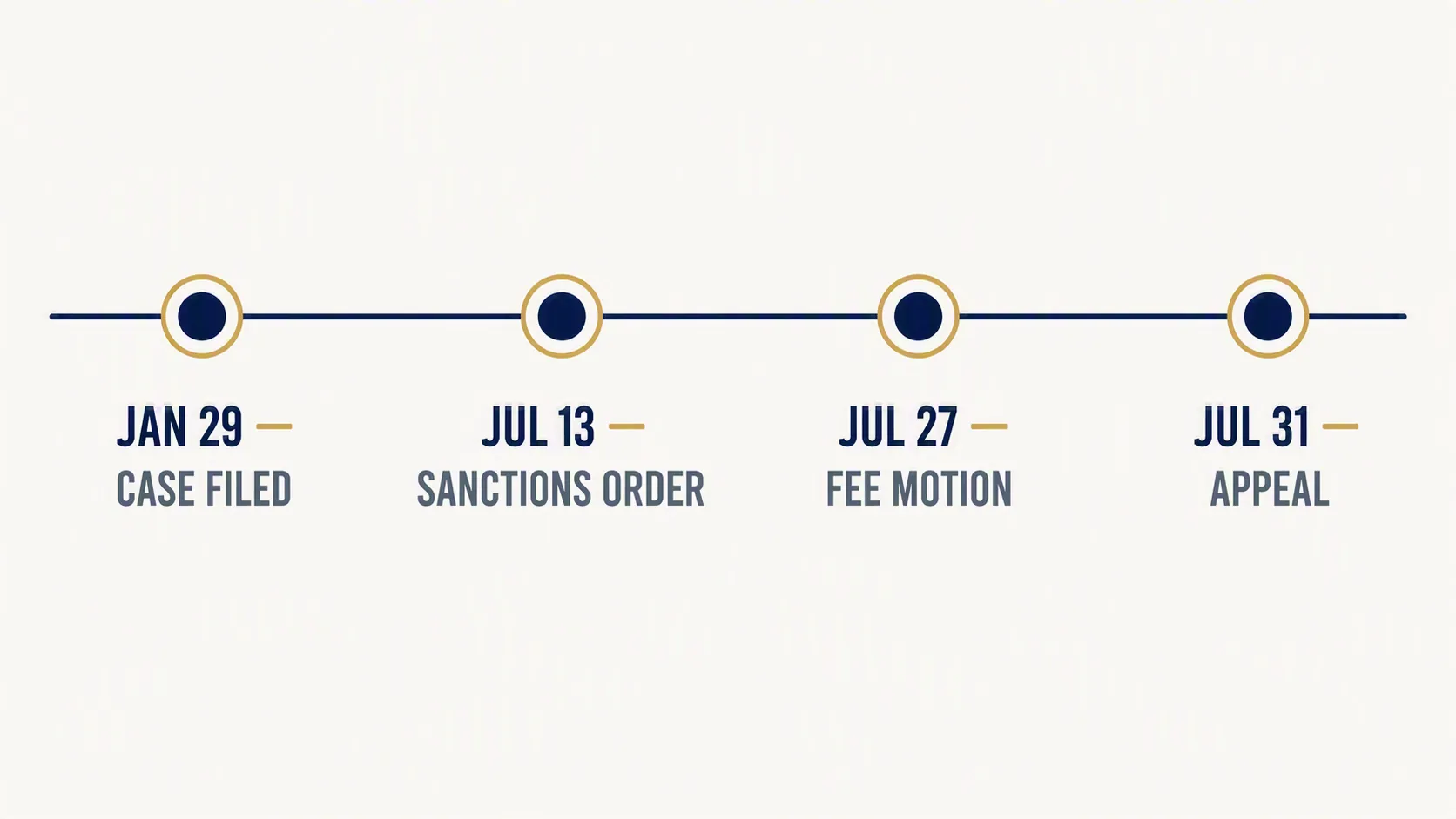
That sequence prevents two common mistakes. First, dismissal did not make the sanctions issue vanish. Courts can address sanctions and collateral matters after a merits dismissal when the legal standard is met. Second, the reopening did not convert the case back into ordinary litigation over the underlying IRS dispute. The live track is sanctions, fees, discipline notice, stay, and appeal—not a revived merits fight over the tax position.[1][2]
The connected settlement-enforceability and nomination issues are better handled in the companion record, The Trump v. IRS case blocking Todd Blanche's AG nomination. This page is narrower: it tracks the sanctions order, the bad-faith finding, the named lawyer remedies, the pending fee issue, and the appeal flag.
The fee issue is open, not implied
The monetary sanction should be marked “amount pending.” ECF 112 is the amici fee motion, filed July 27, 2026, and the docket sets responses for Aug. 10, 2026.[2] Until the court rules on that motion, no dollar amount is fixed by the materials supplied here.
That is not a minor bookkeeping point. Fee sanctions often become the number that gets copied into client alerts, enforcement summaries, partner briefings, and litigation-risk databases. Here, the number is not yet in the record as a final award. The correct short form is: sanctions confirmed; fee amount pending; responses due Aug. 10.
The appeal and stay motion changed the status line on July 31
On July 31, 2026, the docket added a notice of appeal at ECF 113 and an expedited stay motion at ECF 114.[2] That does not erase the July 13 order. It does mean the record should not be treated as procedurally settled.
For a risk database, this is the difference between a confirmed order and a closed penalty record. The confirmed order exists. The bad-faith finding exists. The named remedies in ECF 106 exist. But the fee amount is unresolved, and the appellate/stay posture is live. If a downstream summary has only one status field, it should not say “final.” If it has two, use “confirmed” for the sanctions order and “under appeal” for procedural status.
This is not an AI-hallucination case

This record belongs in a sanctions-ruling digest, not an AI filing-error or hallucinated-citation dataset. The materials supplied do not identify a generative-AI tool, fake case citations, or an AI-assisted filing mistake. The word “sanctions” is doing the work here; it should not drag the case into the wrong incident category.
The clean scope note is: “S.D. Fla. sanctions order in Trump v. IRS; bad-faith finding; Rule 11 and inherent authority; bar referrals/notices and one-year district practice bar; amount pending; under appeal; no AI component identified.” That is less catchy than the merged version circulating in loose summaries, and much harder to misuse.
How to use the secondary coverage
Law Dork, Reuters, and Democracy Forward are useful corroborating pointers for the July 13 ruling and for locating quoted order language while direct PDF review is pending.[3][4][5] Reuters framed the ruling around the court’s rejection of the Trump-IRS settlement posture; Democracy Forward published a release describing the bad-faith finding and linking the order; Law Dork’s coverage is especially useful for readers tracking the exact wording and procedural posture.[3][4][5]
None of those sources should outrank ECF 106 and the docket. If the task is to brief a partner, editor, client, regulator, or disciplinary committee, the order and docket entries carry the record. The secondary links explain how the public story moved; they do not fix the sanction amount, resolve the appeal, or complete any bar proceeding.
For Todd Blanche-specific ethics context, use Todd Blanche's Alleged NY Ethics Violations, Rule by Rule and Four Litigation Risks From the Todd Blanche Confirmation Controversy. For DOJ-representation verification issues adjacent to the same controversy, use Verifying DOJ Representations After the Todd Blanche Exodus. Those records are companions, not substitutes for the sanctions docket.
Current tracking instruction
Mark the July 13 order confirmed. Mark the monetary sanction amount pending. Mark the matter under appeal. Keep the record in sanctions-ruling scope, not AI-hallucination scope. Update after the ECF 112 fee-motion response deadline and after the Eleventh Circuit or district court acts on the July 31 appeal and stay filings.
References
- ECF 106, Order, CourtListener / RECAP, July 13, 2026
- Trump v. Internal Revenue Service, CourtListener
- Trump IRS Sanctions Settlement Order, Law Dork
- US judge voids Trump's settlement with IRS, Reuters, July 13, 2026
- Federal Court Finds Trump v. IRS Lawsuit Plaintiffs Acted in Bad Faith, Democracy Forward
Related records
Tool profile
Browse tool evaluations →Governing regulation
Browse the obligations tracker →Preventive workflow
Browse verification workflows →
Report a correction or tip
Spotted an outdated figure, a misstated fact, or a ruling this case record should reflect? Public comments are disabled for this content given the professional cost of a misreported case outcome, penalty amount, or rule text — use the structured correction channel instead.
Report a correction or tip for this record →