
Can TSA or CBP search your phone without a warrant?
Whether an airport phone search needs a warrant depends on the agency and the zone, not a single rule: TSA states its checkpoint screening does not read or copy device contents, while CBP border searches can proceed without a warrant or individualized suspicion. What refusal costs then varies by the traveler's immigration status.
- Jurisdiction
- US Federal
- Court
- U.S. Court of Appeals for the Fourth Circuit
- AI tool named
- None
- Ruling date
- Jul 13, 2026
- Source document
- View primary court order ↗
- Last verified
- Aug 4, 2026
Lex Machina Review is an independent risk-tracking and reference resource. Nothing on this site is legal advice, and using it does not create an attorney-client relationship. Every record is reviewed against primary sources but may not reflect the most current status of a matter — always verify directly against the cited court order, rule text, or a licensed attorney before relying on it.
Companion explanation — secondary to the source document above
The airport does not create one phone-search rule. The first question is narrower: who is asking for the phone, and where are you standing? A TSA officer at a security checkpoint is screening people and property for transportation security. A CBP officer at an international arrival point or other border setting is conducting a border inspection. Those two encounters carry very different warrant answers.
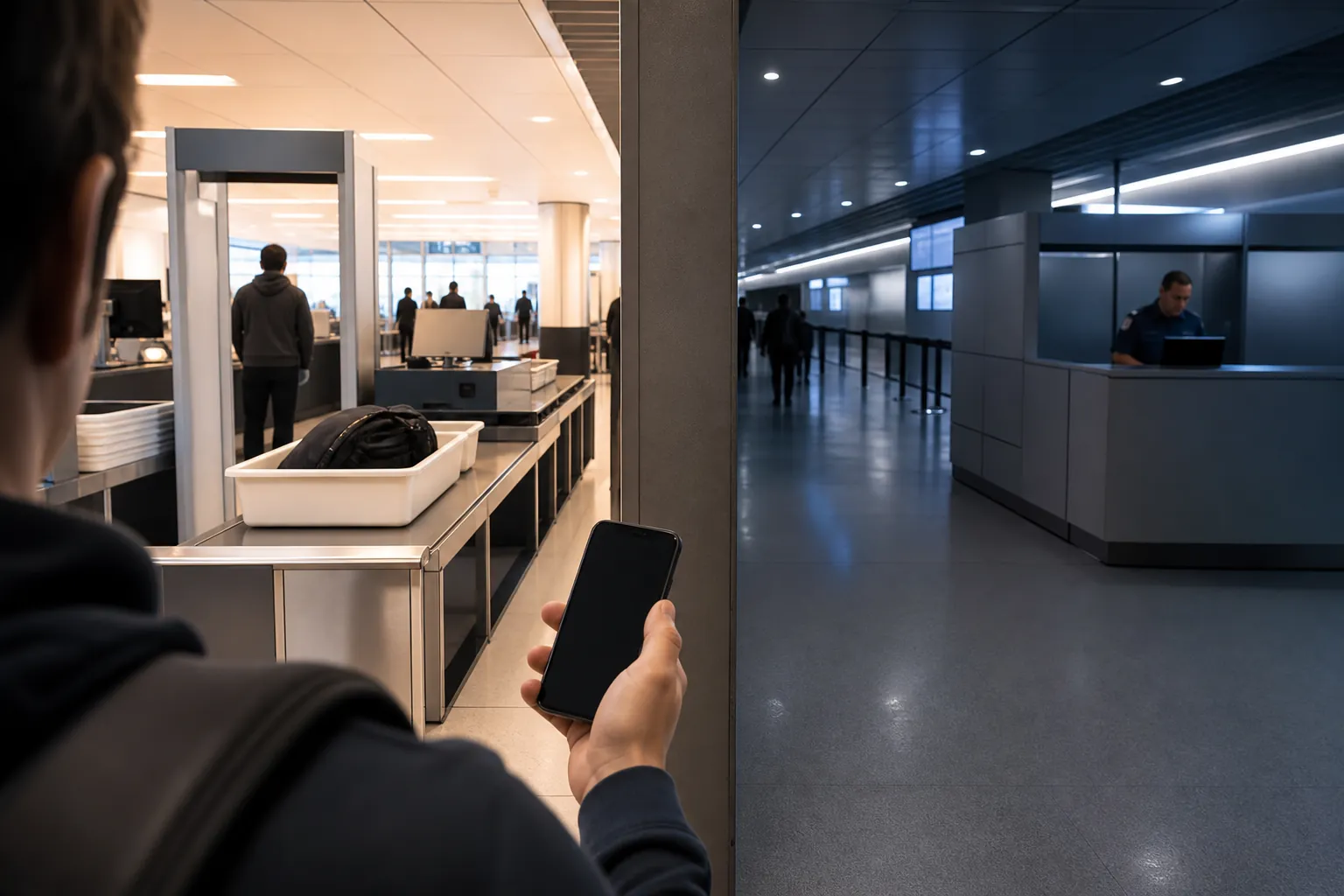
At the TSA checkpoint, the agency’s published position is that its officers screen electronic devices as items, and TSA says it “does not read or copy information from your device.” TSA may ask that a device power on, and TSA says powerless devices will not be permitted past the checkpoint.[1] That is a useful operational answer for most checkpoint encounters. It is not the same thing as a court holding that any imaginable TSA interaction with a phone’s contents is constitutional.
At the border, the answer changes. CBP distinguishes between a basic search and an advanced search of an electronic device. A basic search is a manual review of information resident on the device and accessible through its operating system or software. CBP states that it may conduct that basic search with or without suspicion. An advanced search involves connecting external equipment to review, copy, or analyze device contents; under CBP policy, that requires reasonable suspicion of activity violating laws enforced or administered by CBP, or a national-security concern, and approval from a senior manager.[2]
The TSA checkpoint answer is mostly about screening the object
The common phrase “TSA phone search warrant” points to the wrong legal actor in many airport stories. TSA runs the passenger screening checkpoint. Its job is to screen passengers and property before they enter the sterile area of the airport or board a flight. In that setting, the ordinary electronics issue is whether the phone, tablet, laptop, or other device can be screened as a physical item.
TSA’s own public guidance is blunt on content: “TSA does not read or copy information from your device.” The same TSA page says officers may ask travelers to power up electronic devices, including cell phones, and that powerless devices will not be permitted onboard the aircraft.[1]
That matters because a request to turn on a laptop or phone is not the same as a demand to unlock messages, photos, cloud accounts, or app data. Travelers often experience both as “they searched my phone,” but those descriptions should not be collapsed. A power-on request is about confirming that an item is what it appears to be and can be screened. A content review is a different intrusion and, at a TSA checkpoint, not what TSA says it does.
The careful way to handle a confusing checkpoint encounter is to classify it before arguing about warrants: “Am I at TSA screening, or am I being inspected by CBP at the border?” If the person in front of you is a TSA officer and the request is only to remove a device from a bag, place it in a bin, or power it on, the practical rights question is not the same as a CBP border phone search.
CBP border inspection is where the warrant answer becomes harder
CBP operates under the border-search framework. That framework is why a CBP officer at international arrival, preclearance, or another border setting can ask to inspect a phone in a way that a TSA checkpoint officer ordinarily does not. CBP’s current public policy divides device searches into two categories: basic and advanced.[2]
| Encounter | What is being searched | Warrant rule described by current sources | Important limit |
|---|---|---|---|
| TSA checkpoint screening | Device as an item going through security screening | TSA says it does not read or copy information from the device | This is TSA’s policy description, not a broad judicial ruling on every possible TSA device interaction |
| CBP basic border search | Manual review of information resident on the device and accessible through its software | CBP states this may occur with or without suspicion and without a warrant | The search is still a government search; later legal challenges may turn on facts, circuit law, and remedy posture |
| CBP advanced border search | Use of external equipment to review, copy, or analyze device contents | CBP policy requires reasonable suspicion or a national-security concern, plus senior-manager approval | That policy threshold is not the same as saying a warrant is required |
For a basic search, CBP’s position is that no warrant and no individualized suspicion are required. For an advanced search, CBP’s policy raises the threshold to reasonable suspicion or a national-security concern, plus senior-manager approval. The policy line is important, but it should be described accurately: reasonable suspicion is not a warrant, and senior-manager approval is not a judge.
CBP also reports how often these searches occur. In FY2025, CBP reported 55,318 electronic-device searches out of more than 419 million international travelers processed, which it describes as under 0.01% of arriving international travelers. Of those searches, 50,922, or 92%, were basic searches.[2] Those numbers help calibrate probability. They do not reduce the authority if you are the traveler selected.
What “manual” does and does not settle
A manual search can still be intrusive. A person scrolling through photos, messages, contacts, notes, documents, or locally available app content is not performing a trivial inspection just because no forensic tool is attached. The legal significance is that, under the border-search doctrine and current CBP policy, a manual review is treated differently from an advanced forensic search.
The “resident on the device” language also matters. CBP’s public page describes basic searches in terms of information resident on the device and accessible through its operating system or other software.[2] Travelers should not read that as a clean technical boundary they can apply under stress at a counter. Modern phones blur local data, cached data, and cloud-connected services. The safer legal point is narrower: CBP’s own definitions distinguish manual review from external-equipment analysis, and the policy threshold rises for the latter.
Refusal: the same words do not carry the same cost for every traveler
The next question is not just “Can they search?” It is “What happens if I do not unlock the device?” The answer depends heavily on immigration status.
| Traveler status | Can entry be denied solely for refusing to unlock? | Other consequences described by rights groups |
|---|---|---|
| U.S. citizen | No, U.S. citizens cannot be denied entry to the United States for refusing to provide a password or unlock a device | The device may be detained, searched later, seized, or not allowed to accompany the traveler |
| Lawful permanent resident | Generally no; lawful permanent residents cannot be denied entry solely for refusing to provide device access | The device may still be detained or seized, and the encounter may become more burdensome |
| Visa holder, visa waiver traveler, or other applicant for admission | Yes, refusal may carry more serious immigration consequences, including denial of entry | The person may face additional questioning, device detention, or other admission consequences |
The ACLU states that U.S. citizens and lawful permanent residents cannot be denied entry for refusing to provide a device password or unlock a device, although their devices can still be detained, excluded from accompanying them, or seized. The same materials warn that visa holders and other applicants for admission may be denied entry if they refuse to cooperate with a device search.[3]
That distinction is not a minor footnote. A U.S. citizen who refuses may be delayed and may lose the device for a period of time. A visa holder may be deciding whether to risk the trip itself. A lawful permanent resident sits in a different legal position from a temporary visitor, but that does not make the encounter cost-free.
The ACLU’s border-device guidance also describes CBP practice around device detention: if officers take a device but do not seize it, they generally may hold it for up to five days, with extensions possible in increments of up to seven days, and copied information should generally be destroyed within 21 days if no probable cause exists to keep it.[3] Those are practical timelines, not comfort. A phone held for several days can mean lost access to work, banking, family communication, two-factor authentication, and evidence of the encounter itself.
EFF’s border-search materials point travelers toward documenting the encounter and pursuing complaint or legal channels after the fact, especially where a device is retained or copied.[4] That is often a more realistic posture than trying to litigate constitutional doctrine at the inspection counter.
Riley is real, but it is not the airport shortcut people want
Many people have heard a simplified version of Riley v. California: police generally need a warrant to search the digital contents of a phone seized during an arrest. That memory is useful, but it does not answer the CBP border-search question. Rights groups and courts continue to treat Riley as a major digital-privacy case while recognizing that courts have not simply extended its warrant rule to routine border phone searches.[3][4]
Recent appellate decisions keep that border distinction alive. In July 2026, the Fourth Circuit in United States v. Belmonte Cardozo affirmed that a manual border search of a phone may proceed without a warrant or individualized suspicion.[5] The Seventh Circuit reached the same broad conclusion for a manual border device search in United States v. Eta earlier that month.[6] Those cases are current confirmation of the point, not a reason to stop reading the actual local circuit law when a suppression issue is live.
The circuit landscape has not been perfectly uniform on every device-search question, especially once advanced forensic searches and criminal suppression motions enter the picture. The ACLU’s explainer describes a split across circuits over what limits the Fourth Amendment places on border searches of electronic devices.[3] For lawyers, that means the question is often less “does the airport need a warrant?” and more “which search, which border setting, which circuit, which remedy, and which facts?”
That is the same disciplined habit that matters in other Fourth Amendment settings. A stale-warrant arrest challenge, for example, turns on a sequence of facts rather than a slogan about warrants; Risk Digest’s five-factor stale warrant checklist is useful precisely because it keeps the analysis tied to the actual legal trigger. The same is true in emerging surveillance disputes, where the legality of warrantless observation may depend on location, technology, duration, and doctrine; the site’s discussion of autonomous drones in public spaces is a separate example of why the word “warrant” does not do all the work by itself.
A practical way to classify the encounter
When a traveler is trying to avoid making a bad situation worse, the useful sentence is not a constitutional lecture. It is a classification question: “Am I at TSA screening, or am I being inspected by CBP at the border?”
- If it is TSA checkpoint screening, TSA’s published position is that it does not read or copy device information, though it may require an electronic device to power on before the item can proceed through screening.[1]
- If it is CBP border inspection, a basic manual phone search may occur without a warrant or individualized suspicion under CBP’s border-search authority.[2]
- If CBP wants to conduct an advanced search using external equipment, CBP policy requires reasonable suspicion or a national-security concern and senior-manager approval.[2]
- If the traveler refuses to unlock the device, the likely consequences depend on immigration status: U.S. citizens and lawful permanent residents cannot be denied entry for that refusal, but devices may be detained or seized; visa holders and other applicants for admission face more serious admission risks.[3]
Separate from device-search authority, the ACLU’s airport enforcement materials also warn about other airport data practices and law-enforcement encounters.[7] Those issues can matter, but they should not be folded into the narrower phone-search question. Passenger data access, questioning, device detention, and digital-content searches may involve different legal authorities and different remedies.
The clean bottom line is this: there is no single “airport phone search warrant” rule. TSA checkpoint screening and CBP border inspection are not the same encounter. TSA says it does not read or copy information from devices at screening. CBP can conduct a basic manual border search of phone contents without a warrant or individualized suspicion, while an advanced search requires the higher threshold set out in CBP policy. Refusal then turns from an abstract rights question into a status-specific risk question, especially for noncitizens seeking admission.
References
- What Can I Bring?, Transportation Security Administration
- Border Search of Electronic Devices, U.S. Customs and Border Protection, June 17, 2026
- Can Border Agents Search Your Electronic Devices? It’s Complicated, ACLU
- Border Searches, Electronic Frontier Foundation
- United States v. Belmonte Cardozo, No. 25-4239, U.S. Court of Appeals for the Fourth Circuit, July 13, 2026
- United States v. Eta, No. 25-1891, Justia, July 6, 2026
- What to Do When Encountering Law Enforcement at Airports and Other Ports of Entry into the U.S., ACLU, July 27, 2026
Related records
Tool profile
Browse tool evaluations →Governing regulation
Browse the obligations tracker →Preventive workflow
Browse verification workflows →
Report a correction or tip
Spotted an outdated figure, a misstated fact, or a ruling this case record should reflect? Public comments are disabled for this content given the professional cost of a misreported case outcome, penalty amount, or rule text — use the structured correction channel instead.
Report a correction or tip for this record →