
Verify Kansas City Wrongful Death Lawyer's Trial Experience
Advertised trial experience is self-reported marketing until it is matched to a docket entry. This guide shows Kansas City families how to verify a wrongful-death lawyer's claims through Missouri Case.net, Kansas CaseSearch, and license records — and why the D. Kan. Lexos sanction made that check a court-enforced duty.
- Jurisdiction
- US - District of Kansas
- Court
- U.S. District Court for the District of Kansas
- Judge
- Julie Robinson
- AI tool named
- Unspecified generative AI tool
- Ruling date
- Feb 2, 2026
- Source document
- View primary court order ↗
- Last verified
- Aug 4, 2026
Lex Machina Review is an independent risk-tracking and reference resource. Nothing on this site is legal advice, and using it does not create an attorney-client relationship. Every record is reviewed against primary sources but may not reflect the most current status of a matter — always verify directly against the cited court order, rule text, or a licensed attorney before relying on it.
Companion explanation — secondary to the source document above
A search for “kansas city wrongful death lawyer trial experience” usually drops a family into a marketplace of verdict totals, years in practice, settlement language, review badges, and confident phrases about courtroom readiness. The first useful move is not to decide which claim sounds strongest. It is to ask what record would prove it.
If a firm says it has tried wrongful-death cases, ask for the case number. If it advertises a verdict, ask where the verdict appears in the docket. If it describes a settlement, ask whether the public record supports that the case resolved and whether the claimed amount is publicly verifiable. If it says a particular lawyer has courtroom experience, check whether that lawyer actually appeared in the case.
That is a narrower standard than “does the website sound credible?” It is also a kinder standard for a family making decisions under pressure. A docket will not tell you whether a lawyer listens well, prepares witnesses carefully, or treats clients with patience. It can, however, keep a marketing sentence from passing as a proven fact.

Start with the one thing marketing rarely gives you: the case number
A useful trial-experience claim has three parts: a docketed case, a lawyer’s role in that case, and an outcome that matches the claim. Leave any one of those out and the statement becomes hard to test.
| Claim you see or hear | Record to ask for | What to compare |
|---|---|---|
| “We tried this case” or “trial-tested” | Case number in Missouri Case.net or Kansas CaseSearch | Attorney appearance, docket entries showing trial setting, jury trial, bench trial, verdict, mistrial, dismissal, or other disposition [1][2] |
| “We obtained a verdict” | Case number plus judgment, verdict form, docket entry, or available court document | Whether the named lawyer appeared and whether the recorded outcome matches the advertised result [1][2] |
| “We settled a wrongful-death case” | Case number plus docket disposition, dismissal entry, order approving settlement if one exists publicly, or another non-public document the firm is allowed to share | Whether the public record confirms resolution; many settlement amounts will not be visible from the docket alone [1][2] |
| “Our lawyer handled the case” | Attorney appearance or entry of appearance | Whether the lawyer personally appeared, whether the firm appeared, and whether the record shows lead-counsel responsibility or only some participation [1][2] |
The word “handled” needs particular care. A lawyer may have worked on a case without being lead trial counsel. A firm may have referred, co-counseled, associated in late, or helped with a specific motion. Those roles can all be legitimate. They are not the same thing as trying the case to verdict.
For a Kansas City practice, the state line matters. A Missouri case may be in Jackson, Clay, Platte, or another Missouri circuit court. A Kansas case may be in Johnson, Wyandotte, Leavenworth, or another Kansas district court. A lawyer’s website may serve the whole metro area, but the record search has to follow the courthouse.
Missouri Case.net: what to look for when the case is on the Missouri side
Missouri Case.net is the free public search portal for Missouri circuit-court records. Its name search can show cases, parties, attorneys, docket entries, and dispositions for Missouri state cases, depending on what is publicly available in the particular file [1].
If all you have is a lawyer name, search the lawyer’s name and the firm name separately. Then narrow the results by county and case type where possible. If the firm gives you a case number, use that instead. A case number is better than a name search because names collide, firms change names, and lawyers move between offices.
Once you find a possible match, do not stop at the caption. Open the case detail and compare:
- Parties: do the plaintiff and defendant names match the matter the firm described, allowing for privacy limits or initials where applicable?
- Attorney entries: does the lawyer being marketed appear by name, or only another lawyer at the firm?
- Dates: does the timeline match the advertised result?
- Docket language: do entries show trial settings, jury selection, bench trial, verdict, judgment, dismissal, or settlement-related orders?
- Disposition: was the case tried, settled, voluntarily dismissed, dismissed by the court, transferred, or resolved another way?
A dismissal is not a verdict. A settlement-related dismissal may be perfectly consistent with a strong result, but the docket may not disclose the amount. A trial setting is not a completed trial. An appearance is evidence that a lawyer was in the case; it does not prove the lawyer made opening statement, examined witnesses, or argued the verdict form.
That is why the cleanest verification note is plain and dated: “On August 4, 2026, Missouri Case.net showed Case No. ___, in ___ County, with ___ listed as attorney for ___, and docket entries on ___ showing ___.” The note does not need drama. It needs to be repeatable.
Kansas CaseSearch: do the same work, but do not assume the fields will look identical
Kansas CaseSearch is the statewide district-court search path for Kansas cases. It is the starting point for checking Kansas-side district-court matters, including cases filed in counties such as Johnson or Wyandotte [2].
The same questions apply: what is the case number, who appeared, what does the docket say happened, and does the outcome match the claim? The layout and available detail may differ from Missouri Case.net, so resist the temptation to treat one missing field as proof that nothing happened. Search with the case number if the firm provides it. If it does not, use lawyer names, party names, county, and approximate dates.
For wrongful-death claims, party names can be messy. The plaintiff may be an estate representative, surviving spouse, parent, adult child, or another statutory claimant. A family member’s name may appear where the deceased person’s name does not. If a firm cites a case publicly, it should be able to tell you enough to find the docket without asking you to guess through grief.
When a Kansas docket shows a trial setting and later a dismissal, ask what happened between those entries. A case can settle on the eve of trial. It can be dismissed after a confidential settlement. It can be dismissed for procedural reasons. The docket gives the skeleton; the lawyer’s explanation supplies context. The two should not fight each other.
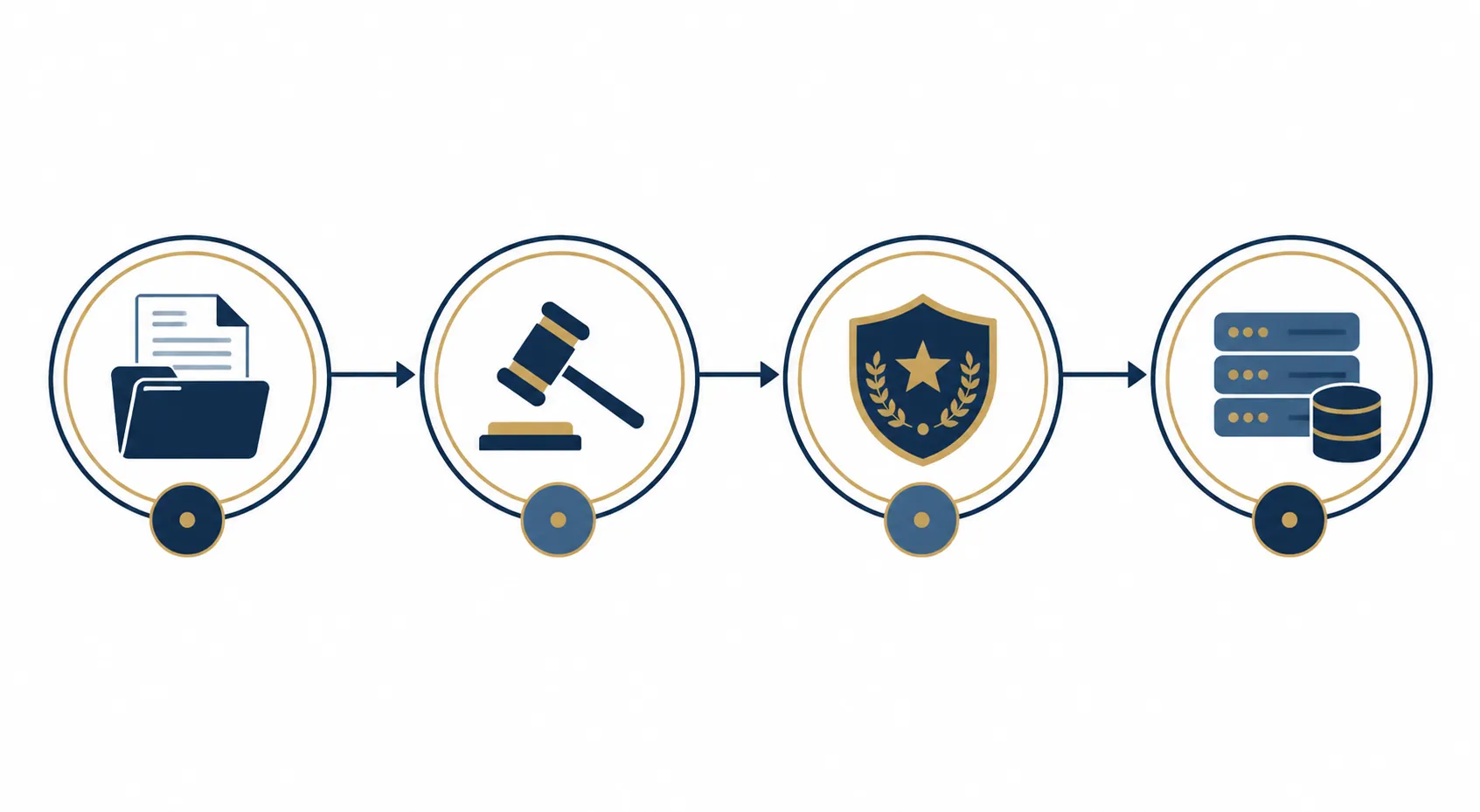
License and discipline checks belong in the same file
Trial experience and license status are different questions. A lawyer can have experience and still have a discipline history. A lawyer can be licensed and still have no meaningful wrongful-death trial record. Check both.
For Kansas, use the Kansas Supreme Court Attorney Registration System Directory to confirm registration and status [3]. For Missouri, the Office of Chief Disciplinary Counsel is the Missouri Supreme Court agency identified for attorney discipline records and can be reached through its site or by phone at 573-635-7400 [4]. For Kansas disciplinary history, the Kansas Office of the Disciplinary Administrator describes a free disciplinary-history letter process [5].
Do not check only one state just because the office address is on one side of State Line Road. Kansas City wrongful-death advertising often reaches families in both Missouri and Kansas. If the lawyer says they handle cases in both states, confirm the basis for that claim in both places: active license, pro hac vice admission, co-counsel arrangement, or some other lawful way to appear.
A simple intake note can prevent later confusion:
- Lawyer name searched, including middle initial or bar name variation.
- Kansas registration result and date checked.
- Missouri discipline-record source checked and date checked.
- Kansas disciplinary-history letter requested or received, if Kansas practice is relevant.
- Any explanation the firm gave for a name mismatch, inactive status, prior discipline, or out-of-state appearance.
For teams building repeatable vetting files, the same dated-record habit used in licensed-claim verification applies here: record the source, the query, the result, and the date. A screenshot without a date or URL is better than memory, but not by much.
Federal dockets are a side path, not the main road
Some Kansas City-area civil cases land in federal court, including the District of Kansas and the Western District of Missouri. PACER and CM/ECF are the federal docket systems to check when a claimed case was filed federally rather than in state court [6].
The same matching discipline applies: case number, party names, attorney appearances, docket events, and outcome. Federal dockets may contain complaints, motions, orders, notices of settlement, pretrial orders, trial minutes, verdict forms, or judgments. They may also contain sealed or restricted material. Do not infer too much from what is not visible.
For most families checking a local wrongful-death trial-experience claim, Missouri Case.net and Kansas CaseSearch will do more immediate work. Federal search matters when the firm gives you a federal case number, a federal court, or a claim that plainly belongs in federal court.
What a docket can prove — and what it cannot
Court records are not personality tests. They do not show every phone call, mediation session, witness-preparation meeting, strategic choice, or family conversation. A lawyer may contribute substantially behind the scenes without the docket giving a satisfying label for that work.
That limitation cuts both ways. A docket also may show that the marketed lawyer was not the one who appeared, that the case settled before trial despite being described as a trial win, or that a number on a webpage cannot be tied to any public judgment. The record is not the whole truth about lawyer quality. It is the guardrail around claims that can be checked.
Be especially careful with large local verdict or settlement snippets that circulate without a case number. Unless the amount can be matched to a docket, judgment, order, public filing, or reliable primary document, treat it as unverified. The same caution applies to “average settlement” figures on firm blogs when the methodology is not disclosed.
Why AI research is not a substitute for the docket
There is now a local, court-enforced reason to be strict about primary sources. In Lexos Media IP v. Overstock.com, a District of Kansas patent case — not a wrongful-death case — Judge Julie Robinson sanctioned four lawyers a total of $12,000 after AI-generated citations made their way into signed filings without adequate vetting. The ruling was issued on February 2, 2026, in No. 2:22-CV-02324 [7].
The point is not that patent sanctions tell you which personal-injury lawyer to hire. They do not. The point is narrower and stronger: in this jurisdiction, a federal judge treated signature as a verification duty. Reuters reported the sanction the next day, and the ABA Journal had earlier covered the December 17, 2025 order requiring the attorneys to explain AI-hallucinated citations [8][9].
The benchmark literature explains why that duty matters for legal research. A Stanford RegLab and HAI study testing May 2024 versions of legal research tools reported hallucination rates above 17% for Lexis+ AI and Ask Practical Law AI, and above 34% for Westlaw AI-Assisted Research [10]. Vals AI’s VLAIR testing of July 2025 tools reported legal-tool accuracy of 78% to 81% against a 69% human-lawyer baseline, but also a 14-point accuracy drop on multi-jurisdiction surveys [11].
The most uncomfortable number for verdict research comes from “Large Legal Fictions.” Dahl and coauthors reported hallucination rates of 58% for GPT-4, 69% for GPT-3.5, and 88% for Llama 2, and found the systems least reliable on district-court metadata [12]. District-court metadata is exactly where a family is trying to verify many Missouri and Kansas trial claims.
Reviews deserve their own caution. Originality.ai reported that 34.4% of 2025 law-office reviews were likely AI-written, according to coverage by NC Lawyers Weekly [13]. That does not prove any particular review is fake. It does mean reviews should not carry the weight of a docketed case, a license record, or a disciplinary-history check.
For law-firm staff, the lesson is the same one used in other AI-citation sanction files: do not let a generated research answer become a public claim until someone has traced it to the primary record. The workflow is closer to checking a sanction order against the court file than to polishing a marketing blurb.
A pre-retainer verification script
A family does not need to sound like a litigator to ask for proof. The request can be calm and specific:
- “You mention trial experience in wrongful-death or serious injury cases. Can you give me two or three case numbers where this lawyer appeared?”
- “Which of those cases went to verdict, and which settled?”
- “Was this lawyer lead trial counsel, co-counsel, local counsel, referring counsel, or involved in another role?”
- “Is the advertised result visible in the public docket, or is there another document you are allowed to share?”
- “Are you licensed in Missouri, Kansas, or both, and should I check any pro hac vice or co-counsel arrangement for my case?”
A good answer may include nuance. A settlement may be confidential. A verdict may have been reduced, appealed, or later resolved. A lawyer may have joined a team after another firm filed the petition. Nuance is not the problem. Refusing to identify the record behind a public claim is the problem.
Keep a dated note of each check: the case number, court, lawyer name, role shown in the docket, outcome shown in the docket, license status checked, discipline source checked, and any explanation the firm gave. If later conversations blur together, that note will matter more than a screen full of badges.
The standard is modest. Before signing, ask for the case number. Verify the lawyer’s role. Check Missouri and Kansas license and discipline sources as needed. Treat everything else — marketing copy, review noise, and AI-generated research — as unconfirmed until it meets the record.
References
- Missouri Case.net, Missouri Courts.
- Kansas CaseSearch, Kansas Judicial Branch.
- Kansas Supreme Court Attorney Registration System Directory, Kansas Judicial Branch.
- Office of Chief Disciplinary Counsel, Missouri Supreme Court.
- Office of the Disciplinary Administrator, Kansas Judicial Branch.
- Public Access to Court Electronic Records, PACER.
- Memorandum and Order, Lexos Media IP v. Overstock.com, No. 2:22-CV-02324, U.S. District Court for the District of Kansas, February 2, 2026.
- Judge fines lawyers $12,000 over AI-generated submissions in patent case, Reuters, February 3, 2026.
- Judge orders patent attorneys to explain AI-hallucinated citations, ABA Journal, December 17, 2025.
- Hallucination-Free? Assessing the Reliability of Leading AI Legal Research Tools, Stanford RegLab and Stanford HAI.
- VLAIR 10/14/25, Vals AI, October 14, 2025.
- Large Legal Fictions: Profiling Legal Hallucinations in Large Language Models, Journal of Legal Analysis, 2024.
- AI-generated law firm reviews: Ethics, FTC, NC Lawyers Weekly, July 30, 2025.
Related records
Tool profile
How Meta's AI Spending Reshapes Law Firm ProfitabilityGoverning regulation
Browse the obligations tracker →Preventive workflow
Browse verification workflows →
Report a correction or tip
Spotted an outdated figure, a misstated fact, or a ruling this case record should reflect? Public comments are disabled for this content given the professional cost of a misreported case outcome, penalty amount, or rule text — use the structured correction channel instead.
Report a correction or tip for this record →