
Which Clackamas Town Center shooting are you citing?
The phrase 'Clackamas Town Center shooting' maps to at least five distinct incidents with different legal statuses; a place-name alone cannot identify the correct docket. Litigators and research teams can confirm the right case record by checking case number, court, docket date, and party names against primary sources.
- Jurisdiction
- Oregon, United States
- Court
- Clackamas County Circuit Court
- AI tool named
- Unspecified AI research tool
- Ruling date
- Jun 16, 2025
- Source document
- View primary court order ↗
- Last verified
- Aug 3, 2026
Lex Machina Review is an independent risk-tracking and reference resource. Nothing on this site is legal advice, and using it does not create an attorney-client relationship. Every record is reviewed against primary sources but may not reflect the most current status of a matter — always verify directly against the cited court order, rule text, or a licensed attorney before relying on it.
Companion explanation — secondary to the source document above
This is a research-verification note, not legal advice. Last verified August 3, 2026. If a draft memo, AI answer, intake note, or litigation alert says only “Clackamas Town Center shooting,” the first edit is not stylistic. It is evidentiary: which one are you citing?
A Clackamas Town Center shooting legal update cannot be checked against the place-name alone. As of August 3, 2026, this article has not confirmed that any AI research tool actually conflated these incidents. The risk assessed here is narrower and more ordinary: a place-name query can return several plausible event records, and the researcher may treat the most familiar or most recent result as though it were a docket.

One location, several legally different records
The useful move is to separate the incidents before arguing about the legal update. The incidents below do not share the same posture, the same defendants, or the same citation value.
| Incident | Source status in this record | Legal posture | Identifiers that matter | Citation use |
|---|---|---|---|---|
| Dec. 11, 2012 mass shooting | Public event accounts; the perpetrator died by suicide | No criminal prosecution of the perpetrator because he died at the scene | Event date, location, perpetrator status | Useful for event background; not a criminal docket for a defendant [1] |
| 2014 reported gang-related shooting | Too thinly sourced in this research set; snippet-level treatment only | Not treated here as a confirmed case record | Needs primary law-enforcement or court confirmation before use | Lead only |
| Dec. 20, 2024 parking-lot shooting | Official county prosecution releases plus news reporting | Adjudicated criminal cases with identified defendants and sentences | Pedro Anthony Cornejo-Morales, 24CR67783; Carlos Raul Hererra-Medrano, 24CR68844; victim identification; sentencing dates | Strongest docket-confirmation example in this set [2][3][4] |
| March 2026 MAX-platform juvenile arrest | Same-site Risk Digest record available | Juvenile arrest record; public legal posture must be handled with juvenile-record caution | CCSO case number and reported/confirmed labels in the dedicated record | Use the dedicated record as the route, not a generic mall-shooting label |
| July 30, 2026 Cinemark gunshot | News reports describe an open investigation | Reported single round, no injuries, no charging document identified in this record | Date, theater setting, investigation status, any later court filing | Volatile lead; not citation-ready as a criminal case unless charging records appear [5][6] |
That table is not a finding that every possible civil docket, claim, or sealed juvenile record has been exhausted. It is a routing device. It keeps a famous 2012 event from swallowing a 2024 criminal sentence, and it keeps a 2026 open investigation from being reported as though it already had charges.
The 2024 parking-lot shooting is the clean adjudicated thread
The Dec. 20, 2024 parking-lot shooting is the easiest place to see why “mall shooting” is not an identifier. There are two named criminal defendants in the materials, two case numbers, and two sentencing outcomes. A tool or researcher that merges them has not found a better summary. It has lost the record.
Pedro Anthony Cornejo-Morales was associated with case 24CR67783. Clackamas County reported that he received 90 months in prison on June 5, 2025, for Attempted Murder in the Second Degree and Unlawful Use of a Weapon in connection with trying to kill a teenager at Clackamas Town Center [2].
Carlos Raul Hererra-Medrano was associated with a different case number, 24CR68844. Clackamas County reported that he received 70 months in prison on June 16, 2025, for Assault in the Second Degree in the shooting of a 15-year-old [3]. OregonLive identified the injured teenager as Zenon Elias Mendez, age 15, in its reporting on the second arrest [4].
Those details are not decoration. They are the controls that prevent the wrong update from entering a brief. If an AI-generated answer gives the Cornejo-Morales sentence but attaches the Hererra-Medrano case number, the error is not cured by the fact that both records point back to the same shopping center. If it says “the defendant” without naming which defendant, the answer has not yet reached docket quality.
Victim identification and sentencing dates also matter because they let the reviewer test whether a news account, an official release, and a court entry are discussing the same procedural moment. The January arrest report is a useful lead for the investigation timeline. The June county releases are useful for sentencing outcomes. Neither should be allowed to flatten two cases into one “Clackamas Town Center shooting” entry.
The other incidents create different verification traps
The 2012 shooting is famous, but it is not a defendant docket
The 2012 mass shooting is the event most likely to dominate broad search associations. It is also the easiest to misuse in a legal update. The perpetrator died by suicide, so the event did not produce a criminal prosecution of that perpetrator [1]. That does not mean no related records could exist in any court file; it means the event itself should not be cited as though there were a criminal defendant docket to update unless the researcher has separately found one.
The March 2026 juvenile arrest already has a narrower record
The March 2026 MAX-platform juvenile arrest belongs in the disambiguation set, but it should be routed through the dedicated March 2026 Clackamas record, which identifies CCSO case 26-005376 and uses a confirmed-versus-reported format. That distinction matters more in a juvenile setting, where public charging information may be limited and later court treatment may not be visible in the same way an adult felony docket is.
The July 30, 2026 Cinemark gunshot is still a live lead
The July 30, 2026 Cinemark incident is a different kind of record problem. KPTV reported a shot fired inside the theater at Clackamas Town Center, no injuries, and an investigation continuing after one person was detained and released [5]. OregonLive likewise reported a gunshot inside the Cinemark, no injuries, and no arrests made [6].
That is not the same posture as the 2024 adjudicated cases. A reported sheriff’s case number appearing in a social-media snippet should be treated as reported-not-confirmed unless it can be matched to a sheriff’s office release, court record, or other primary source. Until then, the legally careful description is an open investigation with no charging document identified in this record.
The 2014 item should not be promoted beyond its source quality
A 2014 gang-related shooting appears in the broader search field, but the available material for this record is too thin to carry legal analysis. If it matters to a filing, the next step is not paraphrase. It is a primary-source search for law-enforcement records, charging documents, party names, and court entries.
How to test an AI-assisted hit before it reaches a filing
AI research tools can be useful for surfacing candidate incidents. The routing failure starts when the output is treated as though it has already done the legal identification work. For a same-place event cluster, the review should be documentary before it is narrative.
- Keep the raw query and output. If the query used only the place-name, mark the result as a location hit, not a case hit.
- Extract the claimed legal record. Identify whether the answer is asserting an arrest, charge, conviction, sentence, civil claim, verdict, or merely an incident report.
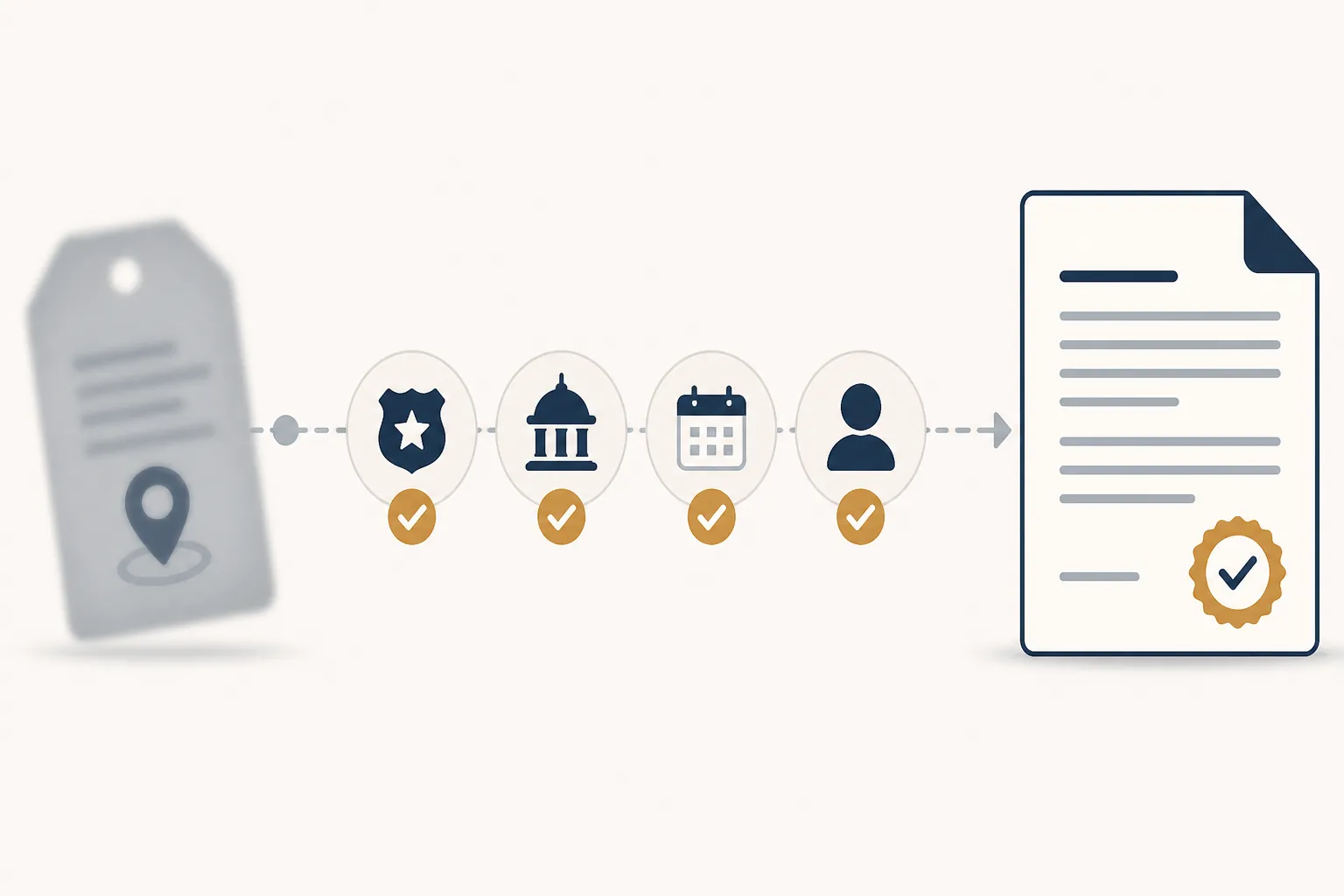
- Require the four anchors before citation use: case number, court, docket date, and party names. If any anchor is missing, the result remains a lead.
- Separate official releases, news reports, and court records. A district attorney or county release may be strong support for a prosecution update, but a filing-bound statement should still be matched against the relevant court record when available.
- Check the posture-changing facts: charging status, plea or conviction, sentence, dismissal, juvenile status, death of a suspect, and whether an investigation remains open.
- Write uncertainty into the work product. Use “reported,” “not yet tied to charging documents,” or “not confirmed in this record” when that is the actual state of the file.
This is the same discipline that prevents more obvious AI citation failures, including the kind discussed in the site’s hallucinated-holdings risk record. It also belongs in tool-selection and supervision policies, not just in end-stage cite-checking; the site’s AI competence discussion is the better place for that broader governance question.
The verification standard
For this event cluster, the safe citation unit is not “Clackamas Town Center shooting.” It is a matched record: case number, court, docket date, party names, and a source that actually supports the legal posture being described.
If the researcher cannot make that match, the result may still be useful. It may point to an incident, a law-enforcement release, a news lead, or a docket to pull. It is not yet a citation-ready legal update.
References
- Clackamas Town Center shooting — Wikipedia.
- Man who tried to kill teenager at Clackamas Town Center gets 90 months in prison — Clackamas County, June 5, 2025.
- Second man convicted in Clackamas Town Center shooting of 15-year-old — Clackamas County, June 16, 2025.
- 2nd man arrested in December Clackamas Town Center shooting that injured 15-year-old — OregonLive, January 2025.
- Shot fired inside theater at Clackamas Town Center, no injuries reported — KPTV, July 31, 2026.
- Gunshot reported inside Cinemark at Clackamas Town Center; no injuries, no arrests made — OregonLive, July 2026.
Related records
Tool profile
How Meta's AI Spending Reshapes Law Firm ProfitabilityGoverning regulation
Browse the obligations tracker →Preventive workflow
Browse verification workflows →
Report a correction or tip
Spotted an outdated figure, a misstated fact, or a ruling this case record should reflect? Public comments are disabled for this content given the professional cost of a misreported case outcome, penalty amount, or rule text — use the structured correction channel instead.
Report a correction or tip for this record →