
No Ruling Yet in White House Ballroom Appeal
The D.C. Circuit heard oral argument in the White House ballroom appeal on June 5, 2026, but no merits ruling has issued as of August 3, 2026, and construction continues under the administrative stay. This status record provides the docket-verified timeline and the standing, statutory, and national-security issues the panel has yet to decide.
- Jurisdiction
- U.S. federal – D.C. Circuit
- Court
- U.S. Court of Appeals for the D.C. Circuit
- Judge
- Patricia Millett, Neomi Rao, Bradley Garcia
- AI tool named
- No AI tool implicated
- Ruling date
- Apr 17, 2026
- Source document
- View primary court order ↗
- Last verified
- Aug 3, 2026
Lex Machina Review is an independent risk-tracking and reference resource. Nothing on this site is legal advice, and using it does not create an attorney-client relationship. Every record is reviewed against primary sources but may not reflect the most current status of a matter — always verify directly against the cited court order, rule text, or a licensed attorney before relying on it.
Companion explanation — secondary to the source document above
Last verified: August 3, 2026, 18:00 UTC. This is a legal-background status record, not legal advice. For the query “white house ballroom lawsuit appeals court update 2026,” the current answer is narrow: the D.C. Circuit heard argument on June 5, 2026, but has not issued a merits ruling; the preliminary injunction remains administratively stayed; and above-ground construction continues under the April 17, 2026 appellate order while the consolidated merits/stay posture remains pending.[1][2]
| Field | Current record |
|---|---|
| Case | National Trust for Historic Preservation v. National Park Service |
| Court now | U.S. Court of Appeals for the D.C. Circuit |
| Appeal docket | No. 26-5123, consolidated with Nos. 26-5134 and 26-5101[1] |
| District court | U.S. District Court for the District of Columbia, No. 1:25-cv-04316-RJL[1] |
| District judge | Judge Richard J. Leon[1] |
| Argument panel | Judges Patricia Millett, Neomi Rao, and Bradley Garcia[2] |
| Argument date | June 5, 2026[2] |
| Status flag | Argued; administratively stayed; consolidated merits/stay posture; opinion pending[1][2] |
| Last docket activity identified in this record | June 17, 2026 FRAP 28(j) letter exchanges; no opinion reflected in the July 29 docket update or August 3 verification[1] |
Use this entry the way one uses a docket sheet, not a headline. The D.C. Circuit has not “ruled for” either side on the merits. A safe citation today says the appeal has been argued and remains pending, with the district court’s injunction administratively stayed. The same last-verified convention appears in related status records such as Sweet v. McMahon eligibility check and the US-Japan-Philippines maritime cooperation record: the point is to keep the procedural status separate from the political temperature.
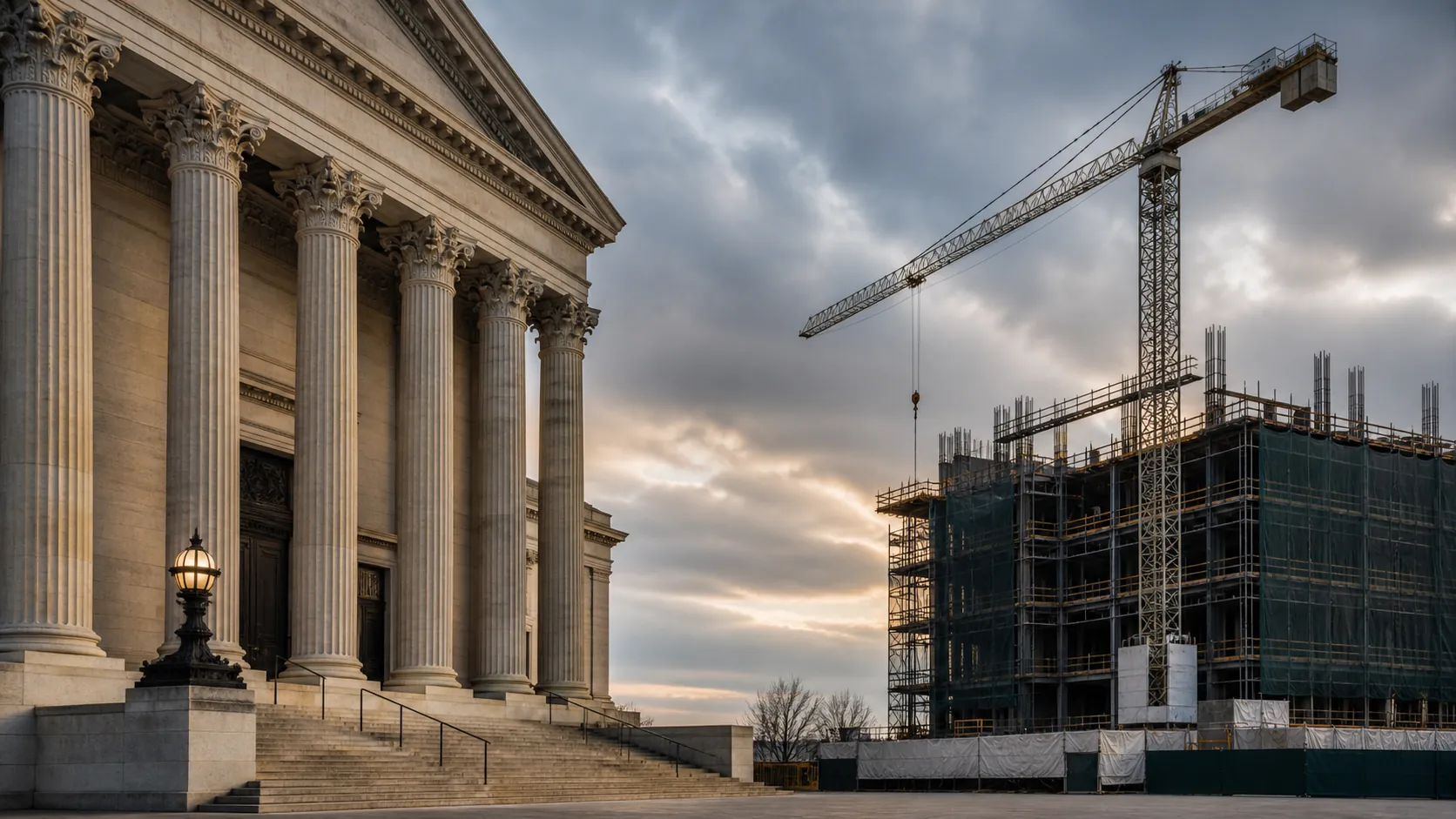
The docket path from complaint to appellate limbo
The suit began on December 12, 2025, when the National Trust for Historic Preservation filed in the District of Columbia after the reported completion of East Wing demolition. The complaint alleged violations of the National Capital Planning Act, NEPA, the requirement of express congressional authorization for buildings on federal land in Washington, D.C., and the Property Clause.[3][4] Standing was supported in part by the Declaration of Alison K. Hoagland, a preservation scholar whose claimed injury was tied to historic-preservation interests rather than a generalized disagreement with the project.[5]
On December 16, 2025, the district court declined temporary restraining order relief.[1] That early denial is easy to overread. It did not decide the final legality of the project; it left the case to move into the preliminary-injunction posture that later produced the order now on appeal.
On March 31, 2026, Judge Leon granted a preliminary injunction stopping construction.[6] Contemporary reports quoted the order in unusually direct terms: “Unless and until Congress blesses this project through statutory authorization, construction has to stop!”[7] CNBC separately reported another line from the order: “The President of the United States is the steward of the White House ... He is not, however, the owner!”[8] Those are district-court statements, not appellate holdings.
On April 11, 2026, the D.C. Circuit issued a stay-and-remand order in No. 26-5101.[9] The order is best treated with care in secondary summaries because the research record flags it as an unpublished Rule 36 disposition and because much of the usable description of its effect comes through reporting rather than searchable order text. Reports described the panel as directing Judge Leon to reconsider national-security implications before the injunction remained in force.[8]
On April 16, 2026, Judge Leon clarified the injunction. Reporting by NPR/AP and BBC described the clarification as allowing only below-ground security work and work “strictly necessary to ensure the safety, security, and structural integrity of the White House,” while preserving the central halt on ballroom construction.[10][11] NPR/AP also reported Leon’s formulation that “national security is not a blank check.”[10]
The next day matters most for present status. On April 17, 2026, the D.C. Circuit entered a per curiam order administratively staying the injunction, consolidating the stay motion with the merits, expediting briefing, and setting oral argument for June 5.[1] That order is why construction can continue while the appellate court decides what to do with the injunction and the merits issues folded into the appeal.
The national-security record then grew more complicated. On April 27, 2026, DOJ moved to dissolve the injunction and cited the April 25 White House Correspondents’ Dinner shooting as part of its national-security argument.[12] A Balls and Strikes account discussed docket entry 79 and reproduced some of DOJ’s more political phrasing; those quoted characterizations should be checked against the primary PDF before being reused as litigation text.[13]
The D.C. Circuit heard more than two hours of argument on June 5, 2026.[2] Argument coverage concentrated on standing and reviewability, including Judge Millett’s reported concern that the government’s theory looked like “move fast and break things and nobody has standing.”[14] Courthouse News and CNN likewise reported sharp questioning about the government’s national-security and reviewability positions, including DOJ’s position that courts could not stop the project even under a hypothetical scenario of “complete lawlessness.”[15][16]
The last docket activity identified for this status record is the June 17, 2026 exchange of FRAP 28(j) letters.[1] As of the July 29 docket update reviewed for this article, and as of the August 3 verification timestamp above, there is still no D.C. Circuit merits opinion.[1]
What the panel still has to decide
Standing is the threshold issue with the most immediate consequence. If the panel concludes that the National Trust and supporting declarants lack Article III standing, the court may never reach the statutory and constitutional questions in a way that restrains the project. That is why the reported oral-argument exchanges are not just color; they identify the gate through which the entire case must pass.[14][15][16]
The government’s reviewability position appears to be broader than an ordinary objection to one plaintiff’s pleadings. Reported accounts describe DOJ as pressing a theory under which no court could halt the construction even if the executive branch acted unlawfully, because no proper plaintiff would have standing to sue.[14][16] If the panel accepts a version of that argument, the decision may matter less for ballroom construction as architecture and more for judicial review of executive building activity on federal property.
The statutory dispute is also still live. The National Trust’s theory places weight on 40 U.S.C. § 8106, which concerns congressional authorization for certain public buildings in the District of Columbia; the government points to 3 U.S.C. § 105(d), involving White House Office and Executive Residence appropriations and administration; and the NPS Organic Act sits in the background because the National Park Service is a defendant and White House grounds management is part of the asserted federal-property framework.[3] The appellate court has not yet said which statutory authority controls, whether the statutes can be reconciled, or whether any violation is judicially enforceable by these plaintiffs.
The ultra vires issue is the doctrinal hinge between a routine administrative-law case and a separation-of-powers case. ACLU-DC’s amicus materials urge the D.C. Circuit to apply what it describes as the correct ultra vires standard to preserve review where officials allegedly exceed statutory authority.[17] The Constitutional Accountability Center’s Members-of-Congress amicus likewise frames the case around congressional power and the Property Clause.[18] Those filings are advocacy positions, not court conclusions.
National security remains a separate issue flag rather than a trump card already accepted by the D.C. Circuit. Lawfare and Courthouse News reported that Judge Leon reviewed four classified national-security submissions in camera.[14][15] The panel still has to decide what weight, if any, those submissions carry in the injunction analysis and whether they alter the standing or statutory questions.
What not to cite this case for today
The D.C. Circuit has not upheld or reversed Judge Leon’s preliminary injunction. The correct status sentence is: the appeal has been argued, the district court’s injunction is administratively stayed, and a merits decision remains pending.
Reported project figures also need caution. Public accounts have used different figures for cost, capacity, and East Wing history; those facts may explain why emergency relief mattered, but they are not findings in the appeal, because the D.C. Circuit has decided nothing on the merits yet.[10][11][12]
Keep this case separate from the AP press-access litigation, Associated Press v. Budowich. Search results can put both White House cases near each other, but this record concerns the ballroom-construction challenge brought by the National Trust against the National Park Service and related federal defendants.
Oral-argument reporting is not an opinion. Judge Millett’s reported “move fast and break things” exchange is important because it shows the pressure point at argument, not because it binds anyone. The same is true of coverage suggesting where particular judges seemed skeptical or sympathetic. Until an order or opinion issues, those accounts remain argument coverage.[14][15][16]
What to watch next
- A D.C. Circuit merits opinion or dispositive order in Nos. 26-5123, 26-5134, or 26-5101.
- Any stay modification that changes whether above-ground construction may continue.
- Any docket entry addressing the June 17 FRAP 28(j) exchanges or requesting additional briefing.
- Any Supreme Court emergency filing. SCOTUSblog has already flagged the dispute as a possible high-court emergency matter, but no such filing changes this record unless it appears on a court docket.[19]
The present legal risk is citation risk. The case is important because it is a live test of judicial review over unilateral executive construction on federal property, but it is not yet a D.C. Circuit ruling. As of August 3, 2026, the record remains: argued, stayed, construction continuing, opinion pending.
References
- National Trust for Historic Preservation v. National Park Service — CourtListener.
- Oral Argument Audio: National Trust for Historic Preservation v. NPS — CourtListener, June 5, 2026.
- National Trust for Historic Preservation v. National Park Service Complaint — National Trust for Historic Preservation, December 12, 2025.
- National Trust Files Suit to Stop Ballroom Construction — National Trust for Historic Preservation, December 12, 2025.
- Declaration of Alison K. Hoagland — National Trust for Historic Preservation.
- National Trust for Historic Preservation v. National Park Service, Filing 60 — Justia, March 31, 2026.
- Judge blocks Trump White House ballroom plan — The Guardian, March 31, 2026.
- Judge told to reconsider national security implications of halting Trump's White House ballroom — CNBC, April 11, 2026.
- Order, No. 26-5101 — U.S. Court of Appeals for the D.C. Circuit, April 11, 2026.
- Judge clarifies order blocking White House ballroom construction — NPR/AP, April 17, 2026.
- Trump White House ballroom construction dispute — BBC, April 2026.
- White House ballroom Donald Trump lawsuit — AP News, April 2026.
- Justice Department Trump Ballroom Filing — Balls and Strikes, April 2026.
- Dispatch: Move Fast and Break Things and Nobody Has Standing — Lawfare, June 2026.
- DC Circuit appears unconvinced national security claims justify White House ballroom — Courthouse News Service, June 2026.
- Takeaways from the White House ballroom appeals court hearing — CNN, June 5, 2026.
- National Trust for Historic Preservation v. National Park Service: White House Ballroom Challenge — ACLU of D.C.
- National Trust for Historic Preservation v. National Park Service — Constitutional Accountability Center.
- White House ballroom battle may soon arrive at the Supreme Court — SCOTUSblog, June 2026.
Related records
Tool profile
How Meta's AI Spending Reshapes Law Firm ProfitabilityGoverning regulation
Browse the obligations tracker →Preventive workflow
Browse verification workflows →
Report a correction or tip
Spotted an outdated figure, a misstated fact, or a ruling this case record should reflect? Public comments are disabled for this content given the professional cost of a misreported case outcome, penalty amount, or rule text — use the structured correction channel instead.
Report a correction or tip for this record →