
Court grants NCAA athletes a fifth year of eligibility
Verified case record for Wisne v. NCAA (D. Colo.): Judge Charlotte N. Sweeney's July 31, 2026 nationwide class certification and preliminary injunction granting a fifth year of eligibility, the August 3–10 transfer-portal window, and the NCAA's expedited Tenth Circuit appeal — the facts to confirm before advising an institution or athlete.
- Jurisdiction
- United States (D. Colo.)
- Court
- U.S. District Court for the District of Colorado
- Judge
- Charlotte N. Sweeney
- AI tool named
- No AI tool named
- Ruling date
- Jul 31, 2026
- Source document
- View primary court order ↗
- Last verified
- Aug 3, 2026
Lex Machina Review is an independent risk-tracking and reference resource. Nothing on this site is legal advice, and using it does not create an attorney-client relationship. Every record is reviewed against primary sources but may not reflect the most current status of a matter — always verify directly against the cited court order, rule text, or a licensed attorney before relying on it.
Companion explanation — secondary to the source document above
Last verified: Aug. 3, 2026, UTC. Confirmed from available reporting and docket-access path: Wisne et al. v. National Collegiate Athletic Association is pending in the U.S. District Court for the District of Colorado, with Judge Charlotte N. Sweeney reported to have entered nationwide class certification and a preliminary injunction on July 31, 2026. The case docket should be pulled before publication or institutional advice; the docket number and exact order text were not available in the crawled research materials and should not be treated as verified from secondary coverage alone. [1]
The immediate answer is narrow but consequential: a federal judge in Colorado has allowed a certified nationwide class of covered Division I athletes to seek a fifth season of NCAA competition, and the order is being treated as effective now while the NCAA says it will pursue an expedited appeal to the Tenth Circuit. The operational deadline is already here. The transfer-portal window for covered athletes is reported as Aug. 3 through Aug. 10, 2026. [2]

Current case record
| Field | Verified or reported status |
|---|---|
| Case | Wisne et al. v. National Collegiate Athletic Association; docket-access path identified, docket number not verified from crawled materials. [1] |
| Court | U.S. District Court for the District of Colorado. [1] |
| Judge | Judge Charlotte N. Sweeney, as reported in coverage of the July 31 ruling. [2] |
| Filed | Reported filed July 8, 2026. [2] |
| Ruling date | July 31, 2026. [2] |
| Relief | Nationwide class certification plus preliminary injunction allowing covered athletes a fifth year of eligibility, subject to the exact order text. |
| Transfer portal | Reported Aug. 3–10, 2026 window for covered athletes. [2] |
| Appeal posture | NCAA says it will pursue an expedited appeal to the Tenth Circuit. [3] |
| Primary-source flag | Order language, docket number, and class definition require verification against the court docket or order-linked copy before legal advice. |
The practical force of the order comes from the pairing of class treatment and preliminary relief. A single-athlete injunction changes one roster. A nationwide class-wide injunction, entered just as the portal opens, changes the work queue for athletes, schools, conferences, compliance offices, and NCAA eligibility staff before an appellate panel has had time to touch the file.
That does not make the ruling final. It makes it operative unless and until it is stayed, narrowed, reversed, or otherwise modified. For anyone advising an athlete or institution on Aug. 3, those two propositions have to sit side by side.
Who the certified class reportedly covers
The class definition is the first fact to verify because it decides who can rely on the order. CBS Sports reports that the certified class covers persons who began collegiate sports in the 2022–23 season, competed in NCAA Division I, completed four years of eligibility under the prior rules by the end of the 2025–26 academic year, and are barred from a fifth season by the NCAA’s adoption and immediate implementation of the new rule. [2]
That definition is more useful than the shorthand “fifth-year eligibility” because it excludes many athletes who may be interested in the ruling but do not match the class criteria. It is tied to start year, Division I participation, completion of four years under the prior regime, and the effect of the challenged NCAA rule. A compliance officer cannot process that as a general amnesty.
The class language also matters because plaintiff counts in secondary coverage do not line up cleanly. The safer record is to identify the class by the order’s definition, then confirm named plaintiffs and total counts from the docket before using any number in advice, a headline, or a risk memo.
What Judge Sweeney is reported to have found
The reported order language tracks the preliminary-injunction sequence in the way lawyers would expect, but the result is unusually broad for the timing. WKYT reports that Judge Sweeney wrote the plaintiffs “have met their burden at every step,” that they are “likely to succeed on the merits of their Section 1 claim,” that they “will suffer irreparable harm without” an injunction, and that the balance of equities and public interest favor relief. [4]
Those quotations should be checked against the order before they carry any more weight than reported excerpts. If accurate, they show the court did not simply preserve a roster spot for a few named athletes. The reported findings go to antitrust likelihood, irreparable harm, equities, and public interest for a nationwide class.
The filing-to-ruling interval is also part of the risk profile. The case is reported to have been filed on July 8 and ruled on July 31, 2026. [2] That is fast for class certification plus preliminary relief with nationwide operational effect. Speed is not error by itself; emergency eligibility cases are built around expiring seasons and missed windows. But the pace becomes important when the losing party’s first appellate argument is likely to challenge process as much as outcome.
The NCAA’s appeal position is procedural as well as substantive
NCAA Chief Legal Officer Scott Bearby called the rulings “egregiously wrong” and said they were issued “with virtually no evidence, and without witness testimony or even so much as a hearing,” according to Sportico. The NCAA also said it intended to seek an expedited appeal in the Tenth Circuit. [3]
That statement should not be filed away as routine institutional outrage. It identifies the points the NCAA wants the appellate court to notice first: the evidentiary record, the lack of witness testimony, the absence of a hearing, and the breadth of relief. Those are not the same as saying the injunction has no present effect. They are reasons the present effect may be attacked quickly.
For universities, the appeal posture creates an uncomfortable Monday problem. Covered athletes may be trying to enter the portal during the Aug. 3–10 window. Athletics departments may be receiving requests that look facially covered. Counsel may be waiting for an appellate docket entry, stay motion, or administrative order. The court order matters now; the appeal docket may matter next.
Why the Aug. 3–10 portal window makes this more than a paper ruling
The order landed on July 31. The reported transfer-portal window opened Aug. 3 and runs through Aug. 10. [2] That short interval is why the distinction between “effective now” and “secure on appeal” matters in practice rather than as a doctrinal nicety.
If an athlete is covered by the class, waiting for a fully developed appeal could mean missing the very window the injunction is meant to make usable. If a school processes the request and the order is later stayed or narrowed, the institution may have to revisit eligibility decisions already communicated to athletes and coaches. If a reporter writes that the NCAA’s five-year limit has simply been “struck down,” the sentence will travel farther than its procedural foundation.
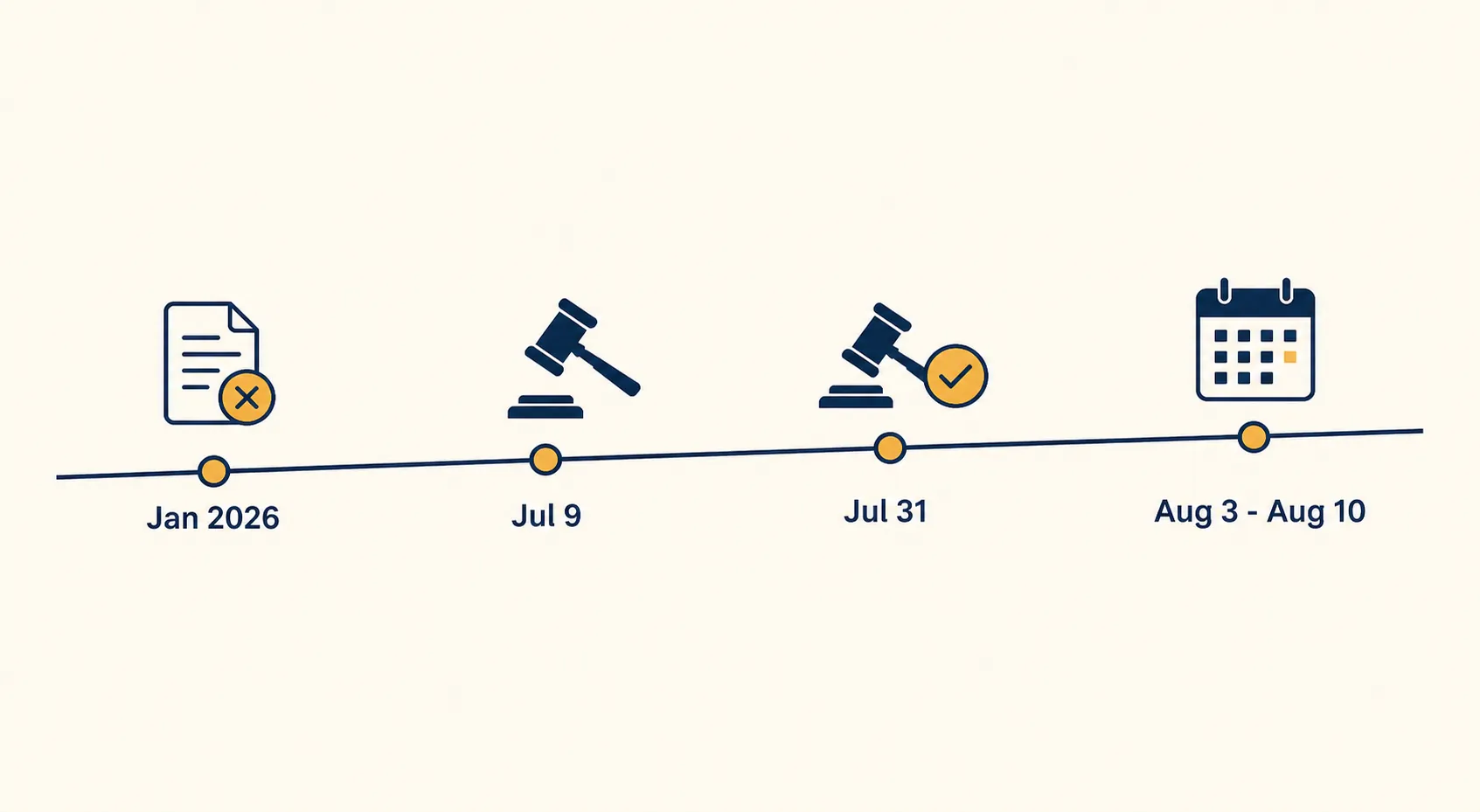
A clean working description is therefore limited: nationwide class-wide preliminary relief is in effect for athletes who fit the class definition, subject to verification of the order and any subsequent appellate stay or modification.
Same-day Tennessee ruling and the wider eligibility wave
Wisne was not the only July 31 eligibility ruling. AP reported that courts handed the NCAA losses that day in two fifth-year eligibility matters. [5] In Tennessee, a Davidson County chancellor granted relief to Jalen Washington and 18 other college basketball players, ordered a transfer-portal opening from noon Aug. 3 to 8 a.m. Aug. 10, and enjoined the NCAA’s restitution rule as applied in that dispute. [6]
The Tennessee order belongs in this record because it reinforces the same operational deadline. It should not be collapsed into Wisne. Different court, different plaintiffs, different order, and, on the present materials, different procedural vehicle. For a lawyer checking whether a particular athlete is covered, “there were two rulings on July 31” is a starting note, not an answer.
The July 31 rulings also sit beside earlier 2026 eligibility decisions. Sportico reported on Ohio’s Borovicanin litigation after a July 9 injunction and contrasted it with the January 2026 denial of preliminary relief in Patterson in the Middle District of Tennessee. [7] Those cases are useful for locating Wisne within the current eligibility wave. They do not turn the Colorado order into a settled national rule beyond its actual class and injunction.
Readers tracking preliminary-injunction posture across NCAA matters may want to compare the format of this record with the internal Heinecke v. NCAA case record. Legislative context, including the Protect College Sports Act, may affect the NCAA’s broader litigation strategy, but it does not change the immediate task here: verify the order, identify covered athletes, and watch the Tenth Circuit docket. For legislative tracking, see the Protect College Sports Act Capito update and Protect College Sports Act Senate vote records.
Items to verify before relying on the order
- Docket number and exact caption from the District of Colorado docket.
- The signed July 31 order or docket-linked copy, including whether class certification and preliminary injunction appear in one order or separate entries.
- Exact class definition, without paraphrasing away start year, Division I participation, prior-rule completion, or the challenged rule’s immediate implementation.
- Exact injunction language: what the NCAA is restrained from doing, whether relief binds member institutions directly or through NCAA enforcement, and whether any notice or implementation language appears.
- Any Tenth Circuit filing, stay motion, administrative stay, briefing schedule, or order entered after the NCAA’s stated expedited-appeal position.
- Named-plaintiff and affected-athlete counts, because secondary reports are not consistent enough to use without docket confirmation.
As of Aug. 3, 2026, the verified posture is this: nationwide class-wide preliminary relief is reported in effect for covered athletes in Wisne; the portal window has opened; the NCAA says it will seek expedited Tenth Circuit review; and the order’s exact terms should be checked against the primary docket before an institution, athlete, or publication treats any secondary summary as complete.
References
- Wisne et al v National Collegiate Athletic Association, PacerMonitor
- Colorado judge immediately grants extra year of eligibility to NCAA athletes who just graduated, CBS Sports
- Big 10 & SEC Now Back Protect College Sports Act As Injunction Issued, Sportico
- Federal judge strikes down NCAA eligibility limits, grants fifth year to Class of 2022, WKYT
- Courts hand NCAA major loss on five-year eligibility rule, ABC News
- Chancellor grants 19 college basketball players a 5th season and orders portal open Monday, AP
- Borovicanin NCAA Eligibility Litigation Ohio Tennessee, Sportico
Related records
Tool profile
How Meta's AI Spending Reshapes Law Firm ProfitabilityGoverning regulation
Browse the obligations tracker →Preventive workflow
Browse verification workflows →
Report a correction or tip
Spotted an outdated figure, a misstated fact, or a ruling this case record should reflect? Public comments are disabled for this content given the professional cost of a misreported case outcome, penalty amount, or rule text — use the structured correction channel instead.
Report a correction or tip for this record →