
AI inference reliability depends on Advantest test coverage
This article examines how Advantest's dominant V93000 test platform creates a structural dependency for AI inference chip reliability, and explains why legal AI buyers should consider test-equipment concentration as a procurement diligence factor.
- Tool
- Advantest V93000
- Benchmark source
- Advantest Q1 FY2026 earnings call
- Hallucination rate
- Not measured / undisclosed
- Test methodology
- Analysis of test content per device generation from Advantest earnings call and company release
- Test date
- Jul 29, 2026
Legal AI procurement usually starts where the vendor wants it to start: model benchmarks, retention terms, access controls, compliance mappings, financial durability, and customer references. That is necessary work. It is also incomplete. In 2026, Advantest’s role in AI inference semiconductor testing raises a reliability question legal buyers rarely name: how thoroughly the inference chips running those tools were screened before they entered data centers.
The uncomfortable part is not that a legal buyer should become a semiconductor engineer. It is that a buyer may approve an AI drafting, research, or review tool while depending on a hardware quality gate that does not appear anywhere in the vendor questionnaire. Advantest’s Q1 FY2026 materials, covering April through June 2026 and published on July 29, 2026, put that gate in view. In the earnings call, CEO Douglas Lefever said that “test content and test insertions per device generation” are the more important driver of future test demand than unit volumes.[1]

That sentence changes the diligence question. “How many AI chips are being shipped?” is a capacity question. “How much test content is required for each new device generation, and where is that testing concentrated?” is a reliability question. For legal AI buyers, the second question is harder to ask, but closer to the failure chain they will be expected to explain if an approved tool later produces unreliable work product.
The quality gate legal buyers usually do not see
Advantest is not a marginal supplier in this chain. In a May 14, 2026 company release, Advantest said it held about 50% to 58% global automated test equipment market share and had been ranked the No. 1 Assembly/Test Equipment Supplier for the seventh consecutive year by TechInsights, based on a survey covering more than 43% of global chip producers.[2]
Those numbers should be read carefully. They come from Advantest’s own release, and a market-share position is not a guarantee that every downstream AI system is reliable. But for procurement purposes, concentration itself matters. If a large share of advanced chips moves through one vendor’s test equipment, then that vendor’s test coverage, capacity, and platform roadmap become part of the infrastructure risk picture.
That is the gap in many legal AI evaluations. A procurement memo may compare a platform’s revenue growth and customer adoption, as in a Palantir AI procurement review, or it may focus on model behavior and retention policy, as in a Claude Opus 5 vs Fable 5 compliance comparison. Those are valid layers of diligence. They do not answer whether the chips supporting inference passed through adequate test coverage for the electrical, thermal, and interface conditions they will face at scale.
Why “test content per generation” matters more than chip volume
A simple unit-volume view treats semiconductor test as a checkout lane: more chips create more test demand. Lefever’s point is narrower and more important. Each new AI or high-performance-computing device generation can require more test steps, more test insertions, and more demanding coverage even if unit volume does not rise proportionally.[1]
“Test content” is the set of conditions, measurements, and patterns used to screen whether a chip behaves correctly. “Test insertions” are the points in the manufacturing and packaging flow where testing occurs. A more complex inference chip may need screening at wafer level, after packaging, under higher current conditions, across high-speed interfaces, or through system-level tests that better resemble real operating conditions. The issue is not merely whether the chip turns on. It is whether enough of its failure modes are exposed before the chip is deployed into infrastructure that legal teams will later treat as dependable.
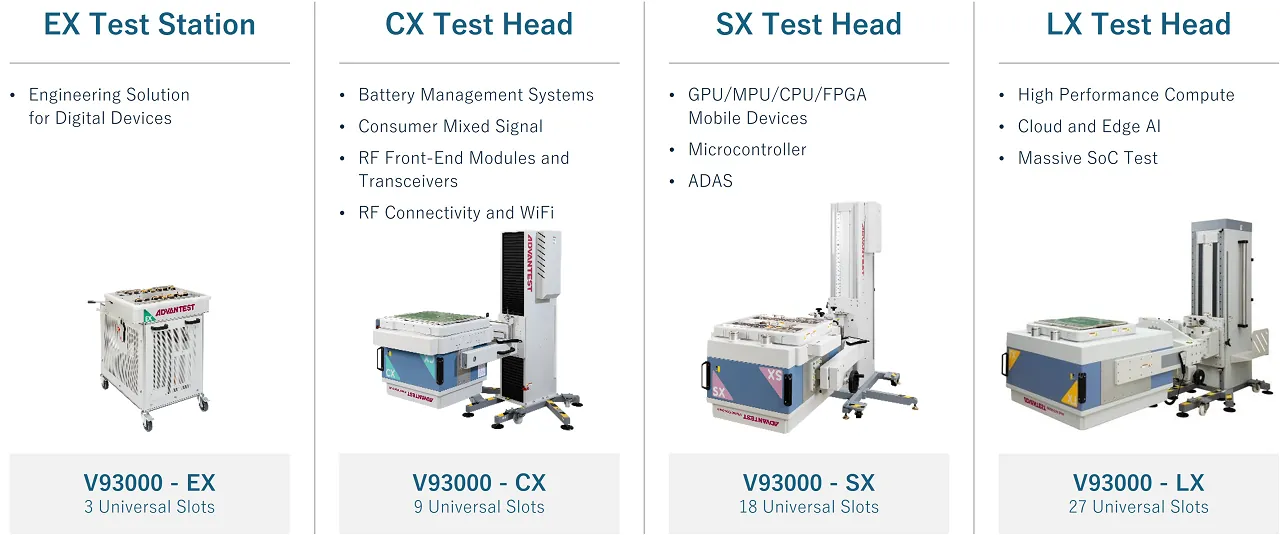
That is where the V93000 platform becomes procurement-relevant. Advantest describes the V93000 EXA Scale as its flagship system for AI and HPC testing, including high current loads, high-speed serial interfaces, and advanced system-level test. Lefever called the platform “a critical foundation supporting our competitive advantage.”[1][3]
For a legal buyer, the relevant inference is not “V93000-tested chips will not fail.” No cited source supports that. The narrower point is that deeper test content is one of the mechanisms by which increasingly complex AI chips are screened before they support inference workloads. If that mechanism is concentrated, under capacity pressure, or poorly documented by the AI vendor’s infrastructure suppliers, then the buyer has an unexamined dependency.
Inference scale makes the hidden dependency harder to ignore
The demand backdrop is not subtle. Deloitte’s 2026 semiconductor outlook forecasts generative AI chips approaching $500 billion in 2026 revenue, roughly half of global chip sales, while representing less than 0.2% of unit volume.[4] That combination is procurement-significant: a small number of very expensive, very complex devices can carry a large share of AI service capacity.
Inference is also where legal users experience AI. Training costs appear in the background. The live matter summary, clause comparison, privilege query, and research answer are inference events. Vast AI describes inference as accounting for about two-thirds of AI compute in 2026, although exact shares vary by definition and methodology.[5] Deloitte’s outlook similarly frames AI chip demand around the rapid expansion of generative AI infrastructure, but it does not validate any Advantest-specific claim.[4]
This distinction matters because legal AI buyers do not buy chips. They buy applications. But the application’s observable reliability sits on a stack: model design, retrieval quality, orchestration, data controls, cloud operations, data-center capacity, accelerators, packaging, and semiconductor test. A failure at the hardware layer will not necessarily look like a neat “chip failure” in a legal workflow. It may present as degraded latency, inconsistent outputs, service instability, or an incident the application vendor explains only in cloud-service terms.
That does not mean chip test gaps can be equated with hallucination rates. No source here measures a direct causal relationship between Advantest test coverage and legal AI hallucinations. Hallucinations are affected by model architecture, training data, retrieval design, prompting, guardrails, evaluation practice, and deployment context. Hardware screening is one upstream reliability condition, not a substitute for model-level validation.
What Advantest’s margins, R&D, and capacity say—and do not say
Advantest’s Q1 FY2026 gross margin reached 69.5%, and operating margin reached 51.7%.[1] Those margins should not be converted into an investment recommendation inside a legal procurement analysis. Their more useful function is evidentiary: customers appear willing to pay premium economics for advanced test capability during a period when AI and HPC chip complexity is rising.
The company’s R&D posture points in the same direction. Advantest says it is investing ¥110 billion in R&D for FY2026, including AI-enabled test tools, silicon photonics, and advanced packaging.[3] Again, this is company-supplied material. It does not independently prove the adequacy of any specific test program. It does, however, support the practical conclusion that test complexity is not flattening.
Capacity also deserves a restrained reading. Lefever said Advantest is scaling to more than 5,000 test units per year, up from about 3,000.[1] That indicates the company sees enough demand to expand production. It also suggests throughput could become a pressure point if inference chip demand accelerates faster than test-equipment supply. It does not show that any AI vendor is currently shipping inadequately tested chips.
The same caution applies to total addressable market claims. Advantest’s own market view is useful because it shows how the company sizes the opportunity, but vendor TAM estimates are not independent industry consensus. A legal buyer does not need to resolve the exact ATE market size to ask a better diligence question. It is enough to recognize that a concentrated test layer exists and that its workload is becoming more technically demanding.
How this changes legal AI procurement diligence
The procurement move is not to demand that a legal AI vendor disclose every chip serial number or every supplier’s proprietary test recipe. That would be unrealistic and, in many cases, contractually impossible. The better move is to add infrastructure reliability fields that force the vendor to explain how it manages chip-level and accelerator-level risk through its cloud, hardware, and model-serving relationships.
| Diligence field | What the buyer is trying to learn |
|---|---|
| Accelerator dependency | Which classes of AI accelerators support production inference for the tool, and whether the vendor relies on a single cloud, chip family, or serving region for legally sensitive workloads. |
| Hardware qualification evidence | Whether the vendor or its infrastructure provider requires documented qualification, burn-in, system-level testing, or reliability attestations for accelerators used in production inference. |
| Test-equipment concentration awareness | Whether the vendor can identify material upstream concentration risks, including semiconductor test-equipment dependencies, without treating them as irrelevant because they sit below the software contract. |
| Incident classification | Whether service incidents distinguish model behavior problems, retrieval failures, cloud outages, accelerator instability, and other infrastructure events. |
| Change management | Whether new accelerator generations or major serving-infrastructure changes trigger revalidation of latency, output consistency, failover, and matter-specific workflow controls. |
| Subprocessor and cloud disclosures | Whether infrastructure changes that affect inference hosting are captured in the same governance process as data-processing and security subprocessors. |
These fields are not a backdoor attempt to make the AI vendor warrant Advantest’s performance. They are a way to prevent the vendor from collapsing reliability into benchmark screenshots and privacy addenda. If the vendor markets the tool for legal work, it should be able to explain how production inference is qualified, monitored, and revalidated when the serving stack changes.
A useful answer may be high-level. For example, a vendor might say that it uses multiple cloud regions and accelerator pools, that infrastructure providers follow documented hardware qualification processes, that major serving-stack changes trigger regression evaluation, and that incidents are categorized by application, model, retrieval, and infrastructure layer. That kind of answer does not expose proprietary semiconductor test content, but it shows that the vendor has mapped the dependency.
An evasive answer is also informative. If the vendor insists that chip qualification is solely a cloud-provider issue and cannot affect legal-tool reliability, the buyer should document that position. The point of procurement diligence is not to eliminate every upstream risk. It is to know which risks the vendor has accepted, transferred, ignored, or made impossible for the customer to audit.
Where this fits with other upstream AI reliability signals
Infrastructure spending has already become part of legal AI risk analysis. The logic behind an Alphabet AI capex risk analysis is that upstream investment can affect capacity, continuity, and the economics of AI services. Advantest extends the same idea one layer deeper. Before the data center can serve the model, the accelerator must be manufactured, packaged, qualified, and tested.
That deeper layer should not crowd out ordinary legal AI diligence. Model benchmark performance still matters. Data-retention terms still matter. Prompt logging, privilege protections, audit trails, and jurisdictional hosting still matter. The added point is that infrastructure reliability should not stop at the cloud logo on the vendor’s security page.
The cleanest procurement conclusion is deliberately narrow: Advantest’s market position and V93000 role make semiconductor test coverage a relevant reliability signal for AI inference infrastructure. They do not allow a legal buyer to infer that a specific legal AI tool will hallucinate less, produce better citations, or satisfy professional-responsibility obligations. Those conclusions require tool-level testing in the buyer’s own workflows.
A disciplined ask for the vendor file
For a legal AI approval memo, the practical addition can be short. Ask the vendor to describe the production inference infrastructure supporting the tool, the process used to qualify accelerator changes, the incident taxonomy used to distinguish model and infrastructure failures, and any known upstream concentration risks that could affect service reliability. If the vendor relies on a cloud provider for those controls, ask what evidence the vendor receives and how often it is reviewed.
That request will not reveal Advantest’s proprietary test programs, and it should not pretend to. It will, however, put the right issue into the record: legal AI reliability is not only a model property. It is also the result of a screened, qualified, monitored infrastructure chain, and in 2026 one of the most concentrated quality gates in that chain sits at semiconductor test.
References
- Advantest Corp Q1 FY2026 Earnings Call Transcript — Investing.com — July 29, 2026.
- Advantest Ranked #1 Assembly/Test Equipment Supplier for 7th Consecutive Year — Advantest — May 14, 2026.
- Financial Review — Advantest.
- 2026 Global Semiconductor Industry Outlook — Deloitte.
- The Future of AI Inference in 2026 — Vast AI.
Chronological incident history
No sanction cases have named this tool in the tracked record set to date. This does not imply the tool is safe — see Risk Digest for ongoing monitoring.
← Compare peer toolsReport a correction or tip
Spotted an outdated figure, a misstated fact, or a ruling this tool profile should reflect? Public comments are disabled for this content given the professional cost of a misreported case outcome, penalty amount, or rule text — use the structured correction channel instead.
Report a correction or tip for this record →