
AWS's AI investment shifts legal-tech risk to buyers
AWS's roughly $200B AI buildout is making it the default infrastructure layer under much of legal tech, but capex is a market signal, not a reliability verdict. The verification duty stays with the firms and legal departments buying AWS-anchored tools, so procurement must judge grounding, citations, and benchmark design at the application layer rather than trust the investment.
- Tool
- Westlaw AI-Assisted Research
- Benchmark source
- Stanford HAI, AI on Trial
- Hallucination rate
- >34%
- Test methodology
- Legal research queries benchmark measuring incorrect answers
- Test date
- Jan 1, 2024
The AWS AI investment impact on legal tech is easy to overstate in exactly the wrong place. Amazon’s spending makes AWS harder to avoid as infrastructure. It does not make an AI-generated citation safer in a brief, or a privilege call better documented, or a compliance summary ready for a regulator.
This article is not legal advice. It separates Amazon’s investment and product facts from legal-AI reliability evidence, and it treats vendor performance claims as vendor claims unless an independent benchmark supports them. The file still lands on the lawyer, law firm, or legal department that approves the workflow.

What Amazon’s AI spend actually changes
Amazon’s 2026 AI spending posture is not cosmetic. CNBC reported in April 2026 that Amazon CEO Andy Jassy defended the company’s AI buildout and said Amazon was “not going to be conservative” on AI investment.[1] CIO Dive reported in February 2026 that Amazon was adding roughly $200 billion to its AI buildout, with AWS AI revenue at a $15 billion annualized run rate and the company’s capital spending rising by about 60% year over year.[2]
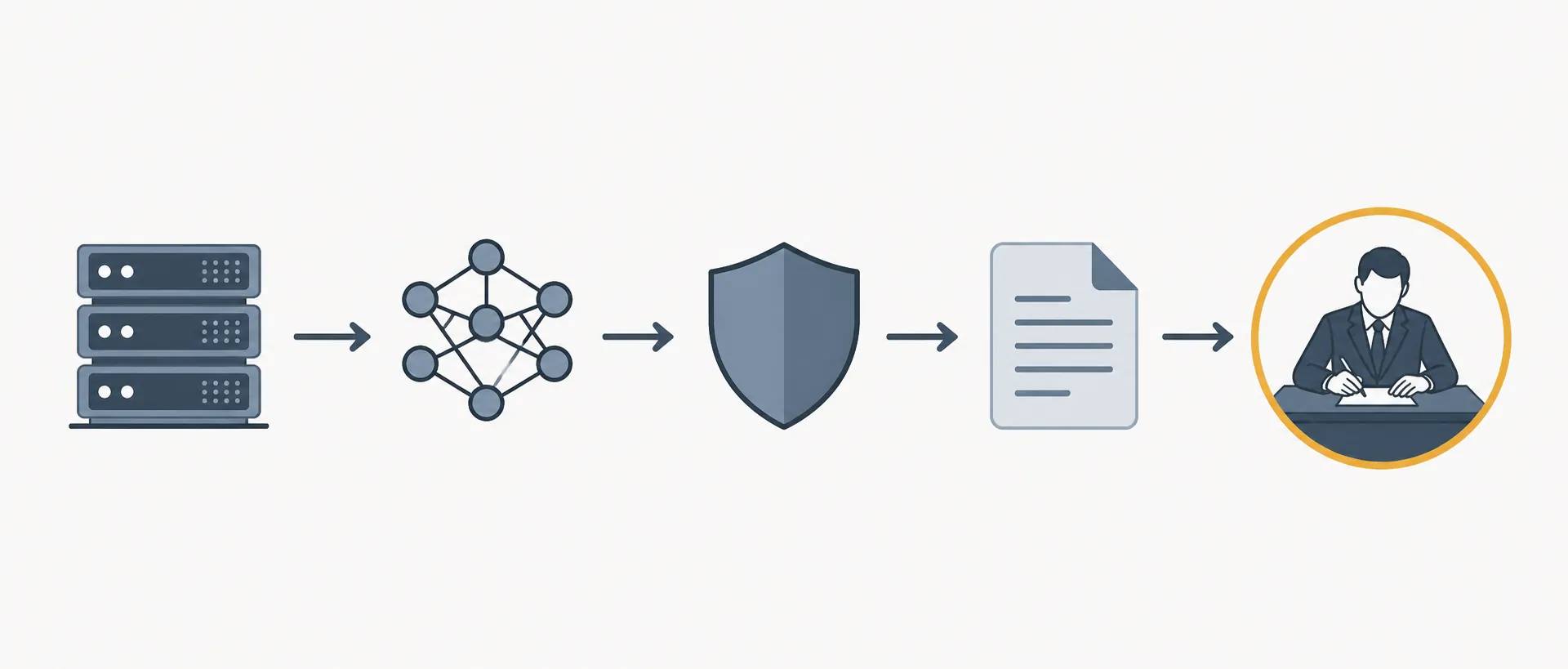
That kind of spending changes the procurement environment. Legal-tech vendors can buy compute, model access, storage, security tooling, and orchestration from a cloud provider already approved by many enterprises. The infrastructure conversation becomes shorter. The assurance conversation should not.
The Anthropic relationship explains why Claude and Bedrock now appear so often in legal-AI architecture diagrams. Amazon announced that it had completed a $4 billion investment in Anthropic to advance generative AI.[3] Anthropic’s own September 2023 announcement said AWS would become its primary cloud provider and that Anthropic would make future foundation models accessible to AWS customers through Amazon Bedrock.[4]
AWS is also publishing legal-tech deployment material directly. Its machine-learning blog describes legal-technology use cases built with generative AI on AWS, including document review, research, and workflow acceleration.[5] In July 2026, legal-tech trade coverage described Amazon Quick moving toward legal-team use cases, with Law.com reporting Amazon Quick for Legal and Artificial Lawyer later noting the updated framing as “How legal teams use Amazon Quick.”[6][7] Epiq separately announced an agentic AI solution for compliance teams using Amazon Quick in April 2026.[8]
| What the AWS stack can give a legal-tech vendor | What that does not prove for the buyer |
|---|---|
| Compute capacity and cloud services | That the legal answer is correct |
| Access to models through Bedrock | That the product’s legal citations are grounded |
| Guardrails and orchestration tools | That the workflow prevents court-facing errors |
| Enterprise procurement familiarity | That the tool has delivered measurable legal value |
The practical result is that AWS is becoming the plumbing beneath a growing share of legal AI. But plumbing is not proof. A court will not ask whether the model ran on impressive infrastructure before asking why a citation, quotation, or record reference was not checked.
The value case is still unsettled
The strongest warning does not come from an AI skeptic. It comes from Amazon’s own legal function. The Global Legal Post reported in July 2026 that Amazon associate general counsel Kathy Sheehan challenged law firms to partner with clients on AI savings, asking “where are the savings?” and “Where’s the transformation?” and saying, “We’re still waiting for the value creation.” The same report said fewer than a quarter of law firms had an AI strategy visible to clients.[9]
That matters because legal-tech spending is already rising. LawNext, discussing the 2026 Report on the State of the US Legal Market, reported that legal-tech spending grew 9.7% in 2025 and 39.3% since 2021.[10] Thomson Reuters Institute’s 2026 analysis said firms with a formal AI strategy were about 3.9 times more likely to report critical benefits from AI.[11]
Those figures support a narrower and more useful conclusion than most procurement decks want to make. Spend is rising. Strategy appears to matter. Value is not automatic. If Amazon’s own legal function is asking where the savings are, a law firm or legal department should not let an AWS logo answer that question on a vendor’s behalf.
This is where the Amazon question differs from the broader Big Tech capex question covered in the site’s sibling analysis of Alphabet’s AI investment and legal-tech risk. The shared lesson is that investment is not reliability. The Amazon-specific lesson is more operational: as AWS becomes the common substrate under legal AI, the unresolved value and accuracy questions move downstream into buyer governance.
Reliability has to be tested where the legal work happens
The independent reliability record is not clean enough to let infrastructure do the talking. Stanford HAI’s “AI on Trial” benchmark reported that legal-specific AI tools still hallucinated in a meaningful share of legal research queries: Lexis+ AI and Ask Practical Law AI were wrong more than 17% of the time, and Westlaw AI-Assisted Research was wrong more than 34% of the time. The same article reported much higher hallucination rates for general-purpose chatbots, ranging from 58% to 82%.[12]
That benchmark should be read carefully. It did not test AWS as the cause of those errors. It tested legal AI systems. So the point is not that AWS makes tools hallucinate. The point is that legal-specific branding, retrieval interfaces, and enterprise distribution still did not eliminate hallucinations in the published benchmark.
Stanford HAI also reported that some tools did not publish evaluation results, and it noted more than 25 federal standing orders on AI disclosure along with California, New York, and Florida bar guidance as of May 2024.[12] That is the legal-operations pressure point. The buyer needs to know not only whether a system sounds fluent, but whether its answers are grounded, whether citations trace back to source material, whether the benchmark resembles the buyer’s work, and who signs off before use.
For a litigation team, the minimum reliability question is not “Does this use Bedrock?” It is “Can we reproduce the answer from the cited source?” For a compliance team, it is not “Does this run in our approved cloud?” It is “Can we show what records were retrieved, what rules were applied, what uncertainty remained, and who approved the output?”
The site’s existing work on Connecticut’s independent AI verification duty and federal legal-AI verification workflows treats that burden as a process problem, not a temperament problem. Someone must check the source. Someone must preserve the record. Someone must be able to explain the workflow after the mistake is found.
Vendor claims belong in the file, with labels attached
AWS has useful material for evaluators, but it needs the right label. An AWS case study on MANZ reported a 77% recall boost and a 20% accuracy improvement using deepset and Anthropic on AWS.[13] An AWS machine-learning post on Lexbe reported that recall improved from 5% to 90% across 2024 for legal document review using Amazon Bedrock.[14] An AWS stp.one case study reported under-30-second response claims with court-decision citations.[15]
Those are not useless claims. They are also not independent proof that a different buyer’s litigation, investigation, or compliance workflow will perform the same way. A procurement file should preserve the source, the test conditions, the task type, the date, the evaluation set, and whether the results were vendor-reported or independently replicated.
The same discipline applies to controls. Amazon Bedrock Guardrails marketing states up to 88% blocking of harmful multimodal content and up to 99% denied-topic detection, with lower latency claims for certain guardrail uses.[16] That is relevant to control design. It is not, by itself, a legal-citation accuracy study.
AWS also announced aws-bench in July 2026 as an open-source benchmark framework for evaluating AI agents.[17] That is a meaningful signal that AWS understands benchmark infrastructure matters. But the announcement does not provide a legal track. A legal buyer still needs matter-specific evaluation: research, drafting, privilege review, contract extraction, regulatory mapping, or whatever task the product will actually perform.
Amazon Quick is a workflow surface, not a legal benchmark
Amazon Quick deserves attention because it moves AWS closer to the user’s desk. Infrastructure risk changes when the tool is no longer hidden behind a vendor’s back end and starts appearing in legal and compliance workflows. Law.com’s July 2026 coverage placed Amazon Quick inside Big Tech’s move into the legal market, and Artificial Lawyer’s update emphasized a more general framing around how legal teams use Amazon Quick rather than a proprietary legal-data or legal-expert-skills product.[6][7]
Epiq’s April 2026 announcement is the more concrete workflow signal: an agentic AI solution for compliance teams using Amazon Quick.[8] Compliance teams are exactly where the assurance question becomes practical. The user may not be filing a brief, but the output may still influence an investigation, remediation plan, regulator response, or board report.
There is no legal-specific benchmark in the available record for Amazon Quick. That absence should not be filled with either fear or faith. It means the buyer has to run the test.
The procurement test for AWS-anchored legal AI
A legal-AI product running on AWS may be well designed. It may also be faster to approve through enterprise IT than a smaller vendor running on unfamiliar infrastructure. Neither fact answers the questions that matter before the tool enters a court-facing, client-facing, or regulator-facing workflow.
- Name the stack: which AWS services, which model, which retrieval layer, which guardrails, and which customer data stores are involved.
- Separate independent evidence from vendor evidence: do not merge Stanford-style benchmark findings, AWS case studies, customer announcements, and marketing claims into one undifferentiated assurance packet.
- Demand task-specific testing: legal research, deposition summaries, contract extraction, privilege calls, compliance mapping, and e-discovery review need different evaluation sets.
- Inspect citation traceability: every authority, quote, record cite, contract clause, or policy reference should be recoverable from the underlying source.
- Preserve the human verification step: the workflow should identify who checks the output, when, against what source, and what happens when the tool is uncertain.
- Measure value separately from adoption: time saved, rework created, error rates, review burden, and client-visible savings should be measured after deployment, not assumed from the cloud provider’s investment.
The same standard applies when the model is Claude through Bedrock, when the interface is Amazon Quick, or when the product arrives through a legal-tech vendor already blessed by enterprise procurement. For teams evaluating Anthropic-based tools, the site’s separate Claude legal-risk review is the closer tool-level analysis; this AWS review is about the infrastructure-to-buyer risk transfer.
The procurement question is therefore simple enough to put at the end of a demo: show the grounded outputs, the citation trail, the benchmark design, the failure log, and the verification workflow. If the answer is only that Amazon spent enough to make the stack serious, the buyer still does not have legal assurance.
References
- Amazon CEO defends AI spend: "We're not going to be conservative", CNBC, April 9, 2026
- Amazon adds $200B to AI spend blitz, CIO Dive, February 6, 2026
- Amazon completes $4B Anthropic investment to advance generative AI, About Amazon
- Expanding access to safer AI with Amazon, Anthropic, September 25, 2023
- How generative AI is transforming legal tech with AWS, AWS Machine Learning Blog
- Amazon Joins Big Tech's Dive Into the Legal Market With Amazon Quick for Legal, Law.com, July 15, 2026
- Meet Amazon Quick "For Legal" – Updated, Artificial Lawyer, July 15/23, 2026
- Epiq and AWS Introduce Agentic AI Solution for Compliance Teams, Using Amazon Quick, Epiq, April 28, 2026
- Amazon GC calls on law firms to partner with clients to deliver elusive AI savings, The Global Legal Post, July 7, 2026
- Legal Tech Spending Surges 9.7% …, LawNext, January 2026
- State of the US Legal Market 2026 analysis: Will the AI bubble burst?, Thomson Reuters Institute
- AI on Trial: Legal Models Hallucinate in 1 out of 6 (or More) Benchmarking Queries, Stanford HAI
- MANZ Uses Amazon Bedrock and Anthropic to Improve Legal Research Accuracy and Recall, AWS Case Study
- Unlocking enhanced legal document review with Lexbe and Amazon Bedrock, AWS Machine Learning Blog
- stp.one Uses Amazon Bedrock to Deliver Fast, AI-Powered Legal Research, AWS Case Study
- Amazon Bedrock Guardrails, AWS
- AWS announces aws-bench, an open source benchmark framework for AI agents, AWS What's New, July 24, 2026
Chronological incident history
- Halusinasi AI pada fakta zodiak Cina — peguam wajib semak
- How to Verify AI Answers on HOA Foreclosure Laws
Report a correction or tip
Spotted an outdated figure, a misstated fact, or a ruling this tool profile should reflect? Public comments are disabled for this content given the professional cost of a misreported case outcome, penalty amount, or rule text — use the structured correction channel instead.
Report a correction or tip for this record →