
AI Compliance Software in 2026: A Categorical Buying Guide for Legal and Compliance Professionals
This guide helps compliance officers, in-house counsel, and legal ops leaders navigate the fragmented AI compliance software market by introducing four distinct tool categories — GRC automation, enterprise AI governance, LLM observability, and runtime control planes — and providing a decision framework to match the right category combination to your regulatory exposure and organizational maturity.
- Hallucination rate
- Not measured / undisclosed
The Fragmentation Problem: Why 'AI Compliance Software' Is Not One Market
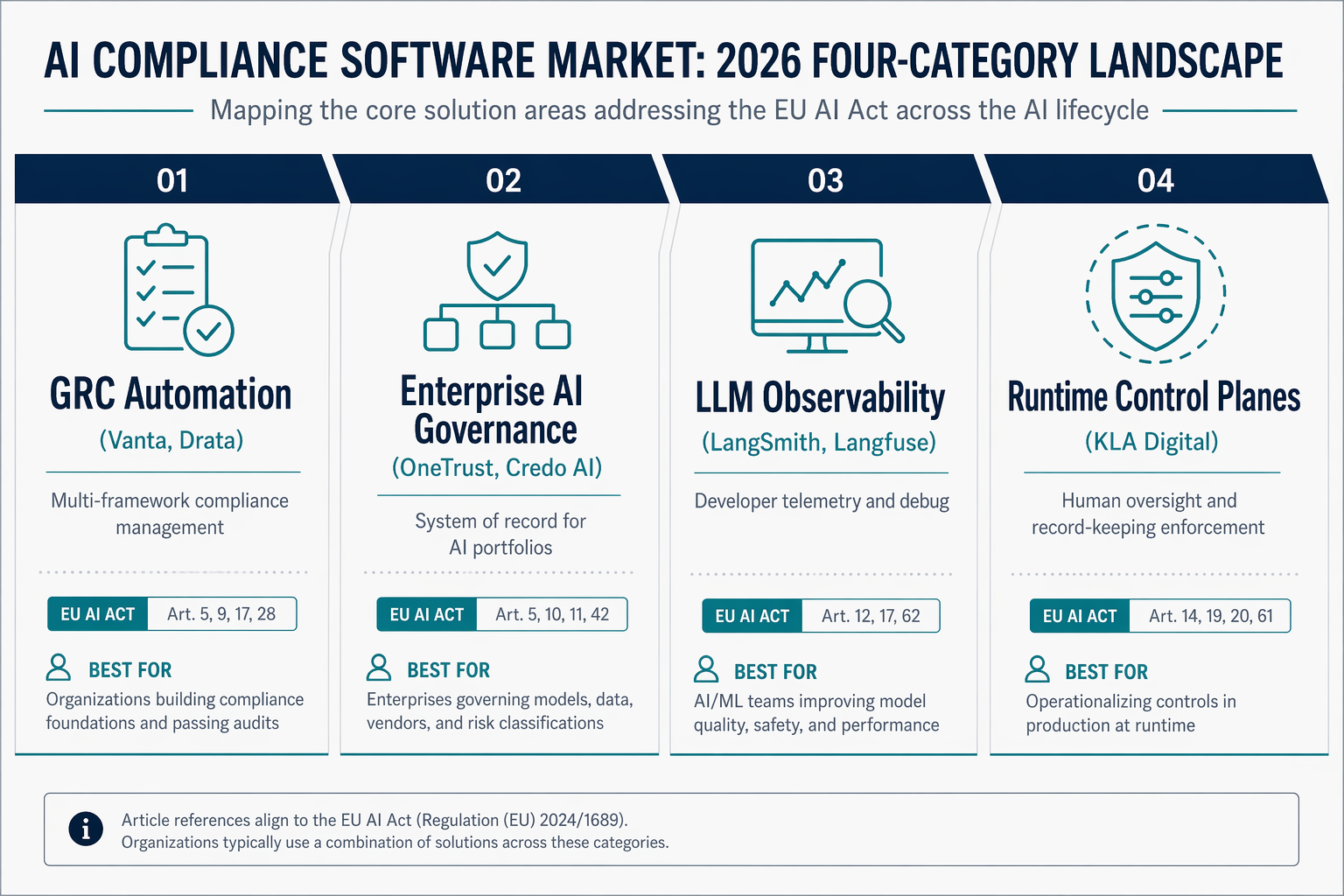
If you search for "AI compliance software" in 2026, you will find lists that lump together tools as different as a SOC 2 evidence collector, a model bias scanner, a prompt debugger, and a cryptographic audit log. Treating these as interchangeable options is the fastest way to buy the wrong tool. The market has fragmented into four distinct categories, each designed for a fundamentally different job: GRC automation, enterprise AI governance platforms, LLM observability tools, and runtime control planes. Most regulated organizations need at least two of them.
The urgency to get this right is not theoretical. The EU AI Act's August 2, 2026 transparency obligation is already binding for deployers. The December 2, 2027 deadline for stand-alone high-risk systems is a window to build governed execution, not a reason to pause. Yet a 2026 survey found that only 23% of organizations feel confident in their AI governance frameworks, and more than 70% of IT leaders say AI compliance is one of their biggest deployment challenges.
Category 1: GRC Automation — The Multi-Framework Workhorse
GRC automation platforms — Vanta, Drata, Secureframe, Sprinto — are the right starting point when AI compliance is one framework among many. These tools were built to automate evidence collection, continuous control monitoring, and policy management across SOC 2, ISO 27001, GDPR, HIPAA, and now the EU AI Act. They excel at breadth: a single dashboard can track control status across a dozen frameworks simultaneously.
For AI-specific compliance, these platforms typically offer AI-powered risk assessment and scoring, automated control testing, and intelligent document analysis that maps policies to regulatory requirements. Drata, for example, supports NIST AI RMF and ISO 42001 alignment alongside its traditional SOC 2 workflows. Vanta, with over 1,900 G2 reviews and a 4.6/5.0 rating, has added AI governance modules that let organizations map AI usage across their infrastructure.
| Capability | What It Does | AI-Specific Limitation |
|---|---|---|
| Automated evidence collection | Pulls control evidence from cloud providers, code repos, and HR systems | Cannot capture runtime model behavior or inference logs |
| Continuous control monitoring | Checks control status on a recurring schedule | Lacks real-time gating of high-risk AI decisions |
| Policy management | Maps policies to framework requirements and tracks exceptions | No model-level bias detection or explainability |
| AI risk scoring | Scores AI use cases based on questionnaire responses | Does not verify actual model outputs against stated risk tier |
Category 2: Enterprise AI Governance Platforms — The System of Record for AI Portfolios
Enterprise AI governance platforms — OneTrust, Credo AI, Holistic AI, IBM watsonx.governance — serve as the system of record for organizations with large AI portfolios. They provide a centralized AI metadata repository, risk assessment workflows, policy packs for proactive compliance, and support for frameworks like NIST AI RMF and ISO 42001. Credo AI, for instance, offers governance artifacts such as AI audit reports and risk reports, plus policy packs that map directly to regulatory requirements.
These platforms excel at inventory and documentation. They help organizations answer questions like: How many AI systems do we have? What risk tier is each one? What training data was used? What bias testing has been performed? Holistic AI adds shadow AI discovery and control, which is critical for organizations where business units deploy AI tools without central IT knowledge.
| Platform | Key Differentiator | Framework Support | Pricing Tier |
|---|---|---|---|
| OneTrust | Broadest regulatory coverage (privacy, GRC, ethics) | EU AI Act, GDPR, NIST AI RMF, ISO 42001 | Enterprise |
| Credo AI | Policy packs for proactive compliance; AI audit reports | EU AI Act, NIST AI RMF, ISO 42001 | Enterprise |
| Holistic AI | End-to-end lifecycle management; shadow AI discovery | EU AI Act, NIST AI RMF, ISO 42001 | Enterprise |
| IBM watsonx.governance | Deep integration with IBM AI stack; model lifecycle management | EU AI Act, NIST AI RMF, ISO 42001 | Enterprise |
Category 3: LLM Observability Tools — Developer Tooling, Not Compliance Evidence
LLM observability tools — LangSmith, Langfuse, Arize AI, Weights & Biases — are designed for engineering debug and performance monitoring. They trace model behavior, measure latency, log prompts and responses, and help developers debug unexpected outputs. These are essential tools for any team building LLM-powered applications.
But they are not compliance tools. The critical distinction that buyers miss: observability platforms lack tamper-evident audit trails, cryptographic integrity verification, and the ability to enforce human oversight. A LangSmith trace log can be edited after the fact. It cannot serve as admissible evidence that a human reviewed a high-risk AI decision before it was executed.
The legitimate use case for observability in a compliance context is as a data source. Trace logs can feed into governance platforms or runtime control planes to provide raw behavioral data. But the compliance evidence — the tamper-evident record, the human oversight gating, the cryptographic integrity check — must come from a tool designed for that purpose.
Category 4: Runtime Control Planes — Enforcing and Evidencing High-Risk AI Actions
Runtime control planes are the newest and most specialized category. They enforce and evidence specific EU AI Act obligations for high-risk AI systems: Article 14 human oversight (ensuring a human can review and override decisions before they take effect) and Article 12 record-keeping with integrity verification (producing tamper-evident audit trails that can be independently verified). KLA Digital is the primary vendor in this category as of mid-2026.
These tools operate at the point of decision execution. When a high-risk AI system generates an output — a credit denial, a hiring recommendation, a patient triage score — the runtime control plane gates that output until a human has reviewed it, logs the decision with cryptographic integrity, and stores the record in a tamper-evident format. This is fundamentally different from a governance platform that documents what the system is supposed to do, or an observability tool that logs what it did without integrity guarantees.
| Capability | What It Does | EU AI Act Article |
|---|---|---|
| Real-time decision gating | Blocks high-risk AI outputs until human review is complete | Article 14 (Human Oversight) |
| Cryptographic audit trails | Creates tamper-evident records of every AI decision and human override | Article 12 (Record-Keeping) |
| Independent verifiability | Allows third parties to verify audit trail integrity without vendor access | Article 12 (Record-Keeping) |
| Human oversight enforcement | Ensures human-in-the-loop is technically enforced, not just documented | Article 14 (Human Oversight) |
Cross-Category Decision Tree: Which Category (or Combination) Do You Need?
The right category depends on two factors: your regulatory exposure (which AI systems you deploy and under which frameworks) and your organizational maturity (how many compliance frameworks you already manage and how centralized your AI governance is).
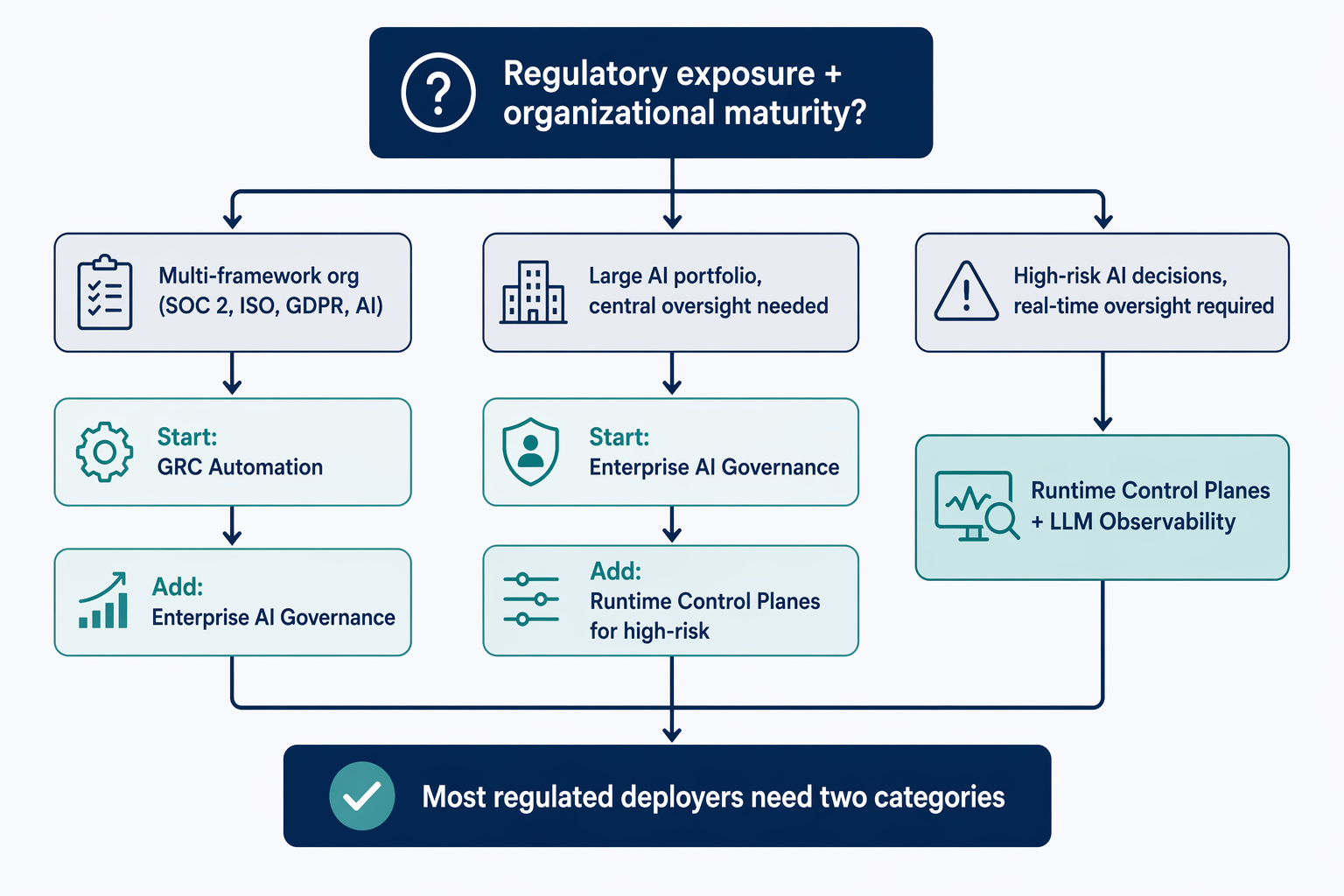
- Multi-framework organizations (SOC 2, ISO, GDPR, plus AI): Start with GRC automation. These tools handle the breadth of framework management and add AI-specific modules as needed. Add a runtime control plane if you deploy high-risk AI systems.
- Large AI portfolios (10+ AI systems, multiple business units): Start with an enterprise AI governance platform. You need the centralized inventory, risk assessment workflows, and policy management before you can enforce anything at runtime. Add a runtime control plane for your highest-risk systems.
- High-risk AI decisions (credit, hiring, healthcare, criminal justice): You need a runtime control plane regardless of your organizational maturity. Article 14 human oversight and Article 12 record-keeping with integrity verification cannot be satisfied by design-time documentation alone.
- Small teams with limited AI deployment: A single GRC automation platform may be sufficient if you are only using low-risk AI tools (e.g., internal chatbots, document summarization). Monitor your needs as your AI portfolio grows.
EU AI Act Deadline Map: The 'Why Now' Context for Your Tooling Decision
The EU AI Act's phased compliance timeline creates distinct urgency milestones for different types of deployers. These deadlines are not abstract — they determine which tool category you need and by when.
| Deadline | Obligation | Who It Applies To | Tool Category Needed |
|---|---|---|---|
| August 2, 2026 | Deployer transparency (Article 50) | All AI system deployers | GRC automation or governance platform (documentation) |
| December 2, 2026 | Provider marking of AI-generated content | AI system providers | Governance platform (labeling workflows) |
| December 2, 2027 | Stand-alone high-risk systems (Annex III) | Deployers of high-risk AI | Runtime control plane (enforcement + evidence) |
| August 2, 2028 | High-risk AI in regulated products (Annex I) | Deployers of AI in medical devices, vehicles, etc. | Runtime control plane + governance platform |
Chronological incident history
No sanction cases have named this tool in the tracked record set to date. This does not imply the tool is safe — see Risk Digest for ongoing monitoring.
← Compare peer toolsReport a correction or tip
Spotted an outdated figure, a misstated fact, or a ruling this tool profile should reflect? Public comments are disabled for this content given the professional cost of a misreported case outcome, penalty amount, or rule text — use the structured correction channel instead.
Report a correction or tip for this record →