
AI Compliance Tool Buyer's Guide for Legal Departments: How to Evaluate, What to Ask Vendors, and How to Avoid Compliance Theater
A practical procurement framework for in-house counsel, legal ops, and compliance officers evaluating AI compliance tools. Covers four critical failure modes, five evaluation criteria, vendor screening questions, a 90-day pilot protocol, and how to interpret user ratings through a legal lens.
- Hallucination rate
- Not measured / undisclosed
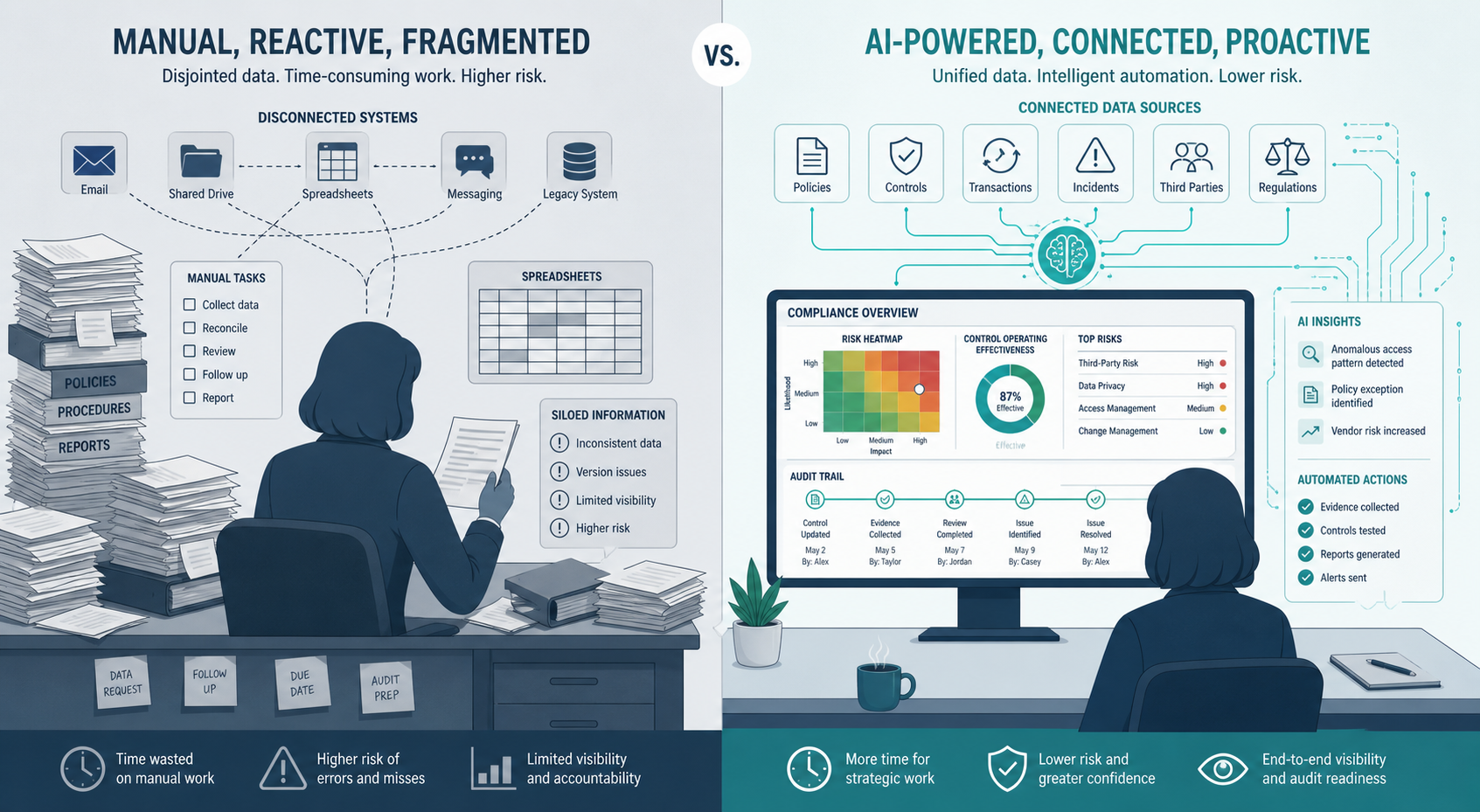
Why Standard Procurement Fails for AI Compliance Tools
Procuring a traditional governance, risk, and compliance (GRC) platform follows a well-worn path: define requirements, compare features against a checklist, negotiate price, and run a proof of concept that validates integration fit. That process works when the tool executes deterministic, rule-based workflows — flagging a missing signature, routing an approval, or tracking a policy acknowledgment. It breaks down when the tool generates outputs that are probabilistic, context-dependent, and grounded in a large language model's training data.
AI compliance tools are not conventional GRC software with a chatbot wrapper. They use retrieval-augmented generation (RAG) to answer security questionnaires, map controls to frameworks, and produce audit evidence. They rely on underlying models that can hallucinate, and they ingest sensitive organizational data that may include privileged communications. A feature checklist cannot surface whether a tool's RAG pipeline reliably grounds answers in the correct policy document, or whether its evidence exports will survive an external auditor's scrutiny.
The stakes are material. The AI compliance tool market is projected to reach $492 million in 2026 and surpass $1 billion by 2030, according to a February 2026 Gartner press release. Organizations that have deployed AI governance platforms are 3.4 times more likely to achieve high effectiveness in AI governance, per the same Gartner survey of 360 organizations conducted in Q2 2025. But the corollary is that organizations selecting the wrong tool — or selecting on the wrong criteria — are not merely wasting budget; they are exposing themselves to contractual liability, audit failure, and regulatory penalties that can reach €35 million or 7% of global annual turnover under the EU AI Act.
The Four Failure Modes Legal Buyers Must Test For
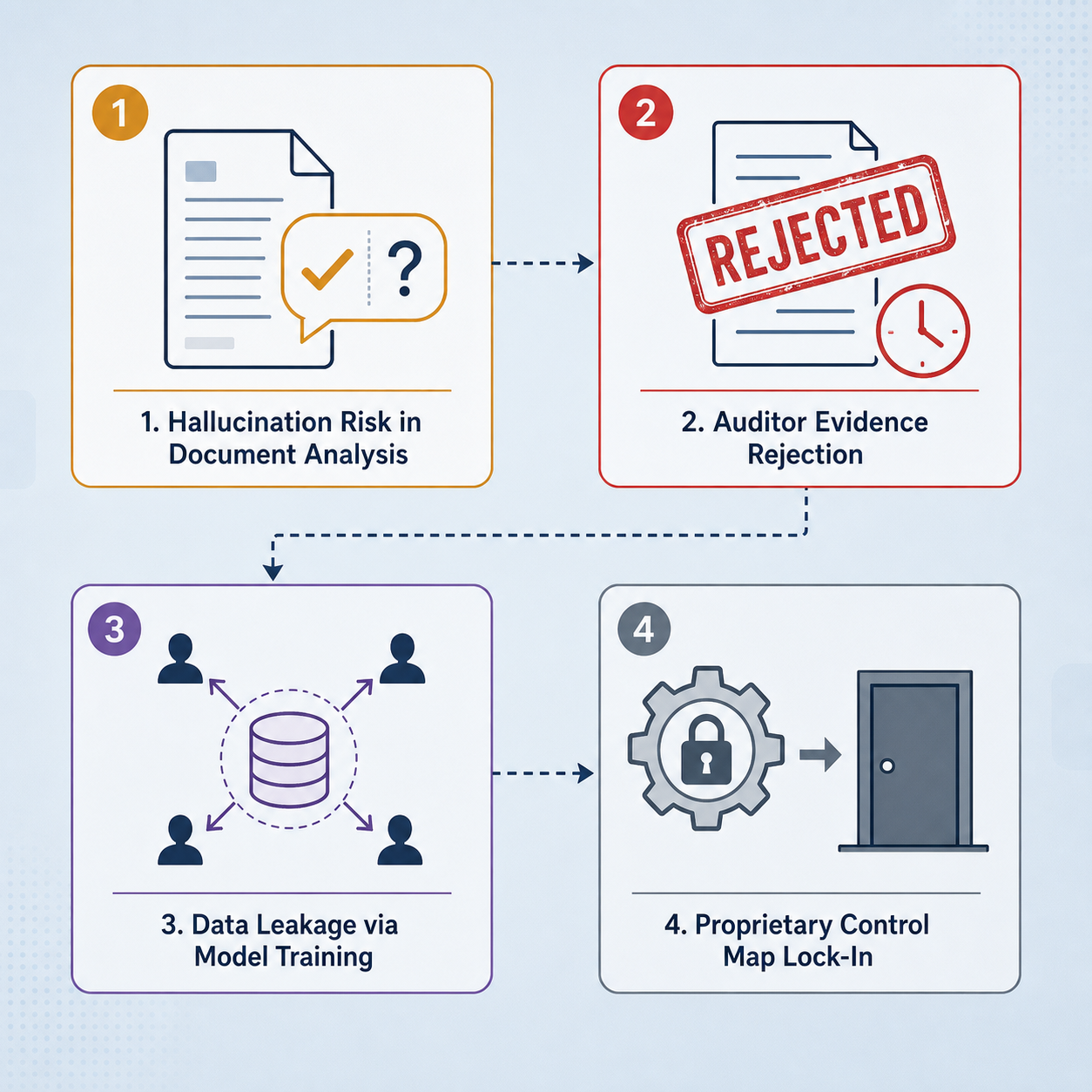
Legal departments evaluating AI compliance tools face four failure modes that conventional GRC procurement processes are not designed to surface. Each corresponds to a specific technical or architectural characteristic of AI-powered platforms, and each has direct legal consequences.
1. Hallucination Grounding in RAG Systems
A compliance tool that uses RAG to answer security questionnaires or map controls to frameworks can produce outputs that sound authoritative but are factually wrong. If the tool's retrieval pipeline fails to locate the correct policy document — or if the underlying language model generates a plausible-sounding answer not supported by the retrieved text — the result is a hallucinated compliance assertion. A tool claiming quarterly penetration tests when only annual was performed constitutes a misrepresentation under contract law if that output is incorporated into a customer's compliance certification or vendor questionnaire response.
The risk is not theoretical. The NIST AI Risk Management Framework explicitly emphasizes human-in-the-loop oversight, stating that no AI tool should auto-send a completed questionnaire without a review gate by a subject matter expert. Legal buyers should treat any vendor that cannot explain its RAG grounding methodology — including how it handles retrieval failures and how it prevents the model from generating answers outside the retrieved context — as presenting an unacceptable contractual liability risk.
2. Auditor Evidence Rejection
The primary hidden cost of a poorly evaluated AI compliance tool is the "evidence rejection problem." Automated evidence — screenshots, configuration snapshots, log extracts — can be rejected by external auditors for lacking timestamps, full audit period coverage, or configuration context. A tool that generates evidence artifacts without embedding verifiable metadata (ISO 8601 timestamps, hash-based integrity proofs, scope markers) forces the legal department into manual remediation during every audit cycle.
This failure mode is especially acute for legal departments subject to regulatory audits under the EU AI Act, which requires automatic logging of events over the system's lifetime, retained for a minimum of six months (Article 12). If the audit logs live in the vendor's environment and the organization does not directly control the audit trail, the legal department cannot independently verify the evidence package's integrity.
3. Data Leakage via Vendor Model Training
Vendors that aggregate customer data to train or fine-tune their underlying models create a data leakage risk that is incompatible with legal departments' confidentiality and privilege obligations. A tool that ingests a law firm's internal compliance policies, risk registers, or privileged communications and uses that data to improve its model for other customers has effectively breached the duty of confidentiality under Model Rule 1.6.
4. Proprietary Control Map Lock-In
Many AI compliance tools use proprietary control maps — internal mappings of controls to frameworks that are not exportable in a standard format. Once a legal department has invested months mapping its controls to the vendor's schema, migrating to a different platform requires re-mapping from scratch. This lock-in gives the vendor pricing leverage and creates operational risk if the vendor is acquired, pivots, or exits the market.
Legal buyers should test the "data exit" scenario during the pilot phase by requesting a portable audit evidence package in a non-proprietary format (JSON, XML, or CSV with a documented schema). If the vendor cannot produce a machine-readable export of control mappings, framework alignments, and risk assessments, the lock-in risk is high.
The Five Evaluation Criteria for AI Compliance Tools
The following five criteria are derived from the EU AI Act's technical documentation requirements (Articles 11 and 12, Annex IV) and the NIST AI RMF's emphasis on traceability and human oversight. They are designed to surface the four failure modes described above and to produce a structured comparison across vendors.
| Criterion | What It Tests | Relevant Failure Mode |
|---|---|---|
| Risk mapping to evidence | Whether the tool links each identified risk to specific, verifiable evidence artifacts with timestamps and scope markers | Auditor evidence rejection |
| AI BOM and technical file generation | Whether the tool can produce an AI Bill of Materials (system description, design specifications, data requirements, post-market monitoring plan) as required by EU AI Act Annex IV | Hallucination grounding |
| Conformity assessment workflow support | Whether the tool supports the iterative risk management process required by EU AI Act Article 9, including versioned risk assessments and audit trails | Proprietary control map lock-in |
| Audit log location and control | Whether audit logs are stored in the vendor's environment or the customer's environment, and whether the customer can export logs in a non-proprietary format | Data leakage via model training |
| Framework alignment documentation | Whether the tool documents its mappings to frameworks (EU AI Act, NIST AI RMF, ISO 42001) in a machine-readable, exportable format | Proprietary control map lock-in |
Vendor Screening Questions Derived from Each Criterion
The following questions are designed for RFPs, vendor demos, and technical due diligence calls. They are organized by the five evaluation criteria and are intended to be asked directly of the vendor's product team, not the sales team.
Risk Mapping to Evidence
- How does the tool timestamp each evidence artifact? Are timestamps in ISO 8601 format and cryptographically signed?
- Does the tool capture evidence across the full audit period, or only at the moment of collection?
- Can the tool export evidence artifacts with their full metadata (timestamp, scope marker, collector identity) in a non-proprietary format?
AI BOM and Technical File Generation
- Can the tool generate an AI Bill of Materials that includes system description, design specifications, architecture, data requirements, and post-market monitoring plan?
- What underlying model or model family does the tool use? Is it a proprietary fine-tune, a RAG-augmented general-purpose LLM, or a custom model?
- How does the tool handle retrieval failures in its RAG pipeline? Can it produce a confidence score for each generated answer?
Conformity Assessment Workflow Support
- Does the tool support versioned risk assessments with a full audit trail of changes?
- Can the tool map controls to multiple frameworks simultaneously (EU AI Act, NIST AI RMF, ISO 42001) and export the mapping in a machine-readable format?
- Does the tool support the iterative risk management process required by EU AI Act Article 9, or does it treat risk assessment as a one-time event?
Audit Log Location and Control
- Where are audit logs stored — in the vendor's environment, the customer's environment, or a hybrid model?
- Can the customer export audit logs in a non-proprietary format (JSON, XML, CSV) without vendor assistance?
- Does the vendor retain logs for at least six months as required by EU AI Act Article 12?
Framework Alignment Documentation
- Does the tool document its mappings to frameworks in a machine-readable, exportable format?
- How often are framework mappings updated, and who is responsible for maintaining them — the vendor or the customer?
- Can the tool map controls to internal nomenclature, or does it require the customer to adopt the vendor's control taxonomy?
The 90-Day Pilot Protocol: Baselining, Tuning, and Evidence-Exit Testing
A structured pilot protocol adapted from the Thoropass practitioner's guide provides a repeatable framework for validating an AI compliance tool before committing to a full deployment. The protocol assumes a 90-day timeline, which may be aggressive for large enterprises with complex infrastructure — legal departments should adjust the timeline based on the number of systems, frameworks, and stakeholders involved.
Phase 1: Baselining (Days 1–30)
- Connect core infrastructure: identity provider (Okta, Azure AD), cloud environments (AWS, Azure, GCP), code repositories, and CI/CD pipelines.
- Mark non-production environments out of scope to reduce noise.
- Document existing risk acceptances and control mappings in the tool's schema.
- Map controls to internal nomenclature — do not adopt the vendor's control taxonomy without testing whether it aligns with the organization's existing risk register.
Phase 2: False-Positive Tuning (Days 31–60)
- Run the tool's automated control testing and evidence collection against the baselined environment.
- Track false-positive rates for each control. A high false-positive rate indicates poor RAG grounding or insufficient context configuration.
- Adjust the tool's scope markers, evidence collection schedules, and control mappings based on observed false positives.
- Document the tuning process as part of the audit trail — a tool that requires extensive manual tuning to achieve acceptable accuracy may not scale.
Phase 3: Evidence-Exit Testing (Days 61–90)
- Request a portable audit evidence package from the vendor in a non-proprietary format (JSON, XML, CSV with documented schema).
- Verify that the evidence package includes timestamps, scope markers, collector identity, and hash-based integrity proofs for each artifact.
- Test the evidence package against an external auditor's requirements — if the auditor rejects the evidence format, the tool has failed the evidence-exit test.
- Export the control mappings and framework alignments in a machine-readable format and verify that they can be imported into a different tool.
How to Interpret G2 and Capterra Ratings Through a Legal Lens
User review platforms like G2 and Capterra are useful for assessing ease of use, onboarding speed, and customer support responsiveness. They are not useful for assessing the failure modes that matter to legal departments: hallucination grounding, auditor evidence rejection, data leakage risk, and proprietary lock-in.
As of February 2026, the following ratings are representative of the top-tier AI compliance tools on G2:
| Tool | G2 Rating | Number of Reviews | What Reviews Typically Measure |
|---|---|---|---|
| Drata | 4.8 / 5.0 | 1,000+ | Ease of use, onboarding speed, SOC 2 automation |
| Vanta | 4.6 / 5.0 | 1,900+ | Framework coverage, integration breadth, customer support |
| Sprinto | 4.8 / 5.0 | 1,400+ | Startup-friendly onboarding, SOC 2 and ISO 27001 automation |
A 4.8 rating on G2 tells a legal buyer that the tool is easy to set up and that customers are satisfied with the onboarding experience. It does not tell the buyer whether the tool's RAG pipeline has hallucinated a security questionnaire answer, whether an external auditor has rejected the tool's evidence artifacts, or whether the vendor uses customer data for model training. Treating high user ratings as a substitute for failure-mode testing is a form of "compliance theater" — the appearance of due diligence without the substance.
Closed-Loop vs. Linear Handoff Models: What Works for Legal
AI compliance tools generally follow one of two architectural models for audit evidence: closed-loop or linear handoff.
Closed-Loop Model
In a closed-loop model, the platform integrates auditors directly into the workflow. Evidence artifacts are generated, timestamped, and presented to the auditor within the same platform. The auditor can request additional evidence, flag gaps, and approve controls without leaving the tool. This model reduces the evidence rejection risk because the auditor's requirements are embedded in the evidence generation process.
Linear Handoff Model
In a linear handoff model, the tool produces evidence artifacts and the auditor reviews them separately. The tool has no visibility into the auditor's requirements, and the auditor has no way to request additional evidence within the tool. This model increases the evidence rejection risk because the tool's evidence format may not match the auditor's expectations, and the legal department must manually remediate any gaps.
For legal departments subject to external audit scrutiny — whether for SOC 2, ISO 27001, EU AI Act conformity assessment, or regulatory compliance — the closed-loop model is strongly preferred. The NIST AI RMF's emphasis on human-in-the-loop oversight aligns with the closed-loop approach: the auditor (human) is integrated into the evidence generation workflow, not relegated to a post-hoc review role.
| Model | Evidence Rejection Risk | Auditor Integration | Best For |
|---|---|---|---|
| Closed-loop | Low | Auditor reviews evidence within the platform | Legal departments under external audit scrutiny |
| Linear handoff | High | Auditor reviews evidence separately | Internal compliance teams with no external audit requirements |
For a deeper analysis of how AI tools introduce hallucination risk in legal practice, see the Harvey AI risk profile and the EU AI Act deployer's guide for legal services.
Chronological incident history
No sanction cases have named this tool in the tracked record set to date. This does not imply the tool is safe — see Risk Digest for ongoing monitoring.
← Compare peer toolsReport a correction or tip
Spotted an outdated figure, a misstated fact, or a ruling this tool profile should reflect? Public comments are disabled for this content given the professional cost of a misreported case outcome, penalty amount, or rule text — use the structured correction channel instead.
Report a correction or tip for this record →