
Four Risk Categories for AI Deposition Summary Tools
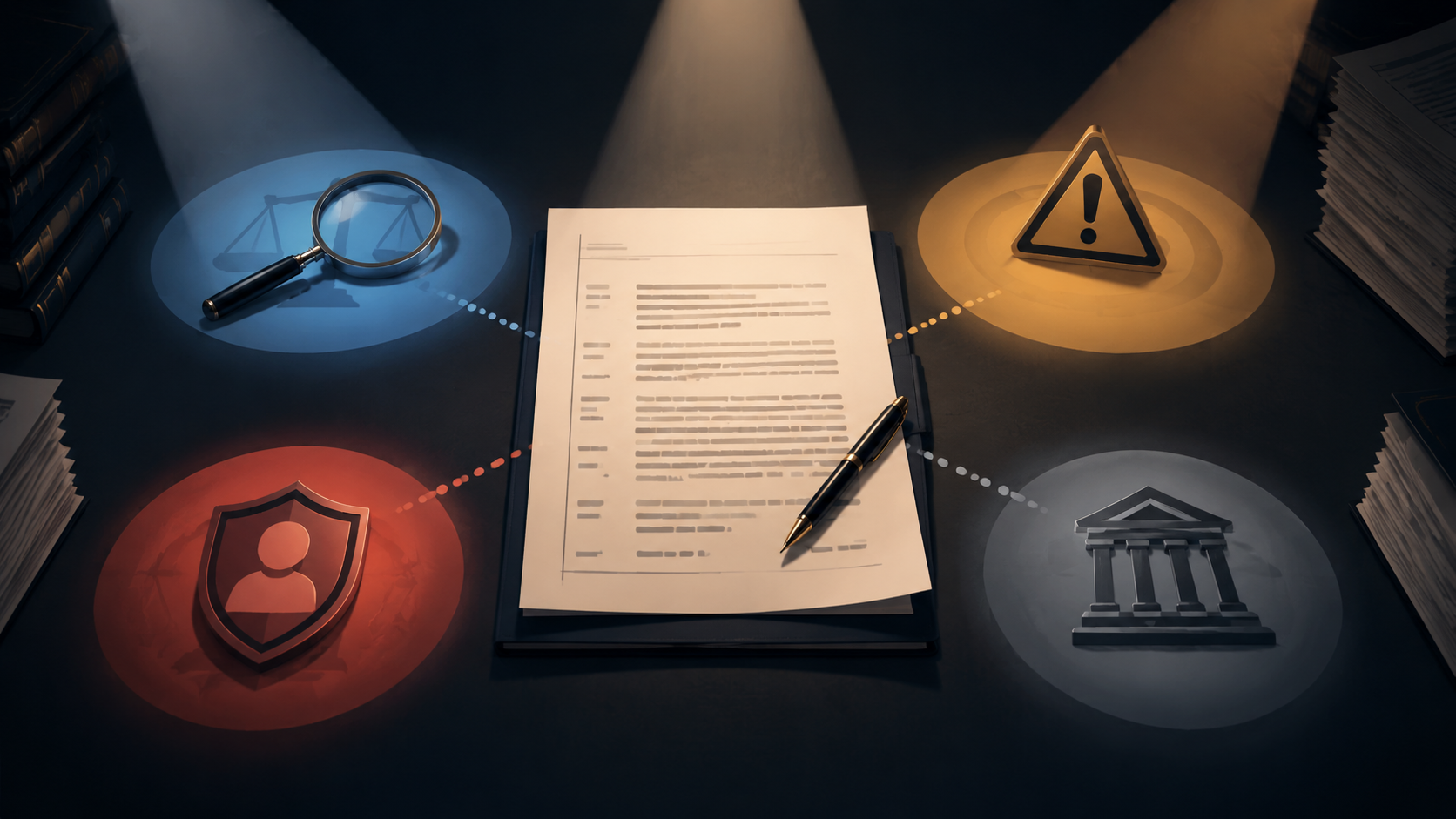
AI deposition summary tools introduce four distinct categories of legal risk—hallucination and accuracy failures, confidentiality and privacy violations, professional responsibility breaches, and e-discovery or spoliation exposure—each requiring a separate mitigation strategy. This article organizes those risks with supporting case law and regulatory guidance so litigators can evaluate tools and build informed governance policies.
- Hallucination rate
- Not measured / undisclosed
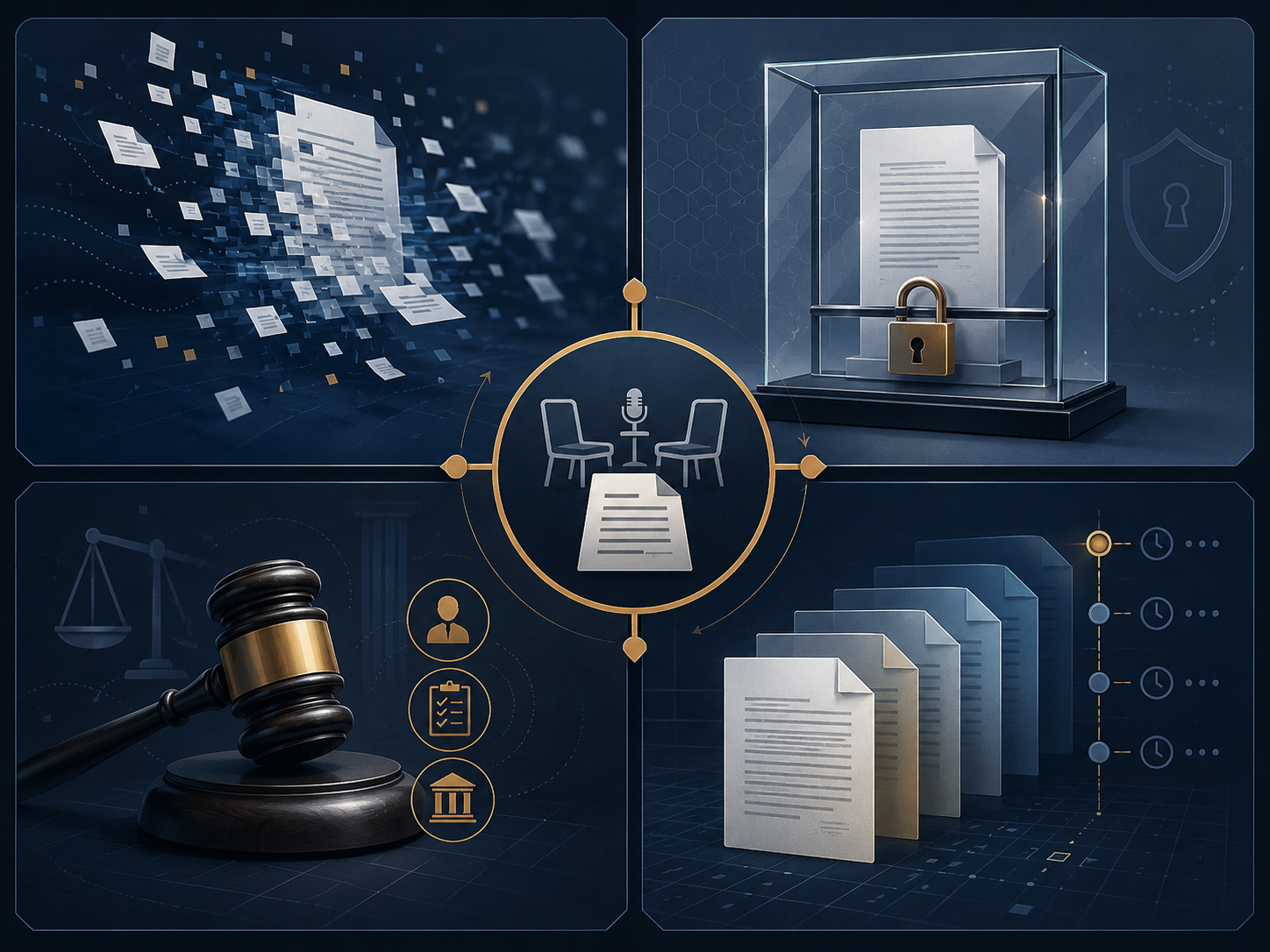
The risky moment in an AI deposition summary workflow is not the moment someone reads the finished summary. It starts earlier, when a litigation team decides to upload a transcript, audio file, exhibit-linked transcript, or rough set of notes into a system that promises a faster issue summary. At that point, four different questions are already in play: whether the output is accurate, whether the transcript data remains confidential, whether a lawyer has supervised the process well enough to satisfy professional duties, and whether the tool has created or altered records that may matter later.
Treating all of those as one generic “AI risk” produces weak controls. A reviewer can catch a fabricated page reference and still miss a confidentiality problem. A vendor can advertise secure cloud hosting and still generate an unreliable chronology. A lawyer can use an AI draft only for internal preparation and still run into certification duties if that draft migrates into a filing. AI deposition summary tool risks need to be separated before a firm decides what to permit, prohibit, document, or negotiate.
| Risk category | What can go wrong | Control that actually fits the risk |
|---|---|---|
| Hallucination and accuracy failures | The tool invents, omits, distorts, or misattributes testimony, issues, dates, citations, or page-line references. | Transcript-grounded verification, source passage review, and limits on unsupported narrative synthesis. |
| Confidentiality and privacy violations | Transcript, audio, biometric, client, witness, or strategy data is exposed, retained, trained on, or shared through an unsuitable platform. | Vendor due diligence, data-use restrictions, consent analysis, encryption, access controls, deletion rights, and privilege-preserving architecture. |
| Professional responsibility breaches | Lawyers rely on AI work product without adequate competence, supervision, client communication, or filing certification discipline. | Defined human review roles, documented supervision, matter-level approval, and stricter controls before anything reaches a court or opposing party. |
| E-discovery and spoliation exposure | Prompt logs, edited summaries, metadata, vendor-retained versions, or transcript discrepancies become relevant but are not preserved or understood. | Version control, retention rules, litigation-hold analysis, and clear separation between source transcript and derivative AI work product. |
Accuracy failures are not limited to fake cases
In deposition work, a hallucination does not need to look dramatic to be dangerous. A summary that says a witness “admitted” a fact when the testimony was qualified can change a trial team’s assessment of impeachment value. A chronology that moves a warning email before a product decision can distort causation. A page-line citation that points to the right topic but the wrong witness can survive casual review because it feels plausible.
The court incidents that have drawn the most attention involve fabricated legal authorities rather than deposition summaries, but they still matter for deposition workflows because they show where responsibility lands after AI output enters legal work. In Park v. Kim, the Second Circuit referred an attorney to a grievance panel after AI-fabricated citations appeared in a filing; FDLI’s case analysis treats the matter as another reminder that lawyers remain responsible for verifying authorities they present to a court.[1] In Mata v. Avianca, sanctions followed the submission of false AI-generated case citations.[2] In Kruse v. Karlan, an appeal was dismissed after reliance on hallucinated authority, and in Kohls v. Ellison an AI-assisted expert report was deemed unreliable because of hallucinations.[3][4]
Those cases do not prove that every AI deposition summary tool will hallucinate at the same rate, and they should not be used that loosely. They do show that courts are not treating “the AI did it” as a transfer of responsibility. Once an AI-generated deposition summary becomes the basis for a motion, expert preparation, settlement assessment, witness outline, or trial theme, the team using it owns the consequences of what it failed to check.
The available error-rate material is useful, but it has to be handled carefully. A UMEVO article discussing AI transcription cites a Whisper hallucination rate of about 1% to 1.4%, and states that 38% of hallucinations contained harmful content, while also tying those figures to secondary sources rather than a deposition-specific benchmark.[5] The same article attributes a 17% to 33% hallucination range in legal retrieval-augmented generation models to Stanford research, but the underlying study is not linked there, so that figure is best treated as a warning signal rather than a universal rate for every legal AI product.[5]
The practical lesson is narrower and more useful than “AI is unreliable.” Different systems fail in different ways. A transcript-summary tool may misread a speaker label, compress hedged testimony into a clean proposition, overemphasize the examining lawyer’s theory, or produce a neat issue outline that hides missing testimony. A tool connected to retrieval may cite transcript passages but still overstate what those passages support. A transcription layer may introduce an error before the summarization layer ever begins.
That is why source traceability is not a luxury feature. A litigation team should be able to move from every important sentence in the AI summary back to the transcript page and line, audio segment if relevant, speaker identity, and surrounding context. The review step should not ask only whether the summary “sounds right.” It should identify which assertions matter enough to verify and who must perform that verification before the summary is used for witness preparation, motion drafting, expert work, or settlement analysis.
For deeper background on incident tracking, a team can pair this workflow analysis with internal review of legal AI hallucination databases and a separate guide to AI legal research hallucinations. Deposition summaries add their own layer because the danger is often not a fake public case, but a false private record of what a witness said.
What verification has to cover
- Issue labels: confirm that the tool did not assign testimony to a legal issue the witness did not actually address.
- Page-line references: check that cited passages support the exact proposition in the summary, not just the general topic.
- Speaker attribution: confirm that answers, objections, colloquy, and attorney characterizations are not blended.
- Qualifiers and uncertainty: preserve “I don’t recall,” estimates, assumptions, and conditional answers instead of smoothing them away.
- Omissions: compare the AI’s issue list against the examining outline or human notes to catch important testimony the model did not surface.
A correct summary can still create a confidentiality problem
Accuracy review does not answer the next question: where did the transcript go? Deposition transcripts may contain client confidences, protected health or employment information, trade secrets, sealed material, personal identifiers, settlement strategy, witness preparation clues, and privileged context around why particular testimony matters. A summary can be perfectly faithful to the transcript and still be created through a platform that the firm should not have used for that matter.
United States v. Heppner is important for that reason. As summarized in UMEVO’s discussion of secondary legal updates, the Southern District of New York ruled on February 10, 2026, that AI-generated documents were not privileged where a consumer platform lacked a confidentiality structure.[5] The full docket was not reviewed here, so the point should be stated with that limitation. Even so, the case usefully shifts attention from whether AI output was wrong to whether the act of using a platform changed the confidentiality posture.
That distinction matters in deposition-summary procurement. A vendor’s promise that its summaries are fast or “secure” is not enough. The firm needs to know whether uploaded transcripts are used for model training, whether data is segregated by customer, whether subcontractors can access it, where it is stored, how long prompts and outputs are retained, whether deletion is technically complete, whether administrators can view matter content, and whether the platform can support protective-order obligations.
The ABA’s July 2024 Formal Opinion 512 addressed lawyers’ use of generative AI and tied that use to professional duties including competence, confidentiality, communication, and supervision.[6] The ABA’s later cloud AI warning in August 2025, as described in the available source materials, adds a practical procurement concern: cloud deployment changes the confidentiality analysis because client information may move through infrastructure outside the firm’s direct control. That does not make cloud tools categorically improper. It does mean that the platform architecture is part of the legal-risk analysis, not an IT footnote.
Voice and meeting-transcription products raise an additional privacy question when audio or biometric identifiers are involved. The research brief identifies Brewer v. Otter.ai, Cruz v. Fireflies.AI, and Fricker v. Fireflies.AI as BIPA class actions alleging voiceprint capture without consent.[5] Those cases are not deposition-summary cases in the narrow sense, but they are relevant when a workflow begins with deposition audio, recorded preparation sessions, or witness interviews rather than a certified transcript.
Survey data shows why this concern is not theoretical for legal teams. The ACEDS and Secretariat 2025 Legal AI Report found that 56% of legal professionals cited data privacy as the top barrier to AI adoption.[7] That is a perception measure, not proof of actual breach frequency, but it tracks the operational reality: the people asked to approve tools are often less worried about whether AI can summarize a transcript than about whether they can explain where the transcript went.
Vendor questions that belong before upload
- Training use: Are transcripts, prompts, annotations, or summaries used to train or fine-tune any model?
- Retention: How long are source files, prompts, outputs, logs, embeddings, and backups retained?
- Access: Which vendor personnel, subprocessors, administrators, or support teams can view matter content?
- Segregation: Is customer data logically or physically separated, and can the vendor describe that separation without relying on marketing language?
- Deletion and export: Can the firm delete matter data, verify deletion, and export records needed for its own file?
- Protective orders: Can the platform support matter-specific restrictions for sealed, confidential, highly confidential, or attorneys’-eyes-only material?
A more formal procurement process can use a Model Rules–mapped AI vendor due diligence checklist and, where client consent or disclosure is being considered, review AI consent clauses for engagement letters. The important point is timing: these questions have to be answered before a transcript is uploaded, not after a partner likes the first dashboard.
Professional responsibility turns “human review” into a defined task
“Human in the loop” is too vague to govern deposition summaries. It can mean a partner glanced at the output, an associate checked three citations, a paralegal compared every issue note to the transcript, or no one knows because the file moved too quickly. Professional responsibility analysis has to identify the person, the review scope, the documentation, and the point at which the AI output becomes legal work product used by the team.
ABA Formal Opinion 512 connects generative AI use to Model Rule 1.1 competence, Model Rule 1.6 confidentiality, duties of communication, fee reasonableness, and supervisory obligations.[6] For deposition summaries, competence is not satisfied by knowing that a tool exists. The lawyer must understand enough about the workflow to know what the system received, what it produced, what it may have omitted, and what level of checking is required before anyone relies on it.
Rule 5.3 supervision also fits uncomfortably but directly. If a nonlawyer staff member, vendor, or litigation-support provider runs transcripts through a tool and prepares the first-pass summary, the lawyer still needs a process that gives reasonable assurance the work is compatible with professional obligations. The same is true when a lawyer uses a vendor interface personally but relies on the vendor’s unseen system design, retention settings, and support access.
The filing cases make the consequences more concrete. Park, Mata, Kruse, and Kohls involve different procedural settings, but they share a common lesson: courts look to the lawyer or proponent who used the AI-assisted material, not to the model as an independent actor.[1][2][3][4] Sanctions in AI citation cases have included monetary sanctions of $5,000 or more, according to documented incident summaries. That figure should not be treated as a ceiling; it simply shows that courts have already attached real consequences to inadequate verification.
Certification duties are stricter when AI-derived material reaches a court. An internal deposition digest used to plan a cross-examination still needs care, but a motion, declaration, expert report, statement of undisputed facts, or brief triggers a different level of obligation. A lawyer cannot certify a filing by assuming that a summary system correctly captured the testimony. The relevant passages must be checked against the transcript, and legal assertions built from those passages must be independently supported.
There is also a human-factors problem. A 2025 CHI conference study found that higher AI confidence correlated with reduced critical-thinking effort.[5] The source information available here does not provide the study’s full bibliographic detail, so the finding should be used cautiously. It still matches a familiar workflow risk: polished output can lower the reviewer’s guard, especially when the review is happening late, under pressure, and after the tool has already arranged the transcript into neat themes.
A usable supervision protocol is specific
- Assign review ownership by matter: name the lawyer responsible for approving AI-assisted deposition summaries.
- Classify use: distinguish internal triage, witness preparation, expert work, settlement analysis, and court-filed material.
- Set verification thresholds: require transcript checks for all material admissions, impeachment points, chronology entries, and page-line citations.
- Record tool use: document which platform, transcript version, prompt or template, and output version were used when the summary matters to case strategy.
- Escalate before filing: require a separate lawyer-level review before AI-derived deposition content appears in any filing, expert report, or served discovery response.
A firm that wants an operational template can adapt a six-phase AI hallucination audit checklist to deposition work. The checklist should not become a ritual. It should tell a tired reviewer exactly which claims must be traced back to the transcript before the summary leaves the safe zone of internal rough work.
E-discovery risk comes from the record the tool leaves behind
The e-discovery and spoliation problem is less developed in the available authorities than the accuracy and confidentiality issues, so it should be described with care. The concern is not that every AI deposition summary will automatically become discoverable. The concern is that the workflow may create records the team has not classified: prompts, upload logs, timestamps, embeddings, summaries, edited summaries, comments, metadata, and vendor-retained versions.
UMEVO’s discussion flags metadata retention and discrepancies between raw and edited transcript versions as a spoliation-related issue.[5] That is a secondary-source discussion rather than a settled rule for all deposition-summary platforms. Still, the operational point is sound. If a team cannot explain which transcript version was uploaded, which summary version was edited, and whether the vendor retained earlier versions, it may struggle later if opposing counsel asks how a testimony digest was created or why a critical passage disappeared from a working summary.
The source transcript should remain the controlled record. AI outputs should be treated as derivative work product unless and until a court, discovery agreement, privilege dispute, or waiver issue requires a different analysis. But that classification has to be intentional. If a platform silently preserves prompt logs or intermediate summaries after a litigation hold is in place, the firm needs to know whether those records fall within its preservation plan and who can retrieve them.
Version control is also a trial-preparation issue. A first-pass AI summary may say the witness denied knowledge. A corrected human version may say the witness did not recall. A later partner edit may turn that into a trial theme. Those differences can be benign, privileged, and ordinary. They can also become uncomfortable if no one can reconstruct the path from transcript to theme.
Records to classify before the first matter goes live
- Source materials: certified transcript, rough transcript, audio, exhibits, errata, and deposition video.
- AI inputs: prompts, templates, uploaded files, issue tags, matter instructions, and user annotations.
- AI outputs: first-pass summaries, chronologies, issue digests, witness profiles, and extracted admissions.
- Human edits: corrected summaries, comments, lawyer notes, rejected passages, and final approved versions.
- System records: access logs, timestamps, retention logs, deletion confirmations, and vendor-side copies.
Vendor efficiency claims are context, not the standard of care
Vendor-published materials from Lexitas, Clio, DISCO, U.S. Legal Support, Opus 2, and eSumry show the market’s basic pitch: AI can help summarize transcripts, identify issues, improve navigation, and reduce manual review time.[8][9][10][11][12][13][14] Those are legitimate workflow goals. Deposition-summary work is expensive, repetitive, and often performed under punishing deadlines. A tool that turns a transcript into a usable first-pass map can be valuable.
But vendor materials should not set the firm’s standard of care. They are useful for understanding available features and industry language, not for deciding whether a specific workflow satisfies confidentiality, supervision, preservation, or filing obligations. A dashboard can show page-line links and still require human verification. A vendor can describe security controls and still need a contractual answer about retention. A product can be designed for legal users and still be unsuitable for a matter involving sealed material, biometric data, or unusually sensitive witnesses.
The right procurement conversation therefore starts with use cases, not features. Is the firm using the tool for rough triage after a single deposition, for mass summaries across coordinated litigation, for expert preparation, for trial outlines, or for documents that may feed court filings? Each use changes the required review depth, confidentiality controls, and preservation plan.
| Planned use | Minimum governance question |
|---|---|
| Internal rough triage | Can users see source passages and mark the output as unverified? |
| Witness preparation | Who checks disputed testimony, qualifiers, and impeachment points against the transcript? |
| Expert preparation | How are assumptions, source passages, and corrected summaries preserved for later scrutiny? |
| Settlement or case valuation | Which material admissions and damages-related testimony require lawyer verification before reliance? |
| Court-filed work product | What separate certification review occurs before AI-derived testimony descriptions enter a filing? |
| Protected or highly confidential material | Does the vendor architecture and contract support the governing protective-order restrictions? |
The controls have to match the category
A policy that says “lawyers must review AI output” addresses only part of the problem. It may reduce hallucination risk, depending on how review is defined. It does little for vendor training use, prompt-log retention, biometric consent, privilege posture, litigation holds, or the boundary between an internal draft and a certified filing.
Accuracy risk calls for transcript-grounded verification. Confidentiality and privacy risk call for vendor due diligence, data controls, consent analysis, and matter-level restrictions. Professional responsibility risk calls for competence, supervision, communication where required, and certification discipline. E-discovery risk calls for version control, retention mapping, and preservation decisions.
That is the governing shape of the issue. AI deposition summary tools can be used in litigation workflows, but only if a firm evaluates them through separate controls rather than one comforting review instruction. The exhausted reviewer checking a 300-page transcript by morning needs more than a vendor promise and a policy slogan. They need a system that tells them what must be verified, what must never be uploaded, what must be documented, and what record must remain after the tool touches the testimony.
For firms building that system, the next work is procurement and policy design: vendor questionnaires, matter approval rules, prompt and output retention settings, supervision assignments, and filing-review protocols. A broader law firm AI policy framework can hold those pieces together. This article is informational and is not legal advice; specific decisions should be made with counsel familiar with the jurisdiction, matter, protective orders, client instructions, and tool architecture.
References
- Park v. Kim - FDLI Case Analysis, FDLI.
- Mata v. Avianca, Inc., sanctions for AI-generated false case citations.
- Kruse v. Karlan, dismissal involving AI-hallucinated authority.
- AI Expert's Report Deemed Unreliable Due to 'Hallucinations' Within - Kohls v. Ellison, Esquire Solutions.
- When AI Transcription Makes Things Up, UMEVO.
- ABA issues first ethics guidance on a lawyer's use of AI tools (Formal Opinion 512), American Bar Association, July 2024.
- 2025 Legal AI Report, ACEDS; AI Adoption Surges in the Legal Industry, Secretariat.
- AI Deposition Summaries: What You Should Know, Lexitas.
- AI Deposition Summary Tool, Clio.
- How to Use AI for Deposition Summaries, DISCO.
- How AI Improves Deposition Summary Efficiency, U.S. Legal Support.
- Using AI for deposition transcript management, Opus 2.
- Do You Want AI Reading Your Depositions?, eSumry.
- The Crucial Art of Precision, eSumry.
Chronological incident history
No sanction cases have named this tool in the tracked record set to date. This does not imply the tool is safe — see Risk Digest for ongoing monitoring.
← Compare peer toolsReport a correction or tip
Spotted an outdated figure, a misstated fact, or a ruling this tool profile should reflect? Public comments are disabled for this content given the professional cost of a misreported case outcome, penalty amount, or rule text — use the structured correction channel instead.
Report a correction or tip for this record →