
Full profile
Last reviewed: Q3 2026.
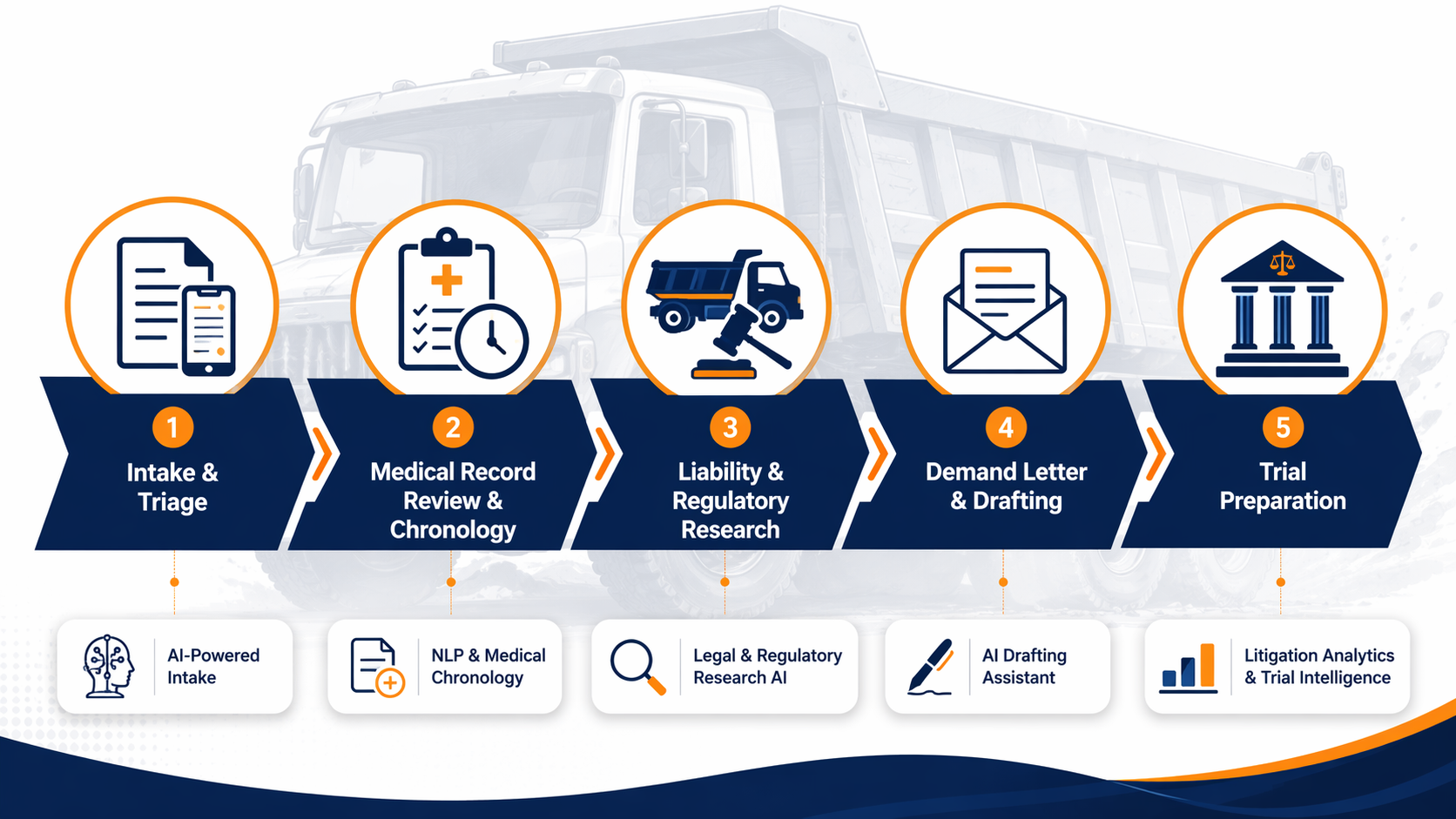
A dump truck collision lawyer in Chico, California is not shopping for “AI” in the abstract. The working question is more concrete: which part of the case file is actually slowing the team down? In a serious heavy-vehicle case, the answer may change as the matter moves from first call to medical chronology, from FMCSA review to demand package, and later into expert and trial preparation.
That is why the first procurement mistake is looking for one platform to own the whole case. The current PI AI market has useful tools, but the useful question is stage coverage. A demand product that shortens drafting does not necessarily solve regulatory research. A medical-record engine that builds a clean chronology does not necessarily prepare deposition outlines or evaluate layered trucking defendants.
| Case stage | What the team is trying to do | AI tools named in current PI materials | What to verify before adopting |
|---|---|---|---|
| Intake & triage | Capture the first account, identify severity, preserve evidence, route the matter quickly | NexLaw and Eve Legal claim all-stage coverage; other PI platforms may support intake depending on configuration | Whether the tool connects to the firm’s CRM or case-management system, flags truck-specific facts, and preserves privilege-sensitive intake notes |
| Medical record review & chronology | Turn high-volume records into a usable treatment timeline, damages summary, and missing-record list | Supio, EvenUp, Demand Pro, Rev-described AI workflows, and other medical-review tools | Whether summaries remain linked to source pages, how the tool handles thousands of pages, and who reviews the chronology before it enters the demand or expert workflow |
| Liability & regulatory research | Analyze driver, carrier, broker, maintenance, hiring, and FMCSA issues | NexLaw claims broader research coverage; general-purpose tools are weakest here unless tightly supervised | Whether the platform can handle 49 C.F.R. Parts 382-396, multi-defendant theories, and California trucking-insurance context |
| Demand letter & drafting | Assemble liability, medical specials, narrative damages, exhibits, and policy-limits arguments | EvenUp, Demand Pro, Anytime AI, NexLaw, Supio | Whether vendor-reported drafting speed translates to the firm’s records, venue, carrier, and review standards |
| Trial preparation | Move from claim presentation into discovery, deposition planning, expert preparation, motions, and trial materials | NexLaw and Eve Legal claim all-stage coverage in the NexLaw comparison; other tools may stop before trial work | Whether trial-stage outputs are litigation-ready or merely repackaged summaries from earlier stages |
Why Dump Truck Cases Stress Generic AI
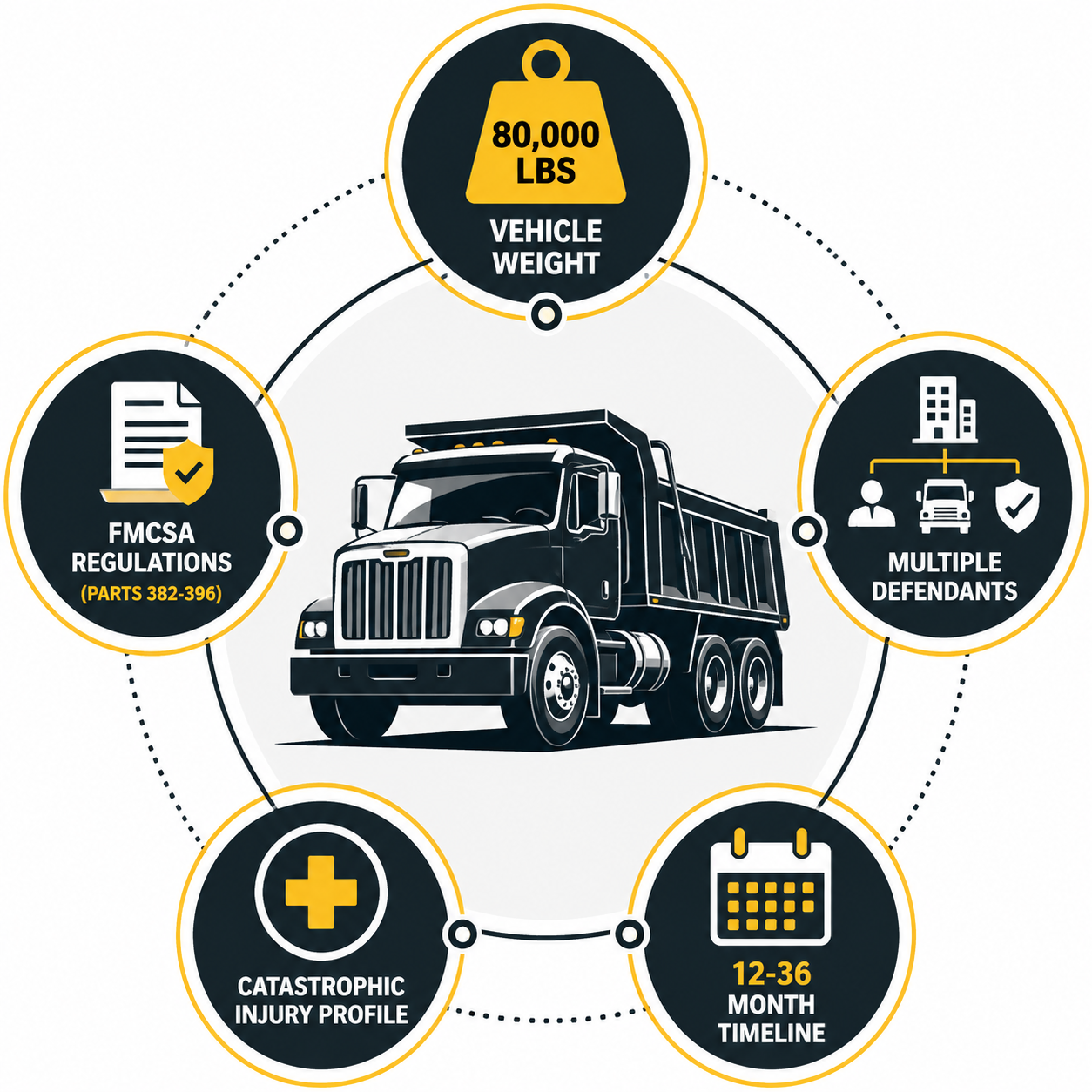
Heavy-vehicle litigation is structurally different from a routine auto claim. NexLaw’s PI AI comparison describes dump truck and similar truck cases around facts that matter to workflow design: vehicles that may weigh up to 80,000 pounds, multiple defendants, catastrophic injury profiles, FMCSA regulatory issues under 49 C.F.R. Parts 382-396, and resolution timelines of 12 to 36 months.[1]
The weight of the vehicle is not just a dramatic detail. It changes the injury profile, the expert path, the insurance analysis, and the likely volume of medical evidence. A broken chronology in that setting is not a formatting annoyance; it can distort valuation, delay demand review, and leave the attorney guessing which medical gaps still need to be filled.
The liability side is just as layered. A California dump truck case may require the firm to look beyond the driver and owner to maintenance entities, contractors, brokers, employers, or loading operations, depending on the facts. The supported materials do not establish how often each defendant type appears, so the safer operational point is this: AI that cannot help the team organize alternative liability theories will leave a real gap in heavy-vehicle files.
Insurance also changes the analysis. Singleton Schreiber’s trucking-regulation discussion contrasts federal trucking minimums that can range from $750,000 to $5 million with California’s SB 1107 minimum auto policy context of $30,000.[2] That gap is one reason a California PI firm should be cautious when a generic drafting tool treats “auto accident demand” as a single category.
Where the Bottlenecks Actually Sit
The first bottleneck is usually not a courtroom task. It is intake discipline: capturing the right facts early enough that the firm can preserve evidence, send notices, identify commercial actors, and decide whether the matter belongs in the serious-injury track. A chatbot or form assistant can help collect structured facts, but the review standard has to be higher for a dump truck file than for a low-impact rear-end claim.
The second bottleneck is the medical chronology. Rev, citing RecordGrabber data, reports that creating a medical chronology for a large case can take more than 50 hours manually, while AI tools can process thousands of pages in minutes.[3] That comparison should not be read as “minutes to a finished chronology.” It is better read as “minutes to a first machine pass that still needs human review.”
For a plaintiff team, that distinction matters. A paralegal still needs to confirm dates, provider names, diagnoses, causation language, missing records, preexisting-condition references, and treatment gaps. The best use of AI in this stage is not replacing that judgment. It is reducing the assembly burden so the review time goes into the parts that affect settlement value and litigation strategy.
The third bottleneck is the jump from records to persuasion. EvenUp reports that AI-powered demand-letter drafting can reduce turnaround from 4 to 6 hours to under 30 minutes, and NexLaw’s competitive analysis reports EvenUp’s claim that AI-generated demands are associated with a 69% higher likelihood of policy-limits tendering and that more than 2,000 U.S. firms use its Piai model.[4][1] Those are vendor-reported and competitive-analysis figures, not independently audited benchmarks. They are still worth testing because demand assembly is one of the places where plaintiff firms lose enormous staff time.
Stage Coverage Matters More Than a Tool Ranking
NexLaw’s comparison says PI-specific platforms commonly cover two to four of five case stages, while only NexLaw and Eve Legal claim coverage across all five: intake, medical review, research, drafting, and trial.[1] Because that conclusion appears in a competitive vendor analysis, it should be treated as a market claim to verify, not as a neutral audit of the category.
Even with that caveat, the stage model is useful. It prevents the firm from buying around the loudest demo. If the demo shows a polished demand letter but the firm’s actual pain is 4,000 pages of records and no clean treatment timeline, the purchase may add another login without relieving the team.
| Tool | Best-supported role in the materials | Useful caution |
|---|---|---|
| EvenUp | Demand generation and damages presentation for auto and PI claims; vendor-reported speed and policy-limits metrics | Strong demand claims do not establish full lifecycle coverage or independent outcome improvement |
| Supio | Medical-record and case-data workflows associated with PI litigation | Verify source-page traceability, chronology quality, and downstream export into the firm’s case system |
| NexLaw | Broader claimed lifecycle coverage, including research and trial-stage positioning | Because stage coverage is presented in NexLaw’s own competitive analysis, confirm capabilities with a live file |
| Anytime AI | PI drafting and workflow support named in the current tool landscape | Confirm whether it solves the firm’s specific stage bottleneck or overlaps with existing subscriptions |
| Demand Pro | Demand-focused PI drafting and productivity framing | Treat second-hand productivity citations and vendor claims as directional until tested internally |
| Eve Legal | Claimed all-stage coverage in NexLaw’s comparison | Verify claim scope directly before relying on it for trial-preparation work |
This is also where tool sprawl begins. NexLaw’s market discussion says PI firms can end up carrying four to six separate AI subscriptions.[1] That may be rational for a large practice with dedicated operations staff. For a smaller California plaintiff firm, it can create a second workflow problem: the team now has to decide which system is the source of truth, which summaries are safe to rely on, and where privileged analysis is stored.
Medical Review: The Place to Demand Source Discipline
If a firm handles catastrophic dump truck injuries, medical-record AI deserves more scrutiny than almost any other feature. The vendor demo may show an attractive chronology, but the real test is whether every important entry remains auditable. A reviewer should be able to jump from a summary sentence to the underlying page, confirm whether the language came from a provider note or an AI paraphrase, and mark uncertain causation language for attorney review.
A workable medical-review trial should include at least one large, messy file rather than a clean sample. The team should ask whether the tool can separate emergency care, imaging, surgery, rehabilitation, pain management, wage-loss documentation, and future-care references. It should also show missing-record signals rather than simply summarizing what was uploaded.
The consequence of a bad chronology lands on staff first. The paralegal rechecks the dates. The associate rebuilds the causation section. The partner distrusts the demand package. That is why a tool that saves ingestion time but creates verification chaos may not be a net improvement.
Demand Drafting: Useful, but Not the Whole Case
Demand automation is the easiest AI benefit to understand because the before-and-after task is visible. Someone spends hours assembling facts, treatment, damages, exhibits, and liability argument; the software produces a first draft faster. EvenUp’s reported reduction from 4 to 6 hours to under 30 minutes belongs in that category.[4]
The harder question is whether the demand is better for this file. In a dump truck case, the draft has to reflect commercial insurance realities, regulatory violations where supported, multiple-defendant leverage, future damages, and the evidentiary posture. A fast demand that ignores the trucking layer may be efficient only in the narrowest administrative sense.
This is where plaintiff firms should avoid confusing adoption with effectiveness. EvenUp’s reported use by more than 2,000 U.S. firms says something about market penetration.[1] It does not, by itself, prove that every firm sees the same settlement effect, that the same result applies in California dump truck litigation, or that a policy-limits tender claim will reproduce in the firm’s own inventory.
Regulatory Research Cannot Be Treated as Generic Summarization
FMCSA work is not just a research memo. It can affect document requests, deposition topics, expert retention, liability theories, and settlement leverage. A platform that summarizes uploaded documents may help the team understand what is already in the file, but it may not know what is missing from the file.
For heavy-vehicle cases, the evaluation should include a regulatory test set that checks whether the tool can help identify driver qualification, hours-of-service, drug and alcohol testing, inspection, repair, and maintenance issues under the FMCSA parts named in the current materials.[1] The firm does not need the AI to make the legal call. It needs the AI to avoid flattening a trucking case into an ordinary negligence narrative.
California insurance context should be tested the same way. If a product cannot distinguish federal commercial coverage ranges from California’s minimum auto policy context, the drafting and valuation workflow needs closer attorney supervision.[2]
Integration Is Where Good Demos Often Break
A tool that lives outside the firm’s case-management system has to justify the extra friction. The research materials identify a familiar integration ecosystem around Filevine, Litify, Clio, CASEpeer, and Smokeball. The practical question is not whether a vendor logo appears on a page; it is whether the integration moves the right data at the right stage.
- For intake, verify whether structured facts flow into the matter record without duplicate entry.
- For medical review, verify whether chronology entries, exhibits, and source-page links remain usable outside the AI platform.
- For regulatory research, verify whether attorney work product is segregated from general file summaries.
- For demand drafting, verify whether damages tables, liens, specials, and exhibits update when the file changes.
- For trial preparation, verify whether outputs can be reused in deposition outlines, expert packets, and motion workflows.
This is the same reason a broader legal AI buying process should come before the product shortlist. A general evaluation guide such as How to Choose a Legal AI Tool for Your Small Law Firm in 2026 can help frame security, budget, and implementation questions; the dump truck workflow then tests those questions against a harder case type.
Security, Ethics, and Performance Claims
AI Demand Pro cites a LawPay/MyCase industry report for two adoption signals: nearly 40% of lawyers already use generative AI for document summarization, and 37% of PI firms cite ethical concerns as a barrier to adoption.[5] Those figures describe behavior and concern, not quality of implementation. A firm can use summarization heavily and still have weak review controls.
The same caution applies to productivity claims. AI Demand Pro also cites a 2025 Harvard Law School study for productivity gains exceeding 100x in certain legal workflows, including one 16-hour task reduced to 3 to 4 minutes.[5] Because the attribution here is second-hand through a vendor article, it should be treated as a reason to test a workflow internally, not as a benchmark to promise staff or clients.
For California plaintiff firms, the review checklist should be plain: confidentiality terms, data retention, model-training policy, access controls, audit history, SOC or comparable security posture if available, role-based permissions, and whether the vendor will sign terms that match the firm’s professional obligations. A litigation team also needs a written rule for when AI output becomes attorney work product and when it remains an unreviewed machine summary.
A Practical Evaluation Framework
The cleanest way to evaluate these tools is to start with the firm’s own case files, not with a vendor’s best sample. Choose one recent or active heavy-vehicle matter that includes intake notes, police or collision materials, medical records, insurance facts, and at least one liability complication. Then test each platform against the stage where it claims to help.
| Evaluation question | What a useful answer looks like |
|---|---|
| Which stage is slowest today? | The firm can name a specific bottleneck, such as chronology assembly, demand drafting, or FMCSA issue spotting. |
| Does the tool cover that stage deeply? | The demo uses a real or realistic heavy-vehicle file, not a generic auto-claim sample. |
| Does it integrate with the firm’s system? | Outputs move into Filevine, Litify, Clio, CASEpeer, Smokeball, or the firm’s actual system without manual rebuilding. |
| Can the team audit the output? | Every important medical, liability, or damages statement can be traced back to a source document or attorney-reviewed note. |
| Are claims internally verified? | Vendor-reported speed, productivity, and outcome claims are measured against the firm’s own files before rollout. |
| Will the tool still fit next quarter? | The firm sets a review date because PI AI features, pricing, and coverage claims are moving quickly. |
PI-specific AI is now useful across the lifecycle of a California dump truck case. It can reduce assembly work, accelerate record review, help organize demand packages, and support research and trial preparation when the product is built for those stages. But dump truck litigation is too complex for a one-size-fits-all platform claim. The better buying decision is stage by stage: prove the bottleneck, test the integration, audit the output, and keep the tool map current.
References
- Best AI Tools for Personal Injury Lawyers 2026, NexLaw
- California Trucking Regulations, Singleton Schreiber
- AI for Personal Injury Lawyers, Rev
- Legal AI Tools for Auto Accident Claims, EvenUp
- Top 5 AI Tools for Personal Injury Law Firms in 2026, AI Demand Pro
Comments
Join the discussion with an anonymous comment.