
Full profile
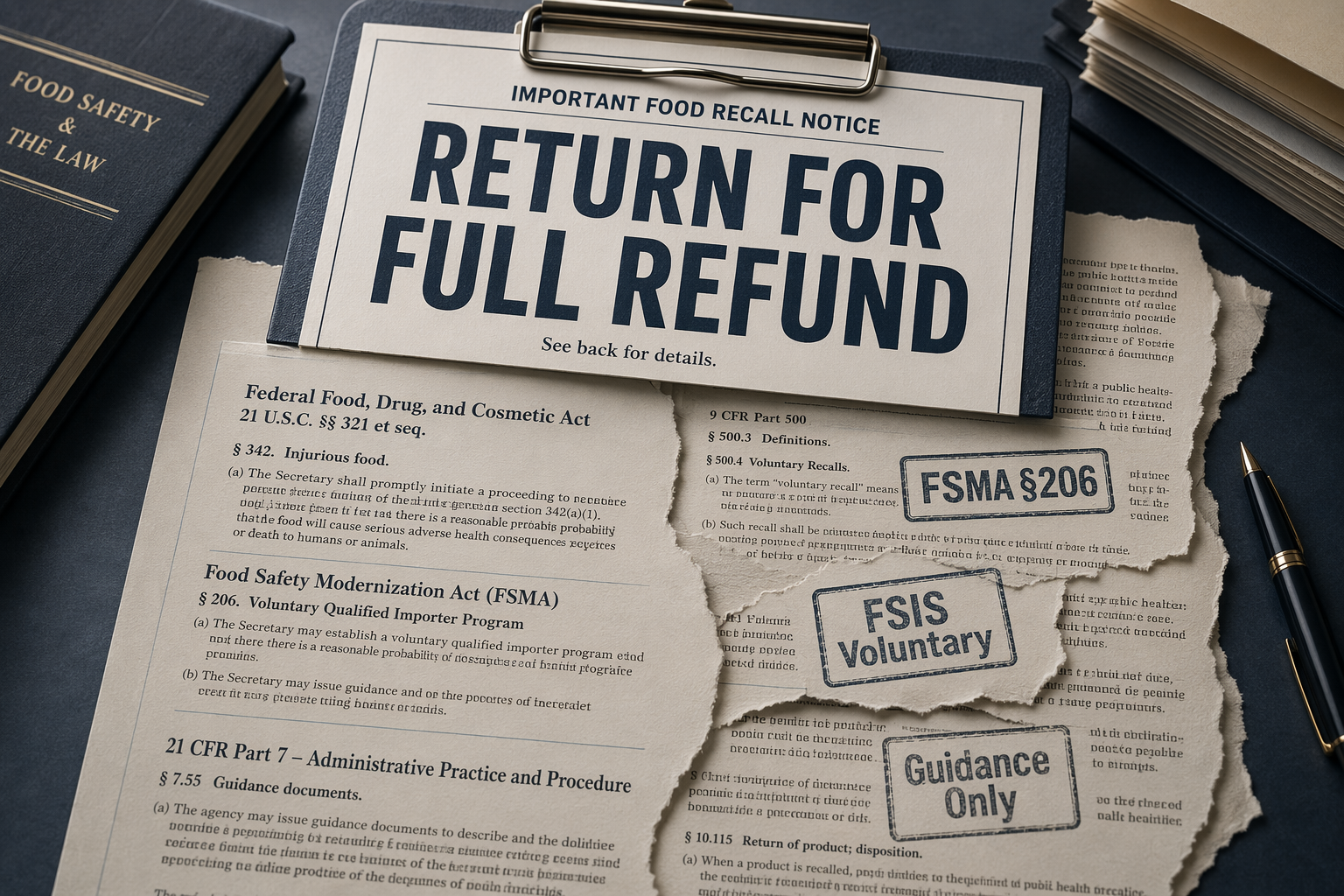
The phrase that matters most to consumers in a food recall notice is usually the plainest one: discard the product or return it to the place of purchase for a full refund. It sounds like a legal entitlement because it appears so consistently. For counsel reviewing the notice, that is precisely the trap. The consumer-facing refund promise is common, expected, and often commercially unavoidable, but it does not come from a single federal rule that says every food recall must include a cash refund.
The actual legal answer is less tidy. Federal food law gives FDA a limited mandatory recall tool for certain high-risk situations. USDA’s Food Safety and Inspection Service supervises meat, poultry, and processed egg recalls through a voluntary recall system. Agency guidance often describes refunds as an available corrective action rather than a required one. Retailers, meanwhile, have trained consumers, call centers, store associates, and suppliers to expect a refund without much debate. Once that language appears in a recall notice, it becomes an operational promise even if its source is not a universal statutory command.
The authority map behind a refund sentence
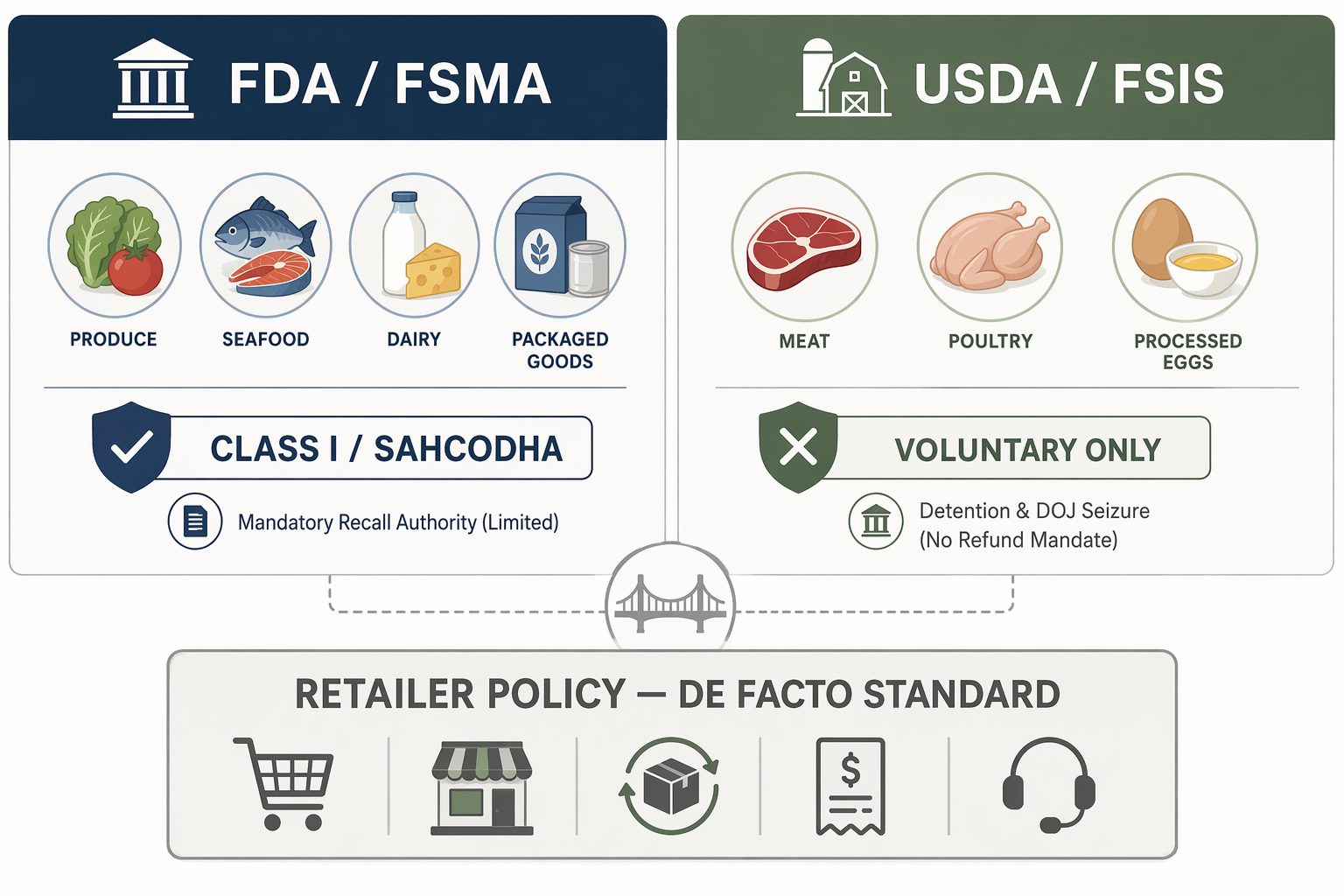
Food recalls in the United States sit inside a divided regulatory structure. FDA regulates most of the food supply under the Federal Food, Drug, and Cosmetic Act as amended by the Food Safety Modernization Act, while USDA/FSIS regulates meat, poultry, and processed egg products under separate statutes. The National Agricultural Law Center summarizes the split by noting that FDA oversees roughly 78% of the food supply, with USDA/FSIS covering the meat, poultry, and processed egg categories.[1]
That split matters because “recall” does not mean the same thing across the food system. It also does not automatically answer the remedy question. A recall classification describes risk; it does not, by itself, prescribe whether a consumer receives cash, replacement product, store credit, or some other remedy.
| Regulatory lane | Core recall authority | What it means for refunds |
|---|---|---|
| FDA-regulated foods | FSMA §206 mandatory recall authority, codified at 21 U.S.C. §350l, plus voluntary recall practice | FDA can order a recall only within the statutory conditions; the statute is not a general cash-refund mandate |
| USDA/FSIS-regulated meat, poultry, and processed eggs | Voluntary recall system, with agency tools such as detention and referral for seizure | FSIS pressure can be substantial, but it is not a direct federal refund requirement |
| Retail sale and customer service | Retailer policy, supplier agreements, recall portal instructions, and customer-retention practice | This is where the full-refund promise usually becomes practically unavoidable |
FDA and FSIS both use three recall classes. Class I is the highest-risk category, used when there is a reasonable probability that use of or exposure to the product will cause serious adverse health consequences or death. FDA’s mandatory recall authority is tied to that serious-risk threshold, commonly described through the SAHCODHA standard: serious adverse health consequences or death to humans or animals.[2]
FSMA gives FDA a mandatory recall power, not a universal refund rule
FSMA §206, codified at 21 U.S.C. §350l, authorizes FDA to require a responsible party to cease distribution and recall an article of food when statutory conditions are met. The statutory trigger is not ordinary nonconformance or mere dissatisfaction. FDA must determine that there is a reasonable probability that the food is adulterated under specified provisions or misbranded with respect to allergen labeling, and that use of or exposure to the food will cause serious adverse health consequences or death.[2]
The sequencing is also important. The statute first gives the responsible party an opportunity to voluntarily cease distribution and recall the article. If the firm does not do so within the time and manner prescribed, FDA may order the action. That is a mandatory recall authority, but it is a narrow one. It does not read like a consumer refund statute, and it does not prescribe a cash remedy for every person who bought the affected food.[2]
FDA’s own mandatory-recall materials have long emphasized the limited use of this authority. FDA reported its first mandatory recall order in 2018, involving kratom products distributed by Triangle Pharmanaturals after the agency concluded the products contained salmonella.[3] The available record states that FDA’s mandatory recall authority has been exercised exactly once, but that point should be treated as a current-activity verification item for any live 2026 legal memorandum because agency enforcement activity after 2018 would have to be checked before relying on the phrase “only once.”
For refund drafting, the key distinction is simple but often blurred in meetings: an agency power to compel removal of product from commerce is not the same as a statutory command to reimburse every retail purchaser in cash. A company may decide that a full refund is the appropriate corrective action, FDA may expect an effective consumer-level remedy, and retailers may require it as a condition of executing the recall. Those are serious constraints. They are not the same source of law.
FDA guidance leaves room for refund, replacement, or repair
FDA’s consumer recall education tells consumers not to eat recalled food and to follow the recall notice, which may instruct them to return the product, discard it, or contact the company.[4] That public-facing framing reflects normal recall administration, but it should not be read as creating one required refund formula for all recalls.
The Administrative Conference of the United States, in describing recall procedures across agencies, uses the familiar remedial vocabulary: repair, replace, refund, or otherwise correct the problem.[5] That vocabulary is useful because it shows how recalls are operationalized. It is also legally dangerous if shortened to “recall equals refund.” The remedy depends on the product, the risk, the agency, the distribution chain, and the company’s own representations.
Food makes this especially sensitive because returning the product is not always the safest or most useful act. Some notices ask consumers to discard the food and contact the company for reimbursement. Some retailers process refunds at the register through item codes. Some suppliers reimburse retailers rather than consumers directly. The consumer may experience all of those as a “refund right,” but the legal mechanics can be quite different.
FSIS recalls are voluntary, even for products most consumers consider high risk
The FSIS side is the part that surprises people who assume high-risk foods must come with stronger federal recall commands. FSIS explains that recalls of meat, poultry, and processed egg products are voluntary actions by manufacturers or distributors to protect the public from products that may be adulterated, misbranded, or otherwise unsafe.[6]
Voluntary does not mean casual. FSIS can request that a company recall product, issue public health alerts, detain product, and pursue seizure through the Department of Justice when warranted. The National Agricultural Law Center similarly describes FSIS recalls as voluntary while noting the agency’s related enforcement tools.[1] Those tools create significant pressure. They still do not amount to a direct federal requirement that the recalling firm give every consumer a cash refund.
For counsel, that distinction changes the review question. The question is not merely, “What does the agency require?” It is also, “What did the firm promise in the recall notice, what did the retailer agree to administer, what reimbursement path exists between supplier and retailer, and what evidence will show that the remedy reached the affected consumers?”
Why the refund still feels mandatory
The absence of a universal federal cash-refund command does not make refunds optional in the practical sense. In a consumer-level food recall, a no-refund position would usually collide with retailer policy, customer-service scripts, brand commitments, insurance expectations, and the need to persuade consumers to remove the product from use. The refund is often the price of making the recall work.
Major grocery and mass retail channels have normalized full refunds for recalled food, frequently without requiring a receipt. Walmart, Costco, Kroger, Target, Trader Joe’s, ALDI, Publix, and Whole Foods are useful as a group for this point: their recall and refund practices have made the consumer-facing remedy more uniform than the underlying legal authorities. That uniformity is a market standard and a retailer-operating requirement, not proof of a single federal refund statute.
This is where recall language hardens. A manufacturer may begin with an internal position that affected consumers “may” seek reimbursement. A retailer portal may convert that into “return for a full refund.” An agency-posted recall notice may repeat the instruction. Customer service may then read from it for weeks. By that point, trying to narrow the promise is no longer an abstract legal drafting exercise; it is a consumer-relations, retailer-relations, and evidence-preservation problem.
The 2024 recall numbers show why remedy execution matters
The practical stakes are not academic. A Settlemate report citing CIDRAP identified 296 food recalls in 2024, including 241 FDA-regulated recalls and 55 USDA-regulated recalls, associated with 1,392 illnesses, 487 hospitalizations, and 19 deaths.[7] Because that statistic is reported through a secondary source citing CIDRAP, counsel relying on it in formal work should verify the underlying methodology, especially how illnesses and severe outcomes were attributed to recall events.
Even with that caveat, the numbers illustrate the operational reality. Recall administration is not just a notice-posting exercise. It requires identifying affected lots, stopping distribution, removing product from shelves, communicating with consumers, processing remedies, and documenting completion. The legal scope of the recall often turns on lot codes, production windows, and traceability records; that mechanics question is addressed separately in the internal guide to how lot numbers determine the legal scope of a food recall.
Consumer product recalls are a useful contrast, not the governing rule
It is tempting to borrow recall instincts from consumer product law. That can mislead food teams. The Consumer Product Safety Commission has a different statutory regime and can announce corrective-action programs that include refund, repair, or replacement remedies for covered consumer products. Product safety commentary reported more than 350 CPSC recalls in 2025, a useful reminder that recall remedy practice varies by agency and product category.[8]
That comparison clarifies the food issue rather than replacing it. A CPSC remedy structure does not become an FDA or FSIS refund mandate merely because the word “recall” appears in both settings. Food recall counsel should resist importing remedy assumptions across regulatory programs unless the governing statute, order, settlement, or company notice actually supports the move.
Refunds do not settle injury exposure
A refund replaces the purchase price or otherwise compensates the consumer for the product. It does not compensate for illness, medical expenses, lost wages, pain, death, or other alleged injury. That boundary should be kept visible in the recall file because the same consumer communication can be read later in a product liability case.
Dibble v. Torax Med., Inc., an Eighth Circuit decision from 2025, is not a food case, but it is a useful boundary marker. The court’s treatment of recall-related issues underscores that recall activity does not automatically shield a company from product liability exposure.[9] In food recalls, the same principle should keep refund administration separate from injury-claim evaluation.
That separation matters when notices are drafted. “Full refund” should not be allowed to imply “full compensation” unless the company intends that result and has evaluated the consequences. Most food recall notices do not do that. They tell consumers how to remove or dispose of the product and how to recover the purchase price. Injury claims remain on a different track.
What AI tools can and cannot change
AI compliance tools can make the refund promise easier to administer. Product safety commentary in 2026 described AI use in product safety for tasks such as monitoring, data analysis, and recall management.[10] In a food recall, the practical use case is less glamorous: matching affected lots to retailer shipments, tracking whether stores received instructions, monitoring consumer contacts, and reconciling refund activity against the recall scope.
Those tools do not change the legal source of the obligation. They can help prove that the company executed the remedy it promised. They cannot convert FDA guidance into a statute, give FSIS mandatory recall authority it does not have, or make a retailer policy disappear from the operational record.
Draft the refund promise to match its real source
The safest legal analysis does not start by asking whether consumers “have refund rights” in the abstract. It asks which authority governs the product, what classification and risk finding apply, what the agency can require, what the retailer will administer, what the company has already promised, and whether any separate injury claims are being preserved or released. Those questions keep recall, refund, remedy, and liability from collapsing into one word.
In practice, the full-refund sentence may still be the right sentence. It is familiar, administrable, and often necessary to obtain cooperation from retailers and consumers. But counsel should approve it as a promise arising from a mixed regime of limited agency authority, agency expectations, retailer requirements, and corporate policy. It should not be treated as evidence that federal food law imposes a cash-refund mandate in every recall.
References
- Food Foundations: What Are Food Recalls and How Do They Work?, National Agricultural Law Center.
- 21 U.S.C. § 350l - Mandatory Recall Authority, Legal Information Institute.
- FDA Food Safety Modernization Act (FSMA) - Mandatory Recall Authority, U.S. Food and Drug Administration.
- Food Recalls: What You Need to Know, U.S. Food and Drug Administration.
- Procedures for Product Recalls, Administrative Conference of the United States.
- Understanding FSIS Food Recalls, USDA Food Safety and Inspection Service.
- 2024 food recall statistics reported by Settlemate citing CIDRAP, CIDRAP / Settlemate.
- July 2025 Product Liability Updates, Product Liability Lawyer Blog, July 2025.
- Dibble v. Torax Med., Inc., 8th Cir. 2025, Justia.
- How AI Is Revolutionizing Product Safety, Product Law Perspective, March 2026.
Comments
Join the discussion with an anonymous comment.