
Full profile
Harvey legal AI now sits on both sides of the market conversation. For large law firms and well-funded legal departments, it is the most complete attempt to turn generative AI into a governed legal work platform. For solos, small firms, and many mid-sized practices, it is also the clearest example of how quickly legal AI can become an enterprise procurement exercise rather than a software subscription.
That split matters more than the usual “best AI tool for lawyers” framing. Harvey is not merely competing as a better chatbot. By Q3 2026, its pitch is a connected system for research, drafting, document review, knowledge retrieval, workflow automation, and collaboration. The serious buying question is whether a firm has enough repeatable legal work, enough internal knowledge, enough security process, and enough implementation capacity to make that breadth pay for itself.

Harvey’s origin story is short enough not to overburden the point. The company was founded by Winston Weinberg and Gabriel Pereyra after early GPT-3 experiments with legal work, with roots connected to O’Melveny & Myers and early legal practice testing.[1] Its funding curve explains why the product no longer looks like a narrow drafting assistant: Harvey moved from a $5 million seed round to more than $1 billion raised and an $11 billion valuation by March 2026, while CNBC reported $190 million in annual recurring revenue as of January 2026, implying a revenue multiple of roughly 58x.[2][3]
Those numbers do not prove product-market fit for every firm. They do show the scale of the bet. A company valued that way has to sell more than convenience. It has to become infrastructure.
What Harvey Actually Includes
The easiest way to misread Harvey is to evaluate it as if it were one text box. Harvey’s current platform is better understood as a set of legal work surfaces that can be connected across matters, documents, firm knowledge, and teams. Public descriptions commonly group the platform around Assistant, Vault, Knowledge, Workflow Agents, and Harvey for Word, with collaborative Shared Spaces supporting multi-user work.[4][5]
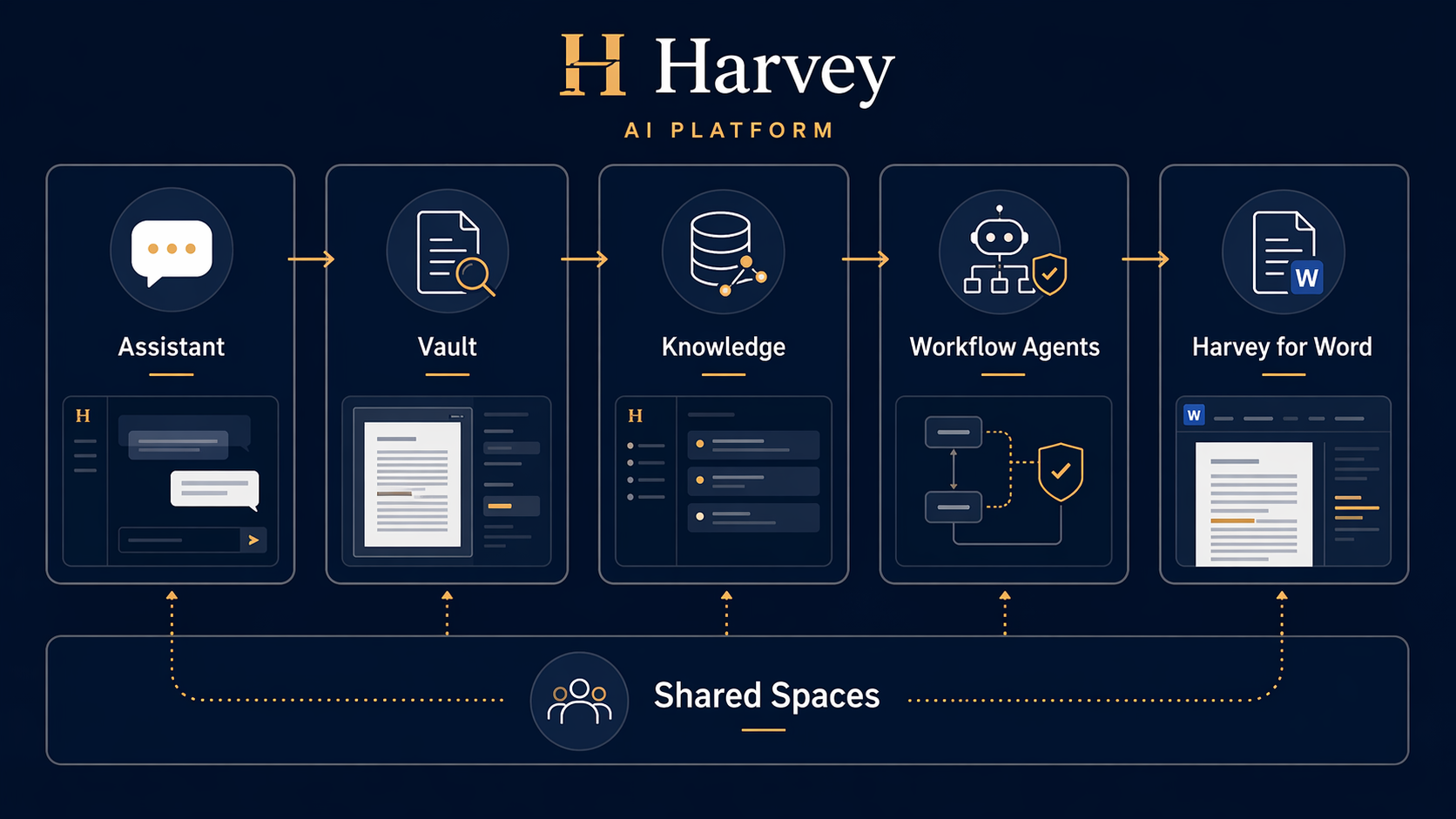
| Platform surface | What it is for | Where it matters most |
|---|---|---|
| Assistant | Chat-style legal research, analysis, drafting support, and question answering | Lawyers who need a general legal AI workspace rather than a single-purpose drafting tool |
| Vault | Document upload, review, comparison, extraction, and analysis | Diligence, investigations, litigation document review, and contract-heavy practices |
| Knowledge | Retrieval over firm-approved knowledge and internal materials | Firms with high-value precedents, playbooks, research memos, and institutional know-how |
| Workflow Agents | Multi-step task automation designed to execute legal workflows with controls such as ethical walls | Teams with repeatable work that can be decomposed into review, drafting, checking, and routing steps |
| Harvey for Word | Drafting and editing inside Microsoft Word | Lawyers who live in negotiated documents and need AI close to the drafting surface |
| Shared Spaces | Collaborative matter or project environments | Teams that need lawyers, reviewers, and specialists to work from common context |
That architecture is why Harvey deserves a different evaluation from a point product. A contract tool can be judged mostly on redlining quality, clause suggestions, Word integration, and price. A research tool can be judged mostly on source grounding, citator behavior, jurisdictional coverage, and answer reliability. Harvey asks the buyer to imagine a wider operating model: a lawyer drafts in Word, checks a clause against firm precedent, pulls matter documents into Vault, asks Assistant to reason over them, and uses a workflow agent to push a repeatable task through a controlled process.
That is a more ambitious claim, and sometimes a more credible one. Legal work rarely stays inside one clean category. A securities team may need research, drafting, precedent retrieval, diligence, and internal review on the same day. A litigation team may need a brief section, a chronology, deposition summaries, issue lists, and privileged-document handling. If those activities happen in disconnected tools, the lawyer becomes the integration layer.
The catch is that platform value compounds only when the organization can feed it real workflows. A firm with scattered usage, thin internal knowledge assets, and no change-management owner may buy breadth and experience it as clutter. A firm with standardized playbooks, high document volume, security review muscle, and practice leaders willing to redesign work may experience the same breadth as leverage.
The Metrics Ledger: Impressive, But Mostly Vendor-Reported
Harvey reports serving more than 142,000 lawyers across more than 1,500 organizations in 60 countries.[3] It also reports 92% monthly adoption and more than 25 hours saved per user per month, figures that have appeared in vendor materials and third-party coverage of the company’s market position.[3][6] Those are strong numbers if they survive scrutiny inside a buyer’s own environment. They are not the same as independently audited productivity results across the legal market.
The distinction is not pedantic. “Adoption” can mean different things depending on whether the denominator is all licensed users, invited users, active lawyers, or a subset of trained teams. “Hours saved” can come from user estimates, workflow studies, time-entry analysis, or controlled before-and-after measurement. Without a disclosed methodology, the figures are useful as buying signals, not as budget proof.
A legal ops director should treat those claims as hypotheses to test during evaluation. Which practice groups use the tool weekly? Which tasks move faster without later correction? Which outputs are accepted by supervising lawyers? Which work merely shifts from drafting time to review time? The answer may still favor Harvey, especially in high-volume environments, but the buyer needs local evidence before turning a vendor metric into a business case.
Pricing Is Where the Market Splits
Harvey does not publish standard pricing. The most detailed public pricing analysis cited here estimates very different effective rates by buyer type: roughly $100 to $200 per seat per month for Am Law 100-scale deployments, roughly $1,200 to $2,000 per seat per month for mid-market buyers, and 25-to-50-seat minimum commitments.[7] The same analysis estimates first-year total cost of ownership for a 100-attorney firm at approximately $1.97 million to $2.25 million.[7]
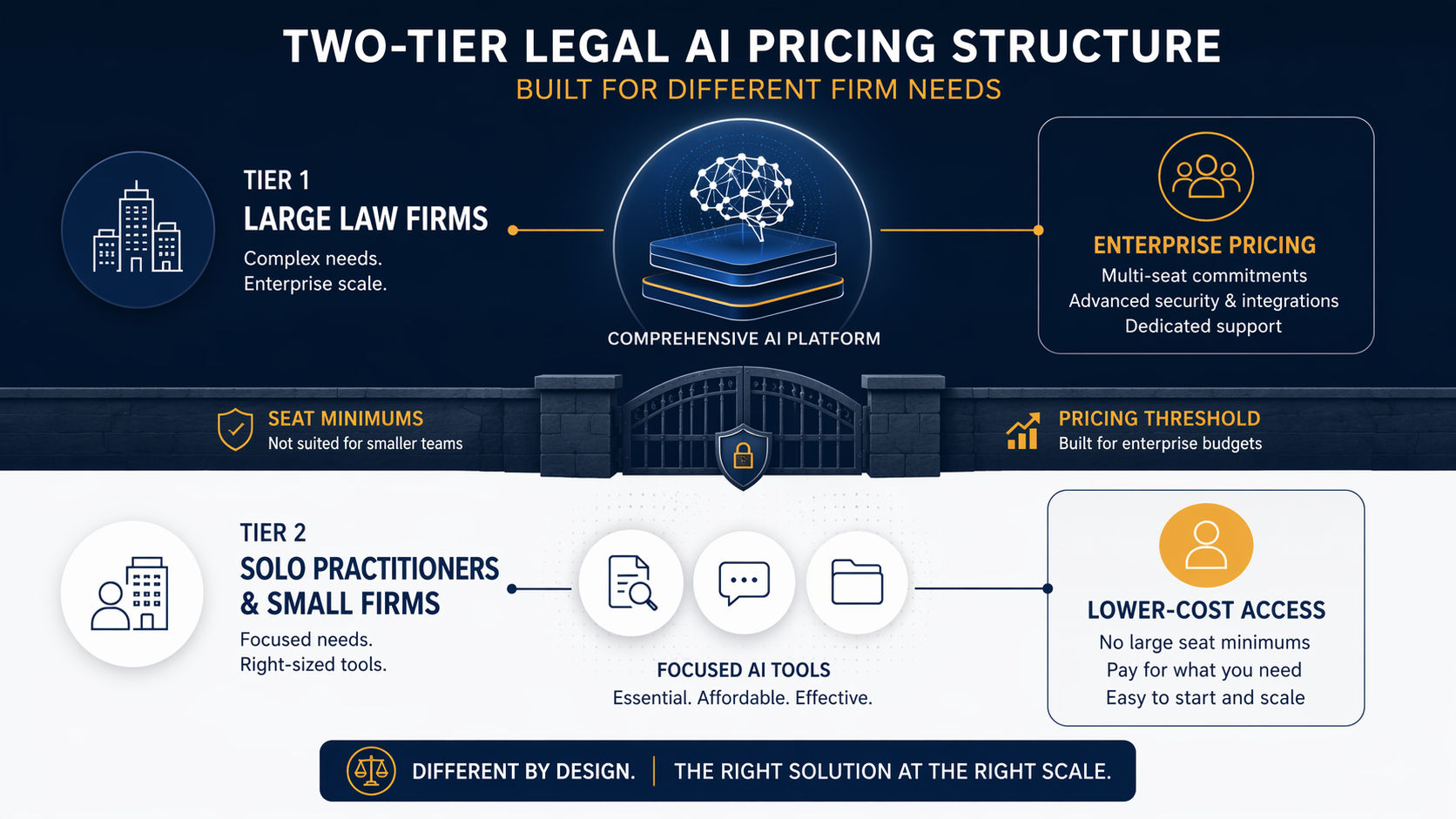
Those figures are triangulated, not official Harvey list prices. Exact quotes will depend on firm size, seats, negotiation leverage, implementation scope, and contract structure. But the direction is consistent with the product motion: Harvey is sold like enterprise infrastructure, not like a self-serve writing app.
That creates an awkward but necessary verdict. A global firm buying hundreds or thousands of seats may be able to spread platform costs across enough matters, practice groups, and knowledge assets to justify the spend. A 20-lawyer firm buying into a 25-seat minimum at mid-market pricing has a very different problem. The issue is not sophistication. It is utilization density.
If five partners want occasional research help and three associates want contract drafting support, Harvey’s breadth is unlikely to be the first dollar of legal AI spend. If a firm has daily diligence, repeatable drafting workflows, knowledge-management discipline, and a partner willing to sponsor adoption, the conversation changes. The platform becomes plausible when the workflows are already waiting for it.
Security Posture Is a Real Part of the Product
For enterprise legal buyers, security is not a procurement footnote. Harvey publicly describes controls including SOC 2 Type II, ISO 27001, ISO 27701, ISO 42001, bring-your-own-key options, and a commitment that customer data is not used to train models.[1][8] Those details matter because large firms and legal departments are not merely asking whether a model can draft. They are asking whether privileged, confidential, regulated, and client-specific materials can move through the system under defensible controls.
This is one reason general-purpose AI tools are not clean substitutes. A $20-per-month chatbot may be useful for low-risk brainstorming or administrative drafting where firm policy permits it, but it does not replace a legal AI platform that has gone through vendor review, data-handling diligence, access-control analysis, and client-facing risk discussions. The cheap tool may still be the right starting point for some lawyers. It is not the same category of purchase.
Security also cuts against casual pilots. A buyer who wants to test Harvey seriously needs enough internal coordination to involve IT, security, knowledge management, practice leadership, and the lawyers who will actually use it. The same process that makes Harvey viable for a large firm can make it too heavy for a small one.
Hallucination Claims Need Careful Reading
Harvey has published a BigLaw Bench result claiming a 0.2% claim-level hallucination rate.[9] That is the kind of number buyers notice immediately, especially in a profession where one fabricated authority can destroy confidence in the whole workflow. It should also be read as a self-published benchmark claim, not as independently replicated proof of general legal reliability.
Even taken at face value, 0.2% does not mean “no hallucinations.” It means roughly one fabricated claim per 500 claims in the tested setting. That may be excellent for some workflows and still unacceptable for final legal work without attorney review. AI Vortex’s discussion of legal hallucination research also notes that broader legal AI hallucination findings involve different models and tasks, so they should not be treated as a direct Harvey comparison.[10]
The practical standard is not whether Harvey can eliminate review. It cannot. The standard is whether it can reduce the amount of low-value work while keeping lawyers inside a review process that catches wrong, unsupported, or overconfident output before it leaves the firm.
Why the A&O Shearman Partnership Matters
Harvey’s relationship with A&O Shearman is useful because it shows where the enterprise legal AI market is heading. Public coverage described a revenue-sharing partnership, while A&O Shearman announced work with Harvey that goes beyond ordinary vendor procurement.[11][12] The structure suggests a move from “law firm buys tool” toward “law firm helps shape and commercialize platform capability.”
That is meaningful, but it is not a template every firm can copy. A global firm can contribute domain expertise, workflow volume, client credibility, and implementation feedback at a scale that changes the product itself. A small firm usually cannot negotiate from that position. It buys what the market offers.
For prospective buyers, the lesson is not that they need their own platform partnership. It is that Harvey’s strongest product signals come from environments where large legal organizations can supply the data, workflows, and governance that make a broad platform useful.
Where Alternatives Fit
The competitive question is less “Who beats Harvey?” than “What job are you actually buying for?” CoCounsel is commonly positioned around legal research and Thomson Reuters/Westlaw-grounded workflows, with public comparison sources placing it around $225 per seat per month.[7][13] Lexis+ AI and Protégé are anchored in LexisNexis’s verified legal content environment.[13] Spellbook is a Word-native contract drafting product with public comparison sources placing it around $99 to $199 per seat per month.[7][13] Legora often appears in comparisons where European data posture and collaborative legal work are central considerations.[13]
Those products do not need to be more comprehensive than Harvey to be better first purchases. A small transactional practice that wants faster contract review may get more immediate value from a focused Word-based drafting tool. A litigation boutique with research-heavy work may start with a research product tied closely to legal databases. A cost-conscious solo may test general-purpose AI for low-risk, non-confidential tasks while reading firm-policy and confidentiality limits carefully.
Readers comparing by workflow rather than brand can use legal document AI tool comparisons, AI legal research tool guidance, or a broader AI legal software comparison by firm size before spending time on an enterprise evaluation.
Who Should Evaluate Harvey
Harvey is most compelling when the buyer can answer yes to several operational questions before the sales call: Do we have enough lawyers to use a broad platform every month? Do we have repeatable workflows beyond one-off drafting? Do we have internal knowledge that is valuable enough to retrieve and reuse? Do we have the security, IT, and training capacity to support rollout? Do we have a sponsor who can insist on workflow change rather than passive experimentation?
| Buyer profile | Harvey fit | Reasonable next move |
|---|---|---|
| Global law firm or Am Law-scale firm | Strong potential fit | Evaluate Harvey as a platform, including knowledge integration, practice-group pilots, security review, and adoption measurement |
| Well-resourced enterprise legal department | Potential fit if workflows are repeatable | Test against contract, compliance, investigation, or knowledge workflows with clear review controls |
| Mid-sized firm with high-volume transactional, litigation, or regulatory work | Possible but price-sensitive | Model first-year cost, seat minimums, training burden, and utilization before committing |
| Small firm with occasional AI needs | Usually weak first fit | Start with focused research, drafting, or document tools before considering Harvey |
| Solo practitioner | Usually poor economic fit | Use lower-cost legal AI tools or carefully governed general-purpose AI for appropriate low-risk work |
Large firms should not evaluate Harvey as a novelty layer. They should evaluate whether it can become a governed work environment: which matters enter the system, which documents may be uploaded, which knowledge sources are approved, which outputs require human review, and which metrics decide expansion. The firms that get value will likely be the ones that treat rollout as an operating change, not a perk.
Mid-sized firms need the hardest discipline. They may have enough sophisticated work to benefit from Harvey, but not enough margin for a vague platform experiment. Before evaluation, they should identify two or three workflows where time savings can be measured without relying on lawyer enthusiasm alone. For a structured procurement process, a broader legal AI evaluation framework is more useful than another demo.
Small firms and solos should be allowed to make the unfashionable choice. Being priced out of Harvey is not a failure to understand AI. It may be a rational refusal to buy enterprise breadth before the firm has enterprise workflows. For many of those buyers, AI legal assistants for solo firms or even a careful review of whether open-source legal AI can replace Harvey or CoCounsel will produce a more practical shortlist.
The Q3 2026 Verdict
Harvey legal AI is the broadest legal AI platform available in mid-2026, and that breadth is not cosmetic. Assistant, Vault, Knowledge, Workflow Agents, Harvey for Word, and Shared Spaces map onto real legal workflows that large firms and sophisticated legal departments already struggle to coordinate. The company’s security posture, customer scale, funding, and partnerships all support the view that Harvey is building for enterprise legal infrastructure rather than isolated AI assistance.
The same facts create the limit. Unpublished pricing, estimated seat minimums, enterprise implementation demands, and self-reported performance metrics make Harvey a poor universal recommendation. Large law firms and well-resourced enterprise legal teams should consider evaluation if they need a unified platform and can measure adoption against real workflows. Mid-sized firms should proceed only with a narrow business case and a realistic first-year cost model. Small firms and solos should usually start with focused, lower-cost tools for contract drafting, research, or document review before pursuing Harvey.
The platform may be impressive. The better procurement question is whether the firm can actually absorb it.
References
- Harvey — Wikipedia.
- Harvey AI hits $11 billion valuation as legal tech startup’s revenue jumps — CNBC, March 25, 2026.
- Harvey raises at $11B valuation — Harvey, March 2026.
- Harvey AI: A Comprehensive Overview — Maryland State Bar Association.
- Long-Horizon Agents for Legal Work — Harvey.
- Harvey AI Review — Constellation Research.
- Harvey AI Pricing Analysis — BindLegal.
- Security — Harvey.
- BigLaw Bench — Harvey.
- Harvey AI Hallucination Rate: Benchmark Claims and Legal AI Risk — AI Vortex.
- A&O Shearman, Harvey Enter Revenue Sharing Partnership — Artificial Lawyer, April 7, 2025.
- A&O Shearman announces partnership with Harvey — A&O Shearman.
- Harvey AI Alternatives — Aline.
Comments
Join the discussion with an anonymous comment.