
The Law Firm AI Adoption Paradox: High Usage, Low Readiness — and What to Do About It
AI adoption among legal professionals has more than doubled in two years, yet most firms lack the policies, training, pricing adjustments, and ROI measurement needed to manage it responsibly. This strategic analysis for managing partners and compliance officers examines the readiness gap and provides an actionable framework for closing it.
- Hallucination rate
- Not measured / undisclosed

The Adoption Data: A Majority Now Uses AI, but the Numbers Tell Different Stories
The first thing to understand about AI adoption in law firms is that the precise number depends heavily on whom you ask and how they define "use." Three major surveys conducted between late 2025 and early 2026 all converge on the same headline — a majority of legal professionals now use AI at work — but their specific figures differ in ways that matter for strategic planning.
The 8am 2026 Legal Industry Report, based on a survey of over 1,300 legal professionals conducted in September and October 2025, found that 69% use general-purpose AI tools at work — more than double the rate from the previous year. The North Carolina Bar Association, citing Clio's 2026 survey, reported that 71% of solo practitioners and 75% of small firms have adopted AI. Meanwhile, the Litify 2025 State of AI in Legal report pegged overall legal community adoption at 78%, up from roughly 19% in 2023.
What these surveys share is more important than their differences: AI use in legal practice has shifted from early-adopter novelty to mainstream behavior in roughly two years. The tools driving this shift are predominantly general-purpose LLMs — ChatGPT (66% of respondents in the Litify survey), Microsoft Copilot (42%), and Google Gemini (24%) — rather than legal-native platforms. Legal research (66% of users), summarizing case histories (39%), and document drafting or review (36%) top the list of use cases.
| Survey Source | Reported Adoption Rate | Sample / Methodology | Key Limitation |
|---|---|---|---|
| 8am 2026 Legal Industry Report | 69% use general-purpose AI at work | 1,300+ legal professionals, Sep–Oct 2025 | General-purpose AI only; may undercount legal-native tool use |
| Clio 2026 (via NC Bar) | 71% solo, 75% small firm | Clio customer base | May over-represent tech-forward firms already using practice management software |
| Litify 2025 State of AI in Legal | 78% overall, up from ~19% in 2023 | Broader legal community survey | Broadest definition of 'adoption'; may include minimal or experimental use |
The speed of this shift is remarkable. A technology that fewer than one in five legal professionals had touched in 2023 is now used by more than two-thirds. But adoption velocity is not the same as organizational readiness — and that is where the paradox emerges.
The Readiness Gap: Policies, Training, and Pricing Haven't Kept Pace
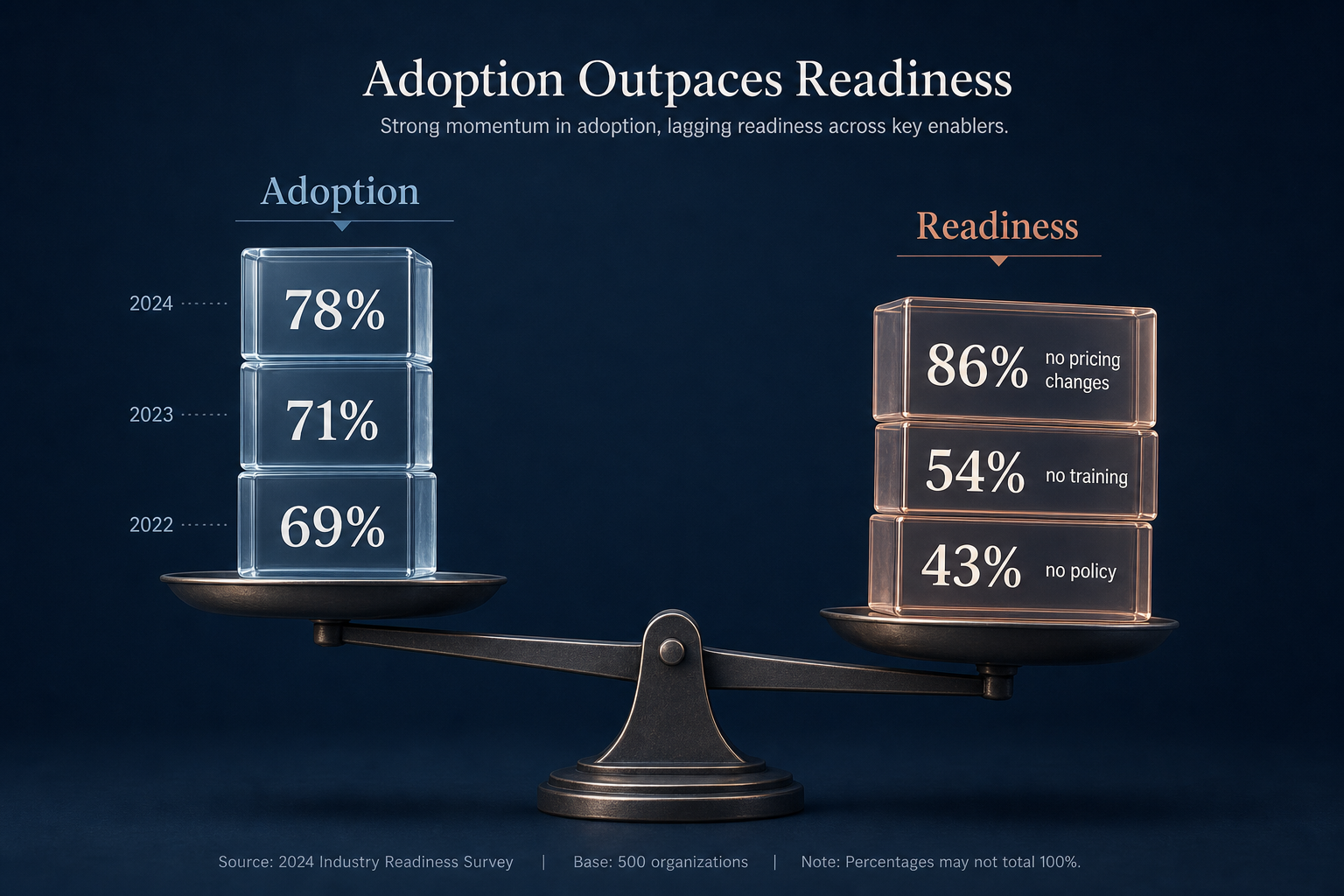
The core paradox is stark: a majority of legal professionals now use AI, but the institutional infrastructure to govern that use is absent in most firms. The 8am report found that 43% of legal professionals say their firm has no formal AI policy and no plans to create one. Only 9% have a written policy that is actually enforced. The Clio data, cited by the NC Bar Association, tells a similar story: 57% of solo firms and 55% of small firms have no AI policy at all.
Training is equally neglected. The 8am survey reports that 54% of firms provided no training on responsible AI use and have no plans to do so. Fewer than half of firms that have adopted AI offer any guidance on how to use it responsibly. This is not a minor oversight — it is a professional responsibility exposure.
The pricing gap is equally striking. According to the Clio data, 86% of solo firms and 78% of small firms have not adjusted their pricing models to account for AI-driven efficiency. This means that when a lawyer uses AI to complete a task in half the time, the firm bills fewer hours for the same outcome — an "unplanned discount" that flows directly to the bottom line.
| Readiness Dimension | Current State (2025–2026 Data) | Source |
|---|---|---|
| Written AI policy | 43% have no policy and no plans; only 9% have an enforced written policy | 8am 2026 (n=1,300+) |
| AI training | 54% provided no training and have no plans to do so | 8am 2026 |
| Pricing adjustment for AI efficiency | 86% of solos, 78% of small firms have not adjusted pricing | Clio 2026 (via NC Bar) |
| ROI metrics collection | Only 18% of organizations collect AI ROI metrics | Thomson Reuters 2026 (via NC Bar) |
These gaps are not evenly distributed. Larger firms, particularly those in the Am Law 100, are further along in developing governance structures. But even among them, the Harvard CLP study — based on interviews with COOs and partners from ten AmLaw100 firms in February 2025 — found unanimous agreement that productivity will increase dramatically, but no consensus on how to measure, price, or govern that productivity.
Why the Billable Hour Model Faces an Unplanned Discount
The billable hour model is the most immediate casualty of the readiness gap. When AI reduces the time required for a task — and the 8am survey found that 61% of legal professionals say AI saves them time each week — the traditional response is to bill fewer hours. But the firm's costs (salary, benefits, overhead) have not changed. The result is an effective revenue reduction per matter, with no corresponding adjustment to capacity or pricing.
The Harvard CLP study offers a revealing contrast. The AmLaw100 leaders interviewed expect productivity gains to improve quality of service, not reduce costs. One firm described a complaint response system that reduced associate time from 16 hours to 3–4 minutes — a gain greater than 100x. Yet none of the firms anticipated reducing attorney headcount; one noted it had just hired the largest associate class in its history. The expectation is that reclaimed time will be reinvested into higher-value work, deeper analysis, and faster client response.
For small firms and solo practitioners, the math is different. With 86% having made no pricing adjustment, the efficiency gains from AI are effectively a discount given to clients — or, worse, a reduction in revenue that the firm cannot absorb. The Clio data shows that only 32% of solos and 31% of small firms report an associated revenue increase from AI adoption. The majority are using AI but not capturing its economic value.
The strategic implication is clear: firms that do not adjust pricing, shift to value-based billing, or fill reclaimed capacity with additional work are leaving money on the table. The competitive advantage goes to firms that close this gap — not necessarily those with the most advanced AI tools.
The Risk Angle: Hallucinations, Sanctions, and Confidentiality
The readiness gap is not just a financial issue — it is a liability issue. The most documented risk in legal AI use is hallucination: the tendency of large language models to generate plausible-sounding but entirely fabricated information, including case citations, statutes, and legal reasoning.
Practitioner-sourced data shared on LinkedIn in June 2026 reported hallucination rates of 17–34% on legal queries — meaning that in nearly one in five to one in three queries, the AI produced incorrect or fabricated legal content. This is not peer-reviewed research; it is practitioner-reported experience. But it aligns with the growing number of documented court sanctions for AI-generated citation errors, which are tracked in this site's Harvey AI evaluation as an example of a tool that requires strong oversight.
The risks fall into three categories:
- Citation fabrication: AI tools, particularly general-purpose LLMs, have been documented generating case citations that look real but do not exist. Courts have imposed sanctions on attorneys who submitted AI-generated briefs containing fabricated citations. The Westlaw CoCounsel profile on this site provides an example of a legal-native platform designed to mitigate this risk through verified source citations.
- Confidentiality breaches: Consumer-grade AI tools (ChatGPT, Claude, Gemini) do not offer the data handling guarantees required for client confidences under Model Rule 1.6. The Xantrion comparison warns that data confidentiality is a serious issue with consumer tools and advises that no AI output should be included in a client deliverable or court filing without human review.
- Quality erosion: When AI is used without verification, errors compound. A hallucinated citation in a draft brief, if not caught, becomes a sanctioned filing. A misstated statute in a contract review becomes a liability. The 8am report found that 61% of legal professionals say AI saves time, but without training on how to verify AI output, that time savings can come at the cost of accuracy.
The distinction between general-purpose LLMs and legal-native AI platforms is critical here. The Xantrion analysis notes that legal-native platforms like Westlaw AI and Lexis+ AI provide verified citations, while general LLMs do not. Firms using general-purpose tools without legal-specific verification layers are operating at significantly higher risk.
What Leading Firms Do Differently: An Adoption Framework That Works
The firms that are successfully navigating the adoption-readiness gap share a common approach. The Attorney at Work adoption framework, published in January 2026 and updated in June 2026, distills this into six actionable principles based on real firm experiences — including a midsize litigation group that cut contract review time by 60% using tools like Spellbook and Kira.
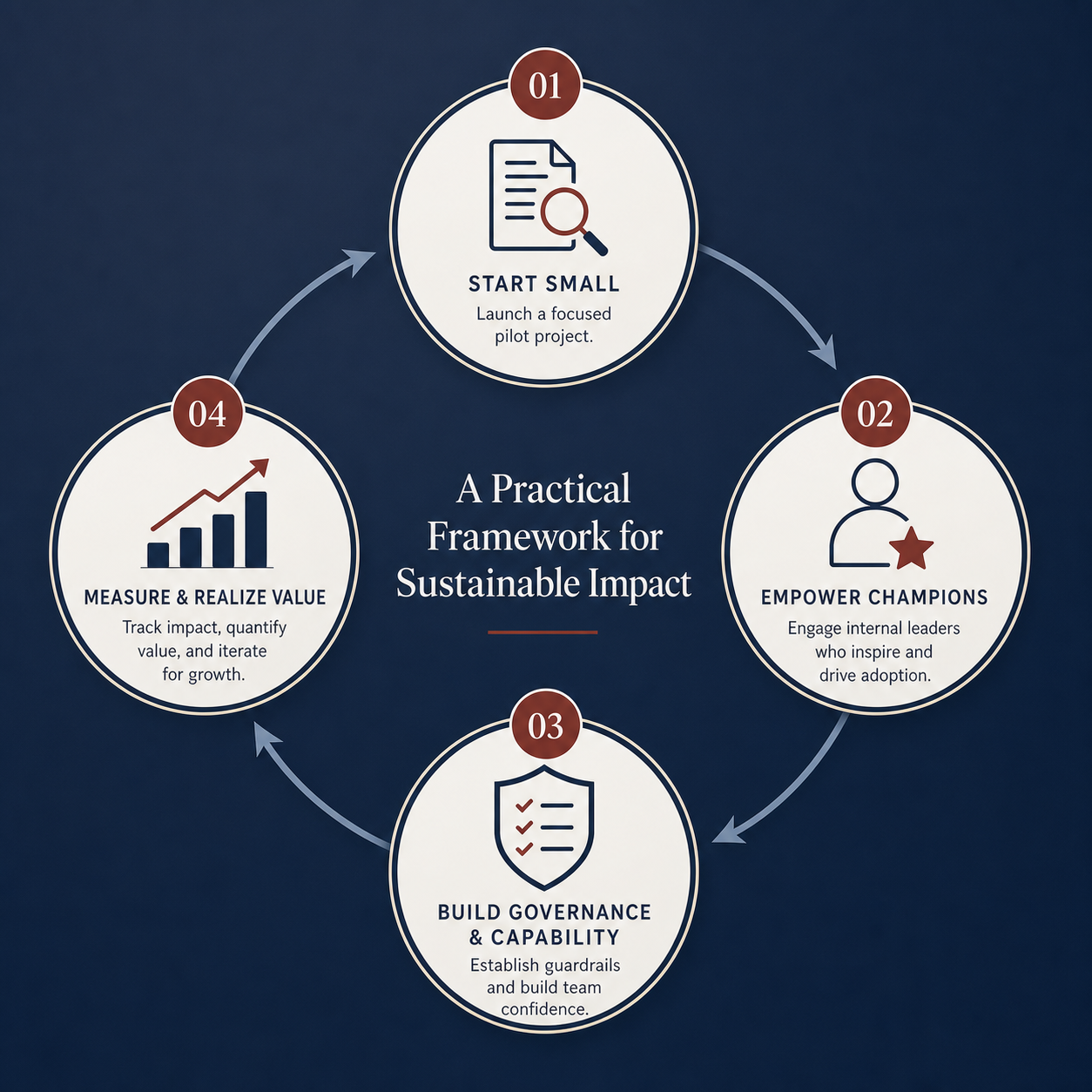
- Start with small, scoped pilots: Rather than rolling out AI firm-wide, leading firms identify a specific workflow — contract review, legal research, document drafting — and test one or two tools on a defined set of matters. This limits risk and generates concrete data on time savings, error rates, and user satisfaction.
- Appoint internal champions: Adoption succeeds when a trusted senior attorney or practice group leader owns the initiative, not when it is driven solely by IT or firm administration. Champions provide credibility, identify workflow-specific use cases, and model responsible use.
- Choose tools that match firm resources: A solo practitioner needs different tools than an Am Law 100 firm. The Clio Manage AI review on this site provides context on a platform popular among small firms, while the Harvey AI evaluation covers enterprise-grade considerations.
- Prioritize client privacy and data security: Before deploying any tool, firms must verify the vendor's data handling policies, training data opt-out provisions, and confidentiality guarantees. The Litify survey found that for 50% of respondents, confidentiality, quality, and privacy concerns are the top roadblocks to enterprise-wide AI adoption.
- Provide practical, role-specific training: Generic "AI awareness" sessions are insufficient. Training should cover how to prompt effectively for legal tasks, how to verify AI output (especially citations), and what to do when the AI produces an error. The 54% of firms that provide no training are not just missing an opportunity — they are creating liability.
- Create fast feedback loops: Firms that succeed treat AI adoption as an iterative process. They collect feedback from users weekly, track error rates, and adjust tool configurations, prompts, and workflows based on real usage data — not vendor promises.
The Attorney at Work framework emphasizes that AI accelerated routine work but did not replace legal judgment. The firms that succeed are those that treat AI as a tool to be managed, not a solution to be deployed.
Measuring What Matters: The ROI Blind Spot
Perhaps the most telling statistic in the readiness gap is this: only 18% of organizations collect any ROI metrics around their AI investments, according to the Thomson Reuters 2026 AI in Professional Services Report, as cited by the NC Bar Association. This means that more than four out of five firms using AI have no systematic way of knowing whether their investment is paying off.
For firms that do measure, the Thomson Reuters blog on AI ROI recommends tracking four categories of metrics:
| Metric Category | What to Measure | Why It Matters |
|---|---|---|
| Time savings | Hours saved per task or matter before and after AI adoption | Directly quantifies efficiency gain; feeds into capacity planning and pricing decisions |
| Error rates | Frequency of AI-generated errors caught during human review; number of corrections needed per document | Measures quality risk; informs training needs and tool selection |
| Client satisfaction | Client feedback on response times, document quality, and communication speed | Captures the quality-of-service improvement that AmLaw100 firms cite as their primary goal |
| Capacity utilization | Number of matters handled per attorney; billable vs. non-billable time allocation | Reveals whether reclaimed time is being reinvested or lost |
The Thomson Reuters blog emphasizes a "productivity multiplier effect" from AI, noting that 59% of law firms believe AI should be integrated into their work. But without measurement, firms cannot distinguish between genuine productivity gains and the illusion of efficiency. The blog recommends continuous measurement of time savings and client satisfaction, not just a one-time assessment.
For small firms, the measurement burden does not need to be complex. A simple spreadsheet tracking time per task type, error corrections, and client feedback over a 90-day pilot period provides enough data to make informed decisions about tool adoption, pricing adjustments, and training needs.
Closing the Readiness Gap: An Actionable Framework for Managing Partners
The data is clear: AI adoption in law firms has crossed the majority threshold, but organizational readiness has not. The firms that will capture the competitive advantage in the next 12–24 months are not necessarily those with the most advanced tools — they are the ones that close the readiness gap.
Here is a concrete, step-by-step framework for managing partners and compliance officers:
- Audit current AI use: Survey your attorneys and staff to find out which AI tools they are already using, for what tasks, and with what safeguards. The 8am data suggests that a significant portion of AI use in firms is informal and ungoverned. You cannot manage what you do not measure.
- Draft a written AI policy: Only 9% of firms have an enforced written policy. A basic policy should address: which tools are approved for client work, data confidentiality requirements (Model Rule 1.6), human review and verification requirements for all AI-generated output, and disclosure obligations to clients and courts. The EU AI Act deployer's guide on this site provides additional context for firms with international or EU clients.
- Implement tiered training: Move beyond generic AI awareness. Provide role-specific training for attorneys (prompt engineering for legal research, citation verification), paralegals (document review workflows), and administrative staff (data entry, scheduling). Include a module on professional responsibility obligations under Model Rule 1.1.
- Adjust pricing or capacity planning: If AI is reducing time per task, decide whether to shift to value-based billing, increase matter volume, or reinvest time into higher-value work. The 86% of solos who have not adjusted pricing are effectively discounting their services. This is not sustainable.
- Set up ROI tracking: Start with the simple four-category framework above. Track time savings, error rates, client satisfaction, and capacity utilization over a 90-day pilot. Use the data to make informed decisions about scaling, tool selection, and pricing.
- Establish a review cadence: AI tools and models are evolving rapidly. The global legal AI software market was valued at $2.75 billion in 2026 and is projected to reach $6.3 billion by 2034 (CAGR 10.91%), according to Straits Research. A policy written today may be outdated in six months. Schedule a quarterly review of your AI governance framework, tool portfolio, and ROI data.
Chronological incident history
No sanction cases have named this tool in the tracked record set to date. This does not imply the tool is safe — see Risk Digest for ongoing monitoring.
← Compare peer toolsReport a correction or tip
Spotted an outdated figure, a misstated fact, or a ruling this tool profile should reflect? Public comments are disabled for this content given the professional cost of a misreported case outcome, penalty amount, or rule text — use the structured correction channel instead.
Report a correction or tip for this record →