
Full profile
Executive Summary and Key Specifications
Luminance is a legal-grade AI platform purpose-built for contract review, analysis, and negotiation. Originally launched in 2015 as an M&A due diligence tool by a team of Cambridge mathematicians, the platform has expanded into a full-spectrum contract lifecycle system serving over 1,000 organizations across more than 70 countries. Its customer base includes all Big Four consultancy firms, over a quarter of the Global Top 100 law firms, and enterprises such as AMD, BBC Studios, Hitachi, and Liberty Mutual. The company raised a $75 million Series C in early 2025 led by Point72 Private Investments, bringing total funding to over $115 million. Luminance differentiates itself through a Mixture-of-Experts architecture called the Panel of Judges, a decade-deep legal training dataset, and a recently launched Institutional Memory feature that cuts across the contract lifecycle.
| Category | Detail |
|---|---|
| Primary use cases | M&A due diligence, high-volume contract review, multi-jurisdiction analysis, enterprise compliance monitoring |
| Product modules | Draft, Negotiate, Analyze, Comply, Investigate, Collaborate |
| Underlying model | Panel of Judges Mixture-of-Experts (generative, embedding, reasoning LLMs with orchestration layer) |
| Deployment | Cloud-hosted on AWS (single-tenant instances) |
| Security certifications | ISO 27001:2022, SOC 2 Type II |
| Pricing model | Undisclosed enterprise pricing; implementation 2–6 weeks |
| Target audience | Law firms, in-house legal departments, legal ops teams (mid-market to enterprise) |
| Last reviewed | 2026-06-11 |
Company Background and Funding Trajectory
Luminance was founded in 2015 by AI researchers from the University of Cambridge. Initially focused on M&A due diligence, the product rapidly gained traction in law firms handling large-scale document reviews. The company's growth accelerated through multiple funding rounds, culminating in a $75 million Series C in early 2025 led by Point72 Private Investments, with participation from Forestay Capital, RPS Ventures, Schroders Capital, and others. Including prior rounds, Luminance has raised over $115 million in the past 12 months. According to the company's January 2026 press release, global revenue doubled in 2025 for the second consecutive year, and North American revenue grew 127% year-over-year, including an eight-figure enterprise deal. Headcount grew 80% across 2024, with significant expansion in the US market.
- 2025 Series C: $75M led by Point72 Private Investments
- Total raised in last 12 months: over $115M
- Global revenue doubled in 2025 for second consecutive year
- North America grew 127% year-over-year (January 2026)
- Headcount grew 40%+ in 2025 across UK, Europe, Australia, and US
The Series C also marked a strategic shift: Luminance moved beyond its due diligence roots to offer a complete platform for the contract lifecycle. CEO Eleanor Lightbody noted that 40% of revenue is now generated in the US. For broader context on legal AI investment trends, see the Legal AI Startup Funding Rounds and Acquisitions tracker.
Product Modules: Full Lifecycle Coverage
Luminance now offers six integrated modules that span the entire contract lifecycle, from drafting to post-execution compliance monitoring. The modules are designed to share a common data layer and AI engine, allowing information to flow seamlessly across functions.
| Module | Capabilities |
|---|---|
| Draft | Generates contract clauses from templates and negotiation history; suggests alternative language based on organizational playbooks. |
| Negotiate | AI instantly marks up contracts, redrafts risky or non-standard clauses, and provides acceptable alternatives within Microsoft Word. Includes step-by-step Checklists and Ask Lumi chatbot for summaries. |
| Analyze | Core contract review engine for due diligence, compliance checks, and anomaly detection. Identifies over 1,000 different concepts and flags deviations from legal standards. |
| Comply | Automates compliance workflows by checking internal policies against regulations and sanction lists. Real-time dashboard shows exposure across active contracts; failed checks trigger automated investigations. |
| Investigate | Designed for internal investigations, litigation support, and e-discovery. Uses AI agents to search, filter, and correlate contract data. |
| Collaborate | Allows deal teams to share workspaces, assign tasks, and track redlines in a unified environment. |
A standout feature is Lumi Go, an auto-negotiation capability launched in December 2024. Lumi Go enables users to send draft agreements to a counterparty, who receives a lightweight version of Luminance within Microsoft Word. The AI provides real-time feedback on whether proposed changes are likely to be accepted and drafts alternative language with one-click insertion. This capability effectively extends Luminance's reach beyond the legal department into direct negotiations.
The compliance module, launched in 2025, is particularly relevant for in-house teams. It uses AI agents to automatically check contracts against internal policies and external sources such as regulations and sanction lists. Failed checks are investigated and escalated with notifications and prioritized task lists, turning static compliance into an active workflow.
Technology Architecture: Panel of Judges and Institutional Memory
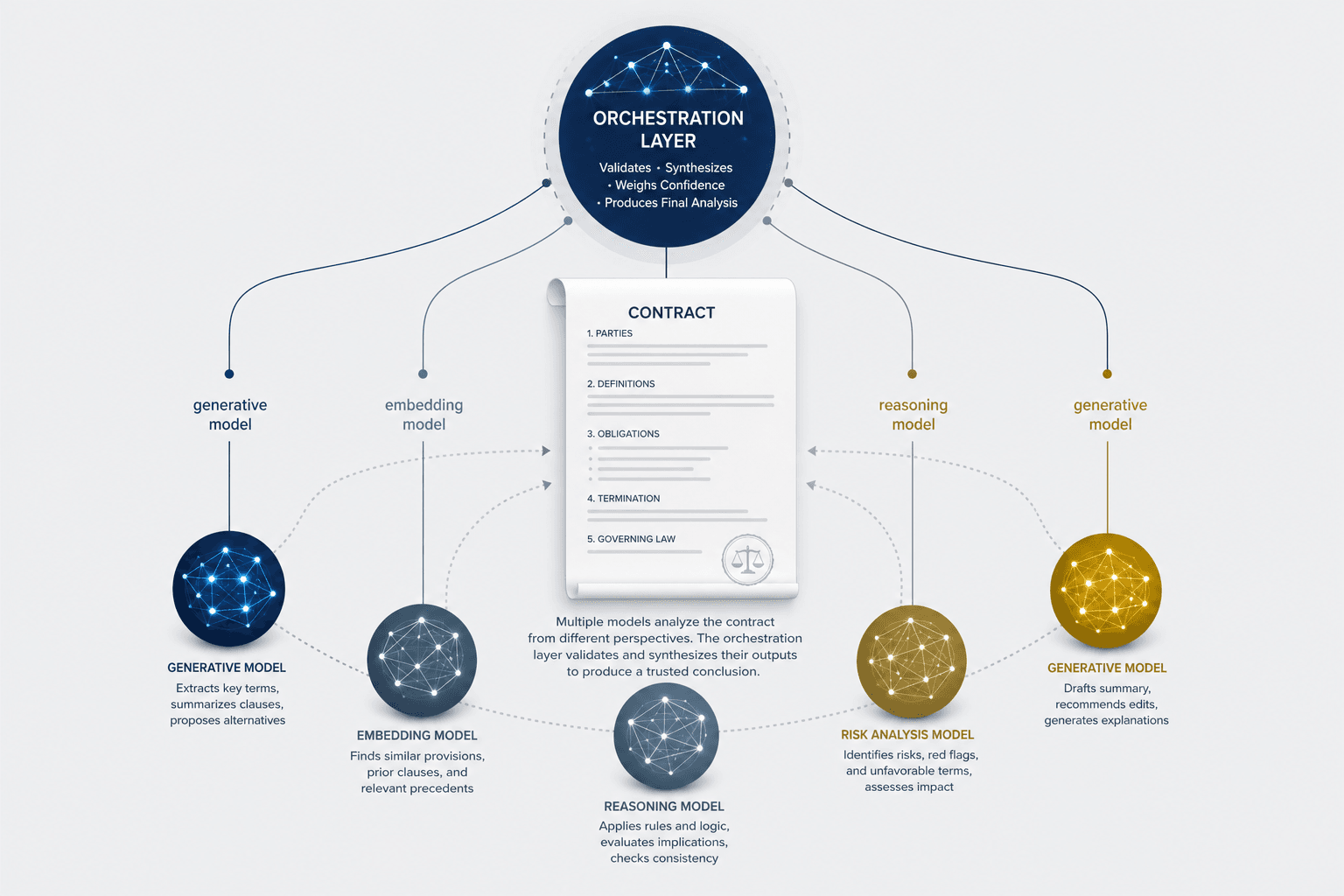
Luminance's core differentiator is its Panel of Judges architecture — a Mixture-of-Experts (MoE) approach that combines several types of AI models rather than relying on a single large language model. The panel includes proprietary fine-tuned models, open-source models, embedding models, and advanced reasoning models. An orchestration layer acts as the "supreme judge," synthesizing outputs from the specialist models and validating results against Luminance's proprietary legal dataset.
Under the hood, Agentic AI sub-agents operate in parallel for reading, reasoning, and acting. Each sub-agent has constrained scope and a supervisor agent that ensures audibility and alignment with legal standards. The system has been exposed to hundreds of millions of legally verified documents collected over a decade of real-world use with top law firms, allowing Luminance to benchmark new models against its proprietary dataset as soon as they are released. This specialization process can be completed in days via fine-tuning.
In January 2026, Luminance launched Institutional Memory, a capability that stores and retrieves negotiation history, organizational preferences, and legal standards across the entire contract portfolio. This addresses what the company calls "enterprise amnesia" — the common problem where contract data, negotiation tactics, and compliance knowledge are siloed across departments and lost over time. The feature incorporates both short-term and long-term memory, allowing the AI to recall specific clause histories and apply institutional knowledge to new drafts. Luminance claims that with Institutional Memory, legal teams can reclaim over 30% of their time, though this figure is vendor-reported.
Security and Data Privacy Posture
For legal professionals evaluating any AI tool, data confidentiality and security are paramount, particularly under Model Rule 1.6 (confidentiality of information). Luminance has invested in a security framework that includes both certifications and governance structures.
- ISO 27001:2022 certified — the international standard for information security management.
- SOC 2 Type II examination completed — an independent audit of controls over security, availability, and confidentiality.
- Data encrypted with AES-256 at rest and TLS 1.2+ in transit; master encryption keys rotated regularly.
- Hosted on AWS in single-tenant instances — each customer's data is isolated from others.
- Regular penetration testing by independent third parties.
- Security Advisory Board includes former MI5 Director General Jonathan Evans, Darktrace founding CTO Jack Stockdale, and former Darktrace CPO David Palmer.
- Uses Darktrace's Enterprise Immune System for real-time threat detection.
This posture supports enterprise-grade confidentiality requirements, making Luminance a plausible option for firms handling sensitive M&A data or cross-border transactions. However, firms should independently verify data handling terms and confirm whether the vendor offers options for data residency or additional contractual protections.
Target Use Cases and Customer Base
Luminance's primary use cases cluster around high-volume, high-stakes contract analysis. The platform is strongest in:
- M&A due diligence – reviewing thousands of contracts in a deal context, flagging anomalies and risks.
- High-volume contract review – for organizations processing 2,500+ contracts annually, where 63% average time savings have been reported (per Dan Cumberland Labs independent data).
- Complex multi-jurisdiction analysis – supporting over 80 languages across 43 countries.
- Enterprise compliance monitoring – automated checks against regulations and sanction lists.
- Large-scale litigation support and internal investigations.
Notable customers span both law firms and corporate legal departments. On the law firm side, clients include Slaughter and May, White & Case, Holland & Knight, and over a quarter of the Global Top 100 law firms. In-house teams include AMD, BBC Studios, Hitachi, Liberty Mutual, Koch Industries, LG Chem, SiriusXM, Rolls-Royce, Lamborghini, and all Big Four consultancy firms. Luminance reports that over 18 million contracts were analyzed across jurisdictions in the 12 months leading to January 2026.
Competitive Positioning: Luminance vs. Six Key Rivals
Luminance competes in a crowded AI contract review market. The table below compares it against six major alternatives across dimensions that matter to procurement decisions. Note that Luminance does not disclose pricing publicly, so estimates are drawn from third-party vendor comparisons (primarily Dan Cumberland Labs and competitor publications).
| Criterion | Luminance | LegalOn | Harvey | Kira | Ironclad | Spellbook | Robin AI |
|---|---|---|---|---|---|---|---|
| Primary use case | M&A, complex review, compliance; full lifecycle | Day-1 contract review, redlining | Am Law 100 generalist legal AI (research, drafting, review) | Due diligence, clause extraction (1,400+ clause models) | Full CLM platform with AI assistant (Jurist) | Drafting-focused, solo/small firm, Word plugin | Contract review and negotiation for mid-market |
| Pricing model | Undisclosed enterprise | $3,000–$8,000/year per user | Enterprise, undisclosed | Annual subscription, custom | Custom enterprise (implementation 2–9 months) | $500–$2,000/year per user (estimate) | Subscription, undisclosed |
| Implementation timeline | 2–6 weeks | Day-1 deployment | 2–4 weeks | 2–6 weeks | 2–9 months | 1–2 weeks | 2–4 weeks |
| Data privacy posture | ISO 27001, SOC 2 Type II, single-tenant AWS | ISO 27001, SOC 2, data encryption | ISO 27001, SOC 2, enterprise controls | SOC 2, encryption at rest/transit | SOC 2, data encryption, GDPR compliant | SOC 2, data encryption | SOC 2, data encryption |
| Best-fit firm size | Mid-market to enterprise (high-volume, complex deals) | Mid-market to enterprise | Large law firms / corporate legal departments | Mid-market to enterprise | Enterprise (full CLM adoption) | Solo/small firm | Mid-market |
For more detailed profiles of key competitors, see the independent evaluations of Harvey AI, Spellbook, Ironclad Jurist, and the Ironclad CLM platform.
Reported Performance Metrics and Independent Data
Performance claims in the legal AI space should be treated with care. Below is a summary of metrics attributed to Luminance, with clear source identification.
| Metric | Claimed Value | Source | Caveat |
|---|---|---|---|
| Time saved on contract review | 90% | Luminance website (vendor-reported) | Not independently verified |
| Contract management cost reduction | 98% | Luminance website (vendor-reported) | Not independently verified |
| Time saved on contract generation | 500+ hours | Luminance website (vendor-reported) | Not independently verified; no context on contract volume |
| Time saved on due diligence (historic) | 85%+ | Artificial Lawyer survey of 24 customers (2019) | Small sample; product has evolved; engagement-level dependency |
| Average time savings (organizations processing 2,500+ contracts/year) | 63% | Dan Cumberland Labs (independent study of multiple tools) | Aggregate across platforms; not Luminance-specific |
| Gartner Peer Insights rating | 4.6/5.0 (31 reviews) | Gartner (aggregated user reviews) | Login required to view individual reviews; small sample size |
| Revenue growth (global, 2025) | Doubled year-over-year | Luminance press release (January 2026) | Not audited; second consecutive year |
| North America growth (2025) | 127% year-over-year | Luminance press release (January 2026) | Not audited |
Strengths, Limitations, and Best-Fit Scenarios
Luminance occupies a clear niche in the legal AI market, but its suitability depends heavily on an organization's contract volume, deal complexity, and budget.
- Strengths: Decade-deep legal dataset with exposure to hundreds of millions of verified documents; multi-model architecture reduces reliance on any single LLM; institutional memory addresses knowledge fragmentation across contract lifecycles; strong security certifications (ISO 27001, SOC 2 Type II) and mature governance structures; adoption by Big Four and Global Top 100 law firms signals enterprise credibility; full lifecycle coverage reduces tool stacking.
- Limitations: Pricing is not publicly disclosed, making it difficult for small or mid-sized firms to budget; implementation requires a 2–6 week onboarding and training investment; the platform's heritage in M&A can be overkill for routine contract review; independent performance data is outdated (2019 survey) or absent (no recent peer-reviewed benchmark); headcount and revenue data vary by source, creating uncertainty about actual organizational scale.
Best-fit scenarios: Luminance is most valuable for organizations that handle large volumes of complex, multi-jurisdiction contracts — particularly M&A teams, in-house legal departments at large multinationals, and law firms with dedicated due diligence practices. For these users, the combination of anomaly detection, language support, and compliance monitoring can justify the undisclosed investment.
Scenarios where alternatives may be better: LegalOn offers day-1 deployment at a known price point and is better suited for firms that need immediate productivity gains without lengthy onboarding. Spellbook is lighter and cheaper for solo and small firm drafting. Ironclad provides a full CLM environment with broader workflow automation but at longer implementation timelines. Harvey targets Am Law 100 firms with a generalist AI that spans research, drafting, and review, but lacks Luminance's depth in contract-specific tasks.
Readers interested in a narrower analysis of Luminance's deployment model and data retention may also consult the existing Luminance AI Contract Review: A Practitioner's Evaluation for a complementary perspective.
Pricing Model and Implementation Timelines
According to multiple independent reviews, Luminance's implementation timeline for the review platform is 2 to 6 weeks, depending on integration complexity. The company provides comprehensive onboarding including a dedicated Account Manager. For the full CLM suite, timelines may extend depending on deployment scope.
| Tool | Pricing Model | Implementation Timeline | Transparency |
|---|---|---|---|
| Luminance | Undisclosed enterprise (contact vendor) | 2–6 weeks | Opaque |
| LegalOn | $3,000–$8,000/year per user | Day-1 deployment | Transparent |
| Kira | Annual subscription, custom | 2–6 weeks | Semi-transparent (custom quote) |
| Ironclad | Custom enterprise | 2–9 months | Opaque |
| Spellbook | ~$500–$2,000/year per user (estimate) | 1–2 weeks | Semi-transparent |
| Harvey | Enterprise, undisclosed | 2–4 weeks | Opaque |
The absence of transparent pricing is a significant barrier for small firms and solo practitioners. Luminance explicitly targets enterprise clients, and its go-to-market strategy appears to rely on tailored negotiations rather than fixed tier structures. For teams with annual contract volumes below 500, a tool with transparent pricing like LegalOn or Spellbook may be more appropriate.
For a deeper look at how to plan and execute an AI contract review implementation, including change management and integration steps, see the AI Contract Review Workflow Implementation: A Phased Roadmap for Legal Teams.
Comments
Join the discussion with an anonymous comment.