
Luminance Legal AI Deep Dive: Panel of Judges Architecture, Pricing, and Who It Actually Serves
A critical decision framework for in-house counsel, law firm partners, and legal ops leaders evaluating Luminance in 2026 — covering its proprietary multi-model architecture, product modules, estimated enterprise pricing, competitive positioning, and the specific use cases where it delivers ROI versus where it is overkill.
- Hallucination rate
- Not measured / undisclosed
Executive Summary: The Luminance Paradox
Luminance occupies an unusual position in the 2026 legal AI market. Its proprietary "Panel of Judges" architecture — a multi-model Mixture of Experts approach that uses probabilistic consensus across several large language models — is genuinely differentiated from the single-model tools that dominate the rest of the field. The company has raised more than $115 million over the past 12 months, counts all four Big Four consultancies and over a quarter of the Global Top 100 law firms as customers, and reports ROI metrics that would make any legal operations director pause: 90% time savings on contract review, 98% reduction in contract management costs, and 500-plus hours saved on contract generation.
Yet those same strengths create a sharp boundary around who should actually buy the platform. Luminance does not publish pricing, but independent market analysis from Bind Legal estimates a first-year total cost of ownership ranging from $150,000 to $500,000 or more — placing it in the same tier as Icertis and at the upper end of the enterprise CLM market. The platform is designed for high-volume M&A due diligence, global contract portfolio management, and the kind of recurring document work that characterizes large law firms and multinational legal departments. For solo practitioners, small firms, or teams whose contract volume does not justify a six-figure annual investment, Luminance is almost certainly the wrong tool.
Company Background: From Cambridge Spin-Out to $115M+ Funded Powerhouse
Luminance was founded in 2015 by artificial intelligence researchers from the University of Cambridge. The company's early development was shaped by a partnership with Slaughter and May, the elite London law firm that became an early backer and helped train the platform's models on real legal workflows. That origin story matters: unlike general-purpose LLMs retrofitted for legal tasks, Luminance's core technology was built from the ground up for contract analysis.
The company's financial trajectory accelerated sharply in early 2025. On February 19, 2025, Luminance announced a $75 million Series C funding round led by Point72 Private Investments, with participation from Forestay Capital, RPS Ventures, Schroders Capital, and existing investors including March Capital, National Grid Partners, and Slaughter and May. The Global Legal Post reported that this round brought total funding to more than $115 million over the preceding 12 months, making it one of the largest capital raises by a pure-play legal AI company in the UK and Europe.
CEO Eleanor Lightbody, previously a Director at the cybersecurity firm Darktrace, has led the company through this growth phase. In comments to the Global Legal Post, she noted that 40% of Luminance's revenue is already generated in the United States, signaling the company's ambition to compete directly with US-based legal AI vendors. The company has been recognized on Forbes' AI 50 List and the Inc. 5000.
- Founded: 2015 by Cambridge AI researchers
- Series C: $75M (February 2025), led by Point72 Private Investments
- Total funding: $115M+ over 12 months
- Early backer: Slaughter and May
- CEO: Eleanor Lightbody (former Darktrace Director)
- Revenue split: 40% from US market
Core Technology: How the Panel of Judges Architecture Works
The most distinctive element of Luminance's technology stack is the "Panel of Judges" — a proprietary Mixture of Experts architecture that combines multiple large language models through a probabilistic consensus mechanism. Rather than relying on a single model to analyze a contract, Luminance runs the document through several models simultaneously, compares their outputs, and selects the result that commands the highest agreement across the panel. The company describes this approach as ensuring "Legal-Grade™ accuracy" on its homepage.
This multi-model strategy stands in direct contrast to tools like Harvey and Spellbook, which typically rely on a single underlying LLM (often a fine-tuned version of GPT-4 or a similar foundation model). The Panel of Judges approach is designed to reduce the hallucination risk that plagues single-model systems: if one model generates an anomalous output, the other models in the panel can overrule it through the consensus mechanism.
The models are trained on a corpus of more than 150 million legally verified documents, according to the company's about page and the Global Legal Post report. This training data includes contracts, regulatory filings, and legal precedents — not general web text. The company's Co-Founder and Director of AI, Dr. Graham Sills, who holds a PhD from Cambridge, devised the core algorithms and much of the mathematics behind the platform's AI.
Product Modules: Draft, Negotiate, Analyze, Comply, Investigate, Collaborate
Luminance organizes its capabilities into six product modules, each addressing a distinct phase of the contract lifecycle. The platform's homepage and product pages describe these modules as covering the full spectrum from initial drafting through post-execution compliance monitoring.
- Draft: AI-powered contract generation from pre-approved templates. Luminance's own legal team used this module to keep over 90% of contract work in-house, according to a techUK case study. Powerful for enterprise template generation but overkill for a solo practitioner who drafts a handful of contracts per month.
- Negotiate (Lumi Go): The most differentiated module. Lumi Go, launched in December 2024, enables automated contract negotiation within Microsoft Word. A counterparty receives a "lite" version of Luminance and gets real-time feedback on whether proposed changes are likely to be accepted. The AI can draft alternative language with a high probability of approval. Artificial Lawyer described it as "not full 'auto-negotiation'" but "a fast review tool that engages both parties by leveraging a playbook." No major competitor has matched this capability at scale.
- Analyze: The core contract review engine. Flags non-standard clauses, suggests compliant alternatives, and integrates directly with Microsoft Word. The platform claims it can review an 80-page MSA in under five minutes. Best suited for high-volume due diligence projects, not one-off contract checks.
- Comply: Monitors evolving regulatory standards, identifies exposure, and provides an auditable compliance trail globally. Relevant for multinational corporations managing cross-jurisdictional compliance obligations. Less relevant for firms operating in a single jurisdiction.
- Investigate: Designed for internal investigations and litigation support. Enables rapid search and analysis across large document sets. An additional-cost module estimated at $25,000 to $75,000 per year.
- Collaborate: A repository and workflow layer that allows legal teams to extract key data for reports in minutes rather than hours, as documented in the techUK case study. The Ask Lumi chatbot enables teams to obtain immediate answers, redraft clauses, and generate middle-ground wording.
Customer Base and Market Position: Who Actually Uses Luminance
Luminance's customer metrics tell a clear story about who the platform is built for. As of 2026, the company reports more than 1,000 organizations across 70 countries using its platform. This represents significant growth from the 700-plus organizations cited in the February 2025 Global Legal Post article and the 500-plus in 60 countries from a 2022 press release.
The customer composition reinforces the enterprise-only positioning:
- All four Big Four consultancy firms (Deloitte, PwC, EY, KPMG)
- Over a quarter of the Global Top 100 law firms, including White & Case, Clifford Chance, and Clyde & Co
- Named enterprise clients: AMD, BBC Studios, Hitachi, Liberty Mutual, Koch Industries, LG Chem, SiriusXM, Rolls-Royce, Lamborghini
- Slaughter and May, the firm that helped develop the platform, remains a customer
This customer profile confirms that Luminance is optimized for organizations with recurring high-volume contract work, multinational operations, and the budget to support a six-figure annual investment. The platform's value proposition scales with document volume: the more contracts an organization processes, the more compelling the ROI math becomes.
Pricing Analysis: The $150K–$500K+ First-Year TCO Reality
Luminance does not publish pricing on its website. This opacity is common among enterprise-tier legal AI vendors, but it creates a significant barrier for prospective buyers who cannot evaluate the platform without committing to a sales process that Bind Legal describes as taking "several weeks."
Bind Legal's market analysis, published March 2026, provides the most detailed independent estimate of Luminance's cost structure. The figures below are market-positioning estimates, not official quotes, but they are consistent with the pricing reported by ToolsForHumans and LegalOnTech.
| Cost Component | Estimated Range | Notes |
|---|---|---|
| Base platform (annual) | $100,000 – $200,000 | Core contract review and analysis |
| Per-user fees (monthly) | $50 – $150/user | Scales with team size |
| Investigate module (annual) | $25,000 – $75,000 | Additional cost |
| Comply module (annual) | $25,000 – $75,000 | Additional cost |
| Implementation (one-time) | $30,000 – $100,000 | Includes onboarding and configuration |
| Mid-market first-year TCO | $150,000 – $300,000 | Typical for firms with 50-200 users |
| Enterprise first-year TCO | $300,000 – $500,000+ | Typical for Global 2000 organizations |
For context, Bind Legal's comparison table lists alternatives at significantly lower price points: SpotDraft ($10,000–$30,000/year), ContractSafe ($5,400–$9,800/year), and Ironclad ($30,000–$100,000+/year). Even Ironclad, which is itself an enterprise CLM platform, starts well below Luminance's estimated base platform cost. The pricing gap is not marginal — it is structural.
The implementation timeline is another hidden cost. LegalOnTech's evaluation notes a setup time of 2–6 weeks for Luminance, compared to "Day 1" for LegalOn and 2–9 months for Ironclad. While Luminance's setup is faster than some CLM platforms, the implementation cost ($30,000–$100,000 one-time) adds to the first-year burden. For a detailed discussion of implementation timelines and change management requirements, see our AI contract review implementation roadmap.
Key Differentiators vs. Harvey, Ironclad, Spellbook, and LegalOn
Luminance competes in a crowded field of legal AI tools, but it occupies a distinct niche. LegalOnTech's July 2025 independent evaluation ranked Luminance #3 overall with a score of 86/100, rating it "Best for M&A" as a "Due diligence specialist." The evaluation methodology was based on over 100 customer testimonials and comprehensive feature analysis, though the authors note that "metrics are self-reported without independent verification."
The table below compares Luminance to its primary competitors across the dimensions that matter most for procurement decisions.
| Dimension | Luminance | Harvey | Ironclad | Spellbook | LegalOn |
|---|---|---|---|---|---|
| Architecture | Multi-model (Panel of Judges) | Single-model (fine-tuned GPT-4) | CLM + AI layer | Single-model (GPT-4) | Single-model (proprietary) |
| Primary strength | Pattern recognition / unsupervised learning | Legal research & drafting | Contract lifecycle management | Document drafting | Contract review (speed) |
| Ideal use case | M&A due diligence, global contract portfolios | Litigation support, legal research | End-to-end CLM workflow | Drafting from prompts | High-volume standard contracts |
| Setup time | 2–6 weeks | 2–6 months | 2–9 months | Days to weeks | Day 1 |
| Price level | $$$ (enterprise) | $$$ (enterprise) | $$ (mid-to-high) | $$ (mid-range) | $ (accessible) |
| LegalOnTech score | 86/100 | 88/100 | 76/100 | Not ranked | 92/100 |
| Best for | M&A due diligence | Legal research | CLM workflow | Drafting | Routine contract review |
The key takeaway from this comparison is that Luminance wins on unsupervised pattern recognition and M&A-scale document processing, but loses on accessibility, setup speed, and price. LegalOn's 92/100 score and "Day 1" setup reflect a fundamentally different product philosophy: LegalOn is designed for immediate value with minimal configuration, while Luminance requires investment in both time and money before delivering returns.
The comparison with Ironclad is particularly instructive. Ironclad is a CLM platform with an AI layer, while Luminance is an AI analysis platform that can integrate with CLM systems. They are not direct substitutes — they serve different primary functions. For a detailed comparison of these two platforms, see our Ironclad CLM review and our broader contract review software comparison guide.
Security Posture: ISO 27001, SOC 2, and the MI5 Connection
For enterprise buyers, security certifications are not optional — they are table stakes. Luminance's security posture is robust and well-documented, which is consistent with its target market of large law firms and multinational corporations.
- ISO 27001:2022 certified: The current version of the international standard for information security management systems.
- SOC 2 Type 2 completed: Assesses controls for security, availability, and confidentiality over an extended period.
- AWS single-tenant hosting: Dedicated instances ensure complete data isolation with no co-mingling of customer data.
- Encryption: AES-256 bit keys for data at rest, TLS 1.2 or higher for data in transit.
- AI-based threat detection: Uses Darktrace's Enterprise Immune System for real-time network monitoring.
The Security Advisory Board adds a layer of credibility that few legal AI vendors can match. It includes Jonathan Evans, former Director General of MI5 (2007–2013); Jack Stockdale, founding CTO at Darktrace; and David Palmer, former Chief Product Officer at Darktrace with 19 years at GCHQ and MI5. This level of security governance is appropriate for organizations handling sensitive M&A data and regulated contracts, but it also reinforces the enterprise-only positioning — smaller firms do not need this level of infrastructure and should not pay for it.
Ideal Use Cases and Skip-If Scenarios
The following decision framework is adapted from ToolsForHumans' independent review (4.0/5 rating, last reviewed March 2026) and supplemented with data from LegalOnTech's evaluation and Bind Legal's pricing analysis. It is designed to help legal leaders determine whether Luminance is the right investment for their organization.
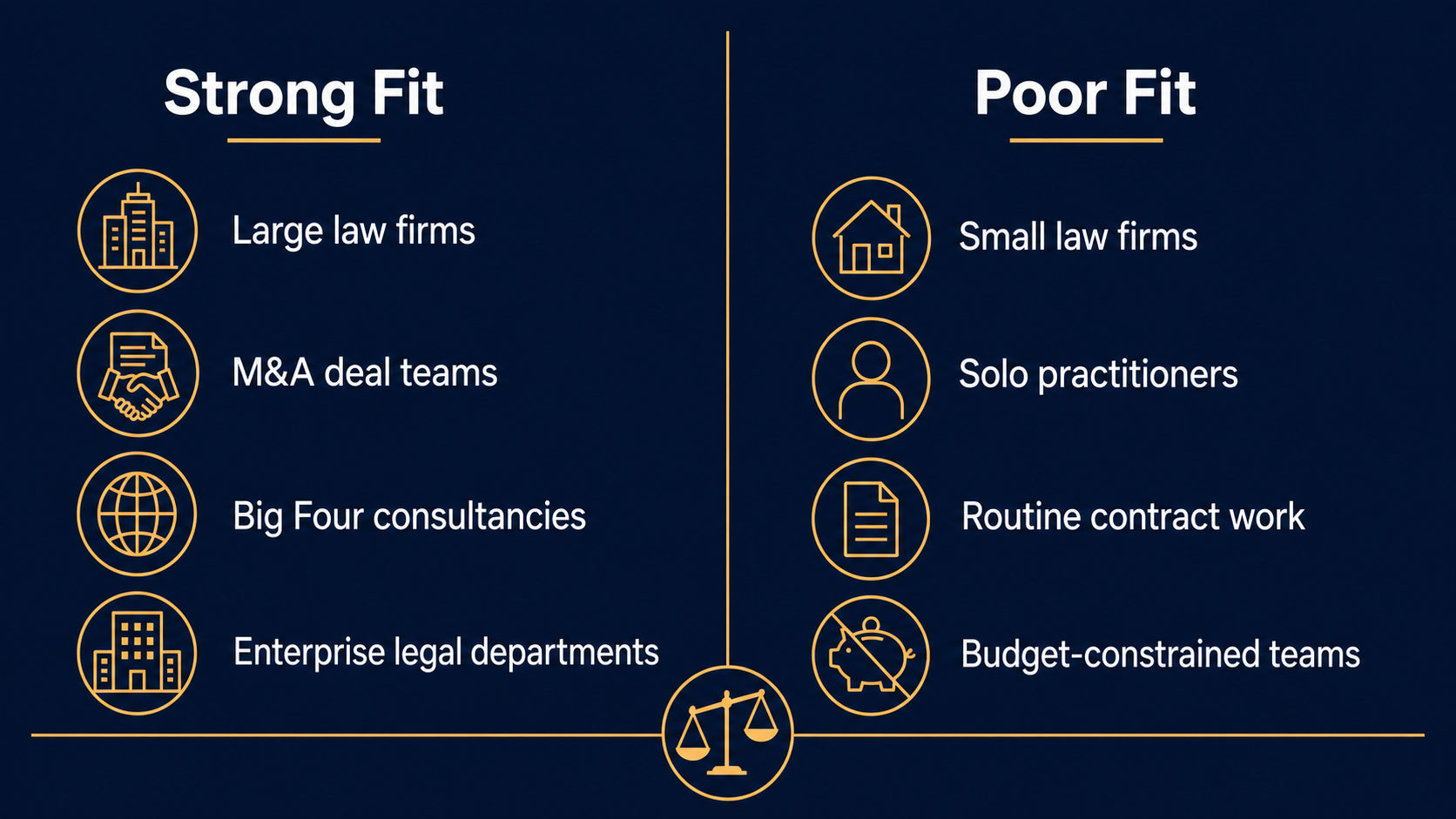
Strong Fit
- M&A deal teams: Luminance's unsupervised learning can find unknown risks in large document sets — a capability that LegalOnTech identifies as its core strength. Teams handling 10,000+ document due diligence projects will see the fastest ROI.
- Global contract portfolio managers: Organizations managing contracts across multiple jurisdictions and languages benefit from the platform's 80-language support and compliance monitoring capabilities.
- Big Four consultancies and Am Law 100 firms: These organizations have the contract volume, budget, and security requirements that align with Luminance's pricing and infrastructure.
- Enterprise legal departments with 50+ users: The per-user pricing model becomes more economical at scale, and the platform's collaboration features deliver measurable efficiency gains for large teams.
Poor Fit
- Small firms and solo practitioners: The minimum $150,000 first-year investment is prohibitive for firms that handle fewer than 500 contracts per year. ToolsForHumans explicitly states: "Skip if you're a smaller firm without recurring high-volume contract work."
- Routine low-volume contract review: LegalOnTech notes that Luminance is "overkill for routine contracts" and "requires document volume for ROI." Organizations reviewing a handful of contracts per week will not see a positive return.
- Budget-constrained teams: With alternatives like LegalOn (setup: Day 1, price: $) and SpotDraft ($10K–$30K/year) available, teams with limited budgets should look elsewhere.
- Organizations needing a full CLM suite: Luminance is an AI analysis platform, not a CLM. Organizations that need end-to-end contract lifecycle management — including e-signature, obligation tracking, and workflow automation — should evaluate Ironclad or ContractPodAi instead.
Verdict: A Serious Enterprise Tool for Serious Enterprise Legal Work
Luminance's Panel of Judges architecture, its decade of in-market refinement since 2015, and its $115 million-plus funding position make it one of the most technically sophisticated legal AI platforms available in 2026. The company's customer roster — all four Big Four firms, over a quarter of the Global Top 100 law firms, and marquee enterprise clients like AMD, Hitachi, and Liberty Mutual — confirms that the platform delivers measurable value for organizations that fit its target profile.
But the same factors that make Luminance powerful for large enterprises also make it a poor fit for most legal professionals. The estimated $150,000 to $500,000-plus first-year total cost of ownership places it in a pricing tier that excludes small firms, solo practitioners, and budget-constrained teams entirely. The M&A-centric design means that organizations handling routine contract work will pay for capabilities they do not need. The opaque pricing and multi-week sales process create friction that smaller buyers cannot afford.
The decision framework is straightforward: if your organization handles high-volume M&A due diligence, manages a global contract portfolio, and has a budget that can absorb a six-figure annual investment, Luminance deserves serious consideration. If you are a small firm, a solo practitioner, or a team with routine contract volume, the ROI math simply does not work — and there are excellent alternatives at a fraction of the cost.
Chronological incident history
No sanction cases have named this tool in the tracked record set to date. This does not imply the tool is safe — see Risk Digest for ongoing monitoring.
← Compare peer toolsReport a correction or tip
Spotted an outdated figure, a misstated fact, or a ruling this tool profile should reflect? Public comments are disabled for this content given the professional cost of a misreported case outcome, penalty amount, or rule text — use the structured correction channel instead.
Report a correction or tip for this record →