
What to Ask a San Jose Bicycle Accident Lawyer
Before signing a retainer, San Jose bicycle accident claimants should verify how a prospective lawyer checks citations and supervises AI-assisted work. This checklist maps the California and N.D. Cal. sanction record to the questions worth asking, and the red flags that justify walking away.
This is general information for people comparing lawyers, not legal advice about your crash, filing deadline, settlement value, or litigation strategy. If you were hurt in a bicycle crash in San Jose, ask a California lawyer to confirm the deadlines and facts that apply to your own claim before you rely on any checklist.
The point of asking a San Jose bicycle accident lawyer questions before signing a retainer is not only to find out whether the firm handles bike crashes. It is also to find out how the firm protects your file from preventable filing mistakes. As of Q3 2026, that includes a question many injured clients were never taught to ask: who checks the citations, authorities, and AI-assisted work before anything is filed in court?

There is no public sanction record in the materials reviewed here involving a San Jose bicycle accident filing specifically. The reason this matters to a San Jose claimant is jurisdictional and practical: San Jose injury cases may be handled under California law, and some disputes can land in the Northern District of California. California courts and federal courts that may matter to San Jose cases have already treated unverified AI-generated legal work as a real professional problem, not a harmless drafting quirk.
Before the retainer: add verification to the usual lawyer questions
Most bicycle-crash consultations already cover fees, insurance communications, medical treatment, liens, liability disputes, and who will answer your calls. Those are still necessary. A cyclist who is missing work or staring at hospital bills should not skip the ordinary basics.
But a polished intake call does not tell you how a brief gets checked. It does not tell you whether a junior lawyer, contract writer, paralegal, or AI tool drafted a filing. It does not tell you whether the signing lawyer opened the actual statute, rule, case, or court order before submitting it. Those details are invisible to a client until something goes wrong.
That is why the retainer stage matters. Before you sign, you still have leverage to ask for process, not just reassurance. The broader lawyer-vetting context belongs in a conventional California personal-injury review, such as this California injury-lawyer directory and AI-risk checklist. This article narrows the lens to one file-handling signal that has become measurable: citation verification and AI supervision.
Why citation-checking is now a hiring signal
In Noland v. Land of the Free, L.P., the California Court of Appeal said 21 of 23 quotations in an opening brief were fabricated, imposed a $10,000 sanction, and referred counsel to the State Bar of California. That is the sort of record that turns “do you check citations against the primary source?” from a technical question into an ordinary quality-control question for any client whose case may depend on written advocacy.[1]
Lacey v. State Farm adds a different warning. Reporting on the Southern District of California matter described a $31,100 sanction for “bogus AI-generated research,” and quoted Judge Mark C. Wilner’s statement that “no reasonably competent attorney should out-source research and writing” to artificial intelligence.[2] That criticism matters because it cuts off the easy excuse that AI was merely used to help draft. Drafting still has to be supervised.
The Webb matter in the Northern District of California makes supervision even more concrete. Reuters reported that a supervising attorney was ordered to pay a $1,001 fine and complete AI-ethics training after a subordinate submitted a filing with a false citation.[3] For a prospective client, the lesson is not that every firm using AI is careless. The lesson is that the person who signs or supervises the work must own the verification process.
Professional guidance points in the same direction. ABA Formal Opinion 512, issued July 29, 2024, discusses lawyers’ duties involving competence, communication, confidentiality, fees, and supervision when using generative AI, including the need to independently verify AI output.[4] California’s own ethics and technology resources include generative-AI practical guidance, originally issued in 2023 and updated in 2026, and California Rule of Professional Conduct 1.1’s comment on keeping abreast of relevant technology.[5]
Federal practice in the Northern District of California has also moved toward more explicit AI controls. A 2026 roundup of court AI orders reported that a July 16, 2025 standing order required identification of generative-AI tools, prompt records, and a prohibition on uncorroboratable AI-generated evidence; it also reported that Magistrate Judge Susan van Keulen’s 2026 Rule 10 imputes AI hallucinations to the signing attorney.[6] Those are court-management signals, not consumer marketing points. Still, they tell a San Jose claimant what to ask before trusting a firm with court filings.
The three AI-verification questions to ask
You do not need to know how legal research platforms work to ask these questions. You are not asking the lawyer to reveal privileged strategy or internal work product. You are asking whether the firm has a reliable habit before it files documents in your name or on your behalf.
| Question to ask before signing | Why it belongs in the conversation | What a clear answer should cover |
|---|---|---|
| Do you check every cited case, statute, rule, and quotation against the primary source before filing? | Noland shows that fabricated quotations can reach an appellate brief and lead to sanctions, not just embarrassment. | The firm should say who performs the check, whether quotations are compared to the actual source, and whether the signing lawyer reviews the authorities before filing. |
| What is your AI-use policy, and who supervises AI-assisted research or drafting? | Lacey and Webb show that courts can treat outsourced or subordinate-generated AI errors as attorney responsibility. | The firm should distinguish between using AI as a tool and relying on AI as authority. It should identify the supervising role, not just the software. |
| Will your engagement letter or written onboarding materials confirm that filings are attorney-reviewed and citations are verified before submission? | Verbal reassurance is easy during intake. Written process is harder to fake and easier to hold the firm to. | The firm does not need to give you its entire internal manual, but it should be willing to put basic filing-supervision commitments in writing. |
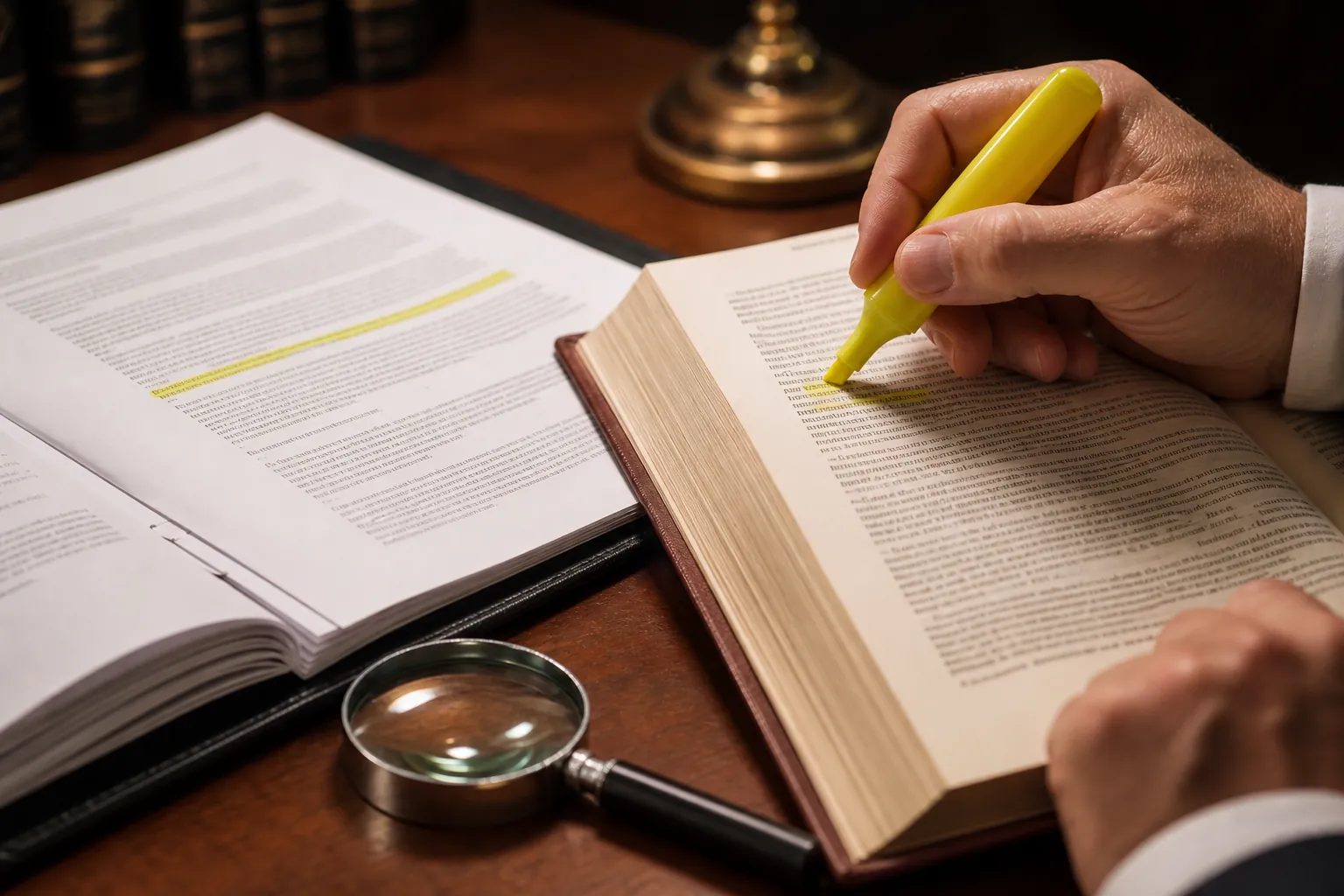
Question 1: Do you check every citation against the primary source?
The useful phrase is “primary source.” For a case, that means the actual opinion or order, not an AI summary of it. For a statute, it means the statutory text, not a blog post paraphrasing it. For a court rule, it means the rule itself and any applicable standing order, not a template someone copied from an old file.
A strong answer will usually describe a sequence: the drafter pulls the authority, the quotation is checked against the source, the proposition is checked against the holding or rule, and the signing attorney reviews the filing before it leaves the office. It may be brief, but it should be concrete.
A weak answer leans on status instead of process: the firm has handled many cases, the lawyer has practiced for years, or the software they use is “reliable.” Those facts may matter elsewhere, but they do not answer whether anyone opened the source. A lawyer can be experienced and still file a bad citation if the firm’s workflow lets unchecked material pass through.
If you want to see what a proper verification habit looks like in an accident-claim setting, compare the intake promises you hear with this example of a personal-injury AI verification workflow. The state and claim type differ, but the file-handling discipline is the same: isolate the legal assertion, find the governing source, verify the quote, and document the check.
Question 2: What is your AI-use policy, and who supervises it?
The question is not “Do you use AI?” A blanket yes or no does not tell you much. A firm may use AI carefully for administrative tasks, drafting assistance, issue spotting, or summarizing non-confidential materials. Another firm may claim not to use AI while relying on vendors, contract writers, or marketing systems that do. The better question is what the firm permits, what it forbids, and who checks the output.
A usable answer separates tools from judgment. It should say that AI output is not treated as legal authority, that confidential client information is handled under the firm’s confidentiality policy, that research and quotations are checked against primary sources, and that a lawyer supervises nonlawyer staff or junior lawyers who use these tools. If the person answering cannot describe the policy, it is fair to ask for someone who can.
Listen especially for who bears responsibility. A bicycle accident claimant should not have to untangle whether a brief was drafted by a partner, associate, paralegal, intake vendor, contract lawyer, or AI system after a problem arises. Before signing, ask who will supervise filings in your case and whether that lawyer reviews citations personally or under a documented review process.
Question 3: Will you put the verification commitment in writing?
Not every office will rewrite its engagement agreement for one client, and some firms may use a separate onboarding memo or policy summary. The form matters less than the commitment. You are looking for written confirmation that court filings are attorney-supervised and that legal citations are verified before submission.
The request should be modest. You are not asking for litigation strategy, privileged internal notes, or access to the firm’s research database. You are asking for the same sort of operational promise that clients already ask for in other areas: how fees are charged, who communicates with insurers, who handles medical-record requests, and how settlement authority is obtained.
If the firm refuses to put even a basic verification commitment in writing, pause. The problem is not that the lawyer failed to recite the perfect sentence. The problem is that citation-checking is now a known professional-risk issue, and a firm asking for your trust should be able to describe how it controls that risk.
What good, weak, and evasive answers look like
You do not need a scripted consultation. In fact, scripts are easy to game. What you need is a way to sort the answer you receive.
| Topic | Good answer | Weak answer | Evasive answer |
|---|---|---|---|
| Citation checking | Identifies that cited authorities and quotations are checked against the actual case, statute, rule, or order before filing. | Says the firm uses respected research tools but does not explain who verifies the source. | Says citation-checking is unnecessary, too time-consuming, or handled entirely by software. |
| AI use | Explains permitted uses, prohibited uses, confidentiality limits, and attorney supervision. | Says AI is only used for “drafting” or “efficiency” without describing review. | Refuses to say whether AI is used or says the client should not worry about it. |
| Supervision | Names the role responsible for final review and explains how junior or nonlawyer work is checked. | Says an experienced team handles the file but does not identify review responsibility. | Blames vendors, staff, or software in advance for possible mistakes. |
| Written confirmation | Will include or point to written language covering attorney review and citation verification. | Gives a verbal assurance but needs follow-up before providing anything written. | Says written commitments are impossible or unnecessary while asking you to sign immediately. |
The clearest answers tend to be ordinary. They do not sound like a technology pitch. They sound like office procedure: who drafts, who reviews, where the authority comes from, and what happens before a filing is submitted.
Be careful with answers that make AI sound magical in either direction. “We never use AI” may be true, but it does not by itself prove that the firm checks citations. “We use advanced AI” may also be true, but it does not prove that a lawyer verifies the output. Your file is protected by review habits, not by the brand name of a tool.
Red flags worth taking seriously
A bicycle accident claimant is often under pressure: pain, transportation problems, insurance calls, repair bills, missed work, and medical appointments. That pressure makes it tempting to treat the first responsive firm as the safest firm. Responsiveness matters, but it is not a substitute for filing discipline.
- Marketing pages with no named attorneys, no physical accountability, and generic AI-sounding injury content that could apply to any city.
- A refusal to confirm that citations and quotations are checked against primary sources before filing.
- Statements that “the software handles the research” or that AI tools are accurate enough without lawyer review.
- A promise that AI is “only used for drafting” with no explanation of supervision, confidentiality, or verification.
- Pressure to sign immediately while avoiding questions about who will actually work on and review your case.
- Unwillingness to provide any written confirmation of attorney review, filing supervision, or citation-verification practices.
One red flag does not prove malpractice, and a short intake call may not answer every operational question. But if the firm treats verification questions as an annoyance, that tells you something about how the office may treat the invisible parts of your file.
Do not let AI questions replace the ordinary bicycle-case questions
The AI-verification questions belong beside the standard questions, not above everything else. A careful firm still needs to understand bicycle infrastructure, crash reconstruction, police reports, medical causation, insurance limits, liens, and fault arguments. A well-verified brief will not help much if the firm misses basic evidence or lets deadlines drift.
- Fee structure: ask how the contingency fee works, what costs may be deducted, and what happens if the case does not resolve favorably.
- Deadlines: ask the lawyer to identify the filing deadline for your claim and whether any shorter notice rules or defendant-specific requirements could apply.
- Insurance communication: ask who will communicate with insurers, whether you should stop giving statements, and how settlement offers will be explained.
- Fault disputes: ask how the firm handles allegations that a cyclist was partly responsible, failed to follow traffic rules, or had a preexisting condition.
- Medical documentation: ask who gathers records and bills, how liens are tracked, and how treatment gaps are addressed.
- Communication: ask who your day-to-day contact will be and how quickly the firm usually responds to client questions.
The difference is that these ordinary questions are visible earlier. You can usually tell whether the lawyer discusses fees or insurance. You cannot easily see whether a draft brief contains a hallucinated case until the filing has already created work for someone else to repair. That is why verification deserves its own place in the hiring conversation.
If the case enters federal court
Many bicycle injury claims resolve through insurance negotiations or state-court practice. Some cases, however, may involve federal court because of the parties, claims, removal, or related disputes. For San Jose, that can mean the Northern District of California. At that point, standing orders and judge-specific AI requirements may matter.
You do not have to predict federal jurisdiction during the first call. A practical question is enough: if my case is filed in or removed to federal court, who checks the judge’s standing orders and any AI-disclosure or certification rules before filing? A firm that regularly files in federal court should not be surprised by that question.
For readers who want the enforcement record behind this checklist, the site’s federal AI citation-hallucination sanctions digest collects additional federal examples. A claimant does not need to memorize those cases. The useful hiring point is simpler: a lawyer who files in federal court should know the judge’s rules before the filing goes out.
A short script for the retainer call
If you are hurt, tired, or speaking with several firms in one week, keep the language plain. You can ask the questions this way:
- Before I sign, can you explain who will be responsible for reviewing filings in my case?
- Does your firm verify every legal citation and quotation against the primary source before filing?
- Do lawyers, staff, vendors, or AI tools help with research or drafting, and how is that work supervised?
- If AI is used at any stage, what is your policy for confidentiality, attorney review, and citation-checking?
- Can the engagement letter or onboarding materials confirm that filings are attorney-reviewed and citations are verified before submission?
The lawyer does not need to answer with a lecture. A direct, calm description is enough. If the firm responds as though these questions are strange, that is useful information. Courts have made the issue visible; clients are allowed to notice.
The decision point
Hiring a San Jose bicycle accident lawyer still involves trust. No checklist can guarantee a settlement, a verdict, or a painless claims process. A lawyer may answer every verification question well and still face disputed facts, difficult insurance coverage, medical-causation arguments, or a defendant who refuses to settle.
The narrower point is more defensible. As of Q3 2026, citation verification and AI supervision have become measurable professional-risk signals. If a firm wants to handle your bicycle accident claim but will not clearly explain who verifies legal authorities, who supervises AI-assisted work, and whether those commitments can be confirmed in writing, walking away is a reasonable decision.
References
- Noland v. Land of the Free, L.P., California Courts, Sept. 12, 2025
- Judge slams lawyers’ AI “bogus research”, The Verge, May 2025
- US judge says senior lawyers must pay for mistakes by subordinates using AI tools, Reuters, May 1, 2026
- ABA issues first ethics guidance on a lawyer’s use of AI tools, American Bar Association, July 29, 2024
- Ethics and Technology Resources, State Bar of California, updated May 14, 2026
- Courts Get Proactive on AI: Disclosure, Certification, and Consequences, Drug & Device Law, April 2026
Grounded in
This procedure is grounded in the cited rule or opinion, independent of any single documented case. See the Regulation tracker for the governing text.
Cases this step would have prevented
No cases have been explicitly linked to this checklist yet. See Risk Digest for documented incidents generally.
← Back to WorkflowsReport a correction or tip
Spotted an outdated figure, a misstated fact, or a ruling this workflow checklist should reflect? Public comments are disabled for this content given the professional cost of a misreported case outcome, penalty amount, or rule text — use the structured correction channel instead.
Report a correction or tip for this record →