
Is Mediation Mandatory in Connecticut Car Accident Cases?
Connecticut's court-annexed J-ADR mediation is not documented as mandatory in car accident cases: a case enters it only by direct scheduling, a party request on form JD-CV-130, or a judge's referral. You get a decision-ready answer on whether attendance is required, the statutory confidentiality protection, and what the available authorities do not verify.
- Applicable role
- attorney
- Workflow stage
- post-filing
- Primary source
- CGS § 51-5a

Connecticut’s court-annexed civil mediation program, known as J-ADR and formerly called Court-Annexed Mediation, is not shown in the available authorities as a mandatory step in every car accident lawsuit. The Connecticut Judicial Branch identifies three ways a case can enter the program: the parties may schedule a judicially conducted conference directly, a party may complete and e-file form JD-CV-130, or a presiding civil judge or designee may refer the case. [1]
That is a narrower conclusion than saying no Connecticut court could ever require attendance in a particular case. If you received a mediation notice, the practical question is what the notice says, who issued it, and whether a judge or the court has entered a case-specific instruction. The materials reviewed do not establish a general statewide duty to mediate merely because the lawsuit arises from a motor-vehicle collision.
The distinction matters because a direct request, a court-program scheduling notice, and a judicial referral do not carry the same information about how the session was initiated. Before treating the notice as equivalent to a trial date—or assuming that declining it cannot affect the case—identify which entry path was used and check the governing case-specific documents.
How a Connecticut J-ADR mediation gets started
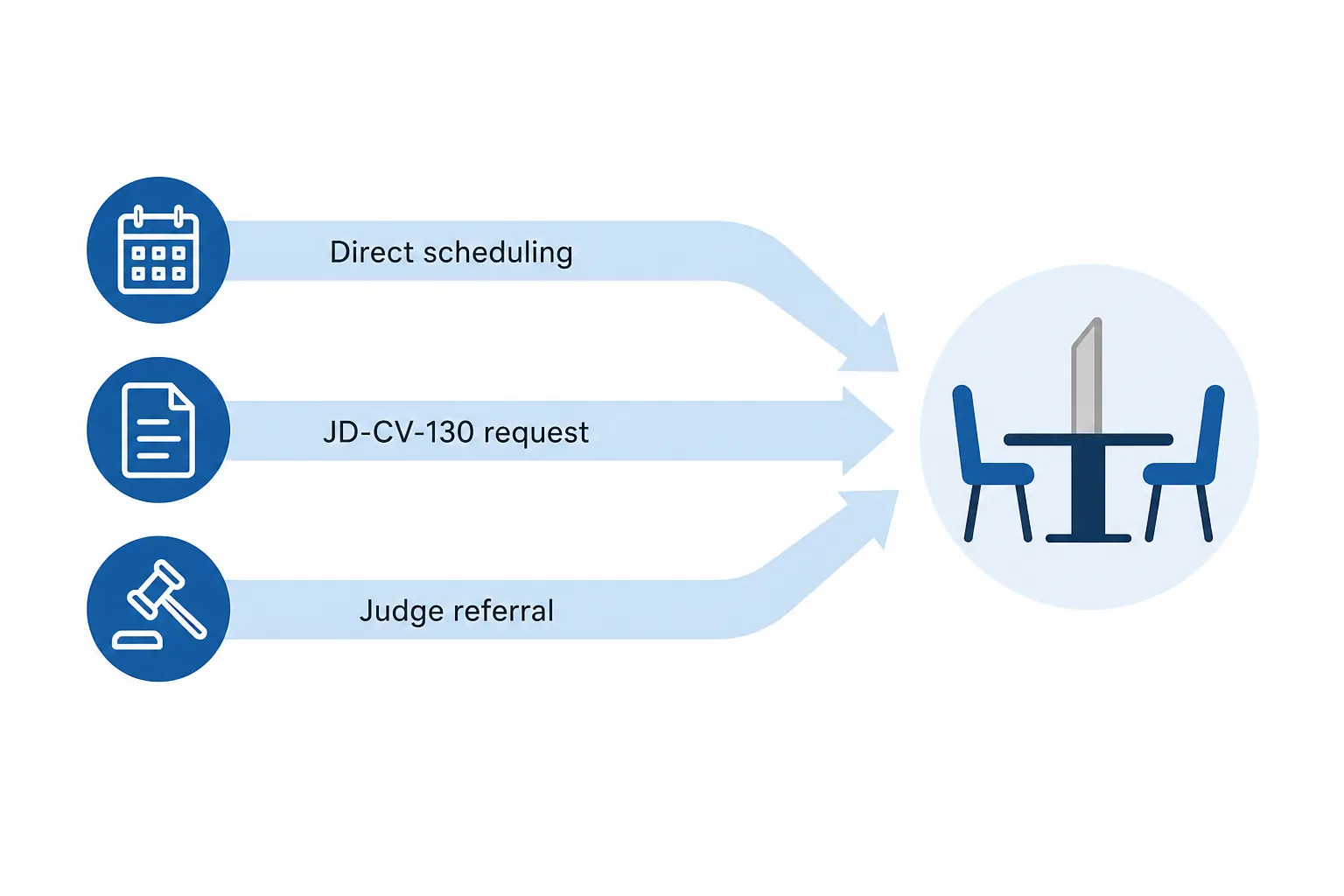
The Judicial Branch’s ADR page describes the program architecture in practical terms:
- Direct scheduling: the parties may arrange a judicially conducted conference.
- Party request: a party may complete and e-file form JD-CV-130 to request mediation.
- Judicial referral: a presiding civil judge or the judge’s designee may refer the case to J-ADR.
The same page cites Connecticut General Statutes § 51-5a as the program’s legal authority. The available material does not identify a Connecticut Practice Book rule that generally makes mediation compulsory in car accident cases. It also does not document a district-specific motor-vehicle mediation order that would fill that gap. That absence supports the careful formulation “not shown as mandatory”; it is not proof that no separate instruction exists in a particular lawsuit.
A mediation notice is not automatically a general statewide mandate
A notice can tell you that a mediation has been scheduled without proving that every comparable case must go through mediation. The source of the scheduling is therefore important. A party-requested session reflects an application to use the program. A direct scheduling arrangement shows that the parties or their representatives arranged a judicially conducted conference. A referral by a presiding civil judge or designee is different because it is a court-directed route into the program.
The available sources do not specify the consequences of failing to appear, declining a proposed date, or disregarding a particular referral. They also do not verify session-level requirements such as position papers, attendance by an insurance adjuster, settlement forms, or sanctions. Those details should not be inferred from the fact that a mediation notice exists.
For a reader trying to decide what the paper means, the useful review is limited but concrete: read the caption and issuing authority, look for a judge’s referral or order, identify whether JD-CV-130 was filed, and compare the notice with the docket and other case-specific instructions. If the document does not answer those questions, individualized legal advice is the appropriate way to determine the effect of nonattendance in that lawsuit.
What confidentiality protects

The Judicial Branch states that statements made during mediation are confidential and may not be used as evidence in court. [1] That protection addresses a central concern for an injured claimant: participating in a settlement conversation does not, on the stated rule, turn the conversation itself into ordinary trial evidence.
The protection should not be expanded beyond what the source says. It does not establish that every document, statement, or fact connected with the lawsuit is confidential. It does not explain every exception, define the treatment of information learned outside the session, or answer whether a party must attend a particular scheduled conference. Confidentiality and attendance are separate questions: the first concerns the use of mediation statements; the second depends on how the session was initiated and what the case-specific instructions require.
Where mediation fits in a car accident lawsuit
In the usual Superior Court lawsuit track described in the available context, mediation is considered after negotiations and while the parties are preparing a dispute that could otherwise continue toward trial. A Connecticut personal-injury practice account describes mediation as voluntary: one lawyer commonly proposes it, both sides agree, the parties select a mediator, and mediators may include judges, senior or retired judges, or personal-injury attorneys. [2] That account is useful practice context, but it is not a statute or Judicial Branch rule and should not replace the official program description.
The lawsuit may take time to reach that point. One private explanation estimates that a Connecticut Superior Court car accident case commonly lasts one to three years from filing and describes discovery as often the longest stage; that range is an estimate, not court-generated statewide data. [3] The same timing discussion addresses Connecticut’s limitations framework, including a two-year period under CGS § 52-584 and a three-year outside limit. Those deadlines govern the preservation of a claim, not a separate deadline for completing mediation.
Readers who are still evaluating the broader case timeline can use this Connecticut car accident timeline audit for the limitations and duration claims, while mediation-specific settlement considerations are addressed in the settlement factors record. Someone earlier in the process may instead need the post-crash legal-steps verification workflow.
The answer to “Do I have to mediate?”
For a Connecticut car accident lawsuit, the available materials do not show court-annexed J-ADR mediation as a universal mandatory requirement. The verified routes into the program are direct scheduling, a party’s completed and e-filed JD-CV-130 request, and referral by a presiding civil judge or designee. Without a case-specific referral or other governing instruction, the materials do not establish a duty to mediate. That conclusion does not tell a particular litigant to attend or refuse a scheduled session. It means the next step is to inspect the notice, identify the entry path, verify the primary Judicial Branch material, and obtain advice about the individual case. On the information available here, mediation is generally presented as a settlement and litigation-timing decision within the Superior Court track—not as an automatic compliance obligation for every car accident claim.
This article is general legal information, not legal advice for a particular lawsuit. The primary-source information was last verified against the materials provided for this article on August 29, 2026.
References
- Alternative Dispute Resolution (ADR) — Connecticut Judicial Branch
- What Happens in a CT Personal Injury Mediation? — Claggett, Sykes & Garza
- How Long Does a Car Accident Lawsuit Take in Connecticut Superior Court? — DeFronzo Law Firm
Grounded in
This procedure is grounded in CGS § 51-5a, independent of any single documented case. See the Regulation tracker for the governing text.
Cases this step would have prevented
No cases have been explicitly linked to this checklist yet. See Risk Digest for documented incidents generally.
← Back to WorkflowsReport a correction or tip
Spotted an outdated figure, a misstated fact, or a ruling this workflow checklist should reflect? Public comments are disabled for this content given the professional cost of a misreported case outcome, penalty amount, or rule text — use the structured correction channel instead.
Report a correction or tip for this record →